- A complete factorial design needs four arms for two compounds, eight for three, and sixteen for four.
- Peptides acting on distinct receptors in one pathway, such as GHRH and GHS-R1a agonists, can have complementary effects.
- Two agonists sharing one receptor draw on the same desensitizable pathway, so combining them mainly adds redundancy.
- Combining reconstituted peptide solutions creates an untested co-formulation, and a clear mixture does not prove compatibility.
- Mixing equal volumes of bacteriostatic and sterile water solutions halves the benzyl alcohol preservative from 0.9% to 0.45%.
- Longevia's Tesamorelin/Ipamorelin uses a fixed 2:1 tesamorelin-to-ipamorelin ratio across both SKUs.
- Any synergy claim requires single-agent controls, because a combination index cannot be calculated without them.
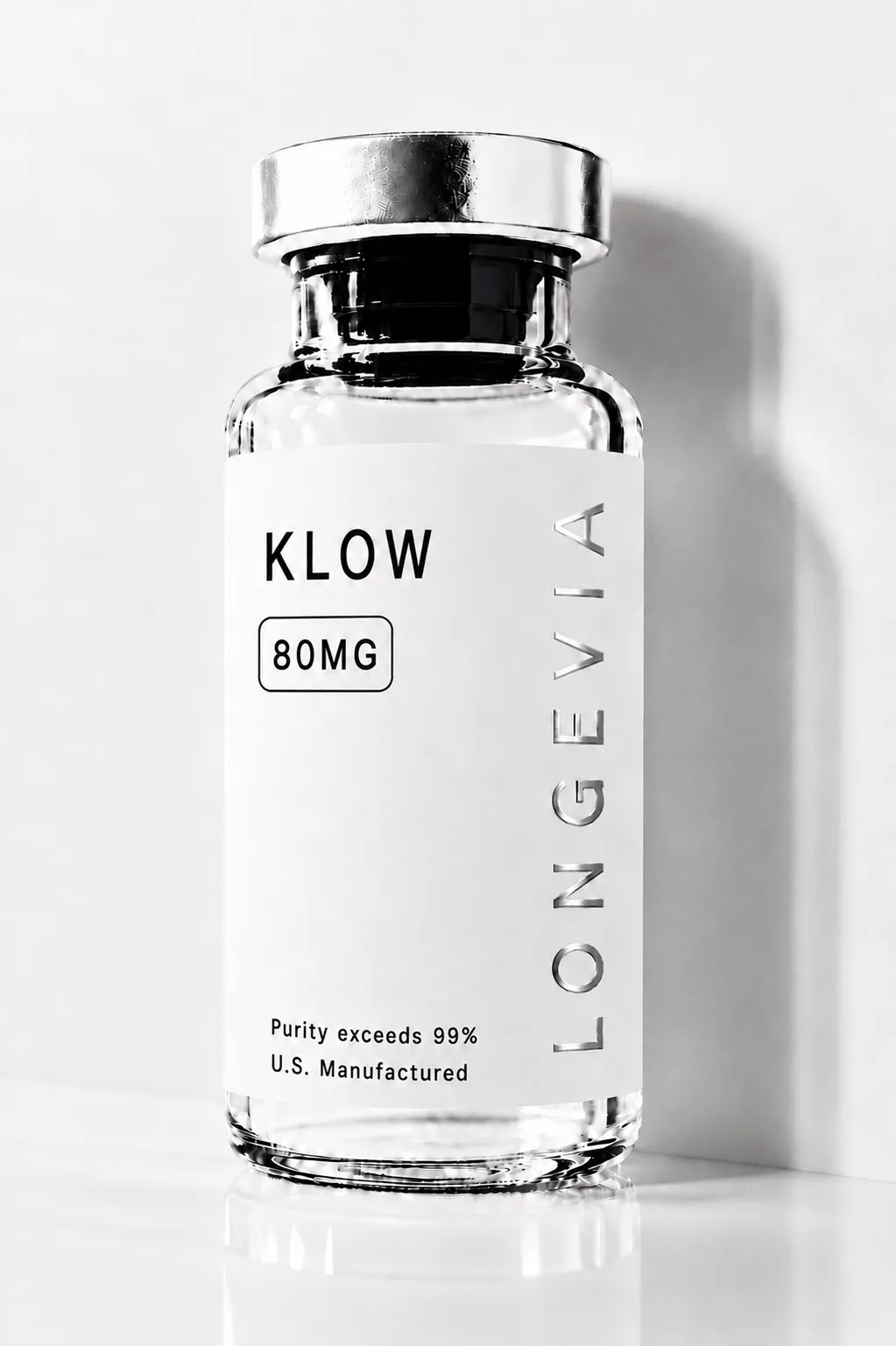
KLOW Blend
Buy KLOW Blend, a laboratory-grade regenerative peptide blend with COA-verified purity. HPLC-tested, batch-traceable, research use only.
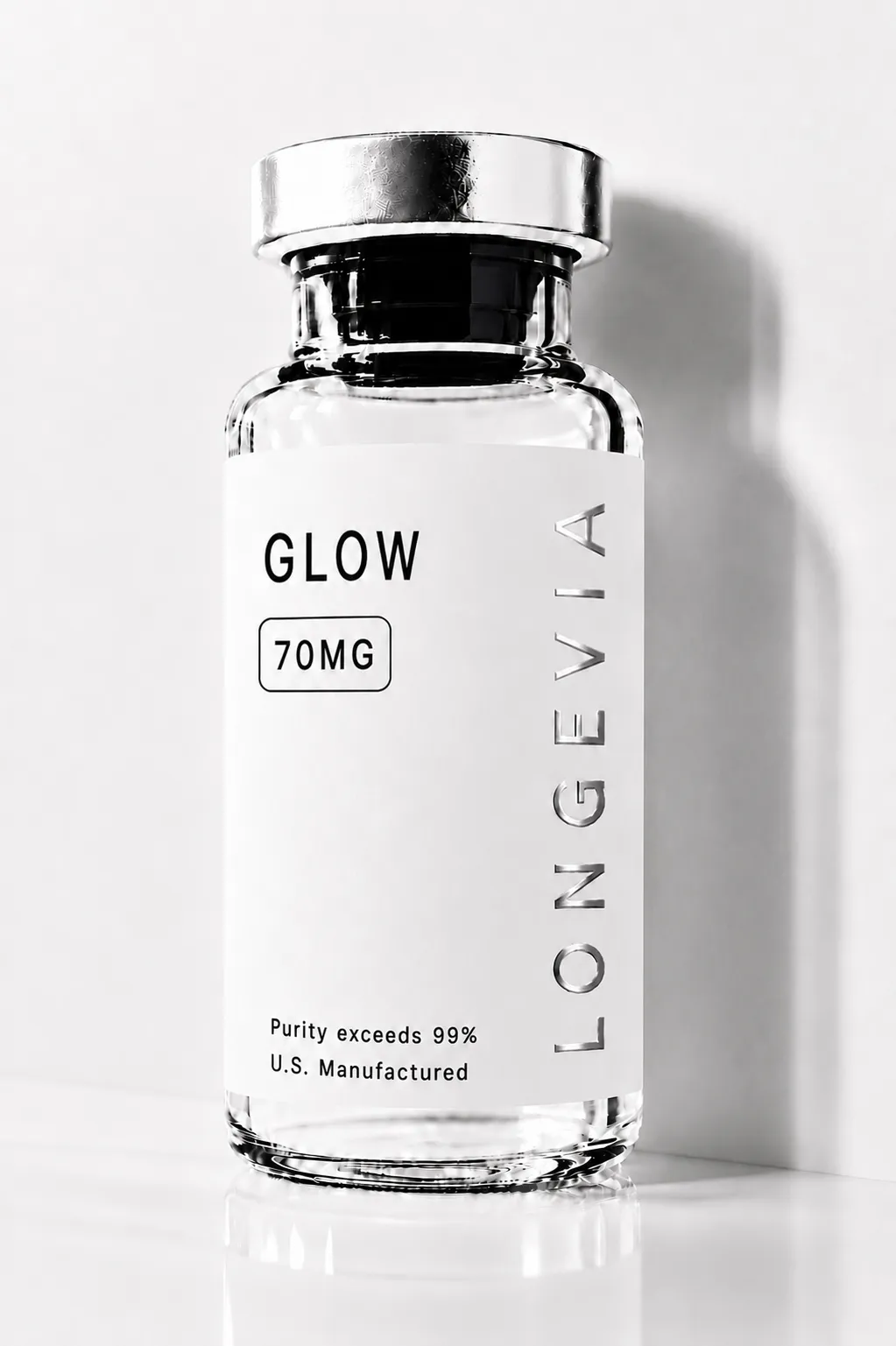
GLOW — 70mg Blend Vial
GLOW is a 70mg research blend containing GHK-Cu (50mg), BPC-157 (10mg), and TB-500 (10mg) — three peptides investigated in copper metallopeptide chemistry, angiogenesis signaling, actin biology, and extracellular matrix research models. Research Use Only — Longevia Research.
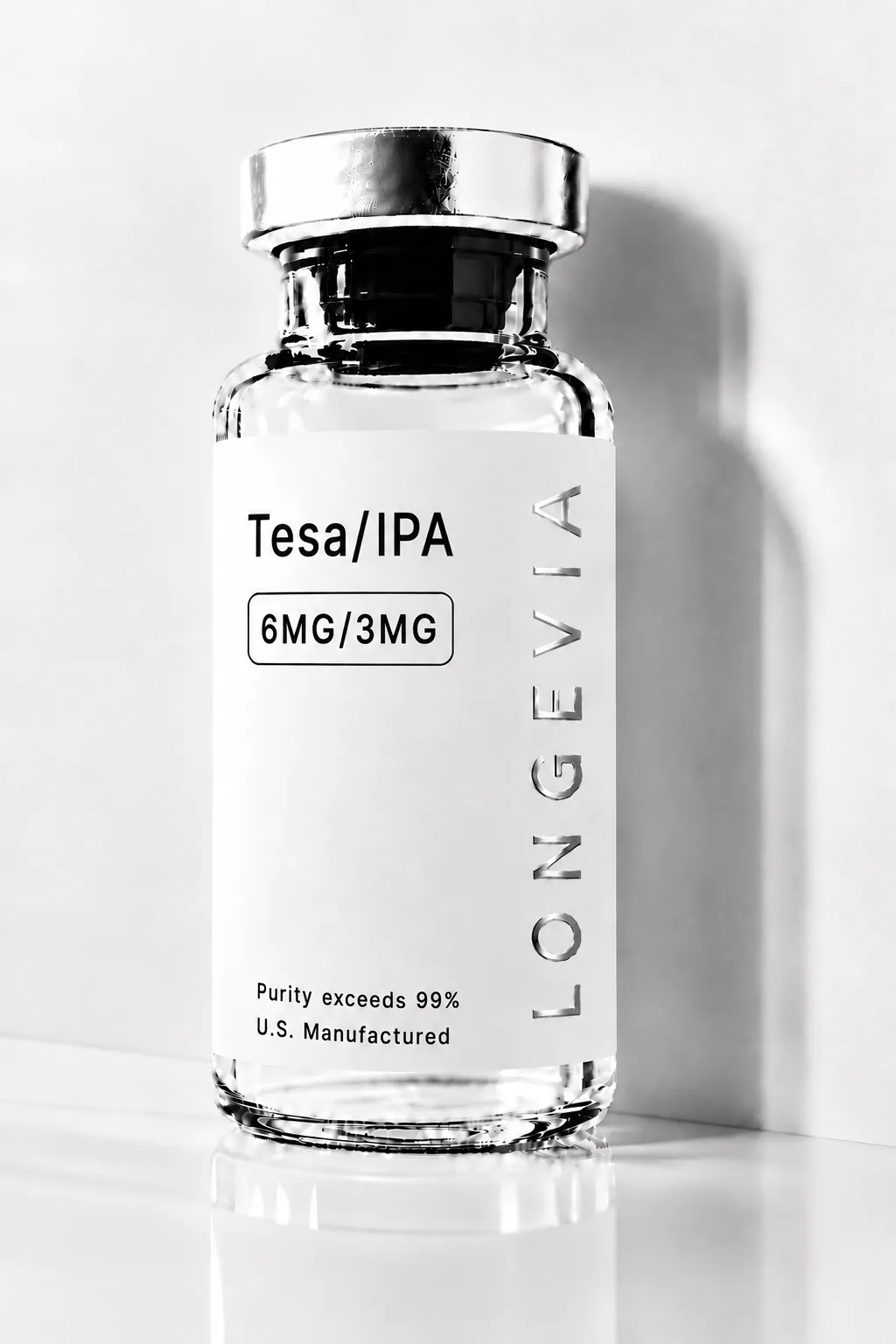
Tesa/IPA
Tesa/IPA — Tesamorelin and Ipamorelin combination research vials in 6mg/3mg and 13mg/3mg formats. GHRH-axis laboratory research compound supplied by Longevia Research for in-vitro use only.
KLOW Blend
Buy KLOW Blend, a laboratory-grade regenerative peptide blend with COA-verified purity. HPLC-tested, batch-traceable, research use only.
GLOW — 70mg Blend Vial
GLOW is a 70mg research blend containing GHK-Cu (50mg), BPC-157 (10mg), and TB-500 (10mg) — three peptides investigated in copper metallopeptide chemistry, angiogenesis signaling, actin biology, and extracellular matrix research models. Research Use Only — Longevia Research.
Tesa/IPA
Tesa/IPA — Tesamorelin and Ipamorelin combination research vials in 6mg/3mg and 13mg/3mg formats. GHRH-axis laboratory research compound supplied by Longevia Research for in-vitro use only.
Stacking research peptides means exposing one experimental system to more than one compound, whether in the same vial, the same session, or a planned sequence, and each of those choices changes what the resulting data can prove. This guide covers the logic researchers use to decide whether a combination is worth running: receptor overlap, redundant-mechanism stacking, co-formulation chemistry, timing and cycling, and the single-peptide controls that make any synergy claim defensible. Longevia Research's pre-formulated KLOW Blend, Glow Blend, and Tesamorelin/Ipamorelin serve as real-world examples throughout.
Quick answer: a sound research peptide stack combines compounds with distinct, complementary targets and a written rationale, never assumes two solutions are chemically compatible just because each is stable on its own, and includes single-peptide control arms whenever the study claims the combination outperforms its parts. Every product discussed here is sold for Research Use Only and is not for human consumption.
What Does Stacking Research Peptides Actually Mean?
Stacking research peptides is the deliberate use of two or more peptides within one experimental design, and in a laboratory it is a study-design decision rather than a shortcut.
The word comes from informal usage, but the practice takes three technically distinct forms. Each form controls a different set of variables, so the first step in any stacking plan is naming which one you're actually using.
- Pre-formulated blend: two or more peptides are combined at a fixed ratio by the supplier and supplied as a single lyophilized product.
- Manual same-session combination: separately supplied peptides are reconstituted on their own and then combined, or introduced to the model within the same session.
- Sequential or staggered protocol: peptides are introduced at different time points, so their exposure windows overlap partly or not at all.
Researchers combine compounds for defensible reasons. Some biological questions involve several pathways operating at once, and a single agent can't model that. Other studies exist specifically to test whether two agents interact. A fixed-ratio blend can also reduce handling steps when the ratio itself is not the variable under study.
Every added compound carries a cost, though, and the cost grows fast. A complete factorial design for two compounds needs four arms: vehicle, compound A alone, compound B alone, and A plus B together. Three compounds need eight arms, and four compounds need sixteen. Skip those arms and the data can no longer tell you which compound produced which effect.
That arithmetic is why experienced labs treat "how many compounds" as a question about statistical resolution rather than ambition. A two-peptide stack with full controls usually produces more interpretable data than a four-peptide stack without them.
Stacking also multiplies the handling surface. More vials mean more reconstitutions, more septum punctures, more diluent choices, and more lot numbers to track. None of that is a reason to avoid combinations, but all of it belongs in the protocol before the first vial is opened. The rest of this guide works through each of those decisions in the order a researcher would face them.
How Does Receptor Overlap Decide Whether a Peptide Stack Makes Sense?
Receptor overlap is the first filter for any stack: peptides acting on distinct receptors within one pathway can produce complementary effects, while peptides competing for the same receptor mostly add redundancy.
Complementary targets: the growth hormone axis example
The growth hormone axis shows the complementary logic clearly. Tesamorelin is a synthetic analog of the full 44-amino-acid sequence of growth hormone-releasing hormone (GHRH), modified with a trans-3-hexenoyl group at the N-terminus, and it acts at the GHRH receptor. Ipamorelin is a synthetic pentapeptide that acts at a different receptor, the growth hormone secretagogue receptor type 1a (GHS-R1a), also called the ghrelin receptor.
Raun and colleagues described ipamorelin in 1998 as the first selective growth hormone secretagogue. In their swine experiments, ipamorelin did not raise ACTH or cortisol even at doses 200-fold higher than the dose producing half-maximal growth hormone release. That selectivity matters for stacking because a cleaner single-agent profile makes the combined profile easier to interpret.
The case for pairing the two receptor classes comes from older work. Bowers and colleagues reported in 1990 that a synthetic growth hormone-releasing hexapeptide (GHRP-6) acted synergistically with GHRH on growth hormone release in normal men. That study used GHRP-6, not ipamorelin, so it supports the receptor-class rationale rather than proving a result for any specific pair.
Redundant targets: when two agonists share one receptor
Pairing two agonists of the same receptor is a different situation. Blake and Smith perifused rat pituitary cells with either GHRH or GHRP-6 until the cells stopped releasing growth hormone. Challenging those desensitized cells with the other secretagogue produced a fresh release, which indicates that the two act through distinct receptor-linked pathways that desensitize separately.
The reverse inference is the practical one. Two agonists that share a receptor draw on the same desensitizable pathway, so neither can restore a response the other has exhausted. Their combined signal is also hard to attribute, since both compete for the same binding sites.
Redundancy isn't automatically an error. Comparing two agonists at one receptor is a legitimate question. It simply needs to be the stated question, with a design built to answer it.
Before building any stack, list each compound beside its primary receptor target. If two rows share a target, write down why that overlap is intentional before the protocol goes any further.
The same two-receptor rationale underlies other GHRH-analog and GHS-R1a pairings researchers commonly study, such as the CJC-1295 and Ipamorelin reconstitution guide.
Can You Mix Peptides in One Syringe or Vial?
Two reconstituted peptide solutions can be physically combined, but the mixture is a new, untested co-formulation whose stability isn't covered by either compound's individual documentation.
A lyophilized peptide's handling guidance assumes that one peptide, in its recommended diluent, at its recommended concentration. Combining solutions changes several of those conditions at once, and each change can affect stability independently.
pH and solubility. Each peptide has a pH range where it stays soluble and stable. Peptides are generally least soluble near their isoelectric point, and two peptides with different isoelectric points may not share a comfortable pH window in one solution.
Concentration. Adding a second peptide raises the total peptide concentration in the final volume. Higher concentrations can favor self-association and aggregation, especially over storage time.
Preservative chemistry. Bacteriostatic water contains 0.9% benzyl alcohol, an antimicrobial preservative included so multi-use containers stay sterile. Benzyl alcohol isn't inert toward every biomolecule. Roy and colleagues found that reconstituting a lyophilized protein, recombinant human interleukin-1 receptor antagonist, with 0.9% benzyl alcohol produced more aggregation than reconstituting it with water. That work studied a protein rather than a short peptide, so the lesson is not that benzyl alcohol damages every peptide; the lesson is that preservative compatibility is molecule-specific and has to be checked, not assumed.
Mismatched diluents. Combining a solution made with bacteriostatic water and one made with sterile water dilutes the preservative. Mixing equal volumes of each halves the benzyl alcohol concentration to 0.45%, below the level the bacteriostatic diluent was formulated to provide.
Handling steps. Every extra vial adds a reconstitution, extra septum punctures, and another container to label and store. Each step is another opportunity for contamination or a recording error.
A clear, particle-free mixture is not proof of compatibility. Soluble aggregates and chemical degradation can form without any visible change, and only analytical methods such as HPLC or LC-MS can confirm that both peptides remain intact in a combined solution.
In practice, most labs keep peptides in separate vials, each in the diluent its documentation specifies, and combine them only at the point of use when a design requires it. Anyone who needs a stored co-mixture should treat it as a new formulation and verify it analytically. Diluent choice deserves its own review — see the bacteriostatic water vs sterile water guide.
Pre-Formulated Blends vs. Manual Combination: Which Suits Your Study?
A pre-formulated blend gives ratio consistency and simpler handling, while manual combination preserves the ability to vary each compound independently, so the right choice depends on whether the study must isolate single-agent effects.
Factor | Pre-formulated blend | Manually combined in the same session |
|---|---|---|
Solvent compatibility | Components share one lyophilized matrix and are reconstituted together in a single diluent | Each vial may use a different diluent, and compatibility of the mixture is unverified |
Dosing precision | Ratio is fixed at manufacture, so every draw delivers the same proportion | Precision depends on separate calculations and measurements for each compound |
Ratio flexibility | None; the ratio cannot be changed | Full; each compound can be varied independently |
Isolating single-agent effects | Not possible from the blend alone; separate single-agent material is required | Possible when each compound is also run by itself |
Batch documentation | One lot number and one lot-specific COA for the product | One lot number and COA per compound, all of which must be recorded |
Practical convenience | One reconstitution and one vial to track | Multiple reconstitutions, vials, and calculations |
Neither format is superior in general. A blend suits studies where the combination itself is the test article. Manual combination suits studies where each component's contribution is the question.
Tesamorelin/Ipamorelin: a disclosed fixed-ratio example
Longevia's Tesamorelin/Ipamorelin uses a fixed 2:1 ratio of tesamorelin to ipamorelin across both of its SKUs, which makes it a useful worked example of a validated fixed-ratio combination. If that ratio is expressed by mass, every 3 mg of total peptide contains 2 mg of tesamorelin and 1 mg of ipamorelin; confirm the basis of the ratio on the product listing before running calculations. Under that assumption, a hypothetical vial holding 6 mg total and reconstituted to 3 mL would contain 2 mg/mL of total peptide, split into about 1.33 mg/mL tesamorelin and 0.67 mg/mL ipamorelin.
A mass ratio is not a molar ratio. Tesamorelin has 44 amino acid residues and ipamorelin has 5, so a milligram of ipamorelin contains far more molecules than a milligram of tesamorelin. In a 2:1 mass blend, tesamorelin dominates by weight while ipamorelin molecules outnumber tesamorelin molecules. Receptor-level interpretations should account for that difference. Full math is in the Tesamorelin Ipamorelin dosage ratio and reconstitution guide.
KLOW Blend and Glow Blend: designing around a non-disclosed composition
Longevia's KLOW Blend and Glow Blend listings do not disclose their individual component peptides or the ratio between them. That shapes study design in specific ways. Each blend should be treated as a single test article, and results should be attributed to the blend as a whole rather than to any presumed ingredient.
Receptor-overlap screening also isn't possible without a component list. Adding another compound to either blend therefore introduces overlap that can't be assessed, which is a strong reason to run these blends on their own. Comparisons between the two are product-to-product comparisons — see the KLOW Blend dosage chart and reconstitution guide and the Glow Blend dosage and reconstitution guide.
How Should Researchers Plan Peptide Stack Timing and Cycling?
Timing in a stacking protocol should follow the research question: simultaneous exposure tests interaction, staggered introduction tests sequence effects, and washout periods protect the interpretability of every later phase.
Simultaneous exposure is the default for interaction studies, because both compounds need to be present together for an interaction to occur. It's also the design most dependent on complete single-agent controls, since nothing in the timing separates one compound's effect from the other's.
Staggered introduction answers a different question. Establishing a stable response to compound A before adding compound B lets researchers observe the increment B produces. The weakness is time: any drift, adaptation, or solution degradation during the first phase gets confounded with B's effect. A parallel arm that receives A alone for the full duration corrects for that.
A basic staggered sequence looks like this:
- Record a baseline with vehicle only.
- Introduce compound A and sample until the response stabilizes.
- Add compound B while continuing compound A exactly as before.
- Run a parallel arm on compound A alone for the same total duration.
- Compare the two arms at matched time points, not against the baseline alone.
"Cycling" in a research context means on-and-off exposure schedules designed either to test response attenuation or to avoid it. The Blake and Smith pituitary work showed that continuous exposure can desensitize a receptor-linked pathway to the point where it stops responding. When a response fades over a long protocol, researchers need to separate three explanations: receptor desensitization, degradation of the stored solution, and ordinary biological variation. Fresh reconstitution at planned intervals helps rule out the second one.
Washout periods between phases aren't a fixed calendar number. The right length depends on how quickly each compound clears the model and how long any downstream marker stays elevated after exposure ends. Crossover designs, where the same subjects receive different treatments in different phases, depend entirely on adequate washout. A carryover effect from phase one quietly contaminates phase two.
Sampling schedules matter too. Growth hormone is released in pulses, so a single sampling time can land between peaks and miss the response. Stacks that act on pulsatile systems need sampling dense enough to capture the pattern rather than one snapshot. The dosing arithmetic behind each phase deserves the same care as the schedule — see the peptide dosage calculation guide.
Why Do Single-Peptide Controls Matter in a Stacking Study?
Single-peptide controls are the only way to demonstrate that a combination does something its components do not, so any study claiming synergy must include each compound on its own.
A combination that outperforms either compound alone hasn't shown synergy. It may simply be additive: two agents each contributing their usual effect. Distinguishing additive from synergistic results requires knowing what each agent does alone across a range of doses.
Chou's combination index method, detailed in a widely cited 2006 review in Pharmacological Reviews, formalizes that distinction. A combination index below 1 indicates synergism, a value of 1 indicates an additive effect, and a value above 1 indicates antagonism. Calculating the index requires dose-effect parameters for each agent alone, so a study without single-agent curves can't compute it at all.
The classic growth hormone work illustrates the design. In the 1990 Bowers study, GHRP-6 was given at three doses by itself, GHRH was given by itself, and GHRH was also given together with GHRP-6. The synergy conclusion rested on those single-agent arms.
Constant-ratio designs connect this directly to blends. The combination index approach commonly tests mixtures held at a fixed ratio while total concentration varies. A fixed-ratio product such as the 2:1 Tesamorelin/Ipamorelin fits naturally into a constant-ratio arm, yet the single-agent curves still have to come from separate single-compound material.
Undisclosed blends change what's testable. Because KLOW Blend and Glow Blend don't list their components, component-level synergy claims can't be designed or tested with them. The valid comparisons are blend versus vehicle, blend versus blend, and dose-response of the blend itself.
Budget the control arms before finalizing the combination. If the study can't afford vehicle, each single agent, and the combination, narrow the question to one the available arms can actually answer.
Control arms also protect against a subtle reporting problem. When only the combination arm is run, any effect gets credited to "the stack," and later readers can't tell whether one component did all the work. Full controls let the data say which compound mattered.
Red Flags: Peptide Combinations and Practices to Avoid
The most damaging stacking errors are unjustified receptor overlap, unchecked diluent compatibility, and missing single-agent controls, and each one makes the resulting data harder or impossible to interpret.
Red flag | Why it's a problem | What to do instead |
|---|---|---|
Combining compounds with overlapping receptor targets without a stated reason | Competing agonists share one desensitizable pathway, and their effects can't be separated | Map every compound to its target and document the reason for any overlap |
Ignoring benzyl alcohol compatibility across combined solutions | Preservatives can promote aggregation in some biomolecules, and mixing diluents dilutes the preservative | Keep each peptide in its specified diluent and verify any stored co-mixture analytically |
Skipping single-agent controls when a synergy claim is the point of the study | Additive and synergistic effects can't be distinguished, and a combination index can't be calculated | Run vehicle, each compound alone, and the combination |
Adding compounds to a blend with an undisclosed composition | Receptor overlap can't be assessed when the components aren't listed | Study the blend alone as a single test article |
Stacking more compounds than the design can resolve | Required factorial arms double with each added compound | Limit the stack to the number of compounds the arms can support |
Recording one lot number for a multi-vial combination | Results can't be traced back to the specific material used | Record the lot number and lot-specific COA for every vial |
Treating a clear mixture as a compatible one | Soluble aggregates and degradation can be invisible | Confirm integrity with HPLC or LC-MS when stability matters |
Documentation is where many otherwise careful stacks fall apart. Every Longevia batch is independently tested by HPLC/LC-MS, and the lot-specific Certificate of Analysis for each batch is published in the site's COA Library. For a combination study, that means one COA per vial used, matched to the lot number recorded in the lab notebook.
A complete stack record typically includes each compound's lot number, the diluent and its volume, the reconstitution date, the storage conditions, the calculated concentration, and the time each solution was combined or introduced. That record turns a combination from an anecdote into data another lab can reproduce.
The underlying rule is simple. A stack should be designed so its results could survive a skeptical reviewer asking which compound did what, and why they were combined in the first place. If the protocol can't answer both questions, it isn't ready to run.
Frequently Asked Questions
- Raun K, Hansen BS, Johansen NL, Thøgersen H, Madsen K, Ankersen M, Andersen PH. Ipamorelin, the first selective growth hormone secretagogue. European Journal of Endocrinology. 1998;139(5):552–561.
- Bowers CY, Reynolds GA, Durham D, Barrera CM, Pezzoli SS, Thorner MO. Growth hormone (GH)-releasing peptide stimulates GH release in normal men and acts synergistically with GH-releasing hormone. Journal of Clinical Endocrinology & Metabolism. 1990;70(4):975–982.
- Blake AD, Smith RG. Desensitization studies using perifused rat pituitary cells show that growth hormone-releasing hormone and His-D-Trp-Ala-Trp-D-Phe-Lys-NH2 stimulate growth hormone release through distinct receptor sites. Journal of Endocrinology. 1991;129(1):11–19.
- Falutz J, Allas S, Blot K, et al. Metabolic effects of a growth hormone-releasing factor in patients with HIV. New England Journal of Medicine. 2007;357(23):2359–2370.
- Roy S, Jung R, Kerwin BA, Randolph TW, Carpenter JF. Effects of benzyl alcohol on aggregation of recombinant human interleukin-1-receptor antagonist in reconstituted lyophilized formulations. Journal of Pharmaceutical Sciences. 2005;94(2):382–396.
- Chou TC. Theoretical basis, experimental design, and computerized simulation of synergism and antagonism in drug combination studies. Pharmacological Reviews. 2006;58(3):621–681.