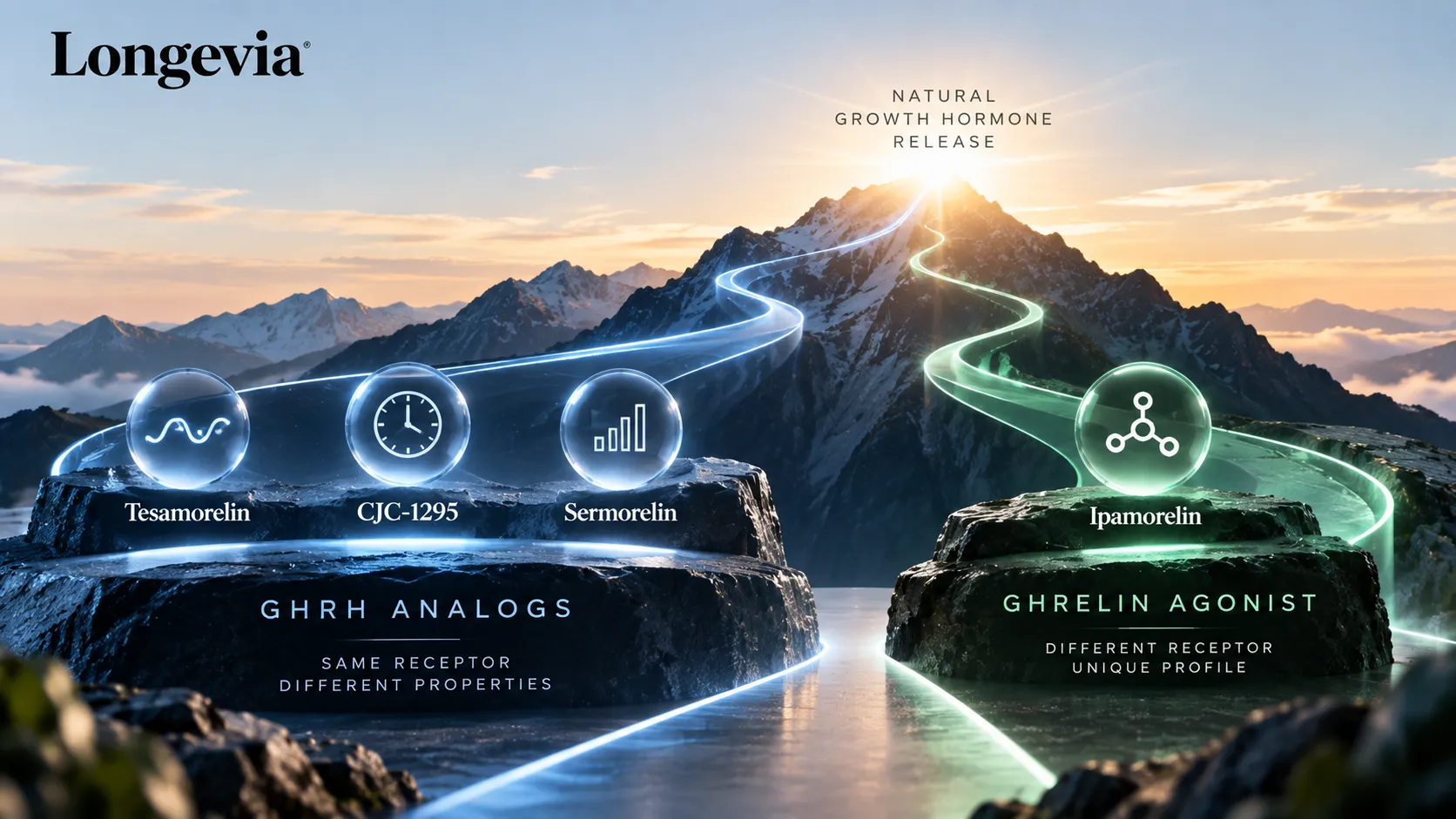
- Tesamorelin, sermorelin and CJC-1295 are GHRH analogs that act on the GHRH receptor, while ipamorelin is a ghrelin mimetic that acts on GHSR-1a.
- Tesamorelin has the strongest human evidence of the four, including two phase 3 randomized, placebo-controlled trials.
- Tesamorelin is the only one of the four with an active FDA approval, limited to reducing excess abdominal fat in HIV-infected adults with lipodystrophy.
- Sermorelin was FDA-approved as GEREF, discontinued in 2008, and later determined by the FDA not to have been withdrawn for safety or effectiveness reasons.
- CJC-1295 with DAC showed an estimated half-life of 5.8 to 8.1 days in 2006 trials in healthy adults.
- Ipamorelin's selectivity for GH release without ACTH or cortisol elevation was established in rat and swine models, not human trials.
- GHRH-class and GHRP-class secretagogues have shown synergistic GH release when co-administered in human studies using other compounds from each class.
- Longevia Research offers only the co-formulated Tesamorelin / Ipamorelin blend; the four individual compounds are discussed as reference compounds.
Tesa/IPA
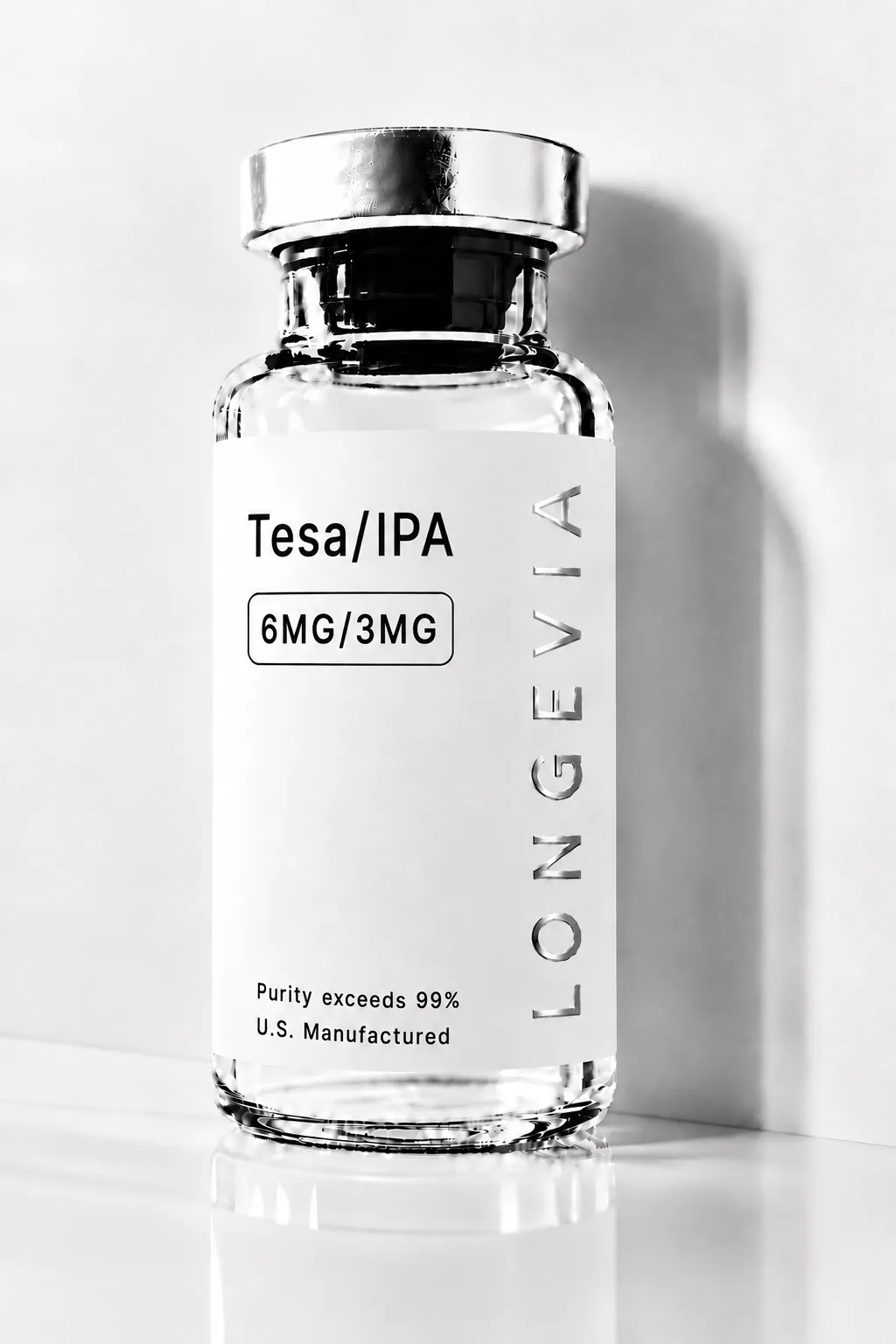
Tesa/IPA — Tesamorelin and Ipamorelin combination research vials in 6mg/3mg and 13mg/3mg formats. GHRH-axis laboratory research compound supplied by Longevia Research for in-vitro use only.
Tesa/IPA
Tesa/IPA — Tesamorelin and Ipamorelin combination research vials in 6mg/3mg and 13mg/3mg formats. GHRH-axis laboratory research compound supplied by Longevia Research for in-vitro use only.
Tesamorelin, CJC-1295, sermorelin, and ipamorelin are the four growth hormone secretagogue peptides researchers compare most often, but they don't belong to a single class. Three of them are analogs of growth hormone-releasing hormone (GHRH), and one is an agonist of the ghrelin receptor. This guide compares all four on receptor target, mechanism class, evidence strength, and 2026 regulatory status, then points you to deeper resources for whichever compound fits your research question.
Quick answer: Tesamorelin has the strongest human evidence of the four growth hormone secretagogue peptides, supported by two phase 3 randomized trials and a current FDA approval for one indication. Sermorelin is the only other one of the four that was ever FDA-approved, while CJC-1295 and ipamorelin rest on smaller early-phase human studies. Tesamorelin, sermorelin, and CJC-1295 act on the GHRH receptor, whereas ipamorelin acts on the ghrelin receptor (GHSR-1a).
What Are Growth Hormone Secretagogue Peptides?
A growth hormone secretagogue peptide is a peptide that causes the anterior pituitary to release its own growth hormone (GH), rather than supplying GH directly.
That distinction is the whole reason this compound family exists in the research literature. Recombinant growth hormone delivers the finished hormone into circulation. A secretagogue works one step upstream, acting on the pituitary somatotroph cells that manufacture and store GH. The pituitary still decides how much hormone to release, and its output remains subject to the body's normal inhibitory brake, somatostatin.
Growth hormone secretion in humans is pulsatile, and that pattern is regulated by both GHRH and somatostatin. Any compound that works through the pituitary therefore interacts with a feedback system rather than bypassing it. For researchers, this makes secretagogues useful tools for probing how the GH axis responds to stimulation, how pulse patterns change, and how downstream markers such as insulin-like growth factor I (IGF-I) follow.
The four compounds in this comparison fall into two mechanistic classes:
- GHRH analogs: tesamorelin, sermorelin, and CJC-1295, which mimic the hypothalamic hormone that tells somatotrophs to release GH.
- Growth hormone-releasing peptides (GHRPs), also called ghrelin mimetics: ipamorelin, which activates a separate receptor that the endogenous hormone ghrelin also uses.
Calling all four "GH peptides" hides that split, and the split matters. Two compounds from the same class compete for the same receptor. Two compounds from different classes act through independent receptors that converge on the same cell, which is why GHRH-plus-GHRP pairings attract so much research attention.
The compounds also differ sharply in how long they last, how they were developed, and how much human data exists. Tesamorelin went through a full phase 3 program. Sermorelin was approved decades ago and later discontinued. CJC-1295 was engineered for a multi-day duration of action. Ipamorelin was designed for selectivity. A "best" ranking only means something once you know which of those properties your research question actually depends on, so the sections below take each dimension in turn.
GHRH vs GHRP: How the Two Receptor Pathways Differ
GHRH analogs activate the GHRH receptor, while GHRPs such as ipamorelin activate the growth hormone secretagogue receptor type 1a (GHSR-1a), also known as the ghrelin receptor.
The GHRH receptor is a class B (secretin-family) G protein-coupled receptor that signals through the stimulatory G alpha (s) pathway. Tesamorelin, sermorelin, and CJC-1295 all bind this receptor. Sermorelin is the synthetic acetate form of GHRH(1-29)NH2, the first 29 amino acids of the 44-amino-acid native hormone, a fragment long described as the shortest fully functional portion of GHRH. Tesamorelin is a GHRH(1-44) analog built on the full-length sequence. CJC-1295 is a modified GHRH analog engineered for a prolonged duration of action.
GHSR-1a is a different receptor entirely. It was identified in pituitary and hypothalamic tissue in 1996, and ghrelin was later recognized as its endogenous ligand. Ipamorelin is a synthetic pentapeptide agonist of this receptor, with the sequence Aib-His-D-2-Nal-D-Phe-Lys-NH2.
The two pathways don't simply add together. In a 1990 study of 18 healthy men, the synthetic hexapeptide GHRP stimulated GH release and acted synergistically when co-administered with GHRH(1-44). A 2001 study in normal adult men reported the same synergistic relationship between GHRH and ghrelin itself. The exact mechanism behind that synergy is still described in the literature as poorly understood.
What is clear is that the GHRP pathway depends on an intact GHRH system. Adults with a homozygous mutation in the GHRH receptor gene showed essentially no GH response to the potent GHRP hexarelin, a deviation of at least 50- to 100-fold from the normal response. Researchers have also observed the GHRH-plus-GHRP-6 synergy in normal subjects but not in patients with active acromegaly, which suggests the combined effect requires hypothalamic cooperation.
Selectivity is the other major difference between classes, and it varies within the GHRP class too. Earlier GHRPs such as GHRP-6 and GHRP-2 raised ACTH and cortisol in swine. Ipamorelin did not raise either hormone above the levels seen after GHRH stimulation in the same model, which is the basis for its description as a selective secretagogue. None of the secretagogues tested in that study affected FSH, LH, prolactin, or TSH.
For a comparison piece, the practical takeaway is simple. If your question is about GHRH receptor pharmacology, you're choosing among tesamorelin, sermorelin, and CJC-1295. If it's about ghrelin receptor agonism, ipamorelin is the reference compound here. If it's about how the two pathways interact, you need one compound from each class.
Tesamorelin vs Sermorelin vs CJC-1295 vs Ipamorelin: Side-by-Side Comparison
Tesamorelin leads on evidence and regulatory standing, CJC-1295 stands apart on duration of action, sermorelin is the minimal GHRH fragment with a historical approval, and ipamorelin is the only ghrelin-receptor agonist of the four.
Compound | Mechanism class | Receptor target | Structure | Reported human half-life | US regulatory status | Relative human evidence |
|---|---|---|---|---|---|---|
Tesamorelin | GHRH analog | GHRH receptor | GHRH(1-44) analog | 26 min (healthy) to 38 min (HIV) per label data | FDA-approved (first 2010) for one indication | Strongest: two phase 3 randomized trials |
Sermorelin | GHRH analog | GHRH receptor | GHRH(1-29)NH2 fragment | Short-acting; not a long-acting design | Approved as Geref (1990, 1997); discontinued 2008 | Moderate: older, largely pediatric data |
CJC-1295 | Long-acting GHRH analog | GHRH receptor | Modified GHRH analog; DAC form conjugates to plasma proteins | 5.8 to 8.1 days (2006 healthy-adult trials) | Never FDA-approved | Limited: ascending-dose trials in healthy adults |
Ipamorelin | GHRP (ghrelin mimetic) | GHSR-1a | Pentapeptide | About 2 hours (IV, healthy men) | Never FDA-approved | Limited: human PK study plus one phase 2 trial that missed its endpoint |
Ranked strictly by the depth of published human evidence, the order is:
- Tesamorelin, with two phase 3 randomized, placebo-controlled trials, a pooled analysis of more than 800 patients, and an FDA-approved label.
- Sermorelin, with a former FDA approval for pediatric GH deficiency and diagnostic use, supported by clinical data from the 1990s.
- CJC-1295, with randomized, placebo-controlled, ascending-dose pharmacokinetic and pharmacodynamic trials in healthy adults.
- Ipamorelin, with a human dose-escalation pharmacokinetic study and a single phase 2 efficacy trial in a non-GH indication that did not reach statistical significance.
That ranking answers "which has the most human data," not "which is best for every study." Duration of action is a good example of where the order flips. Tesamorelin's reported half-life is measured in minutes, while CJC-1295's is measured in days. Neither profile is inherently superior; they suit different questions.
The half-life gap between tesamorelin and ipamorelin is also worth noting for anyone looking at the two together. Tesamorelin's reported half-life is measured in minutes, while ipamorelin's is roughly two hours after intravenous dosing. The values come from different studies, routes, and populations, so they're useful for orientation rather than direct head-to-head comparison.
"CJC-1295" is used inconsistently across suppliers. The long-acting compound studied in the 2006 healthy-adult trials is the version with a drug affinity complex (DAC), which conjugates to plasma proteins. Products labeled "CJC-1295 no DAC" are a different, unconjugated molecule, and published work on the conjugated form describes a much longer half-life than the unconjugated peptide, so half-life data from one form cannot be applied to the other.
Evidence Strength: Which GH Peptide Has the Best Human Data?
Tesamorelin has the best human data of the four, because it is the only one that completed a full phase 3 program with published randomized, placebo-controlled results.
Tesamorelin
A 2007 randomized trial in the New England Journal of Medicine assigned 412 patients with HIV and abdominal fat accumulation to daily subcutaneous tesamorelin or placebo for 26 weeks. Visceral adipose tissue, measured by CT, fell 15.2% in the tesamorelin group and rose 5.0% in the placebo group. IGF-I rose 81.0% with tesamorelin and fell 5.0% with placebo. Triglycerides and the total-to-HDL cholesterol ratio also improved significantly versus placebo.
A 2010 pooled analysis of two phase 3 trials extended that picture. It randomized 806 patients 2:1 to tesamorelin or placebo and reported a 15.4% treatment effect on visceral adipose tissue at 26 weeks. Abdominal subcutaneous fat didn't change significantly, and the visceral fat reduction was maintained at 52 weeks in patients who continued treatment. The authors reported no clinically meaningful differences between groups in glucose parameters at 26 or 52 weeks.
Sermorelin
Sermorelin's human evidence is older and centered on children. A multicenter, open-label study published in 1996 treated 110 previously untreated prepubertal children with GH deficiency for up to a year, measuring height velocity, bone age progression, and safety. Sermorelin was also used intravenously as a provocative test of pituitary GH secretion. Adult data are thinner.
CJC-1295
CJC-1295's key human data come from two randomized, placebo-controlled, double-blind, ascending-dose trials in healthy adults aged 21 to 61, published in 2006. A single injection raised mean plasma GH 2- to 10-fold for 6 days or more and IGF-I 1.5- to 3-fold for 9 to 11 days. After multiple doses, mean IGF-I stayed above baseline for up to 28 days, and no serious adverse reactions were reported in those trials.
Ipamorelin
Ipamorelin's selectivity profile comes from preclinical work, and its human record is small. Human pharmacokinetics were characterized in a 1999 dose-escalation study in 40 healthy men, eight per dose level, which reported a terminal half-life of 2 hours and a single GH peak at about 0.67 hours. A 2014 proof-of-concept phase 2 trial then tested intravenous ipamorelin for postoperative ileus after bowel resection. Median time to the first tolerated meal was 25.3 hours with ipamorelin versus 32.6 hours with placebo, a difference that was not statistically significant (p = 0.15).
The widely cited 1998 paper that named ipamorelin "the first selective growth hormone secretagogue" reported in vitro rat pituitary cell data and in vivo data from anesthetized rats and conscious swine. Its selectivity findings are animal and cell-based results, not human trial outcomes.
Regulatory Status in 2026: Approved, Discontinued, and Unapproved
As of 2026, tesamorelin is the only one of the four with an active FDA approval, sermorelin's approvals were withdrawn after a commercial discontinuation, and CJC-1295 and ipamorelin have never been approved for any indication.
Tesamorelin
Tesamorelin was first approved by the FDA on November 10, 2010. Its approved indication is the reduction of excess abdominal fat in HIV-infected adults with lipodystrophy. The label also carries limitations of use: long-term cardiovascular safety has not been established, and the drug is not indicated for weight loss management. A newer formulation, marketed as EGRIFTA WR, received FDA approval on March 25, 2025, and requires weekly rather than daily reconstitution.
Sermorelin
Sermorelin acetate was marketed as GEREF under two new drug applications. The diagnostic formulation, indicated for evaluating the ability of pituitary somatotrophs to secrete GH, was initially approved on December 28, 1990. The treatment formulation, indicated for idiopathic GH deficiency in children with growth failure, was initially approved on September 26, 1997. The manufacturer discontinued both products in 2008, and FDA withdrawal of both approvals took effect June 18, 2009. In 2013, the FDA formally determined that neither GEREF product had been withdrawn from sale for reasons of safety or effectiveness.
CJC-1295 and Ipamorelin
Neither CJC-1295 nor ipamorelin has ever received FDA approval. In September 2023, the FDA placed both substances in Category 2 of its bulk drug substances framework for 503A compounding, the category for substances flagged for significant safety risks. Both were subsequently reviewed by the FDA's Pharmacy Compounding Advisory Committee in late 2024. Their status has remained in flux since, with HHS reclassification announcements and reported changes to Category 2 listings during 2026.
Neither compound appeared on the agenda of the committee's July 23 to 24, 2026 meeting, which reviewed seven other peptides. Because this area has changed repeatedly in a short period, check the FDA's current bulk drug substances lists directly before relying on any compounding status summary, including this one.
Two points hold regardless of how those proceedings resolve. First, compounding status and research-use supply are separate questions. Second, nothing about a compound's regulatory history makes a research-grade product suitable for human use. Longevia Research supplies these materials strictly for laboratory research, and none of the regulatory history above changes that framing.
Which GH Secretagogue Fits Which Research Question?
The right compound depends on whether your study needs clinical benchmarking, short or sustained GHRH receptor stimulation, selective ghrelin receptor agonism, or dual-pathway stimulation.
Research question | Best-fit reference compound | Why it fits |
|---|---|---|
Benchmarking against the deepest published clinical dataset | Tesamorelin | Two phase 3 randomized trials and an approved label |
Visceral adipose tissue as a measured endpoint | Tesamorelin | CT-measured visceral fat was the primary endpoint in its phase 3 program |
Minimal-fragment GHRH receptor pharmacology | Sermorelin | GHRH(1-29)NH2 is the classic truncated GHRH fragment |
Historical pituitary GH reserve testing context | Sermorelin | Its diagnostic formulation was approved for evaluating somatotroph GH secretion |
Sustained, multi-day GHRH receptor stimulation | CJC-1295 (DAC form) | Reported half-life of 5.8 to 8.1 days in healthy adults |
Selective GHSR-1a agonism in preclinical models | Ipamorelin | No ACTH or cortisol rise above GHRH levels in swine |
Interaction between GHRH receptor and GHSR-1a pathways | Tesamorelin / Ipamorelin blend | One compound from each receptor class |
A few patterns stand out in that table. Tesamorelin is the default reference when a study needs to connect to published clinical outcomes, because no other compound here has comparable trial data. Sermorelin is the cleaner choice when the question is about the GHRH receptor itself rather than about a modified analog. CJC-1295 is the outlier on duration, which makes it the relevant reference for questions about sustained, multi-day GHRH receptor stimulation.
Choosing within the GHRH class usually comes down to three variables: sequence length, duration of action, and how much clinical context the study needs. Sermorelin carries the 29-residue fragment, tesamorelin is a full-length GHRH(1-44) analog with a phase 3 program behind it, and CJC-1295 with DAC has a reported half-life measured in days rather than minutes. Those three variables map directly onto the first five rows of the table above.
Ipamorelin's value is its receptor, not its human evidence. If a study design needs to isolate GHSR-1a activity with minimal ACTH and cortisol involvement, ipamorelin's preclinical selectivity profile is the reason to reference it. The limitation is that its selectivity data come from animal and cell models.
Dual-pathway questions need a compound from each class. That's why GHRH-analog-plus-GHRP pairings keep appearing in the research literature, and it's why the tesamorelin and ipamorelin pairing is covered in its own section below.
For deeper coverage of an individual compound, including handling specifics that this comparison deliberately leaves out, use the dedicated guides: the Tesamorelin dosage and reconstitution guide for tesamorelin, the Sermorelin research guide and GH secretagogue comparison for sermorelin, and the CJC-1295 and Ipamorelin reconstitution guide for CJC-1295 and ipamorelin.
One catalog note belongs here, too. Tesamorelin, CJC-1295, sermorelin, and ipamorelin are discussed in this guide as comparison and reference compounds. Longevia Research does not offer any of them as standalone products; the only related product in the catalog is the co-formulated Tesamorelin / Ipamorelin blend.
Why Tesamorelin and Ipamorelin Are Studied Together
Tesamorelin and ipamorelin are paired because they act on two different receptors, the GHRH receptor and GHSR-1a, which converge on the same pituitary somatotrophs.
The rationale traces back to the class-level synergy described earlier. Human studies have shown that GHRH combined with a GHRP-class agonist releases more GH than the additive effect would predict. Those studies used other compounds, such as GHRH(1-44) and the hexapeptide GHRP-6, so the magnitude of any interaction for the tesamorelin and ipamorelin pairing specifically shouldn't be assumed from them.
Each half of the pairing brings a distinct profile. Tesamorelin contributes the best-characterized GHRH analog in the clinical literature, with a reported half-life of 26 to 38 minutes. Ipamorelin contributes GHSR-1a agonism with a preclinical selectivity profile that set it apart from GHRP-6 and GHRP-2, which raised ACTH and cortisol in the same swine model. Its reported human half-life of about 2 hours is longer than tesamorelin's.
That mismatch in half-lives is one of the first things to account for in a study design. The two compounds won't clear on the same timeline, so sampling schedules built around one compound may not capture the other's activity window. Ratio selection raises a similar design question, and the Tesamorelin Ipamorelin dosage ratio and reconstitution guide covers it in detail.
The pairing also mixes very different evidence bases. Tesamorelin's data come from large randomized trials, while ipamorelin's selectivity data come from animal and cell models. Findings from one compound's literature shouldn't be transferred to the other, and neither should be treated as characterizing the co-formulated material.
Longevia Research supplies this pairing as a single co-formulated product, the Tesamorelin / Ipamorelin blend, rather than as two separate compounds. For researchers, a co-formulation changes what the certificate of analysis needs to show.
For any co-formulated peptide blend, open the lot-specific COA and confirm that identity and purity results are reported for each peptide in the vial, not just for the blend as a whole. Match the lot number on the COA to the lot number on your vial before starting work.
Purity, Identity, and Handling for GH Secretagogue Research
Reliable GH secretagogue research starts with confirming that the peptide in the vial is the right molecule at the stated purity, which is what HPLC and LC-MS testing are designed to show.
HPLC (high-performance liquid chromatography) separates a sample into its components and reports what share of the material is the target peptide. LC-MS (liquid chromatography-mass spectrometry) adds a mass measurement that confirms the molecule's identity. Purity without identity can hide a well-purified wrong compound, and identity without purity can hide significant impurities, so the two results work together.
Identity confirmation matters more than usual in this compound family because of naming problems. CJC-1295 with DAC and the shorter-acting "no DAC" version are different molecules with different masses, and a mass spectrometry result distinguishes them where a label may not. Sermorelin and tesamorelin are both GHRH analogs, but they differ substantially in length, which a mass measurement also resolves.
Every Longevia Research batch is independently HPLC and LC-MS tested, and lot-specific COAs are published in the site's COA Library. Checking the COA for your exact lot, rather than a representative sample, is the step that ties published test data to the material on your bench.
Handling practice for lyophilized peptides follows a few general principles. Keep material dry and protected from light before reconstitution, follow the storage conditions stated in the lot documentation, and avoid repeated temperature cycling. During reconstitution, gentle mixing is preferred over vigorous agitation. The prescribing information for the approved tesamorelin product, for example, instructs users to roll the vial gently and not to shake it.
Compound-specific reconstitution volumes, concentration calculations, and storage timelines sit outside the scope of a comparison hub. Those details belong in the dedicated guides linked throughout this article, where each compound's handling can be covered without being mixed with another's.
Finally, keep the research framing consistent across documentation, protocols, and records. All four compounds discussed here, and the Tesamorelin / Ipamorelin blend itself, are supplied for Research Use Only and are not for human consumption.
Frequently Asked Questions
- Falutz J, Allas S, Blot K, et al. Metabolic effects of a growth hormone-releasing factor in patients with HIV. N Engl J Med. 2007;357(23):2359-2370. doi:10.1056/NEJMoa072375
- Falutz J, Mamputu JC, Potvin D, et al. Effects of tesamorelin (TH9507), a growth hormone-releasing factor analog, in human immunodeficiency virus-infected patients with excess abdominal fat: a pooled analysis of two multicenter, double-blind placebo-controlled phase 3 trials with safety extension data. J Clin Endocrinol Metab. 2010;95(9):4291-4304. doi:10.1210/jc.2010-0490
- Teichman SL, Neale A, Lawrence B, Gagnon C, Castaigne JP, Frohman LA. Prolonged stimulation of growth hormone (GH) and insulin-like growth factor I secretion by CJC-1295, a long-acting analog of GH-releasing hormone, in healthy adults. J Clin Endocrinol Metab. 2006;91(3):799-805. doi:10.1210/jc.2005-1536
- Raun K, Hansen BS, Johansen NL, et al. Ipamorelin, the first selective growth hormone secretagogue. Eur J Endocrinol. 1998;139(5):552-561. doi:10.1530/eje.0.1390552
- Gobburu JV, Agersø H, Jusko WJ, Ynddal L. Pharmacokinetic-pharmacodynamic modeling of ipamorelin, a growth hormone releasing peptide, in human volunteers. Pharm Res. 1999;16(9):1412-1416. doi:10.1023/A:1018955126402
- Beck DE, Sweeney WB, McCarter MD. Prospective, randomized, controlled, proof-of-concept study of the ghrelin mimetic ipamorelin for the management of postoperative ileus in bowel resection patients. Int J Colorectal Dis. 2014;29(12):1527-1534. doi:10.1007/s00384-014-2030-8
- Prakash A, Goa KL. Sermorelin: a review of its use in the diagnosis and treatment of children with idiopathic growth hormone deficiency. BioDrugs. 1999;12(2):139-157. doi:10.2165/00063030-199912020-00007
- U.S. Food and Drug Administration. Determination that GEREF (sermorelin acetate) injection products were not withdrawn from sale for reasons of safety or effectiveness. Federal Register. 2013;78 FR 14095.