- A 2026 Nature Metabolism trial in 65 healthy adults compared oral NR, NMN and nicotinamide against placebo for 14 days.
- Oral NR (1 g/day) and oral NMN (1 g/day) each raised baseline whole-blood NAD+ roughly twofold, to a comparable degree.
- Oral nicotinamide (0.5 g/day) produced a brief acute NAD+ rise at about one hour but no significant change after 14 days.
- NAD+ itself was not a test compound in the 2026 trial, so its findings apply to oral precursors, not to reconstituted NAD+.
- Ex vivo experiments showed human gut bacteria convert NR and NMN into nicotinic acid, which raised NAD+ in whole blood while NR and NMN did not.
- The short-chain fatty acid increases linked to NR and NMN were measured in ex vivo fermentation, not inside participants' guts.
- NAD+ breakdown metabolites rose in every precursor arm, so they are unreliable surrogates for NAD+ status.
- In a 2019 pilot study, plasma NAD+ did not change for the first two hours of a six-hour intravenous NAD+ infusion.
NAD⁺
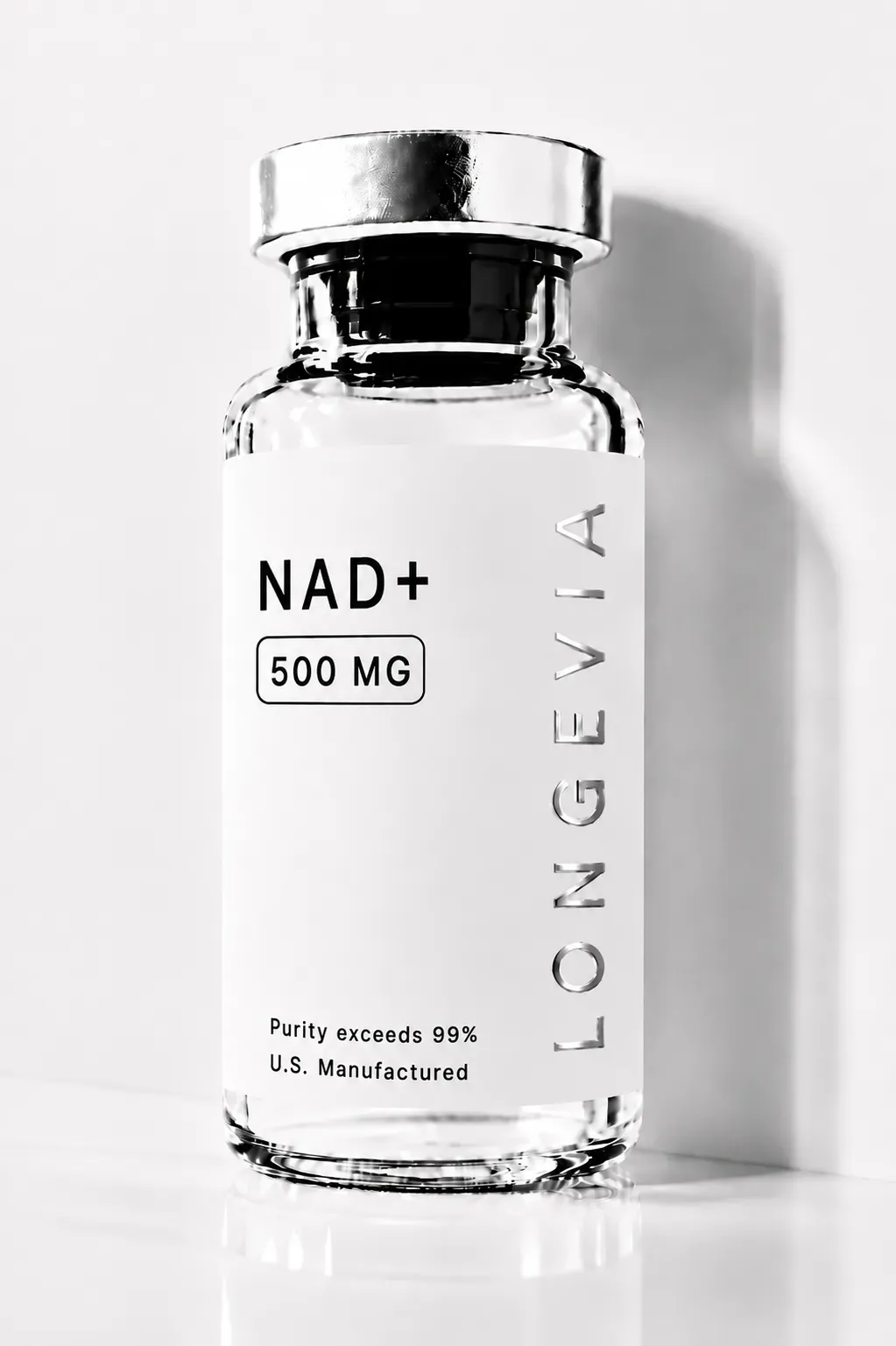
NAD⁺ (nicotinamide adenine dinucleotide) is a naturally occurring coenzyme investigated in research involving cellular energy metabolism, sirtuin biology, PARP enzyme systems, mitochondrial function, and NAD⁺ homeostasis. Available in 500mg and 1000mg vials. Research Use Only — Longevia Research.
NAD⁺
NAD⁺ (nicotinamide adenine dinucleotide) is a naturally occurring coenzyme investigated in research involving cellular energy metabolism, sirtuin biology, PARP enzyme systems, mitochondrial function, and NAD⁺ homeostasis. Available in 500mg and 1000mg vials. Research Use Only — Longevia Research.
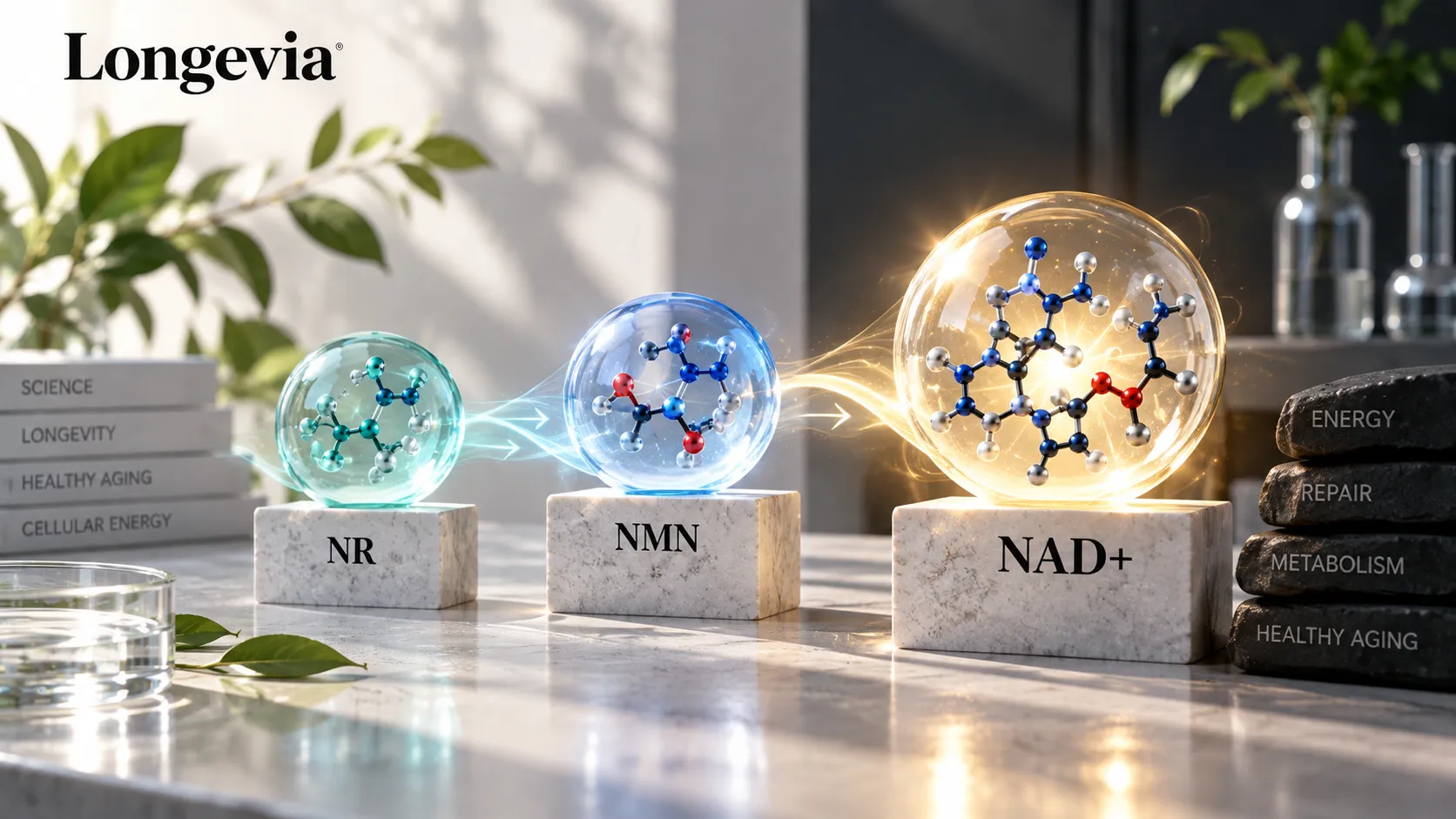
NAD+ vs NMN vs NR is one of the most searched comparisons in longevity-adjacent research, and most of what circulates online blurs three different things together. Nicotinamide adenine dinucleotide (NAD+) is the redox cofactor itself. Nicotinamide mononucleotide (NMN) and nicotinamide riboside (NR) are small-molecule precursors, sold by other companies as oral consumer supplements, that biological systems can convert into NAD+. This guide works through the first human trial to compare NMN, NR and nicotinamide (Nam) head-to-head, published in Nature Metabolism in January 2026, and separates what that trial measured from what it didn't. One detail matters more than any other: NAD+ itself was not one of the compounds the trial tested.
Quick answer: in a 2026 randomized, placebo-controlled trial of 65 healthy adults, 14 days of oral NR (1 g/day) or oral NMN (1 g/day) roughly doubled baseline whole-blood NAD+ to a comparable degree, while oral nicotinamide (0.5 g/day) produced only a brief acute rise and no sustained increase. The trial did not include NAD+ as a test compound, so its findings describe oral precursors and cannot be applied directly to a reconstituted NAD+ research compound.
NAD+ vs NMN vs NR: Three Different Molecules, Not Three Versions of One Product
NAD+ is the finished cofactor, while NMN and NR are upstream building blocks that have to be converted into NAD+ before they do anything as NAD+. That distinction sounds obvious, yet consumer marketing routinely calls all three "NAD+ supplements," which makes comparisons meaningless before they start.
NAD(H) and its phosphorylated form NADP(H) are vitamin B3-derived redox cofactors. They take part in hundreds of metabolic reactions and in post-translational modifications of proteins, and NAD+ is consumed by enzyme families such as sirtuins and PARPs. For a deeper look at that biology, see the NAD+ mitochondrial and sirtuin pathway mechanism guide.
Cells build NAD+ through three canonical routes:
- The salvage pathway, which recycles nicotinamide (Nam) back into NAD+.
- The Preiss–Handler pathway, which starts from nicotinic acid (NA).
- The de novo pathway, which starts from the amino acid tryptophan and converges on the Preiss–Handler pathway.
NMN and NR have traditionally been grouped with the salvage pathway because both contain a nicotinamide group. Nicotinic acid also raises NAD+, but the 2026 trial authors note that its use is limited by skin flushing and gastrointestinal symptoms at high doses. That's a large part of why NR and NMN became the commercially dominant precursors.
None of these compounds are peptides. NAD+, NMN, NR and Nam are small molecules, so peptide-specific concepts don't apply to them, and their stability questions revolve around enzymatic breakdown in biological matrices rather than sequence integrity.
Absorption is where the story gets complicated. The Nature Metabolism authors point out that polar, charged nucleotides and nucleosides structurally similar to NMN and NR have notoriously poor oral bioavailability. Earlier rodent work had also suggested that much of the NAD+-raising effect of oral NR and NMN might come from gut bacteria converting them into nicotinic acid. Until the 2026 trial, nobody had tested that idea in humans alongside a direct precursor comparison.
Compound | What it is | How it's typically encountered | Relationship to NAD+ |
|---|---|---|---|
NAD+ | The redox cofactor itself | Research compound for reconstitution (what Longevia supplies) | End product |
NMN | Mononucleotide precursor | Oral supplement sold by other companies | Must be converted to NAD+ |
NR | Nucleoside precursor | Oral supplement sold by other companies | Must be converted to NAD+ |
Nam | Amide form of vitamin B3 | Oral vitamin or supplement | Salvage pathway substrate |
NMN vs NR: What the 2026 Head-to-Head Trial Actually Found
NMN and NR raised baseline whole-blood NAD+ by a similar amount after 14 days, and the trial doesn't show either one clearly outperforming the other. The paper is "The differential impact of three different NAD+ boosters on circulatory NAD and microbial metabolism in humans" by Stefan Christen, Karine Redeuil, Laurence Goulet, Maria-Pilar Giner, Isabelle Breton, Riccardo Rota, Adrien Frézal, Atiye Nazari, Pieter Van den Abbeele, Jean-Philippe Godin, Sophie Nutten and Bernard Cuenoud, published in Nature Metabolism volume 8, pages 62–73 (DOI: 10.1038/s42255-025-01421-8).
The design was a randomized, open-label, placebo-controlled, four-arm parallel study run at the Clinical Innovation Lab of Nestlé Research in Lausanne, Switzerland, between July and November 2022. It is registered on ClinicalTrials.gov as NCT05517122.
The study enrolled 67 healthy adults aged 18 to 50. Two participants received the wrong product for the whole study, so the analysis covered 65 people with a mean age of 34.7 years (32 men and 33 women). Each arm took one product once daily for 14 days:
Arm | Daily dose | Molar dose | Participants analysed |
|---|---|---|---|
NR | 1,000 mg | 3.4 mmol | 16 |
NMN | 1,000 mg | 3.0 mmol | 15 |
Nam | 500 mg | 4.1 mmol | 17 |
Placebo | 500 mg microcrystalline cellulose | — | 17 |
The primary endpoint was the change in baseline whole-blood NAD+ after 14 days. Compared with placebo, NR raised whole-blood NAD+ by 49.4 µM (95% CI 39.5–59.3 µM) and NMN raised it by 43.1 µM (95% CI 32.7–53.4 µM), both roughly a twofold increase and both highly significant. Nicotinamide did not produce a significant chronic change (P = 0.461).
Several secondary results are worth knowing. Whole-blood NADP+, NADPH and NADH didn't change significantly in any arm in the targeted analysis. Sex and age showed no effect on the NAD+ results in the statistical model. The authors also reported the products as well tolerated, with three adverse events judged probably related to the product across 65 participants: abdominal pain in the placebo group, hypotension in the NR group and headache in the NMN group.
One finding catches people off guard. The NAD+ breakdown metabolites N1-methylnicotinamide (MeNam) and the pooled methylpyridone carboxamides (MeXPY) rose in every precursor arm, including nicotinamide, which didn't raise NAD+ at all. The authors concluded that these degradation metabolites might not be suitable surrogates for an individual's NAD+ status.
If your study design relies on NAD+ status, measure NAD+ directly in a defined matrix such as whole blood. In the 2026 trial, MeNam and MeXPY increased in the nicotinamide arm even though whole-blood NAD+ did not change.
Which NAD Precursor Is Best? Chronic and Acute Effects Point in Different Directions
In this trial, NR and NMN were better at raising baseline NAD+ over two weeks, while nicotinamide acted faster but didn't produce a lasting change. So the honest answer to "which NAD precursor is best" depends on which endpoint a study cares about.
The acute measurements covered the four hours after dosing on day 1 and day 14. Nicotinamide had the strongest acute impact of the three. Whole-blood Nam peaked at around one hour, with an incremental area under the curve of 105.2 µM·h compared with placebo, and whole-blood NAD+, NR and NMN rose mildly and transiently at one hour. Nam's breakdown products built up in blood, plasma and urine at the same time. The authors read this pattern as nicotinamide being quickly absorbed, metabolized and excreted.
NR and NMN behaved very differently in that same window. Their whole-blood concentrations stayed below 2 µM and didn't change after dosing, and the circulating NAD+ metabolome showed no change across four hours. The acute patterns on day 14 matched those on day 1 in magnitude. The authors acknowledge that a longer sampling window, such as 24 hours, might have captured slower acute effects of NR and NMN.
Put simply, the precursor with the fastest measurable blood signal was the one that failed the primary endpoint. The two precursors that showed nothing acutely were the ones that doubled baseline NAD+ by day 14.
A second acute difference involves the methyl pool. Nicotinamide produced a strong acute rise in plasma homocysteine, with a median increase in incremental area under the curve of more than eightfold versus placebo on both study days. The authors linked this to nicotinamide methylation drawing on methyl donors. That acute homocysteine effect was not seen with NR or NMN.
Chronic amino acid results were less clean. Both Nam and NR showed a more sustained concentration of homocysteine and cysteine than placebo over 14 days (P < 0.05), and NMN showed a similar trend that didn't reach significance (P values of 0.065 and 0.173).
Dosing also complicates any ranking. The arms weren't equimolar: nicotinamide supplied 4.1 mmol per day, NR 3.4 mmol and NMN 3.0 mmol. Nicotinamide failed to raise baseline NAD+ despite delivering the largest molar dose, and the NR-versus-NMN comparison was made at similar rather than identical molar amounts.
The trial compared NR and NMN in healthy adults with a mean age of about 35, and it wasn't designed or powered to declare one precursor superior. Treat "NR vs NMN" as a statistical tie on whole-blood NAD+ over 14 days, not as evidence that either wins on other endpoints.
NAD+ Boosters Compared: How Gut Bacteria Change the Picture
The trial authors propose that NR and NMN raise blood NAD+ mainly after gut bacteria convert them into nicotinic acid, rather than by entering circulation intact. That proposal rests on three separate lines of evidence, and each one has different strength.
The clinical metabolic footprint
Participants taking NR or NMN showed signs of Preiss–Handler pathway activity. In a post hoc analysis, whole-blood nicotinic acid adenine dinucleotide (NAAD) rose with NR and NMN but not with nicotinamide. Urinary nicotinic acid riboside (NAR) also increased with chronic NR and NMN, and the nicotinic acid-derived metabolite nicotinuric acid rose too, though less clearly with NMN (P = 0.127). Untargeted blood metabolomics found NR and NMN raised several metabolites that may originate from gut microbiota, including riboflavin 5-monophosphate and phenylacetyl glutamine.
Ex vivo gut fermentation
The team exposed faecal microbiota from six healthy adult donors to NR or nicotinamide for 48 hours. Gut bacteria cleaved NR to nicotinamide, which peaked at 2.1 mM at 8 hours and was then deamidated to nicotinic acid, sustaining 200–400 µM over the final 24 hours. Nicotinamide alone produced only nicotinic acid, which means the microbiota didn't convert nicotinamide into NR or NMN.
NR also changed the bacteria themselves. It significantly increased acetate, propionate and total short-chain fatty acids (SCFAs), raised total bacterial cell density, and specifically increased Enterocloster aldensis in all six donors. Repeat experiments with microbiota from ten healthy older donors and ten people with Crohn's disease showed consistent drops in pH, increases in gas and SCFAs, and nicotinic acid build-up after 24 hours.
NMN was tested against NR using microbiota from 12 healthy older donors. Both produced comparable nicotinamide and nicotinic acid build-up, more bacterial growth, a similar pH drop, and increases in gas production and SCFAs. NMN differed by rapidly generating its deamidated form, nicotinic acid mononucleotide (NAMN).
Ex vivo whole blood
Whole blood from four healthy donors was incubated with each precursor at 50 µM for seven hours. Nicotinic acid increased the NAD+ signal by about 170%, and NAR produced a similar rise. NR and NMN did not raise NAD+; instead, they were broken down within about one hour and 30 minutes, respectively, into nicotinamide and pentose phosphates.
The SCFA changes and the NR/NMN-to-nicotinic acid conversion were demonstrated ex vivo, in fermentation vessels and blood samples, not measured inside participants' guts. Nicotinic acid was not detected in participants' venous blood, which the authors attribute to slow release and rapid uptake. The gut-mediated route is a well-supported proposed model, not a directly observed in vivo pathway.
NAD+ Injection vs NMN Supplement: Different Routes, Different Evidence Bases
Findings about oral NMN and NR can't be transferred to parenterally delivered NAD+, because the 2026 trial's proposed mechanism runs through the gut, a compartment that injected or infused NAD+ bypasses entirely. This is where "NAD+ research compound" and "NAD+-boosting supplement" have to be kept apart.
The human evidence on directly administered NAD+ is thinner and looks different. A 2019 pilot study by Grant and colleagues in Frontiers in Aging Neuroscience tracked plasma and urine during a six-hour intravenous NAD+ infusion at 3 µmol/min. Plasma NAD+ and the measured metabolites (nicotinamide, methylnicotinamide, ADP-ribose and NMN) didn't change until after the first two hours. The authors concluded that, at that infusion rate, NAD+ was rapidly and completely removed from plasma for at least the first two hours.
By six hours, urinary excretion of NAD+ and methylnicotinamide had increased, but urinary nicotinamide had not risen significantly. The metabolite profile was consistent with breakdown by NAD+ glycohydrolase and NAD+ pyrophosphatase activity. Those are pilot-scale findings, and they describe clearance and metabolism rather than any functional outcome.
A 2026 retrospective tolerability study in Frontiers in Aging, comparing intravenous NAD+ with intravenous NR in a real-world setting, states that human data on the efficacy and health effects of intravenous administration remain limited. That's a fair summary of where parenteral NAD+ research stands.
The practical consequence for researchers is straightforward. A result showing that oral NMN doubles whole-blood NAD+ says nothing about what reconstituted NAD+ does in a parenteral model, an in vitro system or a tissue preparation. Equally, the thin human infusion literature doesn't undermine the oral precursor data. They answer different questions.
Longevia supplies NAD+ itself as a research compound for reconstitution in laboratory settings, strictly for Research Use Only and not for human consumption. Longevia does not supply NMN or NR as oral supplements, and nothing in the 2026 trial evaluated Longevia's NAD+.
Compound | Route in the cited human research | Chronic whole-blood NAD+ (14 days) | Acute effect | Proposed route to NAD+ | Supplied by Longevia |
|---|---|---|---|---|---|
NAD+ | Intravenous infusion (2019 pilot); not tested in the 2026 trial | Not measured in the 2026 trial | Plasma NAD+ unchanged for the first 2 hours of a 6-hour infusion | Administered directly; plasma profile consistent with enzymatic breakdown | Yes, as an RUO research compound |
NMN | Oral, 1 g/day | About twofold increase (+43.1 µM vs placebo) | No change over 4 hours | Gut microbial conversion to NA, then Preiss–Handler | No |
NR | Oral, 1 g/day | About twofold increase (+49.4 µM vs placebo) | No change over 4 hours | Gut microbial conversion to NA, then Preiss–Handler | No |
Nam | Oral, 0.5 g/day | No significant change | Mild, transient NAD+ rise at 1 hour | Rapid absorption, salvage pathway | No |
Head-to-Head Trial Limitations Researchers Should Weigh
The 2026 trial is the strongest direct comparison of NAD+ precursors in humans so far, but it was short, open-label, run in healthy younger adults and conducted largely by Nestlé scientists. None of that invalidates it. It does set boundaries on what the data can support.
The authors list several limitations themselves, and a few more follow from the design:
- Duration: supplementation lasted 14 days, so the data don't address longer-term trajectories.
- Blinding: the study was open-label, although the paper states that data collection and analysis were performed with blinding to conditions.
- Population: participants were healthy adults aged 18 to 50, and NAD+ was raised above normal values; the authors say disease populations need separate study.
- Matrix: NAD+ was measured in whole blood, plasma and urine, not in tissues such as muscle or brain.
- Acute window: blood sampling covered only four hours after dosing, which may miss slower acute effects of NR and NMN.
- Missing link: nicotinic acid wasn't detected in participants' venous blood, and no stool samples were collected to confirm microbial deamidation rates in vivo.
- Sequencing depth: the fermentation study used shallow shotgun sequencing, which limits detection of low-abundance bacteria and doesn't support functional gene analysis.
- Meal effects: a standardized breakfast was given on sampling days, and the authors note it may have influenced absorption.
- Rodent mismatch: acute increases in circulating nicotinamide and nicotinic acid seen after NR and NMN in mice weren't recapitulated in this human study.
Industry involvement deserves a plain statement. According to the paper's competing-interests declaration, most authors are employees of Nestlé Research, part of Société des Produits Nestlé SA, and one is an employee of Nestlé Health Science. The fermentation experiments were performed at Cryptobiotix. The NR used was TRU NIAGEN Pro and the NMN came from UltraHealth.
The results also sit alongside earlier single-precursor work rather than replacing it. A 2022 study in NPJ Aging reported that chronic NMN supplementation elevated blood NAD+ in healthy older men, and a 2016 Nature Communications paper described NR as orally bioavailable in mice and humans. The 2026 authors describe their NR and NMN findings as consistent with previous clinical studies at similar dosing. What's new is the head-to-head design and the evidence that gut bacteria are part of how those oral precursors work.
Choosing Between NAD+, NMN and NR in a Research Design
Match the compound to the question: oral-precursor and gut-microbiome questions call for NMN or NR, while questions about the cofactor itself call for NAD+. Most design mistakes in this area come from asking a question about one molecule and running the experiment with another.
A few checkpoints help keep NAD+ vs NMN vs NR studies interpretable:
- Define the route first. If the gut is bypassed, the 2026 trial's proposed mechanism for NR and NMN no longer applies.
- Pick chronic or acute endpoints deliberately. Nicotinamide looked strongest at one hour and weakest at 14 days in the same trial.
- Measure NAD+ directly. MeNam and MeXPY rose even when NAD+ didn't, so they're unreliable stand-ins.
- Account for the microbiome. The fermentation arm of the 2026 study excluded donors who had used antibiotics in the previous three months, which reflects how much microbial status can shape results.
- Plan sample handling around instability. In whole blood ex vivo, NMN and NR broke down within about 30 minutes and one hour, and the trial team analysed NAD+ samples as they were collected to minimize degradation.
- Report molar doses. Mass-matched doses of NR, NMN and nicotinamide are not molar-matched, and that difference affects comparisons.
Compound identity and purity matter just as much as design. NAD+ is a relatively complex nucleotide, and a vial that doesn't contain what its label says will quietly undermine every downstream measurement. Longevia's NAD+ is independently tested by HPLC/LC-MS for every batch, and the lot-specific Certificate of Analysis for each batch is published in the COA Library. See the sourcing NAD+ research compound COA and purity guide for the full verification process.
Before reconstituting, confirm that the lot number printed on the vial matches the lot number on the Certificate of Analysis you're reviewing. A COA only verifies the batch it was issued for.
For researchers whose interest is the precursor biology itself, the 2026 trial is the paper to read in full, particularly its figures on the whole-blood time course and fermentation metabolites. For researchers working with NAD+ directly, the takeaway is narrower but just as useful: the most-cited NMN vs NR evidence doesn't describe your compound, so design and interpret your work on its own terms.
Frequently Asked Questions
- Christen S, Redeuil K, Goulet L, Giner MP, Breton I, Rota R, Frézal A, Nazari A, Van den Abbeele P, Godin JP, Nutten S, Cuenoud B. The differential impact of three different NAD+ boosters on circulatory NAD and microbial metabolism in humans. Nature Metabolism. 2026;8(1):62–73. doi:10.1038/s42255-025-01421-8
- ClinicalTrials.gov. NCT05517122 — randomized, open-label, placebo-controlled study of nicotinamide riboside, nicotinamide mononucleotide and nicotinamide in healthy adults.
- Grant R, Berg J, Mestayer R, Braidy N, Bennett J, Broom S, Watson J. A Pilot Study Investigating Changes in the Human Plasma and Urine NAD+ Metabolome During a 6 Hour Intravenous Infusion of NAD+. Frontiers in Aging Neuroscience. 2019;11:257. doi:10.3389/fnagi.2019.00257
- Intravenous infusion of nicotinamide adenine dinucleotide (NAD+) versus nicotinamide riboside (NR): a retrospective tolerability pilot study in a real-world setting. Frontiers in Aging. 2026. doi:10.3389/fragi.2026.1652582
- Igarashi M, et al. Chronic nicotinamide mononucleotide supplementation elevates blood nicotinamide adenine dinucleotide levels and alters muscle function in healthy older men. NPJ Aging. 2022;8:5. doi:10.1038/s41514-022-00084-z
- Trammell SA, et al. Nicotinamide riboside is uniquely and orally bioavailable in mice and humans. Nature Communications. 2016;7:12948. doi:10.1038/ncomms12948