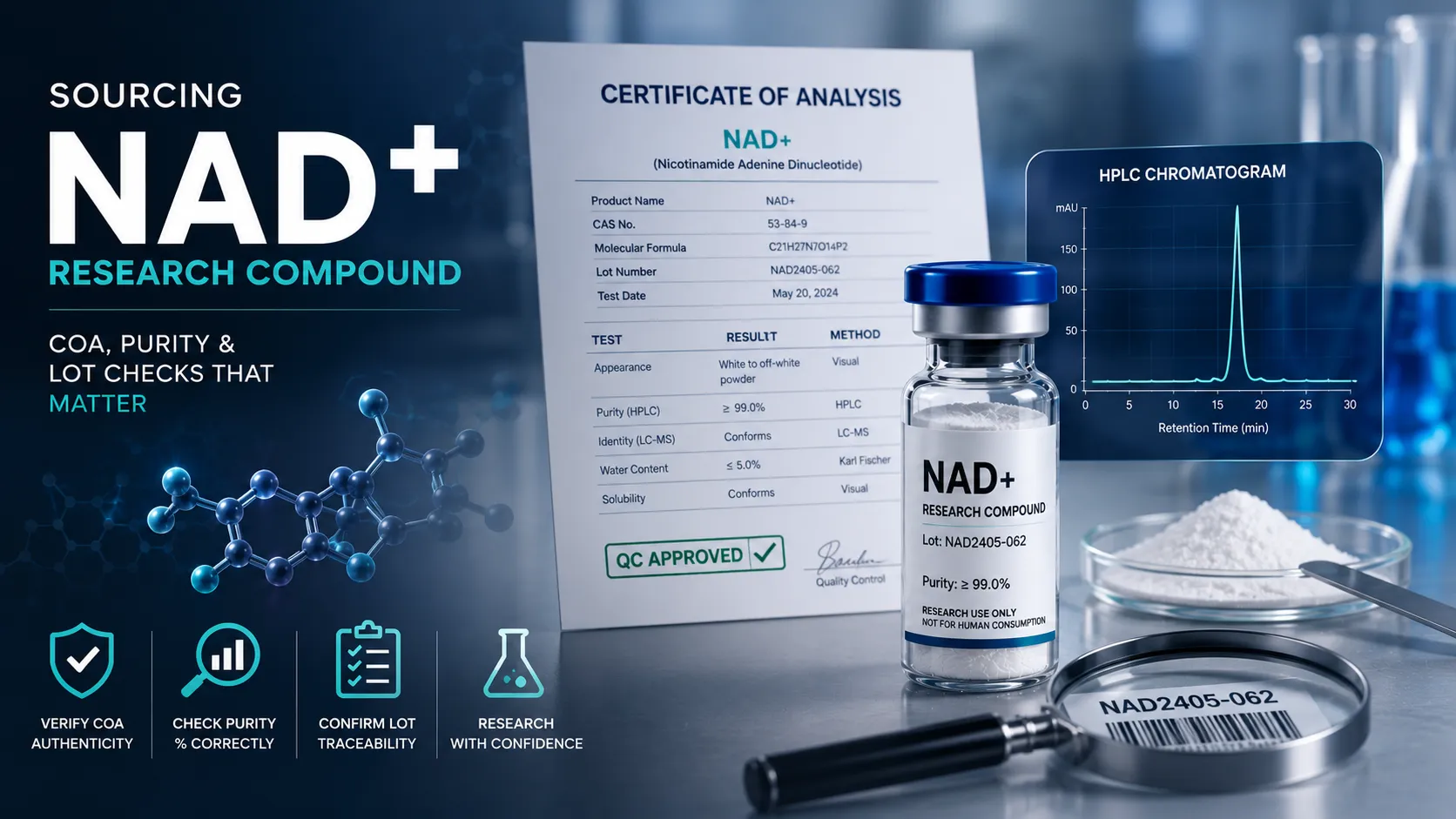
- A lot-specific Certificate of Analysis records what one batch measured; a generic specification only states what a product should be.
- A COA without a batch number cannot be matched to the vial you received and proves nothing about it.
- Purity percentages are relative peak-area measurements and exclude anything the analytical method does not detect.
- HPLC quantifies how much of a sample is the dominant species but cannot confirm which compound it is.
- LC-MS confirms identity by measuring molecular mass, making it orthogonal to and inseparable from purity testing.
- Lot traceability is the check that makes every other check meaningful, before and after an experiment.
- NAD+ is a dinucleotide coenzyme, not a peptide, so peptide-specific impurity categories do not apply to it.
- Health benefit or consumption claims on a research compound listing indicate a misrepresented product category.
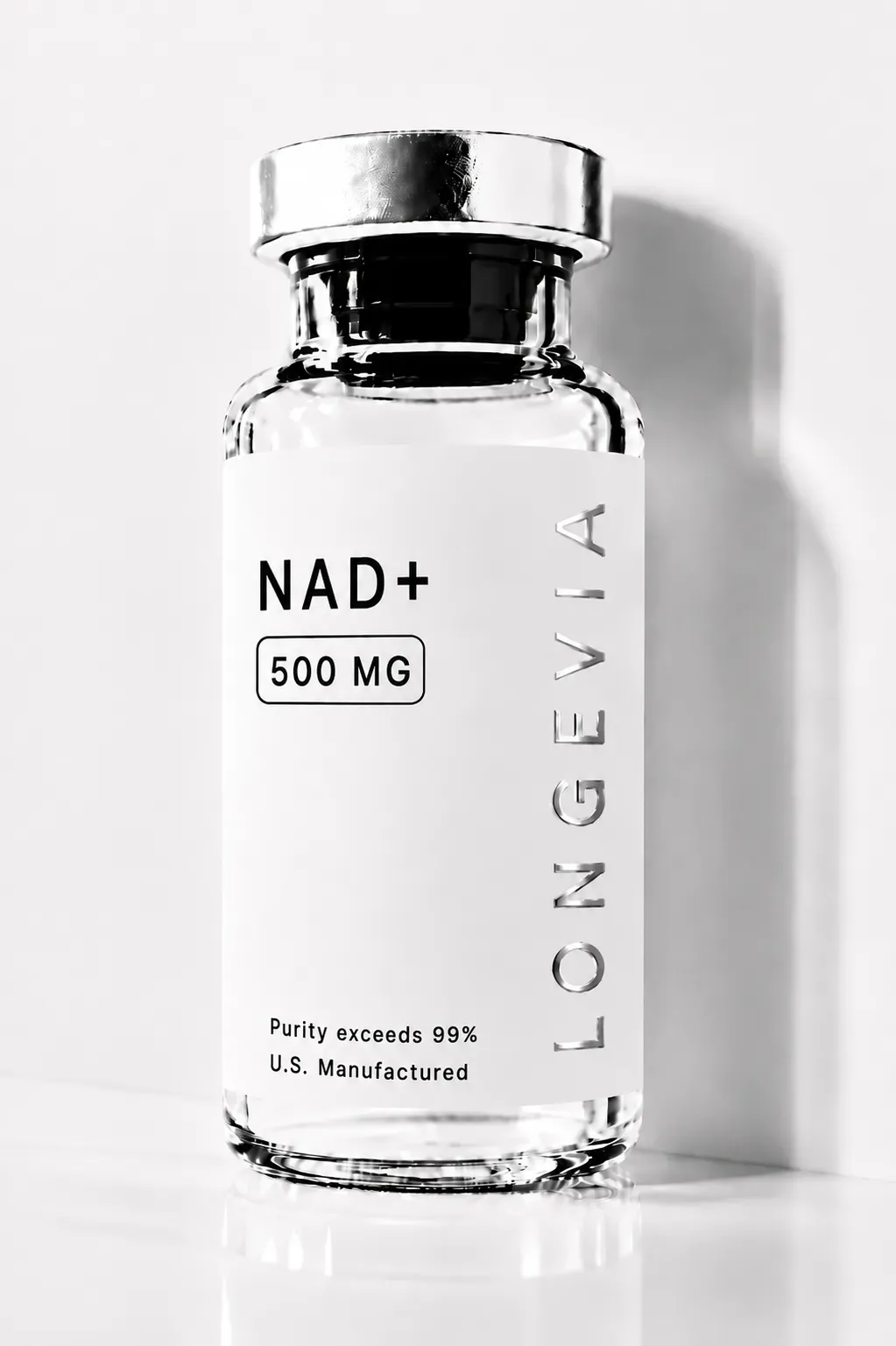
NAD+
NAD+ — high-purity, COA-verified Nicotinamide Adenine Dinucleotide for advanced cellular energy, mitochondrial function, and longevity research. Research use only.
NAD+
NAD+ — high-purity, COA-verified Nicotinamide Adenine Dinucleotide for advanced cellular energy, mitochondrial function, and longevity research. Research use only.
Sourcing an NAD+ research compound is a documentation problem before it is a purchasing problem. Two vials from two suppliers can carry identical labels, identical purity claims, and wildly different actual contents, and the only thing that separates them is what the paperwork proves and whether that paperwork is tied to the specific batch in the vial. This guide covers how to read a Certificate of Analysis, what a purity percentage does and does not tell you, what HPLC and LC-MS each actually prove, why lot traceability is the check that matters most, and the specific red flags worth treating as disqualifying. It is a verification guide, not a mechanism guide. Every compound discussed is supplied for Research Use Only and is not for human consumption.
What an NAD+ Research Compound Is and Why Sourcing Language Varies
An NAD+ research compound is nicotinamide adenine dinucleotide supplied as a laboratory reagent for in vitro and preclinical work, not as a therapeutic product. NAD+ is a coenzyme present in every living cell, functioning as a redox carrier in energy metabolism and as a substrate for enzymes including sirtuins, PARPs, and CD38. Covarrubias and colleagues reviewed this biology comprehensively in Nature Reviews Molecular Cell Biology, and Rajman and colleagues surveyed the in vivo evidence for NAD-boosting approaches in Cell Metabolism. The mechanism is not the subject of this guide, and researchers who need that depth should start with the dedicated pathway resource.
The commercial language around this compound category is where confusion begins. Search demand clusters around phrases like NAD research compound for sale and buy NAD research compound, which are transactional phrasings inherited from consumer commerce. The compound category they point to is a laboratory reagent supply market with an entirely different set of expectations: documentation, batch traceability, and analytical verification rather than consumer product claims.
This mismatch produces a specific sourcing hazard. Suppliers optimizing for transactional search intent sometimes adopt consumer-product framing, which correlates with weaker analytical documentation because consumer framing does not demand it. The suppliers worth using are the ones whose product pages read like reagent listings, with batch numbers, analytical methods, and downloadable lot documentation, rather than like supplement listings with benefit claims.
NAD+ research compounds are supplied for Research Use Only. They are not medicines, not dietary supplements, and not for human or veterinary consumption, diagnostic use, or therapeutic use. Search phrases containing for sale or buy describe procurement of a laboratory reagent for legitimate research purposes and do not imply any permitted use in humans. Any supplier presenting a research compound with health benefit claims or consumption guidance is misrepresenting what they are selling.
How to Read a Certificate of Analysis
A Certificate of Analysis is a record of what one specific batch tested as, and its value lies entirely in whether it is batch-specific rather than generic. This distinction is the single most useful thing to understand about COA documents, because both types look superficially similar and only one of them says anything about the material you receive.
A generic specification sheet states what a product is supposed to be: the target compound, the intended purity threshold, the intended appearance. It is a marketing and design document. A lot-specific COA states what a named batch actually measured: the batch identifier, the date, the methods run, and the numerical results those methods produced. If a document has no batch number on it, it is the former regardless of what it is titled.
COA field | What it should contain | What to check |
|---|---|---|
Product name and identifier | Compound name plus CAS number or equivalent | Matches the compound you ordered, not a related compound |
Lot or batch number | A unique alphanumeric batch identifier | Matches the number printed on the vial you received |
Purity result | A numerical percentage with the method named | A number, not a range or a threshold statement |
Analytical method | Named method, for example HPLC with detection wavelength | Method is stated, not just implied by a result |
Identity confirmation | Mass spectrometry result against expected molecular mass | An orthogonal method distinct from the purity assay |
Appearance | Physical description of the material | Consistent with what arrived in the vial |
Test date | Date the analysis was performed | Recent and tied to the batch, not to an earlier batch |
Testing party | Name of the laboratory that ran the analysis | Identified, ideally independent of the manufacturer |
Two fields carry disproportionate weight. The lot number is what connects the document to the physical vial, and without it the document is unfalsifiable. The named analytical method is what makes the purity number interpretable, because a percentage with no method attached could have been produced by an assay that would not detect the impurities that matter.
For a fuller walkthrough of COA structure and how to interrogate each section, the dedicated COA reading guide covers the topic in depth.
What a 99% Purity Claim Actually Means
A purity figure of 99 percent or higher means that the target compound accounted for that proportion of the analytical signal under one specific method, and it says nothing about the remaining fraction unless that fraction is characterized. This is the most misread number in the entire research compound market.
Purity as reported by chromatography is a relative measurement. It expresses the area of the main peak as a percentage of total integrated peak area in the chromatogram. That framing carries three consequences worth internalizing. First, anything the method does not detect does not appear in the calculation at all, so residual solvents, inorganic salts, water content, and counterions can be entirely absent from a purity figure that reads 99.5 percent. Second, the remaining one percent is unspecified unless the document names what it consists of. Third, purity is method-dependent, so two suppliers reporting the same percentage under different conditions have not necessarily measured the same thing.
Regulatory frameworks handle this by requiring impurity characterization rather than purity thresholds alone. In the pharmaceutical context, individual impurities above defined thresholds must be identified and characterized rather than merely counted, which is a substantively different standard from reporting a single aggregate number. Research supply is not governed by those requirements, but the analytical logic is the right benchmark for evaluating documentation quality.
The practically useful question to ask a supplier is therefore not what is your purity but what method produced that figure and what is in the remainder. A supplier who can answer both is running real analytics. A supplier who can only restate the percentage is quoting a specification rather than a measurement. For a fuller treatment of why this distinction affects experimental reproducibility, the purity guide covers the reasoning.
Ask for the chromatogram, not just the number. A purity percentage is a summary of a chromatogram, and a supplier running genuine batch analytics can produce the underlying trace on request.
HPLC and LC-MS: What Each Method Actually Proves
HPLC proves how much and LC-MS proves what, and a Certificate of Analysis that reports only one of them is reporting an incomplete result. Understanding the division of labour between these two methods is what turns a COA from a document into evidence.
High-performance liquid chromatography separates the components of a sample by their differential interaction with a stationary phase, producing a chromatogram in which each resolved component appears as a peak. Integrating the area under those peaks yields the quantitative purity figure. HPLC is excellent at answering how much of the sample is one dominant species, and it is the standard method behind almost every purity percentage in the market.
What HPLC cannot do is confirm that the dominant peak is the compound you ordered. Retention time is suggestive but not conclusive, because structurally related compounds and synthesis by-products can elute at similar times. A sample that is 99.8 percent one substance is highly pure regardless of whether that substance is the right one.
Liquid chromatography-mass spectrometry closes that gap by measuring the mass-to-charge ratio of the eluting species. Confirming that the main peak carries the expected molecular mass is what establishes identity rather than merely purity. This is why the two methods are described as orthogonal: they interrogate different properties, and neither substitutes for the other.
The pharmacopoeial framework makes this explicit for synthetic peptides. USP General Chapter 1503, which describes quality attributes for synthetic peptide drug substances, specifies identity testing by methods that address different attributes such as mass, sequence, and chromatographic profile rather than by any single test. McCarthy and colleagues discussed the analogous reasoning for reference standards in Pharmaceutical Research. Research reagents do not fall under pharmacopoeial drug substance requirements, but orthogonal identity confirmation plus quantitative purity determination remains the correct documentation standard to expect.
Lot Traceability: The Check That Matters Most
Lot traceability is the ability to connect the physical vial in your hand to the specific analytical record for the batch it came from, and it is the check that makes every other check meaningful. Without it, a COA is a document about a batch you may or may not have received.
The mechanics are simple. The vial carries a batch or lot number. The COA carries the same number. Matching them takes seconds. What makes this check powerful is that it is the hardest thing for a low-quality supplier to fake at scale, because maintaining genuine per-batch documentation requires actually running per-batch analytics rather than reusing one favourable historical result across an indefinite number of shipments.
Three traceability failure modes recur. The first is a COA with no lot number, which cannot be matched to anything. The second is a COA whose lot number does not match the vial, which usually means documentation from a different batch has been supplied. The third is a supplier who will provide a COA only on request and only after purchase, which removes the ability to verify before committing. A published, browsable COA library that lets a researcher look up a lot number independently is the strongest form of this, because it makes the record checkable without a support interaction.
This check also catches a failure that no purity figure would reveal: a supplier changing manufacturing source between batches while continuing to publish documentation from an earlier one. Genuine per-batch analytics make such a change visible in the results, which is precisely why reusing a single favourable historical COA is the shortcut low-quality suppliers take.
Traceability also matters after the fact. When an experiment produces an anomalous result, the lot number is what allows a researcher to determine whether the material was a variable. Studies running across multiple vials should record lot numbers per vial for exactly this reason, and material from a single lot should be preferred within a single experimental series wherever supply allows.
NAD+ Is Not a Peptide, and That Changes What to Check
NAD+ is a dinucleotide coenzyme rather than a peptide, which means the analytical conventions developed for synthetic peptide characterization do not map onto it directly. This distinction is worth making explicitly, because NAD+ is frequently sold alongside research peptides and the documentation conventions get borrowed carelessly across categories.
The FDA distinguishes peptides from proteins by chain length, defining a peptide as a chain of 40 amino acids or fewer. NAD+ is neither: it is a small molecule composed of two nucleotides joined through their phosphate groups. It has no amino acid sequence, so sequence confirmation, amino acid analysis, and peptide mapping are all inapplicable. Peptide-related substance profiling, which looks for deletion sequences, truncations, and diastereomers arising from solid-phase synthesis, has no NAD+ equivalent.
What replaces them is small-molecule analytical practice: chromatographic purity, mass confirmation, water content, residual solvent analysis, and inorganic impurity assessment. A COA for NAD+ that reads exactly like a COA for a peptide, complete with peptide-specific impurity categories, has been generated from a template rather than from analysis of the actual material.
Counterion and salt form are a further category difference. Synthetic peptides are commonly supplied as trifluoroacetate or acetate salts, and counterion content is a recognized COA field because it affects the net peptide content per unit mass. NAD+ is typically supplied as a free acid or as a disodium salt, and which form a given batch takes depends on the manufacturing route. Mass-based concentration calculations differ between the two forms, which makes the stated salt form a field to read rather than skip.
Stability differs too. NAD+ is hygroscopic and hydrolytically sensitive, and its stability in solution is strongly pH-dependent, which is why enzymatic assay protocols specify buffer conditions carefully and why storage guidance differs from that for lyophilized peptides. Water content is therefore a more consequential COA field for NAD+ than it is for many peptides, since absorbed moisture affects both mass-based concentration calculations and shelf stability.
A Pre-Order Verification Checklist
A short sequence of checks before ordering eliminates most sourcing risk, and none of them require specialist equipment or more than a few minutes. The list below is ordered by how much information each check yields relative to the effort involved.
- Confirm that lot-specific COAs are published and browsable before purchase rather than supplied only on request afterwards.
- Open a COA and confirm it carries a batch number, a named analytical method, a numerical purity result, and a mass-based identity confirmation.
- Check that the compound identity on the COA matches what you intend to order, including CAS number where applicable.
- Confirm the testing party is named, and note whether analysis is independent of the manufacturer.
- Check the test date, and confirm it corresponds to the batch rather than to an older reference batch.
- Read the product page for RUO framing, and treat health benefit claims or consumption guidance as disqualifying.
- On arrival, match the vial lot number to the published COA before opening anything.
- Record the lot number in your experimental notes alongside the material, so anomalous results can be traced later.
Red flag | Why it matters | What to ask instead |
|---|---|---|
No lot number on the COA | Document cannot be tied to your vial | Request the COA for the specific batch shipped |
Purity stated as a threshold only | No measurement has been reported | Ask for the numerical result and the method |
No identity confirmation method | Purity without identity is incomplete | Ask whether mass confirmation was performed |
COA supplied only after purchase | Verification is impossible before committing | Ask for pre-purchase access to lot documentation |
Health or dosing claims on a research listing | Supplier is misrepresenting the category | Treat as disqualifying rather than negotiable |
Peptide impurity categories on a non-peptide COA | Document is templated rather than measured | Ask which methods were actually run on this batch |
Longevia Research publishes lot-specific Certificates of Analysis in its COA Library, and every batch is independently tested by HPLC and LC-MS so that both quantitative purity and mass-based identity can be verified against the lot number printed on the vial. The verification workflow above applies to any supplier, and researchers should apply it to all of them, including this one. A supplier confident in its analytics has no reason to object to being checked.
Frequently Asked Questions
- Covarrubias AJ, Perrone R, Grozio A, Verdin E. NAD+ metabolism and its roles in cellular processes during ageing. Nat Rev Mol Cell Biol. 2021;22(2):119-141.
- Rajman L, Chwalek K, Sinclair DA. Therapeutic potential of NAD-boosting molecules: the in vivo evidence. Cell Metab. 2018;27(3):529-547.
- United States Pharmacopeia. General Chapter 1503, Quality Attributes of Synthetic Peptide Drug Substances. USP-NF. Rockville, MD.
- McCarthy D, Han Y, Carrick K, et al. Reference standards to support quality of synthetic peptide therapeutics. Pharm Res. 2023.
- U.S. Food and Drug Administration. FDA Publishes Revised Draft Product-Specific Guidances for Certain Generic Peptide Products. 2026.
- Manning MC, Chou DK, Murphy BM, Payne RW, Katayama DS. Stability of protein pharmaceuticals: an update. Pharm Res. 2010;27(4):544-575.