- No peer-reviewed human study has characterised the pharmacokinetics or bioavailability of intranasal Melanotan II.
- All published human MT-2 pharmacology comes from subcutaneous administration dosed in milligrams per kilogram, not from fixed microgram amounts.
- Melanotan II has a molecular weight of approximately 1,024 Da, placing it above the roughly 1,000 Da threshold where nasal mucosal permeability declines sharply.
- Nasal bioavailability of hydrophilic peptides above 1,000 Da is generally reported as under one percent.
- In published trials of the MT-2-derived analogue bremelanotide, intranasal dosing required more than 7 mg for a significant response while subcutaneous dosing was significant at 4 to 6 mg.
- Any microgram-per-spray figure for MT-2 reflects reconstitution arithmetic or informal convention rather than a validated dosing regimen.
- Reconstituted MT-2 requires refrigeration and light protection, while lyophilised material remains stable far longer when kept frozen and dry.
- Documented adverse events in the Melanotan literature include melanocytic naevus changes, reported melanoma cases, rhabdomyolysis with renal dysfunction, and posterior reversible encephalopathy syndrome.
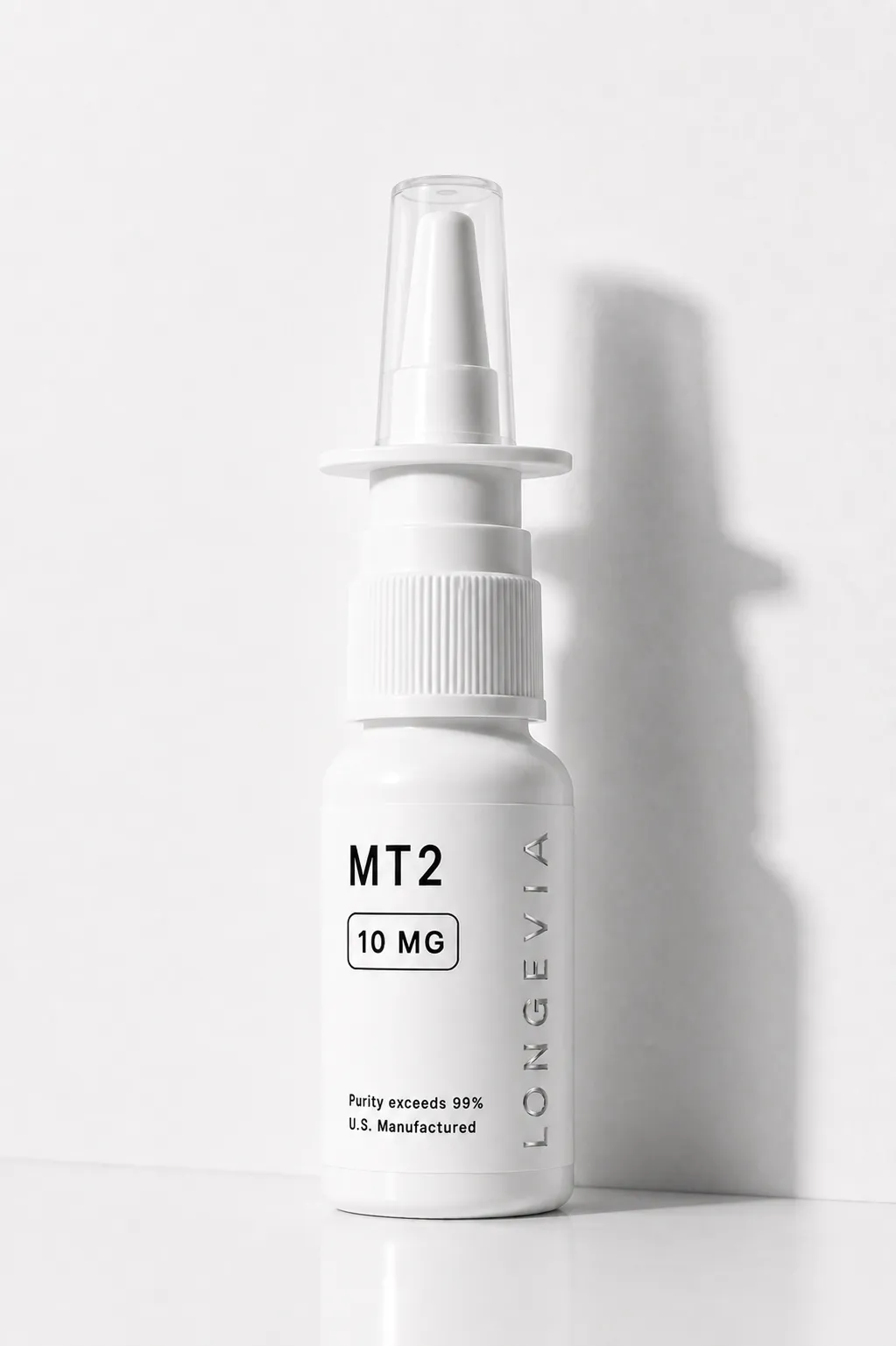
MT-2 Spray
Buy MT-2 Spray, a research-grade Melanotan II preparation in a convenient spray format for melanocortin receptor and pigmentation pathway research. COA-verified, 99%+ purity. Research use only.
MT-2 Spray
Buy MT-2 Spray, a research-grade Melanotan II preparation in a convenient spray format for melanocortin receptor and pigmentation pathway research. COA-verified, 99%+ purity. Research use only.
Melanotan II (MT-2) is one of the few research peptides where the delivery route opens a wider evidence gap than the compound itself. The published human pharmacology of MT-2 comes almost entirely from subcutaneous dosing studies, while the nasal spray format has never been characterised in a controlled human pharmacokinetic trial. That distinction matters for anyone designing a protocol, because a concentration figure calculated at reconstitution is not the same thing as a validated dose. This guide separates three things that routinely get blurred together: what the subcutaneous MT-2 literature actually established, what pharmaceutical science knows about intranasal peptide delivery in general, and what is informal convention with no controlled validation behind it. MT-2 Spray is supplied for research use only (RUO) and is not for human consumption.
No peer-reviewed human study has characterised intranasal Melanotan II dosing, pharmacokinetics, or bioavailability. Every published human MT-2 pharmacology study used subcutaneous injection, dosed on a milligram-per-kilogram basis rather than as a fixed microgram amount. Nasal spray concentrations in research settings are derived from reconstitution arithmetic — total peptide mass divided by diluent volume, multiplied by the device actuation volume — not from any validated dosing regimen.
Why Delivery Route Is the Central Variable for MT-2
Delivery route is the central variable for MT-2 because the compound's molecular weight sits directly at the threshold where nasal mucosal absorption becomes unreliable.
Melanotan II is a synthetic cyclic heptapeptide analogue of alpha-melanocyte-stimulating hormone (alpha-MSH), with the structure Ac-Nle4-Asp5-His6-D-Phe7-Arg8-Trp9-Lys10-NH2 and a molecular formula of C50H69N15O9. Its molecular weight is approximately 1,024 Da. The lactam bridge that closes the ring confers resistance to serum proteases and gives the molecule prolonged activity relative to linear alpha-MSH analogues, which is why it was described as superpotent in the original characterisation work.
That stability advantage is specific to the environment it was measured in. Serum protease resistance says nothing about the aminopeptidase and endopeptidase activity present in nasal mucosa, which is a different enzymatic environment with different substrate preferences. A peptide can be well protected in circulation and still be degraded rapidly at the mucosal surface before it ever reaches circulation.
The molecular weight figure is where the route problem becomes concrete. Reviews of nasal macromolecule delivery identify roughly 1,000 Da as the point above which passage through nasal mucosa becomes substantially impeded, and report that the nasal bioavailability of hydrophilic peptides and proteins is usually less than one percent. MT-2 sits just above that line. It is not a small molecule that crosses nasal epithelium at rates approaching intravenous administration; it is a hydrophilic macromolecule at the size where the barrier starts to dominate.
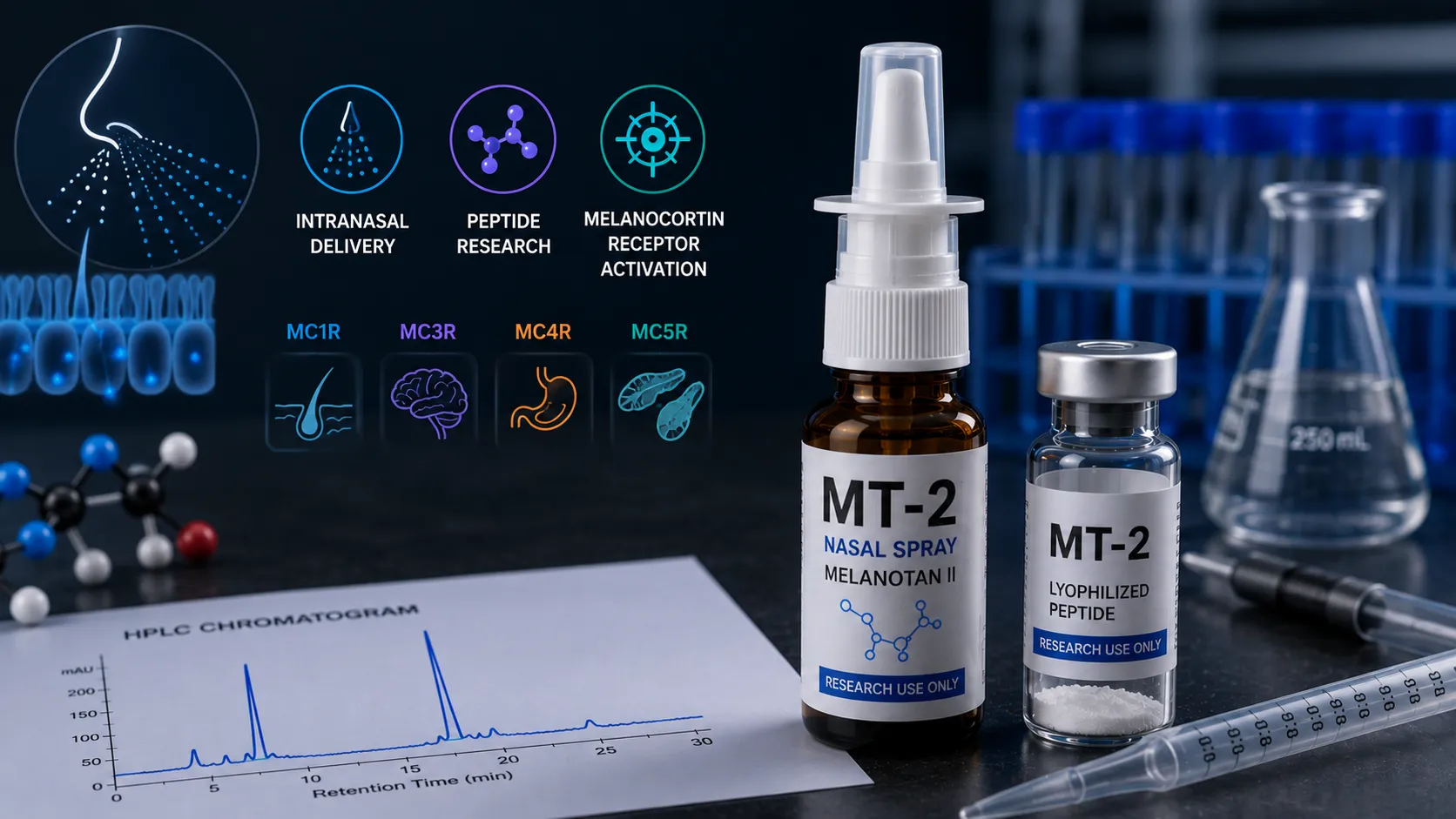
Receptor pharmacology adds a second reason route matters. MT-2 is non-selective across the melanocortin receptor family, binding MC1R through MC5R. MC1R activation drives eumelanin synthesis, MC3R and MC4R are central receptors involved in energy homeostasis and sexual response, and MC5R is associated with exocrine function. Because effects at these receptors depend on systemic exposure rather than local nasal tissue concentration, a route that delivers a small and variable fraction of the applied amount produces correspondingly variable pharmacology.
For the broader legal and regulatory context around Melanotan II, see the Melanotan II research status, legal questions and safety profile guide.
What the Published Human MT-2 Literature Actually Established
The published human MT-2 record rests on a small phase-I trial that used subcutaneous injection, not nasal administration.
Dorr and colleagues conducted a single-blind, alternating-day, placebo-controlled pilot study in three normal male volunteers, reported in Life Sciences in 1996. Subcutaneous injections of MT-II or saline were given daily, Monday through Friday, for two consecutive weeks. The starting dose was 0.01 mg/kg. Two subjects were escalated in 0.005 mg/kg increments to 0.03 mg/kg, and one subject to 0.025 mg/kg. At 0.03 mg/kg, one of two subjects developed Grade II somnolence and fatigue by WHO grading criteria.
Several features of that study constrain how far its numbers travel. The sample was three people. Dosing was weight-normalised in milligrams per kilogram, not administered as a fixed microgram quantity. Adverse effects reported in the early MT-2 human work included nausea, flushing, and spontaneous penile erections, with those effects functioning as the practical dose ceiling rather than any efficacy limit.
Most importantly, the route was subcutaneous throughout. A subcutaneous injection delivers essentially the full measured amount into a depot from which absorption is relatively complete and reproducible. Nothing in a subcutaneous dose-escalation study can be converted into an intranasal equivalent without a bioavailability factor, and no such factor has been measured for MT-2 by the nasal route.
This is the gap that most nasal spray discussion papers over. A source can cite Dorr accurately, quote a real milligram-per-kilogram figure from it, and still produce a completely unsupported nasal recommendation, because the citation supports the number and not the route conversion applied to it. The published literature supports statements about subcutaneous MT-2 in a three-person trial. It does not support statements about how much MT-2 reaches circulation from a nasal pump.
There is also no published human study establishing an intranasal MT-2 pharmacokinetic profile — no Cmax, no Tmax, no AUC, no absolute or relative bioavailability figure. Absence of data is a finding in its own right, and it should be stated plainly rather than filled in by inference.
What Intranasal Peptide Delivery Science Does Establish
Intranasal peptide delivery is well characterised as a general pharmaceutical problem, even though MT-2 specifically has not been studied by that route.
The nasal cavity comprises vestibular, respiratory, and olfactory regions, with the respiratory region accounting for most systemic absorption because of its vascularity and surface area. Three barriers limit peptide uptake there. Mucosal permeability declines sharply with molecular weight above roughly 1,000 Da. Peptidases in the nasal mucosa cleave both terminal and internal peptide bonds. Mucociliary clearance moves the mucus layer steadily toward the nasopharynx, so anything applied to the surface has a short residence window in which to be absorbed.
Volume is an additional hard constraint that has no equivalent in injection. The nasal cavity accepts roughly 0.025 to 0.25 mL per administration. Anything beyond that runs out anteriorly or drains posteriorly and is swallowed. Swallowed peptide is subject to gastric and intestinal proteolysis and contributes essentially nothing to systemic exposure.
Parameter | Subcutaneous route | Intranasal route |
|---|---|---|
Typical peptide bioavailability | High and relatively reproducible | Usually under 1% for hydrophilic peptides above 1,000 Da |
Amount delivered | Full measured volume enters the depot | A fraction of the applied volume; the remainder is cleared or swallowed |
Volume ceiling per administration | Set by formulation and site tolerance | Approximately 0.025 to 0.25 mL |
Principal loss mechanisms | Local proteolysis at the injection site | Mucosal peptidases, mucociliary clearance, anterior drip, posterior drainage |
Inter-subject variability | Moderate | High — affected by congestion, anatomy, device and technique |
Published human MT-2 data | Yes, phase-I dose escalation | None |
The formulation science literature responds to these barriers with permeation enhancers, mucoadhesive polymers, enzyme inhibitors and particulate carriers, precisely because unformulated aqueous peptide solutions perform poorly by this route. A plain peptide dissolved in bacteriostatic water and loaded into a generic pump incorporates none of those strategies. It is the baseline case the enhancement literature exists to improve upon, not a delivery system that has solved the problem.
The Closest Available Clinical Evidence: Intranasal Melanocortin Trials
The most relevant human intranasal melanocortin data comes not from MT-2 itself but from bremelanotide (PT-141), a melanocortin analogue derived from MT-2 that was formally tested in both intranasal and subcutaneous formulations by the same investigator group.
Diamond and colleagues evaluated intranasal PT-141 in a double-blind, placebo-controlled study in healthy males and in patients with mild-to-moderate erectile dysfunction, published in the International Journal of Impotence Research in 2004. Mean Cmax and AUC increased in a dose-dependent manner. Median Tmax was 0.50 hours and mean elimination half-life ranged from 1.85 to 2.09 hours. An erectile response significantly greater than placebo was observed at doses above 7 mg. Flushing and nausea were the most common adverse events.
Rosen and colleagues published the subcutaneous counterpart study in the same journal in the same year. By the subcutaneous route, a statistically significant response was observed at both 4 mg and 6 mg.
That contrast is the single most useful published data point for this topic. The same molecule, evaluated by the same group in the same year, required more than 7 mg intranasally to produce an effect that appeared at 4 to 6 mg subcutaneously. It is a direct, peer-reviewed demonstration that a cyclic melanocortin heptapeptide needs materially more material by the nasal route to achieve a comparable pharmacodynamic endpoint. Development subsequently moved away from the intranasal formulation, and the melanocortin agonist that ultimately reached regulatory approval is a subcutaneous product.
Two limits on that comparison need stating clearly. PT-141 is not MT-2 — it differs structurally and was deliberately engineered for reduced MC1R activity and a more central melanocortin profile, so its absolute figures do not transfer to MT-2 in either direction. And the endpoint measured was erectile response, not pigmentation, so nothing in that dataset speaks to MC1R-mediated effects by the nasal route.
What does transfer is direction and magnitude of the route penalty. When a closely related cyclic melanocortin heptapeptide was studied head to head across routes in controlled trials, intranasal delivery was the less efficient route by a clear margin. Any protocol assuming rough equivalence between nasal and subcutaneous amounts is assuming something the closest available evidence contradicts.
Where Microgram-Per-Spray Figures Actually Come From
Any specific microgram-per-spray figure for MT-2 originates from reconstitution arithmetic or informal community convention, not from a published clinical dosing study.
The arithmetic chain is straightforward and worth stating explicitly, because seeing it makes clear how much it assumes. Nominal peptide mass is divided by diluent volume to give a concentration. That concentration is multiplied by the device actuation volume to give a nominal amount per actuation. Every term in that calculation is a label value rather than a measurement, and the chain says nothing about absorption.
Four things break between the calculated figure and the amount that reaches circulation.
- Labelled peptide mass is gross mass, not net peptide content. Lyophilised peptides carry counterions and residual water, so net peptide content is routinely lower than the number on the vial and should be read from the lot-specific certificate of analysis rather than assumed.
- Actuation volume varies. Pump output depends on the device, priming state, fill level, orientation and actuation force, and a nominal specification is not a measured output for the specific unit in use.
- Nominal delivered is not absorbed. This is the largest term and the one most often silently set to 100 percent, when the general peptide literature places it below one percent for molecules of this size.
- Losses accumulate over the life of the device. Peptides adsorb to plastic and glass surfaces, and a nasal pump assembly presents a large surface area and a dead volume relative to the liquid it holds.
Three categories of information get blended together in nasal spray discussions of Melanotan II: controlled subcutaneous human data, general intranasal peptide pharmaceutics, and uncontrolled community convention. The first two are peer-reviewed, and neither describes an intranasal MT-2 dosing regimen. Any figure presented as a standard or typical nasal dose for MT-2 has no controlled human trial behind it, regardless of how precisely it is expressed or how consistently it is repeated across sources.
Precision is not evidence. A figure quoted to the microgram carries an implication of measurement that the underlying derivation does not support, and repetition across many sources does not convert a convention into a finding. For the general arithmetic behind concentration and dilution calculations, see the peptide dosage calculation guide.
Reconstitution and Concentration Reference
Reconstitution concentration is the ratio of lyophilised peptide mass to diluent volume, and it is the only figure in a nasal spray workflow that can be calculated with confidence.
Lyophilised peptide | Diluent volume | Resulting concentration | Nominal peptide per 0.1 mL actuation |
|---|---|---|---|
10 mg | 1.0 mL | 10 mg/mL | 1,000 mcg |
10 mg | 2.0 mL | 5 mg/mL | 500 mcg |
10 mg | 5.0 mL | 2 mg/mL | 200 mcg |
10 mg | 10.0 mL | 1 mg/mL | 100 mcg |
5 mg | 5.0 mL | 1 mg/mL | 100 mcg |
5 mg | 10.0 mL | 0.5 mg/mL | 50 mcg |
Every value in the right-hand column is a nominal figure describing what is in the liquid, not a delivered dose and not an absorbed amount. The table scales linearly, so any vial size and diluent volume can be resolved the same way: concentration equals mass divided by volume, and per-actuation content equals concentration multiplied by actuation volume in millilitres.
Technique affects whether the calculated concentration is the actual one. Diluent should be directed down the inside wall of the vial rather than as a stream onto the lyophilised cake, which reduces mechanical stress on the peptide. The vial should be swirled gently or left to dissolve rather than shaken, since agitation promotes aggregation and denaturation at the air-liquid interface. Full dissolution should be confirmed visually before any transfer, because undissolved material means the solution drawn off is less concentrated than calculated.
Actuation volume can be measured rather than assumed, and doing so removes one of the four uncertainty terms above. Weigh the filled device, prime it, deliver a counted number of actuations into waste, and weigh it again. Divide the mass difference by the number of actuations. For dilute aqueous solutions, density is close to 1 g/mL, so the mass in grams approximates the volume in millilitres. Repeating this at the start and end of a device's working life also quantifies output drift, which is not a constant.
Storage, Stability and Handling
Lyophilised MT-2 is substantially more stable than reconstituted MT-2, and the two forms have sharply different storage requirements.
In lyophilised form, the peptide should be kept cold, dark, sealed and dry. Long-term storage is conventionally at -20 degrees Celsius or below, with the vial protected from moisture ingress, since the dry state is what confers stability and any absorbed water undermines it. Brief excursions to ambient temperature during shipping are generally tolerated by lyophilised peptide in a way that reconstituted solution is not.
Once diluent is added, the stability clock starts. Reconstituted solution should be refrigerated at 2 to 8 degrees Celsius and protected from light. The tryptophan residue in the MT-2 sequence is photosensitive, which makes amber or opaque containment a functional requirement rather than a cosmetic preference. Working stock should be dated at reconstitution so that time in solution is a recorded variable rather than an estimate.
Diluent choice determines the usable window. Bacteriostatic water contains benzyl alcohol as a preservative and supports repeated access to the same container over a longer period. Sterile water contains no preservative and is appropriate only for single use or immediate aliquoting. Freeze-thaw cycling degrades peptides in solution, so material intended for longer storage should be aliquoted into single-use volumes before freezing rather than repeatedly frozen and thawed as one stock.
A nasal pump assembly introduces a variable that a sealed vial does not: significant dead volume and a large plastic surface area relative to the liquid it holds. Both reduce the peptide actually available for delivery across the working life of the device, and neither is captured by the concentration calculated at reconstitution.
Material verification closes the loop on all of this. A lot-specific certificate of analysis should confirm identity by mass spectrometry, purity by HPLC area percent, and net peptide content as distinct from gross vial mass. Purity and net peptide content are different parameters, and a product can report high purity while delivering less peptide per vial than the label implies. An observational study of unregulated, online-available alpha-MSH analogues published in the Journal of the American Academy of Dermatology documented how freely these compounds are marketed without such verification, which is a direct argument for treating lot documentation as part of the protocol rather than as sales collateral.
Documenting an Intranasal Peptide Protocol
A defensible intranasal peptide protocol treats the delivery device and administration technique as primary experimental variables rather than incidental details.
This follows directly from the pharmaceutics. When absorbed fraction is small, variable, and sensitive to technique, the administration procedure carries as much influence over exposure as the nominal concentration does. Two protocols with identical calculated concentrations can differ several-fold in delivered amount purely through device and technique differences, which makes any result uninterpretable if those parameters went unrecorded.
A protocol record adequate for replication captures the following:
- Device make, model, and manufacturer-specified actuation volume
- Measured actuation volume for the specific unit, determined gravimetrically
- Priming procedure and number of priming actuations before first use
- Actuations per administration and their distribution between nostrils
- Head position, breathing instruction, and interval between successive actuations
- Peptide lot number with a reference to the corresponding certificate of analysis
- Diluent type, diluent volume, and reconstitution date
- Storage temperature, light exclusion method, and elapsed days in solution at each use
Analytical verification is what converts that record from documentation into evidence. If a study depends on the amount delivered, the residual solution can be assayed at the end of a device's working life and compared against the calculated starting concentration, which quantifies cumulative adsorptive and dead-volume losses directly rather than leaving them as an unbounded error term.
Environmental conditions belong in the record as well. Nasal mucosal state varies with ambient humidity, temperature, congestion and any recent nasal irrigation, and each of those shifts the clearance rate and residence window that govern absorption. Capturing them costs nothing at the time of administration and is the only way to distinguish a genuine treatment effect from a difference in delivery conditions between sessions.
Route should also be recorded as an explicit study variable and reported as such in any write-up. Given that no intranasal MT-2 pharmacokinetic data exists, an intranasal protocol cannot be described as following established methodology. It should be described accurately: as an uncharacterised route for this compound, in which delivered and absorbed amounts are unknown and the nominal concentration is the only quantity established with confidence.
Documented Safety Signals in the Melanotan Literature
The Melanotan safety record consists largely of case reports and review synthesis rather than controlled trials, and the reported signals are both dermatological and systemic.
A 2017 review in the International Journal of Dermatology examined the risks of unregulated use of alpha-MSH analogues and found that an increasing number of case reports associate melanotan I and II use with cutaneous complications, particularly melanocytic changes in existing moles and newly emerging dysplastic naevi. That review also synthesises non-dermatological reports, including sympathomimetic toxicity with rhabdomyolysis and renal dysfunction following a large subcutaneous dose, and posterior reversible encephalopathy syndrome.
A separate case report published in Dermatology in 2014 described melanoma associated with the use of melanotan-II. The mechanistic question that case raises has not been resolved: case reports establish that a signal exists and has recurred across independent reports over more than a decade, but they cannot distinguish direct causation from preferential activation of pre-existing dysplastic melanocytes, and no controlled prospective study has settled it.
The controlled human data adds its own tolerability picture. The 1996 phase-I trial documented nausea, flushing and spontaneous erections as the effects that limited dose escalation, with somnolence and fatigue appearing at the top of the escalation range.
None of this literature characterises an intranasal safety profile. Melanocortin receptor effects are mediated systemically, so in principle the receptor-level consequences of a given plasma concentration do not depend on how that concentration was produced. But the exposure profile itself — peak concentration, time to peak, and total exposure — does depend on route, and the subcutaneous adverse-event record cannot be assumed to describe intranasal exposure in either direction. It is not evidence that the nasal route is safer, and it is not evidence that it is more hazardous. It is evidence about a different route.
That asymmetry is the practical summary of this entire topic. For MT-2 by the nasal route, the mechanism is known, the receptor pharmacology is known, the general delivery barriers are known, and the specific dose-exposure relationship is not. MT-2 Spray is supplied for research use only, is not for human consumption, and carries no therapeutic or diagnostic claim. For the full legal and regulatory picture, see the Melanotan II research status, legal questions and safety profile guide.
Frequently Asked Questions
- Dorr RT, Lines R, Levine N, Brooks C, Xiang L, Hruby VJ, Hadley ME. Evaluation of melanotan-II, a superpotent cyclic melanotropic peptide in a pilot phase-I clinical study. Life Sciences. 1996;58(20):1777-1784.
- Diamond LE, Earle DC, Rosen RC, Willett MS, Molinoff PB. Double-blind, placebo-controlled evaluation of the safety, pharmacokinetic properties and pharmacodynamic effects of intranasal PT-141, a melanocortin receptor agonist, in healthy males and patients with mild-to-moderate erectile dysfunction. International Journal of Impotence Research. 2004;16(1):51-59.
- Rosen RC, Diamond LE, Earle DC, Shadiack AM, Molinoff PB. Evaluation of the safety, pharmacokinetics and pharmacodynamic effects of subcutaneously administered PT-141, a melanocortin receptor agonist, in healthy male subjects and in patients with an inadequate response to Viagra. International Journal of Impotence Research. 2004;16(2):135-142.
- Ozsoy Y, Gungor S, Cevher E. Nasal delivery of high molecular weight drugs. Molecules. 2009;14(9):3754-3779.
- Habbema L, Halk AB, Neumann M, Bergman W. Risks of unregulated use of alpha-melanocyte-stimulating hormone analogues: a review. International Journal of Dermatology. 2017;56(10):975-980.
- Hjuler KF, Lorentzen HF. Melanoma associated with the use of melanotan-II. Dermatology. 2014;228(1):34-36.
- Hadeler E, et al. Evaluation of synthetic alpha-melanocyte-stimulating hormone analogs: an observational study of unregulated, online-available drugs. Journal of the American Academy of Dermatology. 2022.