- 1 mg equals 1,000 mcg; always convert mcg to mg before calculating doses to avoid 10-fold errors.
- Concentration (mg/mL) = Mass of peptide (mg) / Volume of solvent (mL); this is the foundation of all dosage calculations.
- Volume to draw (mL) = Desired dose (mg) / Concentration (mg/mL); apply this formula for any peptide and any concentration.
- U-100 insulin syringes: 100 units = 1 mL, so multiply mL by 100 to get insulin units.
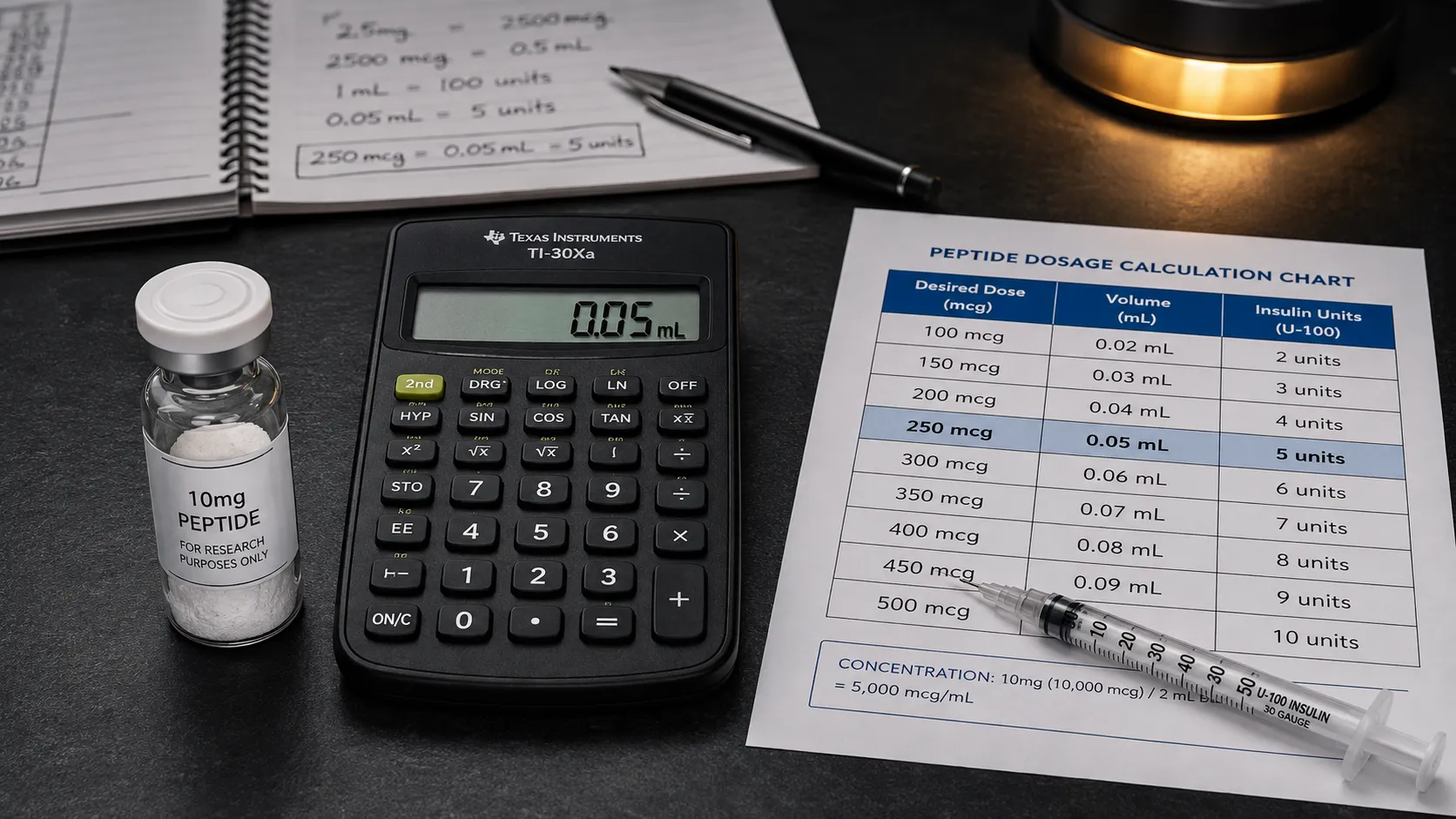
- For a 10 mg vial reconstituted with 2 mL (5 mg/mL), 250 mcg equals 0.05 mL or 5 insulin units.
- Molarity calculations require molecular weight: Moles = Mass (g) / MW (g/mol).
- Use C₁V₁ = C₂V₂ for dilution calculations when preparing working solutions from stock.
- Common mistakes include confusing mg/mcg, ignoring vial size, and using wrong syringe calibrations.
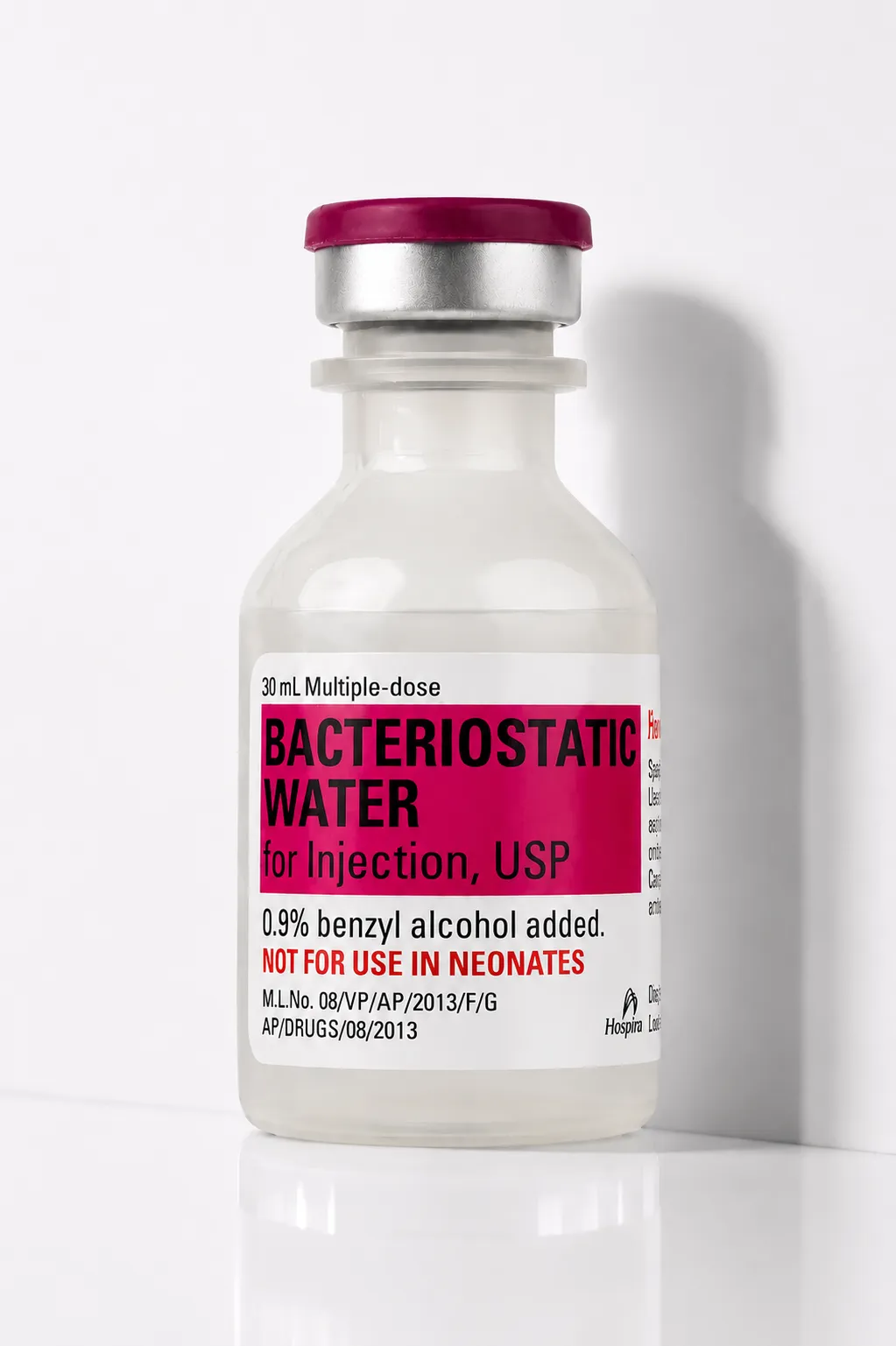
Reconstitution Solution
Buy Reconstitution Solution for peptide reconstitution. 0.9% benzyl alcohol preserved, sterile filtered. Essential laboratory supply for research use only.
Reconstitution Solution
Buy Reconstitution Solution for peptide reconstitution. 0.9% benzyl alcohol preserved, sterile filtered. Essential laboratory supply for research use only.
Accurate dosage calculations are fundamental to rigorous peptide research. Whether you're preparing a 100 mcg subcutaneous injection or formulating a 10 mM cell culture solution, understanding the relationships between milligrams (mg), micrograms (mcg), and milliliters (mL) ensures reproducible results and prevents costly errors.
This comprehensive guide walks researchers through peptide dosage calculations from first principles. You'll learn conversion formulas, insulin syringe unit mathematics, and practical examples that translate directly to laboratory workflows. By the end, you'll confidently calculate any peptide dose regardless of vial size or concentration.
Understanding Mass and Volume Units
Before diving into calculations, it's essential to distinguish between mass (amount of substance) and volume (liquid measurement). Confusion between these categories is the most common source of dosing errors.
Mass Units: mg and mcg
Peptide quantities are measured in mass units:
- Milligram (mg): One-thousandth of a gram (1 mg = 0.001 g)
- Microgram (mcg or μg): One-millionth of a gram (1 mcg = 0.000001 g)
The critical conversion:
1 mg = 1,000 mcg
This means:
- 0.1 mg = 100 mcg
- 0.25 mg = 250 mcg
- 0.5 mg = 500 mcg
- 1 mg = 1,000 mcg
- 2 mg = 2,000 mcg
- 5 mg = 5,000 mcg
- 10 mg = 10,000 mcg
Always verify whether your protocol specifies doses in mg or mcg. A 10-fold error (confusing mg for mcg) can invalidate experiments or waste valuable peptide.
Volume Units: mL
Liquid volumes are measured in milliliters (mL) or microliters (μL):
- Milliliter (mL): One-thousandth of a liter (1 mL = 0.001 L)
- Microliter (μL): One-millionth of a liter (1 μL = 0.000001 L)
The critical conversion:
1 mL = 1,000 μL
In peptide research, volumes typically range from 0.05 mL (50 μL) to 2 mL depending on administration route and concentration.
Concentration: The Bridge Between Mass and Volume
Concentration expresses how much peptide (mass) is dissolved in a given volume of solvent. The standard unit for peptide solutions is mg/mL.
Concentration (mg/mL) = Mass of Peptide (mg) / Volume of Solvent (mL)
For example:
- 10 mg peptide in 1 mL water = 10 mg/mL concentration
- 10 mg peptide in 2 mL water = 5 mg/mL concentration
- 10 mg peptide in 0.5 mL water = 20 mg/mL concentration
Understanding concentration is the key to all dosage calculations.
The Fundamental Dosage Formula
Once you know the concentration of your reconstituted peptide, calculating the volume needed for any dose is straightforward.
Basic Formula
Volume to Draw (mL) = Desired Dose (mg) / Concentration (mg/mL)
This formula works for any peptide, any concentration, and any desired dose.
Step-by-Step Example
Scenario: You have a 10 mg vial of BPC-157 reconstituted with 2 mL of bacteriostatic water. Your protocol requires a 250 mcg dose.
Step 1: Calculate concentration
Concentration = 10 mg / 2 mL = 5 mg/mL
Step 2: Convert desired dose to mg
250 mcg = 0.25 mg
Step 3: Apply the formula
Volume = 0.25 mg / 5 mg/mL = 0.05 mL
Step 4: Convert to insulin syringe units
Insulin syringes are marked in "units" where 100 units = 1 mL.
0.05 mL × 100 units/mL = 5 units
Result: Draw 5 units on an insulin syringe (U-100) to deliver 250 mcg of BPC-157.
Always double-check your calculations before drawing peptide. A simple arithmetic error can result in 10-fold overdosing or underdosing.
Insulin Syringe Unit Conversions
Most peptide researchers use U-100 insulin syringes, which are calibrated so that 100 units = 1 mL. Understanding this relationship simplifies dosing.
U-100 Insulin Syringe Basics
- 100 units = 1 mL
- 50 units = 0.5 mL
- 10 units = 0.1 mL
- 1 unit = 0.01 mL
To convert mL to insulin units:
Insulin Units = Volume (mL) × 100
To convert insulin units to mL:
Volume (mL) = Insulin Units / 100
Practical Conversion Table
For a peptide reconstituted at 5 mg/mL concentration (10 mg in 2 mL):
Desired Dose | Dose in mg | Volume (mL) | Insulin Units (U-100) |
|---|---|---|---|
100 mcg | 0.1 mg | 0.02 mL | 2 units |
150 mcg | 0.15 mg | 0.03 mL | 3 units |
200 mcg | 0.2 mg | 0.04 mL | 4 units |
250 mcg | 0.25 mg | 0.05 mL | 5 units |
300 mcg | 0.3 mg | 0.06 mL | 6 units |
500 mcg | 0.5 mg | 0.1 mL | 10 units |
1 mg | 1.0 mg | 0.2 mL | 20 units |
2 mg | 2.0 mg | 0.4 mL | 40 units |
2.5 mg | 2.5 mg | 0.5 mL | 50 units |
5 mg | 5.0 mg | 1.0 mL | 100 units |
This table is one of the most common reference points for peptide researchers. Memorizing the 5 mg/mL row accelerates daily workflows.
Different Concentrations, Different Units
If you reconstitute at a different concentration, the insulin units change proportionally.
For 10 mg/mL concentration (10 mg in 1 mL):
Desired Dose | Volume (mL) | Insulin Units |
|---|---|---|
100 mcg (0.1 mg) | 0.01 mL | 1 unit |
250 mcg (0.25 mg) | 0.025 mL | 2.5 units |
500 mcg (0.5 mg) | 0.05 mL | 5 units |
1 mg | 0.1 mL | 10 units |
For 2.5 mg/mL concentration (10 mg in 4 mL):
Desired Dose | Volume (mL) | Insulin Units |
|---|---|---|
100 mcg (0.1 mg) | 0.04 mL | 4 units |
250 mcg (0.25 mg) | 0.1 mL | 10 units |
500 mcg (0.5 mg) | 0.2 mL | 20 units |
1 mg | 0.4 mL | 40 units |
Lower concentrations (e.g., 2.5 mg/mL) make it easier to measure small doses accurately but require larger injection volumes. Higher concentrations (e.g., 10 mg/mL) minimize injection volume but require more precise measurement for low doses.
Common Reconstitution Scenarios
Most peptide vials come in standard sizes (2 mg, 5 mg, 10 mg). The following scenarios cover the majority of research protocols.
Scenario 1: 10 mg Vial with 2 mL Bacteriostatic Water
Concentration: 5 mg/mL
This is the most common reconstitution protocol for general research.
Desired Dose | Volume (mL) | Insulin Units |
|---|---|---|
100 mcg | 0.02 mL | 2 units |
200 mcg | 0.04 mL | 4 units |
300 mcg | 0.06 mL | 6 units |
500 mcg | 0.1 mL | 10 units |
1 mg | 0.2 mL | 20 units |
2 mg | 0.4 mL | 40 units |
5 mg | 1.0 mL | 100 units |
Scenario 2: 10 mg Vial with 1 mL Bacteriostatic Water
Concentration: 10 mg/mL
Use this for peptides where you want to minimize injection volume.
Desired Dose | Volume (mL) | Insulin Units |
|---|---|---|
100 mcg | 0.01 mL | 1 unit |
250 mcg | 0.025 mL | 2.5 units |
500 mcg | 0.05 mL | 5 units |
1 mg | 0.1 mL | 10 units |
2 mg | 0.2 mL | 20 units |
5 mg | 0.5 mL | 50 units |
Scenario 3: 5 mg Vial with 1 mL Bacteriostatic Water
Concentration: 5 mg/mL
Same concentration as Scenario 1, just smaller vial size.
Desired Dose | Volume (mL) | Insulin Units |
|---|---|---|
100 mcg | 0.02 mL | 2 units |
250 mcg | 0.05 mL | 5 units |
500 mcg | 0.1 mL | 10 units |
1 mg | 0.2 mL | 20 units |
2.5 mg | 0.5 mL | 50 units |
Scenario 4: 2 mg Vial with 1 mL Bacteriostatic Water
Concentration: 2 mg/mL
Common for potent peptides requiring lower doses.
Desired Dose | Volume (mL) | Insulin Units |
|---|---|---|
50 mcg | 0.025 mL | 2.5 units |
100 mcg | 0.05 mL | 5 units |
200 mcg | 0.1 mL | 10 units |
500 mcg | 0.25 mL | 25 units |
1 mg | 0.5 mL | 50 units |
Advanced Calculations: Molarity and Cell Culture
For in vitro research, you'll often need to prepare solutions at specific molar concentrations (mM, μM).
Molecular Weight and Moles
The number of moles in a given mass depends on the peptide's molecular weight (MW), expressed in g/mol.
Moles = Mass (g) / Molecular Weight (g/mol)
For example, BPC-157 has a molecular weight of approximately 1,419.6 g/mol.
10 mg BPC-157 = 0.01 g
Moles = 0.01 g / 1,419.6 g/mol = 0.000007045 mol = 7.045 μmol
Preparing Molar Solutions
To prepare a solution at a specific molarity:
Volume (L) = Moles / Desired Molarity (mol/L)
Example: You want to prepare a 10 mM (0.01 M) solution of BPC-157 using 10 mg of peptide.
Moles = 0.01 g / 1,419.6 g/mol = 7.045 μmol = 0.000007045 mol
Volume = 0.000007045 mol / 0.01 mol/L = 0.0007045 L = 0.7045 mL
Result: Dissolve 10 mg BPC-157 in 0.7045 mL (704.5 μL) to achieve a 10 mM solution.
Dilution Calculations
When diluting a stock solution to a lower concentration:
C₁V₁ = C₂V₂
Where:
- C₁ = Initial concentration
- V₁ = Volume of stock to use
- C₂ = Final concentration
- V₂ = Final volume
Example: You have a 10 mM stock solution and need 1 mL of 1 mM working solution.
C₁ = 10 mM C₂ = 1 mM V₂ = 1 mL
V₁ = (C₂ × V₂) / C₁ = (1 mM × 1 mL) / 10 mM = 0.1 mL
Result: Mix 0.1 mL (100 μL) of 10 mM stock with 0.9 mL (900 μL) of solvent to obtain 1 mL of 1 mM solution.
For cell culture work, prepare concentrated stock solutions (e.g., 10 mM) and dilute to working concentrations (e.g., 1–100 μM) immediately before use to minimize degradation.
Common Calculation Mistakes to Avoid
Even experienced researchers make calculation errors. Watch for these common pitfalls.
Mistake 1: Confusing mg and mcg
Wrong: Protocol says 250 mcg, you calculate for 250 mg (1,000-fold overdose).
Prevention: Always convert mcg to mg before calculating (divide by 1,000).
Mistake 2: Forgetting to Account for Vial Size
Wrong: Assuming all vials are 10 mg when some are 5 mg or 2 mg.
Prevention: Verify vial size on the label and Certificate of Analysis before reconstitution.
Mistake 3: Using the Wrong Syringe Calibration
Wrong: Using U-40 syringe calculations with U-100 syringes (or vice versa).
Prevention: Confirm syringe type. U-100 is standard for peptide research (100 units = 1 mL).
Mistake 4: Rounding Errors in Small Doses
Wrong: Rounding 2.5 units to 3 units for a 250 mcg dose.
Prevention: Use insulin syringes with half-unit markings for doses under 10 units, or reconstitute at a concentration that yields whole-unit doses.
Mistake 5: Not Re-Checking After Reconstitution
Wrong: Assuming concentration without recalculating after adding solvent.
Prevention: Always recalculate concentration after reconstitution, even if you've used the same protocol before.
Practical Tools and Resources
Quick Reference Formula Sheet
Keep this handy in your lab notebook:
- Concentration (mg/mL) = Mass (mg) / Volume (mL)
- Volume to Draw (mL) = Desired Dose (mg) / Concentration (mg/mL)
- Insulin Units = Volume (mL) × 100
- 1 mg = 1,000 mcg
- C₁V₁ = C₂V₂ (for dilutions)
Digital Calculators
Several online peptide dosage calculators automate these formulas. However, always verify calculator outputs manually before administering doses.
Printable Dosage Charts
Create custom charts for your most-used peptides and concentrations. Laminate them and keep them at your reconstitution workstation.
Conclusion
Peptide dosage calculations are straightforward once you understand the relationships between mg, mcg, and mL. The fundamental formula (Volume = Dose / Concentration) applies universally, whether you're preparing subcutaneous injections or cell culture media.
By mastering these calculations, you ensure reproducible results, minimize waste, and maintain rigorous experimental standards. Keep reference charts accessible, double-check all calculations, and never hesitate to verify your math before drawing peptide solutions.
Accurate dosing is not just about precision—it's about scientific integrity. Take the time to get it right every time.
Frequently Asked Questions
- Peptide Dosage Calculation Guide. PeptideMind Research, 2026. https://peptidemind.com/dosage-calculations
- Reconstitution Mathematics for Research Peptides. SeekPeptides, 2026. https://www.seekpeptides.com/blog/peptide-solutions
- USP General Chapter <797>: Pharmaceutical Compounding—Sterile Preparations. United States Pharmacopeia, 2025.
- Insulin Syringe Calibration Standards. National Institute of Standards and Technology, 2024.