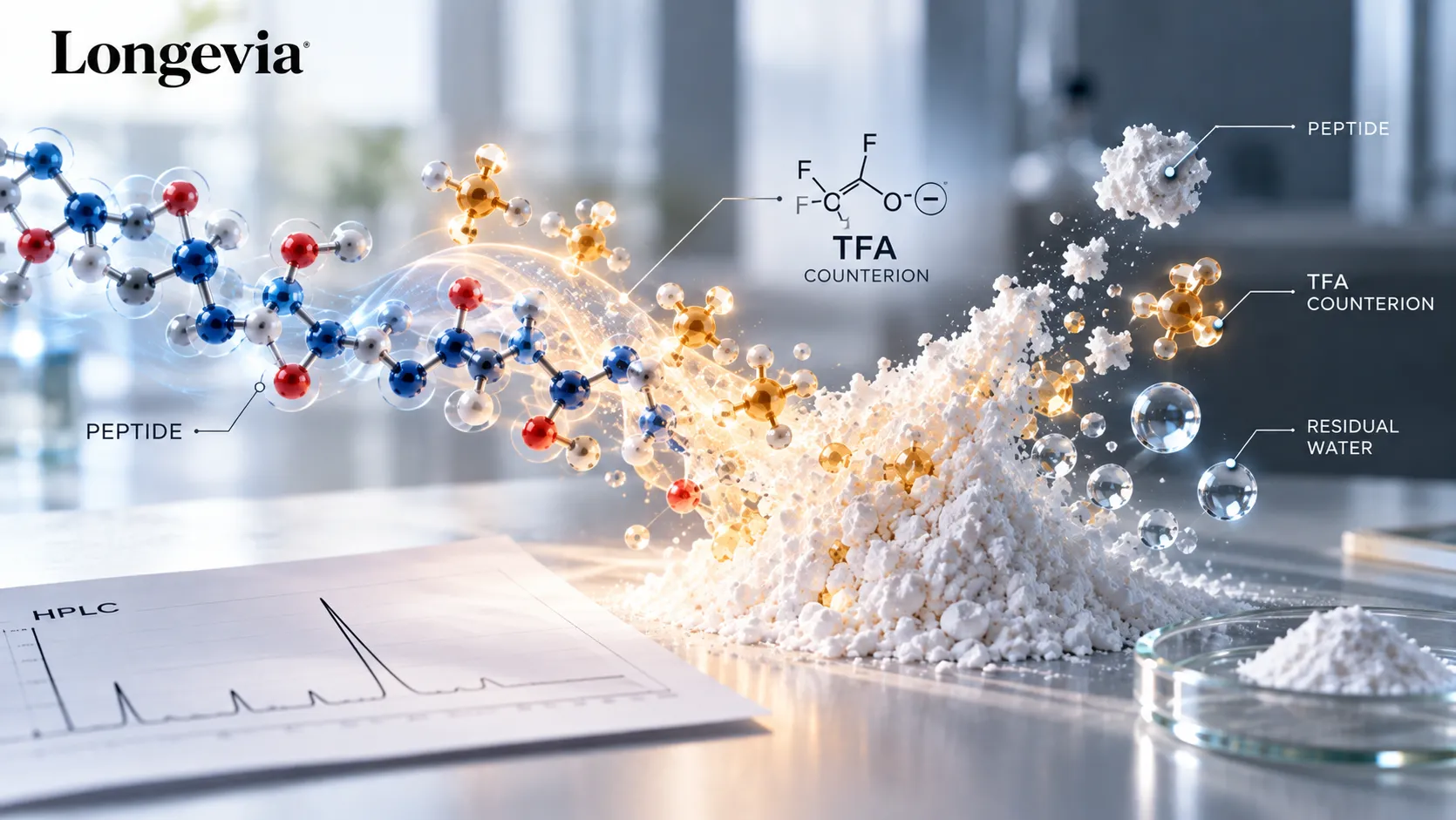
- A synthetic peptide powder is a salt, made of peptide plus counterion plus residual water.
- TFA enters twice, at resin cleavage in Fmoc synthesis and again as the ion-pairing acid in reversed-phase HPLC.
- Trifluoroacetate weighs about 113 g/mol, so it adds real mass to the labeled weight of a vial.
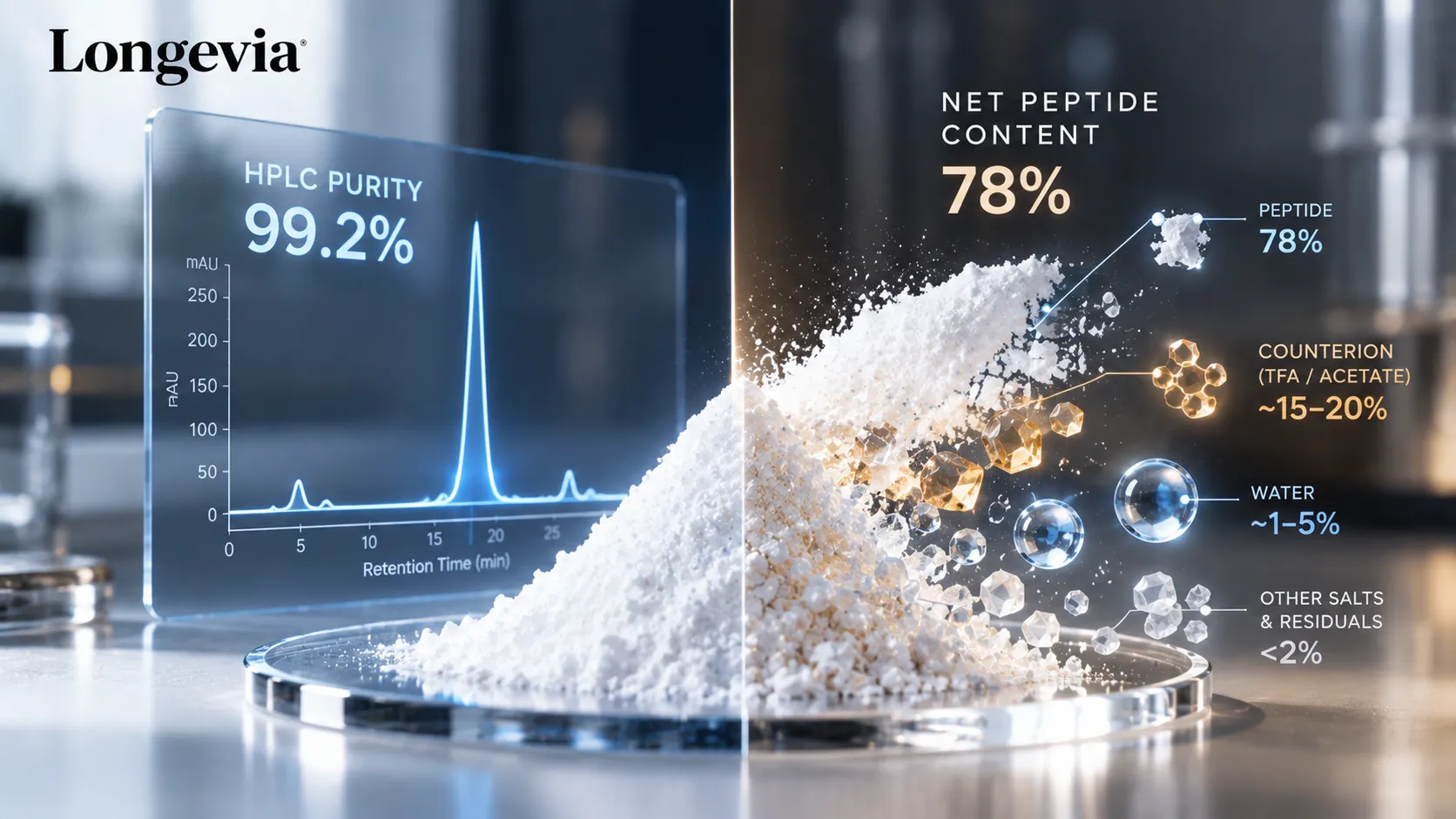
- Net peptide content and HPLC purity answer different questions and can differ widely for the same lot.
- Cell-culture studies report effects of trifluoroacetate on proliferation that vary by cell type and concentration.
- Counterion exchange to chloride or acetate is a process step with its own trade-offs and is rarely complete.
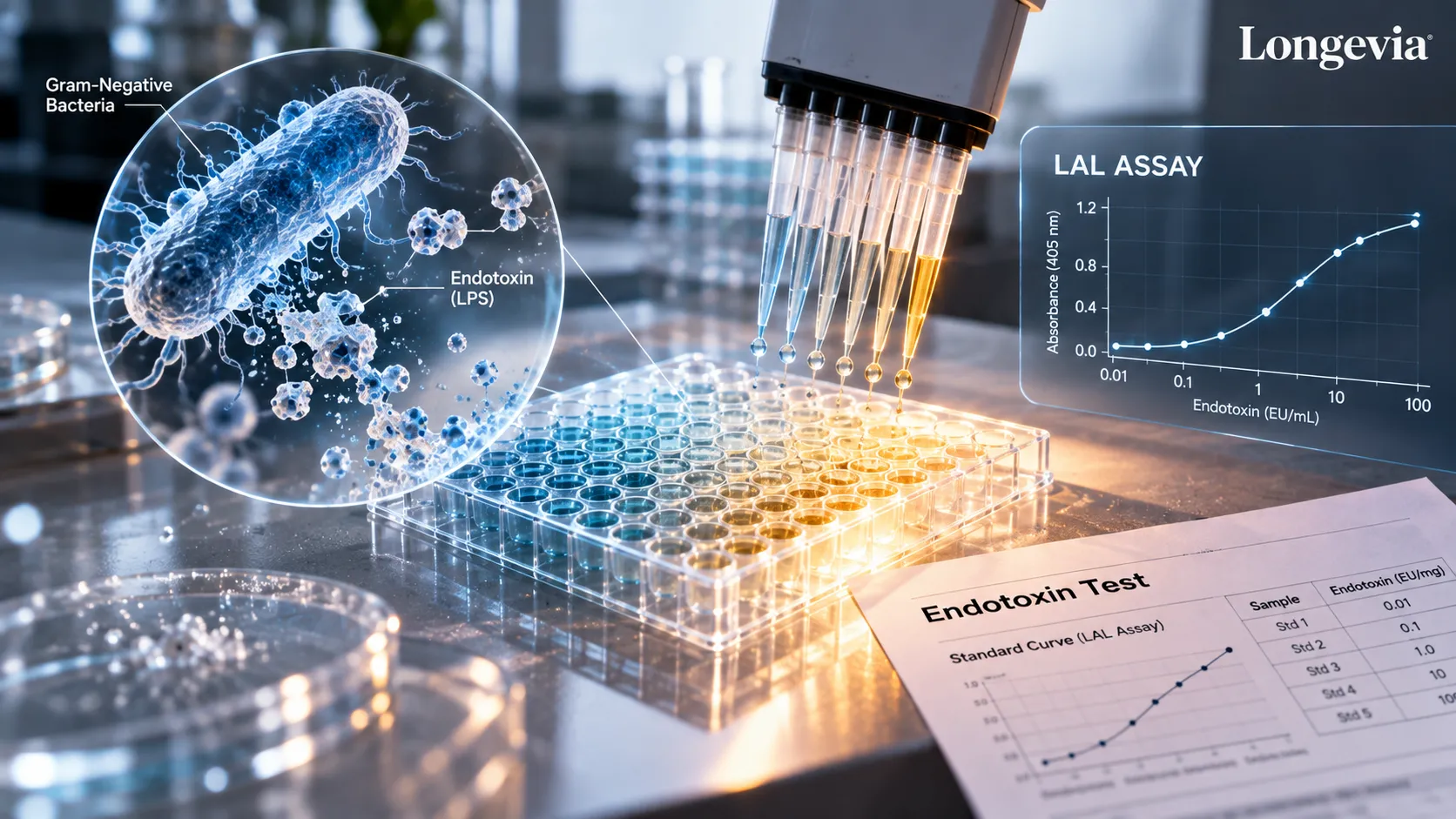
- Karl Fischer titration measures water, while ion chromatography, 19F NMR, HPLC-ELSD and FT-IR measure trifluoroacetate.
- A missing counterion or water figure on a COA means not reported, not zero.
A synthetic peptide picks up trifluoroacetic acid twice before it reaches a vial. Once when the finished chain is cut off the resin. Again when the crude material is purified by reversed-phase HPLC. Both steps use the same acid, and some of it stays behind.
That leftover acid is what "TFA salt" means on a label. It is also why TFA in peptides turns up on data sheets and certificates of analysis. It is not an impurity in the ordinary sense. It is the counterion, the negative partner that balances the peptide's positive charges.
Below you will find where the acid comes from and how much mass it adds. You will also find what published cell work reports, how much water sits alongside it, and which COA fields answer the question for a given lot.
Quick answer. TFA is trifluoroacetic acid. It cleaves the peptide from the resin, then acts as the ion-pairing agent in reversed-phase HPLC. Most synthetic peptides therefore end up as TFA salts. The counterion adds real mass to the powder, and in some cell-based work it is a variable worth controlling.
What is TFA and where does it come from?
Trifluoroacetic acid is a strong organic acid, acetic acid with three fluorines in place of the methyl hydrogens. It does two jobs in peptide production. Both of them leave traces in the final powder.
Cleavage comes first. Fmoc solid-phase synthesis builds the chain on a resin bead, with acid-labile protection on the side chains. A concentrated TFA cocktail cuts the finished chain free and strips those protecting groups in the same step.
Purification comes second. Crude peptide runs on a reversed-phase column, usually C18 silica, with water and acetonitrile. An acid is added to hold the pH low and to pair with the peptide's charges. TFA at 0.1% by volume is the routine choice, alongside acetic, formic, phosphoric and hydrochloric acids at the same level.
Why does the peptide keep it? At low pH the basic groups are protonated and carry positive charge. The N-terminal amino group counts, and so do the side chains of lysine, arginine and histidine. Each positive charge needs a negative partner, and here that partner is trifluoroacetate.
The acid ends up in the dried cake in two different ways. Part of it is bound to those basic sites. Part is simply trapped in the lyophilizate as leftover free acid. Both are weighed when the vial is filled.
One reason TFA became standard is that it leaves easily. Freeze-drying removes the excess after purification, so no separate desalting step is needed. Phosphoric acid does not behave that way. Convenience during manufacture becomes a line on the COA later. Other process residues, including deletion sequences and solvents, are a separate question covered in our guide to synthesis impurities and LC-MS.
Why is a peptide powder a salt, not just a peptide?
The solid in the vial is not pure peptide. It is peptide plus counterion plus residual water, and a balance weighs all three alike.
A counterion is the oppositely charged ion that pairs with a charged molecule so the solid stays electrically neutral. Table salt is the everyday case, sodium paired with chloride. A peptide with three protonated sites needs roughly three negative partners to do the same job.
Measurement supports that picture. A 2025 analytical study counted trifluoroacetate anions per peptide by 19F NMR. The count tracked the number of positively charged residues in each sequence. Sequences carrying more positive charge held more counterion.
This is why net peptide content exists as a separate figure from purity. HPLC purity asks what share of the peptide-related material is the target sequence. Net peptide content asks what share of the total powder weight is peptide at all. A lot can read very high on the first and much lower on the second. Our comparison of net peptide content and HPLC purity sets out the difference.
Quality guidance for synthetic peptides treats the question as mass balance. Peptide content, counterion content, water and residual solvents should account for close to 100% of the dry weight. Anything absent from that sum is unexplained mass.
The consequence is arithmetic rather than chemistry. Weigh out powder, assume the whole weight is peptide, and you overestimate what went into the tube. How badly depends on the peptide salt form and the moisture, not on how clean the chromatogram looks.
How much mass does TFA add?
Trifluoroacetate weighs about 113 g/mol. Set against a peptide of 1,000 g/mol, one bound counterion is already about a tenth of the powder.
Laid out as arithmetic, it looks like this. These are illustrative numbers, not any specific product.
TFA anions bound | Added mass (about) | Peptide fraction before water | With 5% water (about) |
|---|---|---|---|
1 | 113 | 89.8% | 85% |
2 | 226 | 81.6% | 77% |
3 | 339 | 74.7% | 71% |
Real peptides rarely bind exactly one TFA per basic site. Read the table as a sense of scale, not as a prediction for any lot.
Measured values vary from lot to lot. That is why labs report counterion content by a method such as ion chromatography instead of assuming one figure for every peptide.
Two factors move the figure. Sequences with more basic residues hold more counterion. Higher residual moisture dilutes the peptide fraction further. A heavily basic peptide in a damp lyophilizate can sit well below the table above.
Note what none of this changes. The purity figure stays where it was. A chromatogram still shows one dominant peak, because the counterion is not a peptide-related species and is not counted in peak-area purity. Mass and purity answer different questions, and only one of them usually appears on a label.
What is the difference between TFA, acetate, and HCl salts?
Three counterions cover most of what a researcher will meet. Comparing a TFA salt vs acetate salt peptide comes down to where the counterion came from and what it costs you.
Salt form | Where the counterion comes from | Why it gets chosen | Trade-offs |
|---|---|---|---|
Trifluoroacetate | Resin cleavage and RP-HPLC ion pairing | Default output of the standard workflow, easy to freeze-dry off | Heavy anion, reported effects in cell-culture work, strong FT-IR and 19F NMR signals |
Acetate | Counterion exchange, or purification with acetic acid as the modifier | Most approved peptide drugs are acetate salts, viewed as the more biocompatible option | Acetic acid is too weak to displace TFA by simple lyophilization, and pharmacopoeias treat acetate as an impurity to be measured |
Chloride | Repeated freeze-drying from dilute HCl, or ion-exchange resin | Small, simple, well characterized counterion | Low pH risks peptide-bond hydrolysis, and removal is rarely complete |
Peptide counterion removal is a real process step, not a relabeling. Repeated dissolution in dilute HCl followed by lyophilization is the simplest route. Reported efficiency reaches about 98% after several rounds. Ion-exchange resin loaded with the desired anion gives high exchange rates in fewer steps. Preparative HPLC with a different acid modifier also works, though HCl is unsuitable there because it corrodes stainless steel hardware.
Acid strength sets the limits. Trifluoroacetic acid has a pKa near 0.5, so displacing it takes a stronger acid. Hydrochloric acid qualifies. Acetic acid, with a pKa near 4.8, does not. That is why counterion exchange to acetate runs through resin or chromatography rather than a freeze-drier.
Conditions matter as much as the method. The 2025 analytical study tested a range of HCl concentrations and found 10 mM gave the best removal. No loss of peptide purity was measured at any concentration tested.
Can TFA affect cell-based assays?
The evidence here is cell-culture and in-vitro work, not human data. Published studies report that trifluoroacetate can shift cell behavior at low concentrations. Direction and size depend on the cell type.
The best known report is a 1999 cell-culture study. TFA at concentrations in the tens of nanomolar reduced cell numbers and thymidine incorporation in fetal rat osteoblast cultures over 24 hours. Similar effects appeared in articular chondrocyte cultures and in neonatal mouse calvariae. When the TFA and hydrochloride salts of the same three peptides were compared, proliferation was consistently lower with the TFA form.
Findings do not all point one way. A 2020 review of counterion effects notes that TFA stimulated growth in one glioma cell line in a concentration-dependent manner. For a series of short cationic lipopeptides, removing TFA raised antibacterial and antifungal activity in most cases and lowered it in a few.
Physical assays shift too. In the 2025 liposome work, apparent passive permeability coefficients differed between the TFA and chloride forms of the same peptides. The size of that difference depended on sequence.
Everything reported above is a cell-culture or in-vitro finding. Results vary by cell type, by peptide and by concentration, and none of them establish a fixed rule for any particular assay.
So, does TFA affect cell assays in your hands? The honest answer is that it depends, which is why the practical response is procedural. Record the salt form for every lot. Where an assay is sensitive to small changes in proliferation or membrane behavior, run a counterion-only control at a matched level. Treating TFA as an automatic confound is as unhelpful as ignoring it.
Analytical techniques feel the anion as well. Trifluoroacetate absorbs strongly near 1700 cm-1, which overlaps the amide I band used for secondary-structure work by infrared spectroscopy. Bands near 1147 and 1200 cm-1 are cleaner markers for tracking it.
How much water is in a freeze-dried peptide?
Residual water in lyophilized peptides is easy to forget and simple to account for. Freeze-dried peptides are hygroscopic. They keep moisture from the drying cycle and take on more from the air, and a few percent by mass is common.
Water matters for two reasons. The first is mass. Every milligram of water in the vial is a milligram that is not peptide, which feeds straight into the net content figure and into anything calculated from a weighed sample.
The second is stability documentation. Residual moisture affects how a solid peptide behaves across its stated shelf life. Water content therefore belongs in stability records, not in a single number filed once and forgotten.
Karl Fischer titration is the standard method. The volumetric version relies on a defined reaction between iodine, sulfur dioxide and water, and it needs a workable amount of material per sample. Coulometric versions handle smaller samples.
Handling changes the figure. Powder left open on a humid bench gains water, so a lot measured at release is not the same lot sitting on a shelf a year later. That argues for recording the reported number with its date rather than carrying it forward indefinitely.
One caution on reading a certificate. Water and counterion are reported as separate lines, and adding them to the purity figure is not how mass balance works. Purity describes the peptide-related fraction. Water and counterion describe the rest of the powder.
How are TFA and water measured?
No single instrument answers both questions. Water, fluorinated counterions and general anion content each have their own established methods.
Method | What it measures | Note |
|---|---|---|
Karl Fischer titration | Water | Standard method for water content, volumetric or coulometric |
19F NMR | Trifluoroacetate | Characteristic singlet near -75 ppm, can count anions per peptide |
Ion chromatography | TFA, acetate, chloride, fluoride | First-choice technique for counterion work, suppressed conductivity detection |
HPLC with ELSD | Trifluoroacetate | Detects the anion without needing a chromophore |
FT-IR | Trifluoroacetate | Bands near 1147 and 1200 cm-1 track removal, the 1700 cm-1 band overlaps amide I |
Capillary electrophoresis | Anions generally | Indirect UV detection, cheaper than ion chromatography but less sensitive |
Thermogravimetric analysis | Mass lost on heating | Used in mass-balance purity assignment to account for volatile content |
Validation is what separates a number from a guess. The three methods used in the 2025 study, FT-IR, 19F NMR and HPLC-ELSD, were each validated against ICH guidelines before being used to compare salt forms.
Method choice usually follows what the lab already runs. Ion chromatography is the common industrial answer, because it is sensitive, cheap per sample and quantifies several anions at once. 19F NMR is attractive when counting anions per peptide matters more than absolute concentration.
A certificate that names its method is worth more than one that does not. A counterion figure reported by ion chromatography can be compared across lots and suppliers. A bare percentage cannot.
Which COA fields should I look for?
Seven fields carry most of what a lab needs to know about salt form and mass. Not every certificate reports all of them.
Field | What it means | Why a lab wants it |
|---|---|---|
Salt form | Which counterion the peptide was isolated with | Sets the mass arithmetic and flags a possible assay variable |
Counterion content (%) | Share of the powder that is counterion | Converts label mass into peptide mass |
Water content (%) | Residual moisture, usually by Karl Fischer | Second largest non-peptide fraction in most lots |
Net peptide content (%) | Share of total powder weight that is peptide | The figure that governs how much peptide you actually weighed |
HPLC purity (%) | Share of peptide-related material that is the target sequence | Catches deletion sequences and related impurities, says nothing about salt |
Method named | The technique behind each number | Makes figures comparable between lots and suppliers |
Lot number | Ties every figure to the vial in hand | A number from another lot is not evidence about this one |
Read a blank field carefully. A missing counterion or water figure means "not reported", never "none". Every synthetic peptide isolated by the standard route carries a counterion, and every lyophilized powder holds some water.
Purity and content get confused in both directions. A high purity figure with no net content figure leaves the mass question wide open. Our walkthrough of COA purity testing covers what a chromatogram does and does not prove.
Record the salt form next to every lot number in your notebook, even when the assay seems insensitive to it. Reconstructing it later from a filed certificate is far harder than writing it down once.
What should I record for my next assay?
Three habits cover almost every downstream question about a peptide's mass.
- Write the salt form down with the lot number, at the moment the vial arrives.
- Copy across water content and net peptide content if the certificate gives them, and mark them as not reported if it does not.
- Keep the lot number attached to every experiment that used the vial, so a later discrepancy traces back to material rather than technique.
None of this needs extra instrumentation. It needs the certificate read once, carefully, with the numbers traveling alongside the material.
At Longevia Research, every batch is independently HPLC and LC-MS tested, and lot-specific COAs are published in the COA Library.
Research use only. All materials described here are for laboratory research use only. They are not for human or veterinary use, and are not intended to diagnose, treat, cure, or prevent disease.
Frequently Asked Questions
- Erckes V, Streuli A, Chamera Rendueles L, Kramer SD, Steuer C. Towards a Consensus for the Analysis and Exchange of TFA as a Counterion in Synthetic Peptides and Its Influence on Membrane Permeation. Pharmaceuticals. 2025;18(8):1163.
- Cornish J, Callon KE, Lin CQX, Xiao CL, Mulvey TB, Cooper GJS, Reid IR. Trifluoroacetate, a contaminant in purified proteins, inhibits proliferation of osteoblasts and chondrocytes. American Journal of Physiology Endocrinology and Metabolism. 1999;277(5):E779-E783.
- Sikora K, Jaskiewicz M, Neubauer D, Migon D, Kamysz W. The Role of Counter-Ions in Peptides: An Overview. Pharmaceuticals. 2020;13(12):442.
- McCarthy D, Han Y, Carrick K, Schmidt D, Workman W, Matejtschuk P, Duru C, Atouf F. Reference Standards to Support Quality of Synthetic Peptide Therapeutics. Pharmaceutical Research. 2023;40(6):1317-1328.