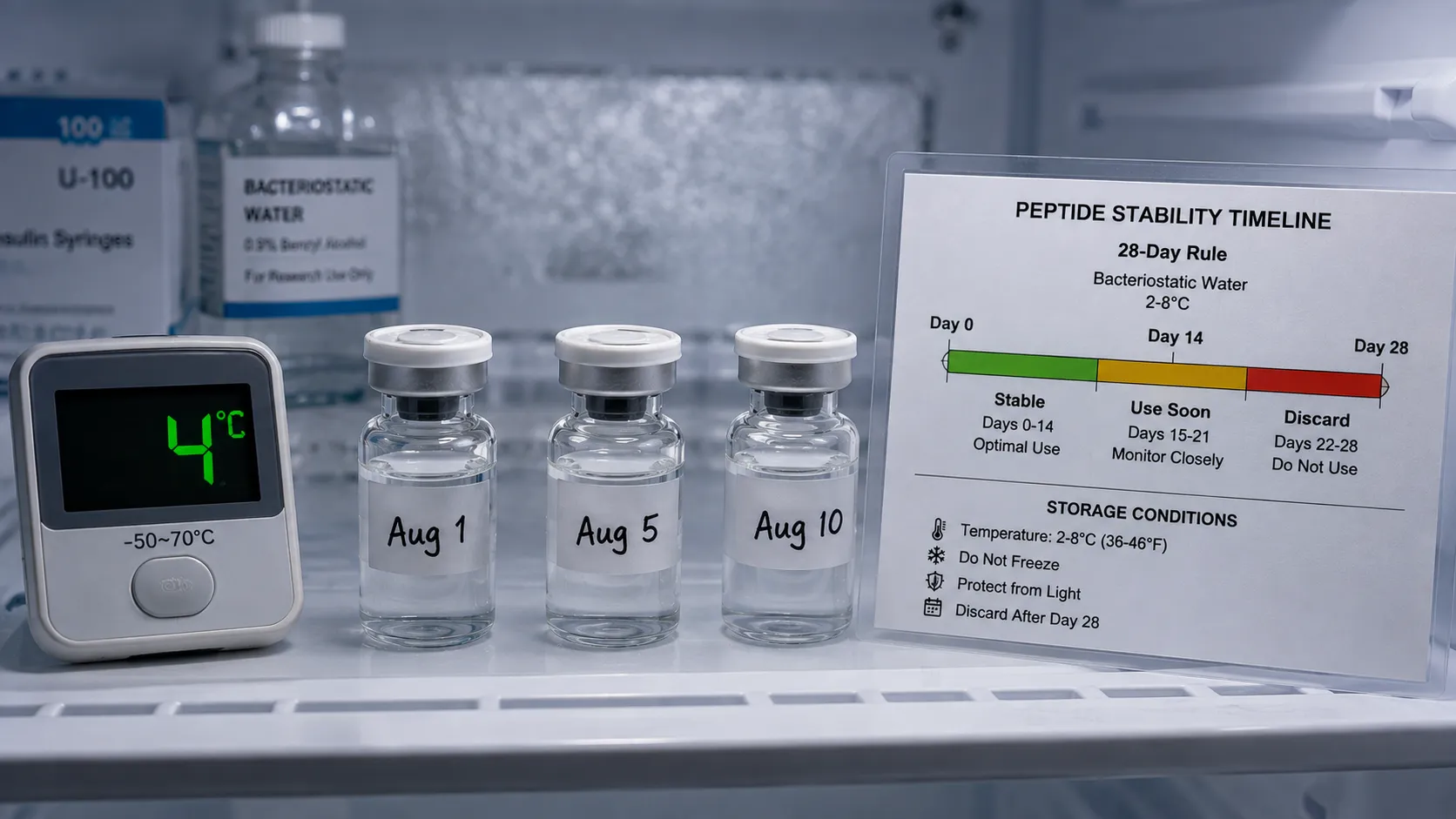
- Reconstituted peptides last 28–30 days at 2–8°C when prepared with bacteriostatic water (0.9% benzyl alcohol).
- The 28-day rule derives from USP <797> pharmaceutical standards for multi-dose vials with preservatives.
- Peptides in sterile water (no preservative) must be used within 24 hours, even when refrigerated.
- GHK-Cu and oxidation-sensitive peptides (Cys, Met, Trp) have shorter stability: 14–21 days.
- Signs of degradation include yellow/brown discoloration, cloudiness, particulates, and unusual odor.
- Store reconstituted peptides in the main refrigerator compartment (not the door) to minimize temperature fluctuations.
- Freezing extends stability to 3–4 months but requires aliquoting to avoid freeze-thaw damage.
- Always label vials with reconstitution date and discard after 28 days regardless of appearance.
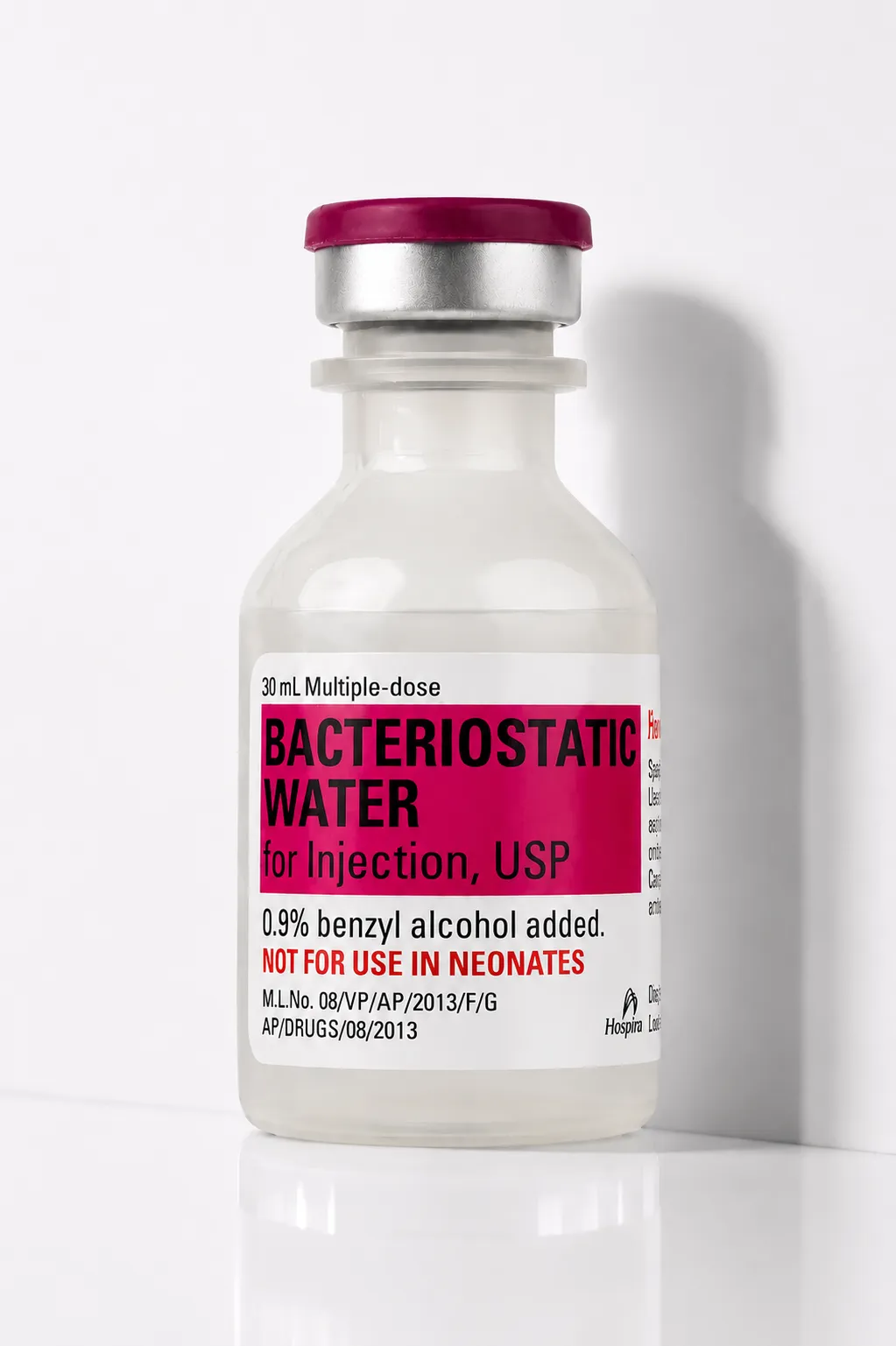
Reconstitution Solution
Buy Reconstitution Solution for peptide reconstitution. 0.9% benzyl alcohol preserved, sterile filtered. Essential laboratory supply for research use only.
Reconstitution Solution
Buy Reconstitution Solution for peptide reconstitution. 0.9% benzyl alcohol preserved, sterile filtered. Essential laboratory supply for research use only.
Peptide stability after reconstitution is one of the most critical yet frequently overlooked aspects of peptide research. A lyophilized peptide vial may remain stable for years when stored properly, but once reconstituted into solution, the clock starts ticking. Understanding how long reconstituted peptides last—and under what conditions—prevents wasted materials, ensures experimental reproducibility, and maintains research integrity.
This evidence-based guide examines peptide stability timelines across different diluents, storage temperatures, and peptide sequences. You'll learn the 28-day rule, degradation mechanisms, and peptide-specific recommendations for BPC-157, Semaglutide, CJC-1295, GHK-Cu, and other commonly researched compounds.
The 28-Day Rule: Why It Matters
The most widely cited guideline for reconstituted peptide stability is the 28-day rule: peptides reconstituted with bacteriostatic water and stored at 2–8°C should be used within 28 days. This timeline is not arbitrary—it's grounded in pharmaceutical standards and peptide chemistry.
Origin of the 28-Day Standard
The 28-day window derives from USP General Chapter <797>, which governs sterile compounding in pharmacy practice. For multi-dose vials preserved with 0.9% benzyl alcohol (bacteriostatic water), the beyond-use date is 28 days when refrigerated, even if the drug itself remains chemically stable longer.
This standard applies to peptides for several reasons:
- Bacteriostatic water efficacy: Benzyl alcohol at 0.9% concentration maintains antimicrobial activity for approximately 28 days after vial entry. Beyond this point, bacterial contamination risk increases even with refrigeration.
- Peptide degradation kinetics: Most peptides retain 90–95% potency at 28 days under refrigeration, but degradation accelerates thereafter. By 60 days, potency may drop to 80–85%.
- Oxidation and hydrolysis: Even in cold storage, peptides undergo slow oxidation (especially Cys, Met, Trp residues) and hydrolysis. These processes are temperature-dependent but not eliminated by refrigeration.
The 28-day rule is a conservative, safe maximum for nearly all peptides. Some sequences tolerate longer storage, but 30 days is the reliable upper limit for research-grade peptides.
What Happens After 28 Days?
After 28 days, several degradation pathways accelerate:
- Microbial growth: Bacteriostatic water's preservative effect diminishes, increasing contamination risk.
- Aggregation: Peptides may form insoluble aggregates, reducing bioavailability and altering experimental outcomes.
- Oxidation: Methionine, cysteine, and tryptophan residues oxidize, potentially changing biological activity.
- Deamidation: Asparagine and glutamine residues undergo deamidation, affecting charge and function.
- Hydrolysis: Peptide bonds slowly hydrolyze, especially at non-optimal pH.
For rigorous research, discarding peptides after 28 days ensures you're working with material of known, consistent quality.
Stability by Diluent Type
The choice of diluent significantly impacts reconstituted peptide stability. Not all solvents are created equal.
Bacteriostatic Water (0.9% Benzyl Alcohol)
Shelf life: 28–30 days at 2–8°C
Bacteriostatic water is the gold standard for multi-dose peptide vials. The 0.9% benzyl alcohol concentration inhibits bacterial growth, allowing repeated vial entries over several weeks.
Advantages:
- 28-day stability window under refrigeration
- Suitable for most peptide sequences
- Widely available and inexpensive
- Compatible with subcutaneous injection
Limitations:
- Benzyl alcohol may cause mild irritation in sensitive subjects
- Not suitable for neonatal or certain in vivo applications
- Does not prevent chemical degradation (oxidation, hydrolysis)
Best for: General research peptides, multi-dose protocols, subcutaneous administration studies.
Sterile Water (Preservative-Free)
Shelf life: 24 hours at 2–8°C
Sterile water contains no preservatives, making it unsuitable for multi-dose use. Reconstituted peptides must be used immediately or aliquoted and frozen.
Advantages:
- No preservative-related irritation
- Ideal for single-use applications
- Compatible with all peptide sequences
Limitations:
- 24-hour maximum use window
- High contamination risk after first vial entry
- Requires immediate aliquoting for extended storage
Best for: Single-dose experiments, cell culture applications, peptides sensitive to benzyl alcohol.
Never use sterile water for multi-dose peptide vials. Bacterial contamination can occur within 24–48 hours, even with refrigeration.
Phosphate-Buffered Saline (PBS)
Shelf life: 7–14 days at 2–8°C (varies by peptide)
PBS (pH 7.0–7.4) is commonly used for cell culture and in vitro applications. Stability depends on the peptide's pH sensitivity.
Advantages:
- Physiological pH (7.4) suits many peptides
- Compatible with cell culture media
- No preservatives
Limitations:
- Shorter stability than bacteriostatic water for many peptides
- Salt content may affect some assays
- No antimicrobial protection
Best for: In vitro studies, cell culture treatments, short-term experiments.
Acetic Acid / Trifluoroacetic Acid (TFA)
Shelf life: Variable; typically 7–14 days at 2–8°C
Acidic solvents (e.g., 1% acetic acid, 0.1% TFA) are used for peptides requiring low pH for solubility.
Advantages:
- Solubilizes hydrophobic peptides
- Inhibits some degradation pathways
Limitations:
- Acidic pH may accelerate hydrolysis for some sequences
- Not suitable for all administration routes
- Requires neutralization for certain applications
Best for: Hydrophobic peptides, analytical preparations, HPLC applications.
Storage Temperature and Stability
Temperature is the single most important factor determining reconstituted peptide stability.
Refrigerated Storage (2–8°C)
Standard recommendation for all reconstituted peptides
Refrigeration slows enzymatic, oxidative, and hydrolytic degradation pathways. Most peptides remain stable for 28–30 days when stored at 2–8°C in bacteriostatic water.
Best practices:
- Store in the main compartment (not the door) to minimize temperature fluctuations
- Protect from light (amber vials or opaque containers)
- Avoid freezing unless specifically recommended for the peptide
- Label vials with reconstitution date and discard after 28 days
Frozen Storage (-20°C)
Shelf life: 3–4 months (with caveats)
Freezing extends stability but introduces risks:
- Freeze-thaw damage: Repeated freeze-thaw cycles cause aggregation and precipitation
- Excipient crystallization: Some formulations crystallize upon freezing, altering peptide conformation
- Container stress: Glass vials may crack; plastic may leach
When to freeze:
- Peptides known to be freeze-stable (verify literature)
- Aliquoted single-use volumes to avoid freeze-thaw
- With cryoprotectants (e.g., 10% glycerol) for sensitive sequences
If freezing is necessary, aliquot into single-use volumes to avoid repeated freeze-thaw cycles. Thaw only what you need immediately before use.
Deep Frozen Storage (-80°C)
Shelf life: Up to 1 year for some peptides
Ultra-low temperature storage is reserved for long-term archival of reconstituted peptides. This is uncommon in routine research but may be appropriate for precious or irreplaceable samples.
Requirements:
- Cryoprotectants (glycerol, sucrose, trehalose)
- Single-use aliquots
- Rapid thawing at 37°C when needed
Room Temperature Storage
Shelf life: Hours to days (not recommended)
Room temperature storage accelerates all degradation pathways. Peptides should never be stored at room temperature after reconstitution except during immediate use.
Exceptions:
- Some stable peptides tolerate 24–48 hours at room temperature during shipping
- Lyophilized (unreconstituted) peptides are stable at room temperature for weeks
Peptide-Specific Stability Timelines
While the 28-day rule applies broadly, some peptides have unique stability profiles based on their amino acid sequences.
BPC-157
Stability: 28–30 days at 2–8°C in bacteriostatic water
BPC-157 is relatively stable due to its lack of oxidation-prone residues. It tolerates refrigeration well and shows minimal degradation at 28 days when stored properly.
Special considerations:
- Avoid repeated freeze-thaw cycles
- Stable in both acidic and neutral pH
- No special handling beyond standard peptide protocols
Semaglutide
Stability: 28–30 days at 2–8°C in bacteriostatic water
Semaglutide (a GLP-1 analog) is moderately stable but sensitive to agitation and temperature fluctuations.
Special considerations:
- Do not shake vigorously; gentle swirling only
- Protect from light (light-sensitive)
- Avoid freezing (may aggregate)
CJC-1295 (with or without DAC)
Stability: 28–30 days at 2–8°C in bacteriostatic water
CJC-1295 is stable under standard refrigeration but may degrade faster if exposed to temperature fluctuations.
Special considerations:
- Store in the back of the refrigerator (most stable temperature)
- Avoid door storage (temperature swings)
- Reconstitute gently to prevent foaming
GHK-Cu (Copper Peptide)
Stability: 14–21 days at 2–8°C in bacteriostatic water
GHK-Cu is less stable than many peptides due to the copper moiety's catalytic effects on oxidation.
Special considerations:
- Use within 2–3 weeks for optimal potency
- Protect from light (copper complexes are photosensitive)
- Consider aliquoting and freezing for extended storage
TB-500 (Thymosin Beta-4)
Stability: 28–30 days at 2–8°C in bacteriostatic water
TB-500 is relatively stable but prone to aggregation if mishandled.
Special considerations:
- Avoid vigorous shaking
- Allow to reach room temperature before reconstitution (reduces aggregation risk)
- Filter-sterilize if particulates appear
Tirzepatide
Stability: 28–30 days at 2–8°C in bacteriostatic water
Tirzepatide (a dual GLP-1/GIP agonist) follows standard stability guidelines.
Special considerations:
- Light-sensitive; store in amber vials
- Do not freeze
- Use within 28 days for consistent dosing
Ipamorelin
Stability: 28–30 days at 2–8°C in bacteriostatic water
Ipamorelin is a stable pentapeptide with no unusual handling requirements.
Special considerations:
- Standard peptide protocols apply
- No special sensitivity to light or temperature beyond general guidelines
Semax and Selank
Stability: 21–28 days at 2–8°C in bacteriostatic water
These Russian nootropic peptides are moderately stable but may degrade faster than average.
Special considerations:
- Use within 3 weeks for optimal results
- Protect from light
- Avoid temperature fluctuations
Oxidation-Sensitive Peptides (Cys, Met, Trp)
Stability: 14–21 days at 2–8°C
Peptides containing cysteine, methionine, or tryptophan are prone to oxidation.
Examples: Glutathione, certain growth factors, some antimicrobial peptides
Special considerations:
- Use within 2 weeks for best results
- Consider adding antioxidants (e.g., ascorbic acid) if compatible with your research
- Store under nitrogen blanket if possible
- Avoid metal contamination (catalyzes oxidation)
If a peptide solution develops yellow or brown discoloration, cloudiness, or particulates, discard it immediately regardless of storage time. These are signs of degradation or contamination.
Signs of Peptide Degradation
Visual inspection is the first line of defense against using degraded peptides. Watch for these warning signs:
Color Changes
- Yellow or brown tint: Indicates oxidation (especially in Cys/Met/Trp-containing peptides)
- Pink or red discoloration: May indicate bacterial contamination or chemical degradation
- Loss of clarity: Cloudiness suggests aggregation or microbial growth
Particulates and Precipitation
- Visible particles: Floating specks or crystals indicate aggregation or contamination
- Precipitate at bottom: Peptide has come out of solution; may be irreversible
- Stringy or gel-like texture: Severe aggregation; discard immediately
Odor Changes
- Unusual or foul odor: Suggests bacterial contamination
- Sharp chemical smell: May indicate solvent breakdown or peptide degradation
Performance Changes
- Reduced efficacy: If the peptide no longer produces expected results in your assays, degradation is likely
- Inconsistent results: Variable outcomes between doses suggest instability
When in doubt, discard. The cost of a peptide vial is far less than the cost of compromised research data.
Best Practices for Maximizing Stability
Follow these protocols to ensure your reconstituted peptides remain stable for their full shelf life.
1. Use Bacteriostatic Water
Unless your protocol specifically requires otherwise, bacteriostatic water is the safest choice for multi-dose vials.
2. Store in the Main Refrigerator Compartment
Avoid door storage, where temperature fluctuates with each opening. The back of the middle shelf is ideal.
3. Protect from Light
Store vials in amber containers or wrap in aluminum foil. Light accelerates oxidation, especially for copper peptides and aromatic amino acid-containing sequences.
4. Minimize Air Exposure
- Open vials only when ready to draw doses
- Use sterile technique to prevent contamination
- Consider nitrogen blankets for long-term storage of precious peptides
5. Avoid Freeze-Thaw Cycles
If you must freeze, aliquot into single-use volumes. Thaw only what you need immediately before use.
6. Label Clearly
Every vial should be labeled with:
- Peptide name and concentration
- Reconstitution date
- Expiration date (28 days from reconstitution)
- Storage conditions
7. Track Inventory
Maintain a log of all reconstituted peptides with dates and discard schedules. This prevents accidental use of expired material.
Stability Comparison Table
Peptide | Diluent | Storage Temp | Shelf Life | Special Notes |
|---|---|---|---|---|
BPC-157 | Bacteriostatic water | 2–8°C | 28–30 days | Standard stability |
Semaglutide | Bacteriostatic water | 2–8°C | 28–30 days | Light-sensitive; do not freeze |
CJC-1295 | Bacteriostatic water | 2–8°C | 28–30 days | Avoid temperature fluctuations |
GHK-Cu | Bacteriostatic water | 2–8°C | 14–21 days | Photosensitive; shorter shelf life |
TB-500 | Bacteriostatic water | 2–8°C | 28–30 days | Avoid shaking; aggregation-prone |
Tirzepatide | Bacteriostatic water | 2–8°C | 28–30 days | Light-sensitive |
Ipamorelin | Bacteriostatic water | 2–8°C | 28–30 days | Standard stability |
Semax | Bacteriostatic water | 2–8°C | 21–28 days | Use within 3 weeks |
Glutathione | Bacteriostatic water | 2–8°C | 7–14 days | Oxidation-sensitive; short shelf life |
Any peptide | Sterile water | 2–8°C | 24 hours | Single-use only |
Any peptide | PBS | 2–8°C | 7–14 days | Cell culture applications |
Conclusion
Reconstituted peptides are time-sensitive research materials. The 28-day rule provides a safe, conservative guideline for most peptides stored in bacteriostatic water at 2–8°C. Some sequences (GHK-Cu, glutathione, oxidation-prone peptides) require shorter timelines, while others may tolerate slightly longer storage—but 30 days is the reliable maximum.
Proper storage, careful handling, and vigilant monitoring for degradation signs ensure your peptides remain stable and effective throughout their shelf life. When in doubt, discard. The integrity of your research depends on the quality of your materials.
By following the guidelines in this resource, you'll minimize waste, maximize reproducibility, and maintain the highest standards of peptide research practice.
Frequently Asked Questions
- Peptide Reconstitution and Storage Guide. PeptideMind Research, 2026. https://peptidemind.com/peptide-reconstitution-guide
- How Long Do Reconstituted Peptides Last in Fridge? SeekPeptides, 2026. https://www.seekpeptides.com/blog/articles/how-long-reconstituted-peptides-last-fridge
- USP General Chapter <797>: Pharmaceutical Compounding—Sterile Preparations. United States Pharmacopeia, 2025.
- Peptide Stability Guide: Freezer vs. Refrigerator Storage. Onyx Biolabs, 2026. https://onyxbiolabs.com/2026/01/25/peptide-stability-guide-freezer-vs-refrigerator-storage-protocols/
- The Complete Peptide Reconstitution & Storage Guide. BlueWell Peptides, 2025. https://bluewellpeptides.com/the-complete-peptide-reconstitution-storage-guide/