- Semax is a synthetic heptapeptide with the sequence Met-Glu-His-Phe-Pro-Gly-Pro and an average molecular weight of approximately 814 Da.
- At roughly 814 Da, Semax sits below the approximately 1,000 Da threshold above which nasal mucosal permeability declines sharply.
- A 1 percent Semax solution is 10 mg/mL and a 0.1 percent solution is 1 mg/mL, since percentage strength here means weight per volume.
- A rat study using tritium-labelled Semax found measurable brain penetration two minutes after intranasal administration, with about 80 percent of brain radioactivity corresponding to intact peptide.
- A placebo-controlled study in 24 healthy volunteers reported default mode network changes after a single intranasal dose of 1 percent Semax.
- Semax contains no cysteine, asparagine, or glutamine, so disulfide scrambling and deamidation are not available degradation pathways.
- The single N-terminal methionine makes oxidation the principal chemical degradation route for Semax.
- Semax is not an FDA-approved drug in the United States, and FDA's July 2026 briefing document proposed that Semax not be included on the 503A Bulks List.
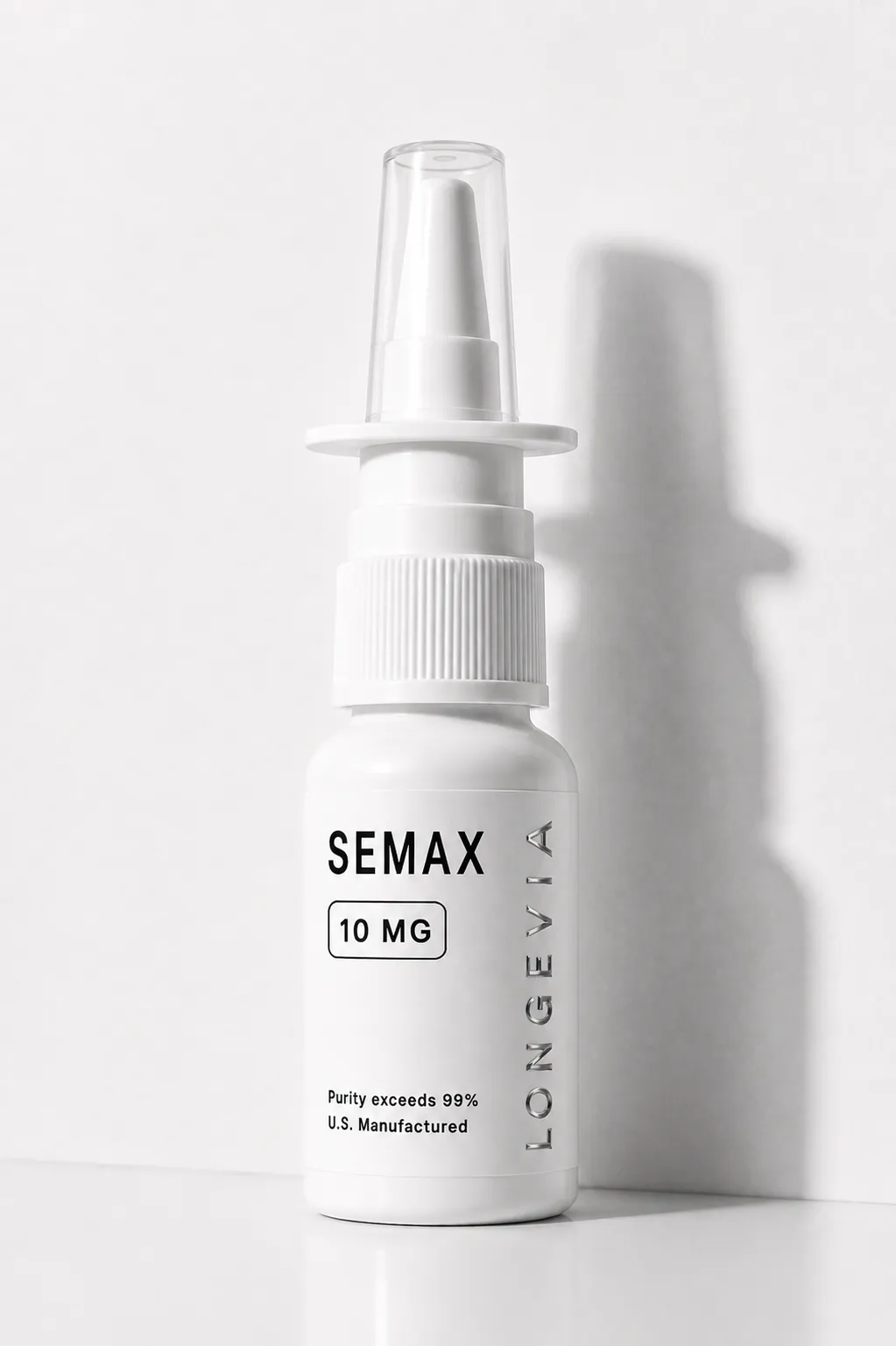
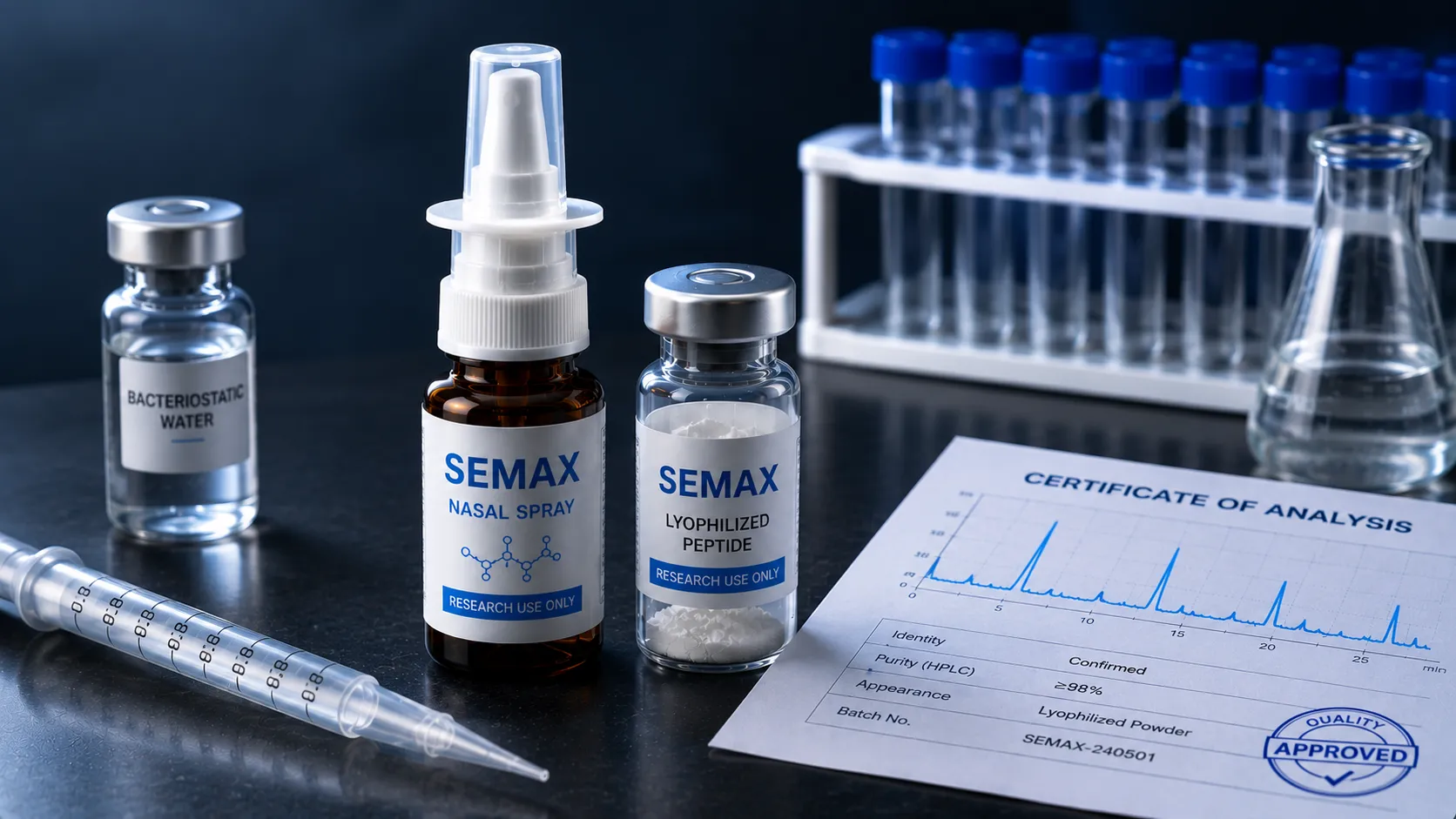
Semax Spray
Buy Semax Spray, a research-grade nootropic neuropeptide preparation in a convenient spray format studied for BDNF modulation and neuroprotective signaling research. COA-verified. Research use only.
Semax Spray
Buy Semax Spray, a research-grade nootropic neuropeptide preparation in a convenient spray format studied for BDNF modulation and neuroprotective signaling research. COA-verified. Research use only.
Semax occupies an unusual position among research peptides: the nasal route is not a convenience format layered onto an injectable compound, it is the route the molecule was designed for and the route almost all of its published pharmacology uses. That changes what a handling guide can honestly say. This article covers how Semax solution strength is expressed and converted, how to prepare a spray solution from lyophilised material, what the storage requirements are, and where the published record ends and informal convention begins. Semax Spray is supplied for research use only (RUO), is not for human consumption, and carries no therapeutic or diagnostic claim, regardless of the regulatory status of any similar product in any other jurisdiction.
In the published literature, Semax is administered intranasally as an aqueous solution described by percentage strength rather than by a fixed microgram figure. A 1 percent solution is 10 mg/mL and a 0.1 percent solution is 1 mg/mL, so the amount delivered per actuation depends on both the solution strength and the volume the device dispenses. Concentration is the figure a researcher controls at preparation, and it is the only one in the chain that can be calculated exactly.
What Semax Is and Why the Nasal Route Suits It
Semax is a synthetic heptapeptide whose small size and enzymatic stability make it one of the few research peptides for which intranasal delivery is pharmaceutically sensible rather than merely convenient.
The sequence is Met-Glu-His-Phe-Pro-Gly-Pro. The first four residues correspond to a fragment of adrenocorticotropic hormone (ACTH), and the C-terminal Pro-Gly-Pro tripeptide is a synthetic addition that confers resistance to proteolytic cleavage. Calculated from that sequence, the average molecular weight is approximately 814 Da.
That molecular weight figure carries more practical weight than it first appears. Reviews of nasal macromolecule delivery identify roughly 1,000 Da as the threshold above which passage through nasal mucosa becomes substantially impeded, and report that nasal bioavailability for hydrophilic peptides above that size is typically under one percent. Semax sits below that line. It is a small peptide by the standards of the field, and the nasal permeability barrier that dominates the behaviour of larger peptides is correspondingly less severe.
The Pro-Gly-Pro extension addresses the second barrier. Nasal mucosa contains aminopeptidases and endopeptidases that degrade peptides at the absorptive surface, and unmodified ACTH fragments are cleaved rapidly. The C-terminal extension slows that cleavage enough for meaningful quantities to survive transit.
Those two structural properties together explain why the intranasal literature on Semax exists at all. For most research peptides, nasal administration is an unvalidated route borrowed from injectable pharmacology. For Semax, intranasal administration is the route used in the published pharmacokinetic work, the route used in the human studies, and the route the molecule was engineered around.
This guide treats mechanism only to the extent it bears on handling. Semax research centres on neurotrophin regulation, particularly BDNF and NGF expression, and on gene-expression responses in models of cerebral ischemia. For how Semax compares to a related nootropic research peptide, see the Semax vs Selank nootropic peptide comparison.
What the Published Evidence Actually Establishes
The Semax evidence base is genuinely stronger than that of most research peptides, and it is also narrower and more methodologically limited than enthusiastic summaries suggest.
The intranasal pharmacokinetic work is real and specific. Shevchenko and colleagues prepared tritium-labelled Semax and administered it intranasally to rats at 50 micrograms per kilogram in a 20 microlitre volume, reported in the Russian Journal of Bioorganic Chemistry in 2006. They found that 0.093 percent of the total administered radioactivity per gram was present in rat brain two minutes after administration, and that approximately 80 percent of that brain radioactivity corresponded to intact Semax rather than metabolites. The peptide underwent rapid enzymatic degradation, with the C-terminal fragment Pro-Gly-Pro predominating in biological samples.
Two things follow from that study. Brain penetration by the nasal route is measurable and rapid, occurring within minutes. It is also small in absolute terms, and the parent peptide is short-lived once absorbed.
Human data exists and is limited. Lebedeva and colleagues conducted a placebo-controlled resting-state functional MRI study in 24 healthy volunteers, published in Bulletin of Experimental Biology and Medicine in 2018. Fourteen participants received intranasal 1 percent Semax and ten received placebo, with imaging before dosing and again at 5 and 20 minutes afterward. The Semax group showed a greater volume of the rostral medial frontal cortex subcomponent of the default mode network than controls.
Mechanistic work in animals is substantial. Medvedeva and colleagues published a genome-wide transcriptional analysis in BMC Genomics in 2014 examining Semax effects on gene expression in ischemic rat brain cortex, reporting that the peptide predominantly enhanced expression of immune-system-related genes following middle cerebral artery occlusion.
The honest limits matter as much as the findings. Most clinical publications are Russian-language, several key trials are non-randomised and not placebo-controlled, and independent replication in Western trials is essentially absent. Semax does not appear in Cochrane systematic reviews of stroke neuroprotection. A strong evidence base by research-peptide standards is not the same as a strong evidence base by pharmaceutical standards.
Percentage Strength Versus Milligram Concentration
Semax solution strength is expressed as a percentage in the published literature, and converting that percentage into milligrams per millilitre is the single most useful calculation in a Semax spray workflow.
Percentage here means weight per volume. One percent weight per volume means one gram of solute in 100 millilitres of solution, which is 10 milligrams per millilitre. The conversion is fixed and requires no assumptions.
Solution strength | Concentration | Peptide per 0.1 mL actuation | Peptide per 0.05 mL actuation |
|---|---|---|---|
1% | 10 mg/mL | 1,000 mcg | 500 mcg |
0.5% | 5 mg/mL | 500 mcg | 250 mcg |
0.1% | 1 mg/mL | 100 mcg | 50 mcg |
0.05% | 0.5 mg/mL | 50 mcg | 25 mcg |
0.01% | 0.1 mg/mL | 10 mcg | 5 mcg |
The right-hand columns depend on the device. Nasal pumps commonly dispense somewhere between 0.05 and 0.14 mL per actuation, so a single stated concentration produces materially different per-actuation amounts across devices. Two protocols using identical solution strengths can therefore deliver amounts differing by a factor of two or more purely through hardware.
Three categories of figure circulate for Semax and they should not be blended. Solution strengths appearing in published studies, such as the 1 percent solution used in the Lebedeva human imaging study, are documented research parameters. Strengths and schedules associated with products registered in other jurisdictions are regulatory facts about those products, not validated research protocols and not applicable to material supplied for research use only. Microgram-per-spray figures circulating in community sources are arithmetic derived from assumed concentrations and assumed actuation volumes, and carry no controlled validation. A number's precision says nothing about which of these three categories produced it.
Working backward from a target amount is the same arithmetic in reverse. Dividing the target mass by the concentration gives the volume required, and dividing that volume by the measured actuation volume gives the number of actuations. Every step is exact except the last, which depends on a device figure that should be measured rather than assumed. For the general arithmetic behind concentration and dilution calculations, see the peptide dosage calculation guide.
Preparing a Spray Solution From Lyophilised Material
Preparation concentration is determined entirely by the ratio of peptide mass to diluent volume, and technique determines whether the calculated concentration is the actual one.
The target concentration should be chosen before the vial is opened, because it determines the diluent volume and cannot be adjusted upward afterward without a second vial. Reconstituting 10 mg in 10 mL gives 1 mg/mL, which is a 0.1 percent solution. Reconstituting 10 mg in 1 mL gives 10 mg/mL, a 1 percent solution. Working out which strength the protocol calls for is the first step, not an afterthought.
Technique matters at several points.
- Allow refrigerated or frozen vials to reach room temperature before opening, so that condensation does not form on cold lyophilised material.
- Direct diluent slowly down the inside wall of the vial rather than as a stream onto the lyophilised cake, which reduces mechanical stress on the peptide.
- Swirl gently or allow the vial to stand rather than shaking, since agitation drives peptide to the air-liquid interface where aggregation occurs.
- Confirm complete dissolution visually before transferring anything, because undissolved material means the solution drawn off is more dilute than calculated.
Transfer into the spray device introduces losses that reconstitution arithmetic does not capture. Nasal pump assemblies hold a dead volume that is never dispensed, and they present a large plastic surface area relative to the liquid they contain. Peptides adsorb to those surfaces, and the proportional loss is greatest for dilute solutions. Preparing a modest excess over the calculated requirement is the practical response.
Actuation volume can be measured rather than assumed. Weigh the filled device, prime it, deliver a counted number of actuations to waste, and weigh it again. Dividing the mass difference by the number of actuations gives the mean volume per actuation, since dilute aqueous solutions have a density close to 1 gram per millilitre. Repeating the measurement when the device is nearly empty quantifies output drift across its working life.
Storage, Stability and the Methionine Question
Lyophilised Semax is considerably more stable than Semax in solution, and the peptide's specific residue composition gives it an unusually clean degradation profile.
Form | Temperature | Light | Handling note |
|---|---|---|---|
Lyophilised, long-term | -20 C or below | Protect from light | Keep sealed and desiccated; dryness confers the stability |
Lyophilised, short transit | Brief ambient acceptable | Protect from light | Warm to room temperature before opening |
Prepared solution, in use | 2 to 8 C | Protect from light | Date at preparation and track elapsed days |
Prepared solution, extended | -20 C or below, aliquoted | Protect from light | Aliquot before freezing; avoid repeated thaw cycles |
Loaded spray device | 2 to 8 C between uses | Opaque or amber housing | Account for dead volume and surface adsorption |
The sequence Met-Glu-His-Phe-Pro-Gly-Pro determines which degradation pathways are available. Semax contains a single methionine, and methionine is the most oxidation-labile of the common amino acids, which makes oxidation the principal chemical degradation route to guard against. That methionine sits at the N-terminus, where it is sterically exposed rather than buried.
What Semax does not contain is as informative as what it does. There is no cysteine, so disulfide scrambling and disulfide-mediated aggregation cannot occur. There is no asparagine or glutamine, so deamidation, one of the most common degradation routes in peptide pharmaceuticals, is not available either. There is no tryptophan. Semax therefore has a narrower set of degradation pathways than most peptides of comparable size, and protecting it largely reduces to excluding oxygen, light, and trace metals.
Compound-specific stability data for Semax in solution has not been established in the peer-reviewed literature with the precision a protocol would want, so the conditions above reflect general peptide handling practice. Stability in solution depends on concentration, diluent, pH, container material, and temperature history, and a laboratory relying on a specific window should determine it empirically rather than adopting a supplier figure.
Freeze-thaw cycling is the avoidable loss. Each cycle concentrates solutes at the ice interface and shifts local pH, both of which promote aggregation, and aliquoting at preparation eliminates the problem entirely at no cost. For a fuller treatment of post-reconstitution stability, see the how long peptides last after reconstitution guide.
Documenting Administration and Device Variables
An intranasal protocol becomes reproducible when device and technique are recorded as experimental variables rather than treated as incidental details.
This follows from the pharmaceutics rather than from procedural formality. When the delivered amount depends on actuation volume, priming state, head position, and nostril distribution, those parameters carry as much influence over exposure as the stated concentration does. A protocol reporting only a concentration has reported perhaps half of what determines the result.
A record sufficient to support replication captures:
- Device make, model, and manufacturer-specified actuation volume
- Measured actuation volume for the specific unit, determined gravimetrically
- Priming procedure and number of priming actuations before first use
- Actuations per administration and their distribution between nostrils
- Head position, breathing instruction, and interval between actuations
- Peptide lot number and a reference to the matching certificate of analysis
- Diluent type and volume, resulting concentration expressed both as mg/mL and as a percentage
- Preparation date, storage temperature, and elapsed days in solution at each use
Reporting concentration in both formats is a small courtesy with real value, because the Semax literature uses percentages while research material is supplied by mass. A reader who has to perform the conversion is a reader who can perform it incorrectly.
Nasal condition is a further variable worth capturing in any model where it can vary. Mucosal state changes with humidity, ambient temperature, congestion, and recent nasal irrigation, and each of those alters the clearance rate and residence window that govern absorption. In a compound whose route is the defining feature of its pharmacology, treating nasal condition as background noise discards one of the larger sources of between-session variance.
Administration schedule also belongs in the record. Published Semax protocols generally use discrete multi-day courses rather than continuous administration, and where a protocol adopts a course-and-interval structure, both the course length and the interval are parameters that shape the result and should be stated rather than implied.
Verifying Identity and Purity
A lot-specific certificate of analysis should establish identity, purity, and net peptide content as three separate parameters, and a document addressing only one of them is incomplete.
Identity is confirmed by mass spectrometry. For Semax, the observed mass should correspond to the sequence Met-Glu-His-Phe-Pro-Gly-Pro, computing to an average molecular weight of approximately 814 Da. Checking the reported mass against that expected value takes seconds and catches the failure mode that no purity figure compensates for, which is receiving a different peptide entirely.
Purity is established by HPLC, conventionally reported as area percent of the main peak. This describes the proportion of peptide material matching the target sequence, with the balance consisting of deletion sequences, truncations, and synthesis by-products.
Net peptide content is the third parameter and the one most often missing. Synthetic peptides are supplied as salts, commonly trifluoroacetate salts, and retain bound water, so gross vial mass exceeds actual peptide mass. A vial labelled 10 mg may hold meaningfully less than 10 mg of peptide, and a concentration calculated from the label value is correspondingly overstated. Where the certificate reports net peptide content, concentration should be calculated from it, and the record should state which basis was used.
Physical inspection on arrival supplies a fast informal cross-check. Lyophilised Semax should present as a dry, intact cake or a free-flowing powder, and material that appears collapsed, sticky, or discoloured points to moisture ingress or a temperature excursion in transit. Dissolution behaviour departing from expectation, such as unusually slow dissolution or persistent cloudiness, is worth recording alongside the certificate values rather than dismissed.
Two further checks close the process. The certificate must be lot-specific and match the lot number printed on the vial, since a generic certificate describes different material. Water content and counterion identity, where reported, explain the gap between gross and net mass and allow the figures to be checked for internal consistency.
Regulatory Status: What FDA Has Published
Semax has been the subject of documented FDA regulatory activity in 2026, and FDA's own published record supports a narrower and more specific set of statements than most secondary coverage provides.
Three FDA sources establish the verifiable facts. A Federal Register notice published on 16 April 2026 announced a meeting of FDA's Pharmacy Compounding Advisory Committee for 23 and 24 July 2026 and listed Semax-related bulk drug substances, in both free base and acetate forms, among substances to be considered for inclusion on the 503A Bulks List. FDA's meeting page for that event identifies the uses the agency evaluated for Semax as cerebral ischemia, migraine, and trigeminal neuralgia, and schedules the discussion for 24 July 2026.
FDA's briefing document for the meeting states the agency's own position going in. Under points to consider for the 24 July afternoon session, the document records that FDA proposed that Semax free base not be included on the 503A Bulks List, and that Semax acetate not be included either. That same document notes that the Semax nominations were withdrawn by both nominators, and that FDA elected to proceed with the presentation to the committee regardless.
Two structural points come from FDA's own descriptions. Advisory committees make non-binding recommendations, and FDA states that while it generally follows them it is not legally bound to do so. Separately, inclusion on the 503A Bulks List is one condition among several under section 503A and does not make a substance an FDA-approved drug.
This article does not report the committee's vote outcome. FDA had not published summary minutes for the July 2026 meeting at the time of writing, and vote tallies appearing in secondary coverage cannot be checked against a primary agency record. Regulatory status here is actively changing, and anything depending on it should be verified directly against FDA's current published materials rather than against this or any other third-party summary.
None of this alters the research position. Semax is not an FDA-approved drug for any indication in the United States, and registration or approval in another jurisdiction confers no US regulatory status. Material supplied for research use only is intended for laboratory research, is not for human consumption, and is not a compounded preparation regardless of what the 503A Bulks List contains at any given moment.
Frequently Asked Questions
- Shevchenko KV, Nagaev IY, Alfeeva LY, Andreeva LA, Kamensky AA, Levitskaya NG, Shevchenko VP, Grivennikov IA, Myasoedov NF. Kinetics of semax penetration into the brain and blood of rats after its intranasal administration. Russian Journal of Bioorganic Chemistry. 2006;32(1):57-62.
- Lebedeva IS, Panikratova YR, Sokolov OY, Kupriyanov DA, Rumshiskaya AD, Kost NV, Myasoedov NF. Effects of Semax on the Default Mode Network of the Brain. Bulletin of Experimental Biology and Medicine. 2018.
- Medvedeva EV, Dmitrieva VG, Povarova OV, Limborska SA, Skvortsova VI, Myasoedov NF, Dergunova LV. The peptide semax affects the expression of genes related to the immune and vascular systems in rat brain focal ischemia: genome-wide transcriptional analysis. BMC Genomics. 2014;15:228.
- Ozsoy Y, Gungor S, Cevher E. Nasal delivery of high molecular weight drugs. Molecules. 2009;14(9):3754-3779.
- Manning MC, Chou DK, Murphy BM, Payne RW, Katayama DS. Stability of protein pharmaceuticals: an update. Pharmaceutical Research. 2010;27(4):544-575.
- U.S. Food and Drug Administration. Pharmacy Compounding Advisory Committee; Notice of Meeting; Establishment of a Public Docket; Request for Comments - Bulk Drug Substances Nominated for Inclusion on the Section 503A Bulk Drug Substances List. Federal Register, 16 April 2026.
- U.S. Food and Drug Administration. July 23-24, 2026: Meeting of the Pharmacy Compounding Advisory Committee. FDA Advisory Committee Calendar.
- U.S. Food and Drug Administration. July 23-24, 2026, Meeting of the Pharmacy Compounding Advisory Committee - FDA Briefing Document Introduction. Center for Drug Evaluation and Research.