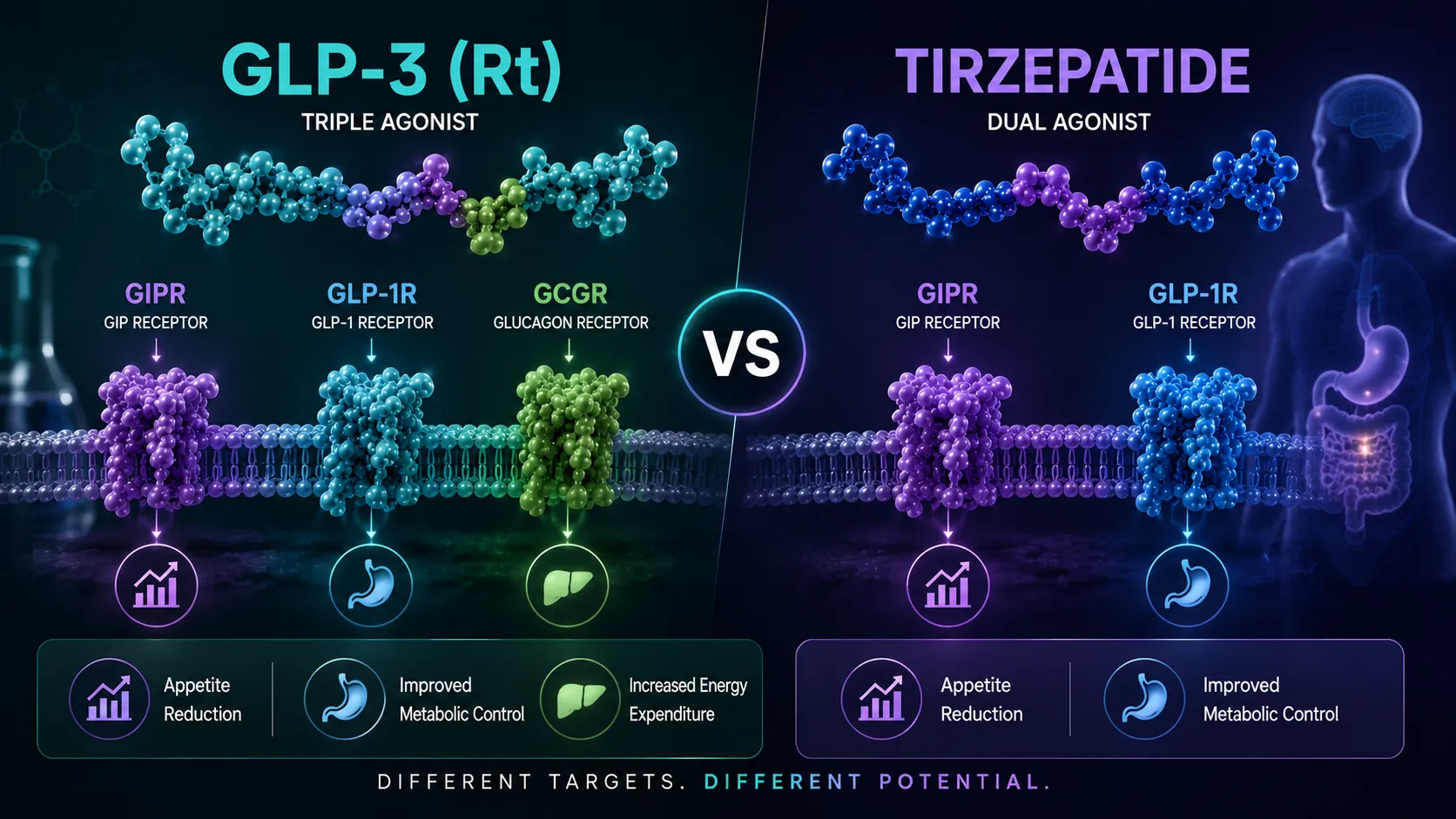
- GLP-3 targets the GIP, GLP-1, and glucagon receptors, while tirzepatide targets only the GIP and GLP-1 receptors.
- The glucagon receptor arm is the sole receptor-level difference between the two compounds.
- Tirzepatide acts on energy intake, while GLP-3 acts on energy intake plus hepatic energy expenditure.
- Glucagon receptor activation raises hepatic glucose output, creating internal tension with the two incretin arms.
- Neither compound activates its receptors with equal potency, so receptor count alone understates the difference.
- Willard and colleagues characterized tirzepatide as an imbalanced and biased dual agonist in JCI Insight.
- Tirzepatide is an approved prescription medicine, while retatrutide remains investigational and unapproved.
- Approval status attaches to a regulated clinical product and never extends to research material of any compound.
GLP-3 (Rt)
Explore GLP-3 (Rt) — a high-purity, COA-verified research peptide targeting GLP-1, GIP, and glucagon receptors. Lyophilized, batch-tested. Research use only.
GLP-3 (Rt)
Explore GLP-3 (Rt) — a high-purity, COA-verified research peptide targeting GLP-1, GIP, and glucagon receptors. Lyophilized, batch-tested. Research use only.
The comparison between GLP-3 (Rt) and tirzepatide comes down to one receptor. Both are engineered incretin-class peptides, both engage the GIP and GLP-1 receptors, and both were developed from the same research programme at the same pharmaceutical company. The difference is that GLP-3, the informal name for the triple agonist retatrutide (LY3437943), adds glucagon receptor agonism on top of the shared incretin pair. This article compares the two compounds on receptor targets, mechanism class, potency distribution, published evidence, and research context, and explains why adding a third receptor changes the pharmacological category rather than just the receptor count. Tirzepatide is discussed here strictly as a comparison compound. All research material referenced is supplied for Research Use Only and is not for human consumption.
GLP-3 vs Tirzepatide at a Glance
GLP-3 is a triple GIP, GLP-1, and glucagon receptor agonist, while tirzepatide is a dual GIP and GLP-1 receptor agonist, and the glucagon receptor arm is the entire difference between them. The table below sets out the head-to-head comparison across the parameters that matter for research design.
Parameter | GLP-3 (Rt) / retatrutide | Tirzepatide |
|---|---|---|
Development code | LY3437943 | LY3298176 |
Receptor targets | GIPR, GLP-1R, GCGR | GIPR, GLP-1R |
Mechanism class | Triple hormone receptor agonist | Dual incretin receptor agonist |
Key differentiator | Glucagon receptor agonism | Balanced dual incretin agonism |
Primary metabolic lever | Energy intake plus hepatic energy expenditure | Energy intake and insulin response |
Structure | Acylated synthetic peptide, fatty diacid moiety | Acylated 39-amino-acid peptide, C20 fatty acid |
Reported half-life | Approximately 6 days | Supports once-weekly dosing intervals |
Discovery paper | Coskun et al, Cell Metabolism, 2022 | Coskun et al, Molecular Metabolism, 2018 |
Regulatory status | Investigational, not approved | Approved as a prescription medicine |
Typical research context | Multi-receptor integration, hepatic lipid handling, energy expenditure | Incretin receptor pharmacology, GIP arm contribution |
Two entries in that table deserve emphasis before anything else. The regulatory status line is not a minor footnote: tirzepatide is an approved prescription medicine, while retatrutide remains investigational and has not been approved by any regulatory authority for any indication. Approval status attaches to a specific clinical product manufactured under pharmaceutical quality systems, and it does not extend to research material of any compound, including tirzepatide.
The second is the half-life comparison. Both compounds are acylated to support albumin binding and weekly administration intervals in clinical protocols, so their pharmacokinetic profiles are broadly similar in shape. The differences between them are pharmacodynamic rather than pharmacokinetic, which is why receptor targets rather than dosing frequency are the productive axis of comparison.
Receptor Targets: Two Arms Versus Three
Tirzepatide engages two receptors and GLP-3 engages three, with the shared pair being the GIP and GLP-1 receptors and the additional target being the glucagon receptor. Understanding what each shared arm contributes clarifies what the third one adds.
The GLP-1 receptor arm is common to both compounds and to the entire incretin therapeutic class. Activation promotes glucose-dependent insulin secretion, slows gastric emptying, and produces satiety signaling through central pathways. This arm accounts for most of the food-intake reduction observed across incretin compounds, and it is the arm that mono-agonists such as semaglutide target in isolation.
The GIP receptor arm is also common to both. Coskun and colleagues developed tirzepatide specifically to test whether adding GIP receptor activity to established GLP-1 receptor agonism produced metabolic benefits beyond GLP-1 alone, and the dual agonist was the answer to that question. GIP receptor activation amplifies glucose-dependent insulin secretion and has documented actions in adipose tissue and in central circuits associated with nausea signaling.
The glucagon receptor arm belongs to GLP-3 alone. Glucagon receptor activation acts primarily on hepatic tissue, driving glycogenolysis, gluconeogenesis, and fatty acid oxidation, and it is associated with increased energy expenditure. Tirzepatide does not touch this receptor. In the preclinical work reported with the retatrutide discovery paper, glucagon receptor activation was identified as the component responsible for the increase in energy expenditure observed in obese mouse models.
All three receptors belong to the same structurally related family of G protein-coupled receptors, which is what makes a single peptide capable of engaging them together in the first place. This is not a general-purpose technique for combining arbitrary receptors. It works for these targets because they share enough architecture that one engineered sequence can satisfy multiple binding requirements, which is equally true of the two-receptor and three-receptor versions of the design.
This produces the structural asymmetry that defines the comparison. Tirzepatide operates on two arms of a single system, the incretin axis. GLP-3 operates on the incretin axis plus a second, counter-regulatory hormonal system that in normal physiology opposes rather than complements it.
Mechanism Class: What the Glucagon Receptor Actually Adds
The glucagon receptor arm shifts GLP-3 into a different mechanism class than tirzepatide because it acts on energy expenditure rather than energy intake. This is the substantive answer to what triple agonism adds over dual agonism, and it is a category difference rather than a quantitative one.
Both incretin arms shared by the two compounds act principally on the intake side of the energy equation. Appetite signaling, gastric emptying, and glucose-dependent insulin secretion all shape how much energy enters the system and how it is partitioned. Nothing in a dual incretin agonist directly increases the rate at which the body spends energy. The glucagon arm does exactly that, through hepatic substrate mobilization and thermogenic pathways, and it also drives the hepatic lipid handling that motivated a dedicated phase 2a study of liver outcomes published by Sanyal and colleagues in Nature Medicine.
The addition creates a design tension that has no equivalent in a dual agonist. Glucagon receptor activation raises hepatic glucose output, which directly opposes glycemic control. A triple agonist therefore has to balance a glucose-raising arm against two glucose-lowering arms within a single molecule, which makes the relative potency at each receptor a critical engineering parameter rather than an incidental property. A dual incretin agonist faces no such internal opposition, because both of its arms push in the same glycemic direction.
The receptor arms of a tri-agonist are not simply additive. One arm opposes the glycemic direction of the other two, so the molecule's behaviour depends on the potency ratio between them rather than on the presence of three receptors alone.
This is why researchers should be cautious about the intuition that three receptors must outperform two. Three receptors create three degrees of freedom in molecular design, one of which introduces counter-regulation. Whether that produces a better profile depends entirely on where the ratio lands, which is an empirical question rather than an architectural guarantee.
Potency and Signaling Bias: Why Receptor Count Is Not the Whole Story
Neither compound activates its receptors with equal potency, which means that describing them by receptor count alone understates how different they are. This is the most commonly overlooked point in any GLP-3 versus tirzepatide comparison.
Willard and colleagues characterized tirzepatide in JCI Insight as an imbalanced and biased dual agonist. Imbalanced means its potency at the two receptors is unequal relative to the endogenous ligands. Biased means its activation preferentially engages some downstream signaling routes over others at the same receptor, so the receptor identity does not fully determine the cellular response. Both properties were reported as intentional features of the molecular design rather than artefacts.
The same principles apply to retatrutide with an additional variable. Coskun and colleagues reported that retatrutide shows balanced glucagon receptor and GLP-1 receptor activity with proportionally greater GIP receptor activity, and that relative to the endogenous ligands its potency profile is not uniform across the three targets. A triple agonist therefore has three potency values and three signaling profiles interacting simultaneously.
Comparison axis | GLP-3 (Rt) / retatrutide | Tirzepatide |
|---|---|---|
Number of potency variables | Three receptor targets | Two receptor targets |
Reported potency distribution | Balanced GCGR and GLP-1R with greater GIPR activity | Unequal potency across GIPR and GLP-1R |
Signaling characterization | Multi-receptor integration across three systems | Characterized as imbalanced and biased |
Internal glycemic tension | Present, glucagon arm opposes incretin arms | Absent, both arms glucose-lowering |
Attribution difficulty in assays | Three possible mechanistic origins per readout | Two possible mechanistic origins per readout |
The practical implication is that neither compound can be modelled as the sum of its constituent single-receptor pharmacologies. Published data on GLP-1 mono-agonists do not transfer cleanly to either compound, and published data on tirzepatide do not transfer cleanly to retatrutide simply because two of the three arms overlap.
What the Published Trial Data Show for Each Compound
Both compounds have peer-reviewed clinical trial literature, but they sit at different stages of development, and the comparison is between a completed development programme and one still in progress. Reading the two evidence bases as equivalent is the most common error in this comparison.
For tirzepatide, the evidence base is mature. The discovery and proof-of-concept pharmacology was published by Coskun and colleagues in Molecular Metabolism in 2018, followed by a phase 2 dose-ranging programme and a large phase 3 programme that supported regulatory approval. Its receptor pharmacology was further characterized by Willard and colleagues in 2020.
For retatrutide, the evidence base is substantial but incomplete. The discovery pharmacology appeared in Cell Metabolism in 2022. Urva and colleagues published the phase 1b multiple-ascending-dose study in the Lancet the same year, establishing pharmacokinetics. Two phase 2 trials followed in 2023: Jastreboff and colleagues reported a 48-week obesity trial in the New England Journal of Medicine, and Rosenstock and colleagues reported a trial in adults with type 2 diabetes in the Lancet. A phase 2a study in metabolic dysfunction-associated steatotic liver disease was published in Nature Medicine in 2024. A phase 3 programme is ongoing, and a phase 3 monotherapy trial in type 2 diabetes was published in the Lancet in 2026.
The asymmetry matters for how confidently anything can be claimed. Long-term safety data across years exist for tirzepatide and do not yet exist for retatrutide. Regulatory review has assessed one compound's full dossier and has not yet assessed the other's. Any source presenting head-to-head superiority as established fact is overstating what cross-trial comparison of differently designed studies in different populations can support.
Longevia Research supplies GLP-3 (Rt) strictly for Research Use Only. Tirzepatide is discussed in this article solely as a mechanistic comparison compound and is not offered as a product. Neither compound described here is for human or veterinary consumption, diagnostic use, or therapeutic use, and published clinical trial data are provided as scientific context only.
Research Context Differences: Designing Studies Around Each
The two compounds suit different research questions, and choosing between them for a study should follow from the question rather than from which is more potent. This is where the comparison becomes operationally useful.
Tirzepatide is the appropriate reference compound for questions about incretin receptor pharmacology in isolation, particularly the contribution of the GIP arm relative to GLP-1 alone. Because it engages only the incretin axis, an observed effect has two possible receptor origins rather than three, which makes attribution experiments simpler to design and interpret. It is also the natural comparator when the research question is specifically what the glucagon arm adds, since the two compounds are otherwise closely matched in receptor coverage.
GLP-3 (Rt) is the appropriate compound for questions involving hepatic substrate handling, energy expenditure, or multi-system integration across incretin and counter-regulatory signaling. It is also the compound of interest for methodological work on how to partition effects across three receptor arms, which is an open experimental design problem in its own right.
Studies involving either compound benefit from selective antagonists or receptor-deficient model systems, but the requirement is more acute for the tri-agonist because the number of plausible mechanistic explanations for any single readout is larger. Dose-ranging designs that exploit differing potency thresholds across receptors are a partial substitute where selective tools are unavailable, and they consume proportionally more material, which is worth factoring into procurement.
Material budgeting differs accordingly. A two-arm attribution design consumes less compound than a three-arm design at equivalent statistical power, so studies built around the tri-agonist should plan procurement against the full dose range and the number of control conditions required rather than against the headline number of experimental groups.
For a wider comparison that includes the GLP-1 mono-agonist class alongside both of these compounds, the three-way comparison covers all three mechanism classes together.
Sourcing and Verification Differences
The sourcing question differs sharply between the two compounds because one exists as an approved pharmaceutical product and the other does not, and this shapes what documentation a researcher should expect. An approved medicine carries manufacturing quality assurance through a regulated supply chain. Research material of any compound does not sit inside that system, which places the verification burden on the supplier's analytical documentation and on the researcher's willingness to check it.
For research material, the documentation standard to expect is a lot-specific Certificate of Analysis reporting quantitative purity by HPLC and identity confirmation by LC-MS, tied to the specific batch number printed on the vial rather than to a generic product specification. A generic specification describes an intended product. A lot-specific COA describes a tested batch. Only the second says anything about the material actually in hand.
Identity confirmation is the check most often skipped and the most consequential for a comparison like this one. Retatrutide and tirzepatide are both acylated synthetic peptides with broadly similar physicochemical behaviour, and a purity figure alone cannot distinguish one from the other or from a related synthesis impurity. Mass confirmation against the expected molecular weight is what closes that gap. A batch reporting high purity without an orthogonal identity method is reporting an incomplete result.
Longevia Research tests every batch independently by HPLC and LC-MS and publishes lot-specific Certificates of Analysis in its COA Library, so that identity and purity can be verified against the specific lot number on the vial. For the underlying receptor pharmacology behind this comparison, the dedicated mechanism guide covers the primary literature in detail. For handling, concentration math, and storage conditions specific to reconstituted tirzepatide material, the dosage and reconstitution guide is the appropriate reference.
Frequently Asked Questions
- Coskun T, Urva S, Roell WC, et al. LY3437943, a novel triple glucagon, GIP, and GLP-1 receptor agonist for glycemic control and weight loss: from discovery to clinical proof of concept. Cell Metab. 2022;34(9):1234-1247.e9.
- Coskun T, Sloop KW, Loghin C, et al. LY3298176, a novel dual GIP and GLP-1 receptor agonist for the treatment of type 2 diabetes mellitus: from discovery to clinical proof of concept. Mol Metab. 2018;18:3-14.
- Willard FS, Douros JD, Gabe MB, et al. Tirzepatide is an imbalanced and biased dual GIP and GLP-1 receptor agonist. JCI Insight. 2020;5(17):e140532.
- Jastreboff AM, Kaplan LM, Frias JP, et al. Triple-Hormone-Receptor Agonist Retatrutide for Obesity - A Phase 2 Trial. N Engl J Med. 2023;389(6):514-526.
- Rosenstock J, Frias J, Jastreboff AM, et al. Retatrutide, a GIP, GLP-1 and glucagon receptor agonist, for people with type 2 diabetes: a randomised, double-blind, placebo and active-controlled, parallel-group, phase 2 trial conducted in the USA. Lancet. 2023;402(10401):529-544.
- Sanyal AJ, Kaplan LM, Frias JP, et al. Triple hormone receptor agonist retatrutide for metabolic dysfunction-associated steatotic liver disease: a randomized phase 2a trial. Nat Med. 2024;30(7):2037-2048.
- Bajaj HS, Welch M, Shah P, et al. Efficacy and safety of retatrutide, a GIP, GLP-1, and glucagon receptor agonist, in people with type 2 diabetes and inadequate glycaemic control with diet and exercise (TRANSCEND-T2D-1): a double-blind, randomised, phase 3 trial. Lancet. 2026;407(10546):2402-2413.