- Tesamorelin reconstitution instructions depend on the exact formulation and current prescribing information.
- EGRIFTA SV and EGRIFTA WR are not interchangeable.
- The EGRIFTA SV label specifies a 2 mg vial, 0.5 mL of supplied diluent, and 1.4 mg in 0.35 mL after reconstitution.
- The supplied diluent should not be replaced with BAC water unless authorized by a qualified professional.
- EGRIFTA SV labelling directs immediate use after reconstitution and disposal of unused solution.
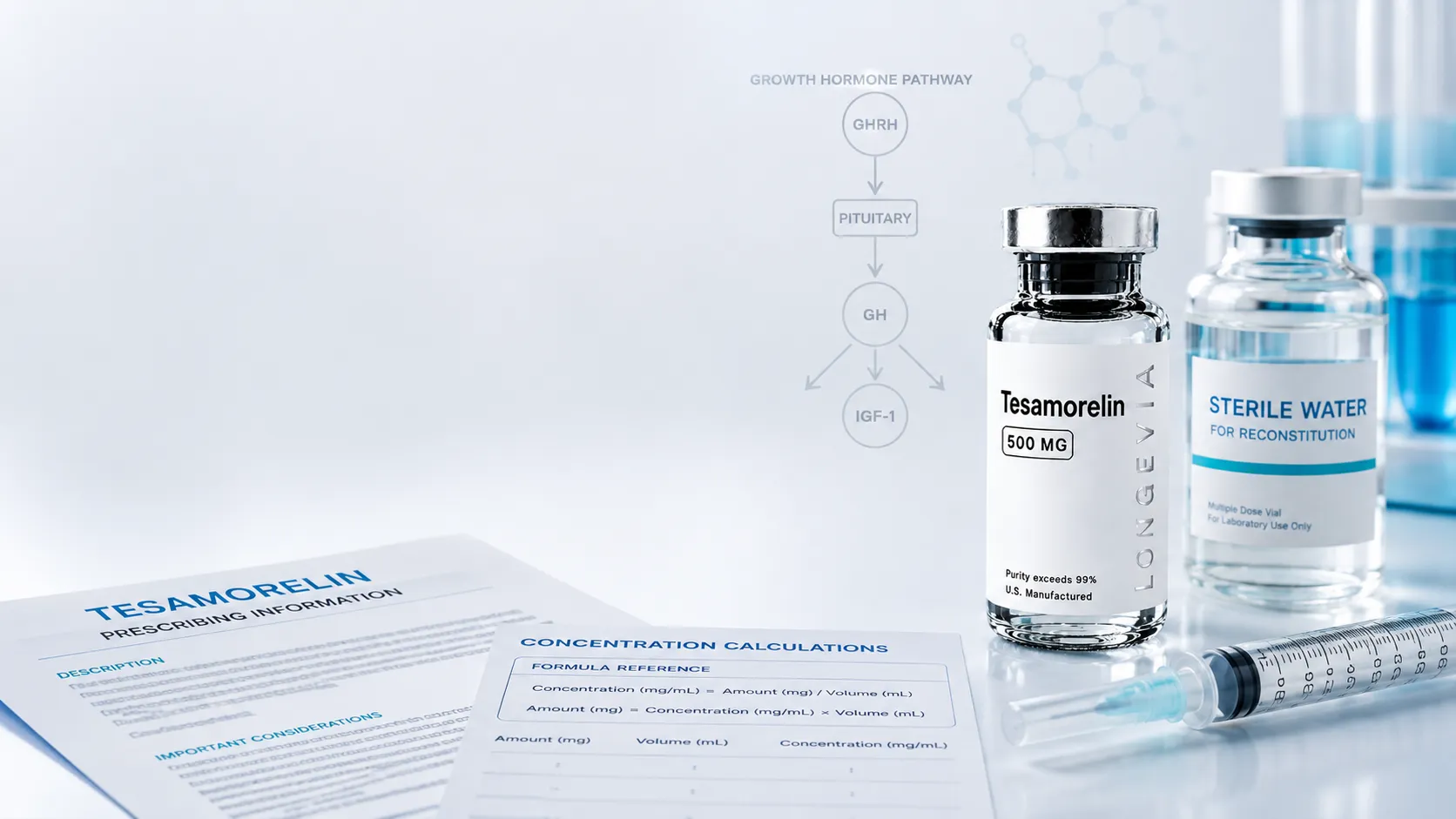
- Concentration is calculated by dividing total tesamorelin amount by final solution volume.
- A product-specific label is more reliable than a generic online tesamorelin mixing chart.
- Tesamorelin affects the GH/IGF-1 axis and requires appropriate clinical monitoring when prescribed.
Tesamorelin
Tesamorelin is a synthetic 44-amino-acid analogue of growth hormone-releasing hormone (GHRH) investigated in research involving GHRHR pharmacology, pituitary somatotroph signalling, and GH/IGF-1 axis biology. Available in 10mg and 20mg vials. Research Use Only — Longevia Research.
Tesamorelin
Tesamorelin is a synthetic 44-amino-acid analogue of growth hormone-releasing hormone (GHRH) investigated in research involving GHRHR pharmacology, pituitary somatotroph signalling, and GH/IGF-1 axis biology. Available in 10mg and 20mg vials. Research Use Only — Longevia Research.
Tesamorelin reconstitution must be approached differently from informal online peptide protocols because FDA-approved tesamorelin products have product-specific instructions. The two current formulations, EGRIFTA SV and EGRIFTA WR, are not interchangeable, and their labels must be checked before any calculation or preparation.
This guide explains how to read the label, distinguish nominal amount from concentration, document the supplied diluent, and identify common errors. It is educational and does not replace the current prescribing information, pharmacist instructions, or clinician supervision. Tesamorelin is a prescription medicine with specific indications, contraindications, monitoring requirements, and formulation instructions.
What tesamorelin is
Tesamorelin is a synthetic growth-hormone-releasing factor analogue. It acts on the growth-hormone axis and has been studied and approved for reduction of excess abdominal fat in adults with HIV-associated lipodystrophy under specific prescribing conditions.
The FDA-approved EGRIFTA SV label describes a 2 mg vial that is reconstituted with 0.5 mL of the supplied diluent. The labelled dose is 1.4 mg, represented by 0.35 mL of reconstituted solution, and unused solution is discarded. [16]
Older EGRIFTA labelling describes a different presentation and concentration. The FDA’s earlier label states that the reconstituted solution concentration is 1 mg/mL and should be injected immediately. [24] These differences demonstrate why product names, vial strengths, diluent volumes, and dose volumes must be verified together.
EGRIFTA SV and EGRIFTA WR are not interchangeable. Never use the reconstitution volume or draw-volume instructions from one formulation with the other formulation.
Product-specific label interpretation
The first step is to identify the exact product. The label should be checked for brand name, formulation, vial strength, supplied diluent, final concentration, dose, volume, storage, and discard instructions.
Label element | Why it matters |
|---|---|
Formulation name | Determines which instructions apply. |
Vial strength | Establishes the total nominal amount before reconstitution. |
Supplied diluent | May be required for the labelled preparation. |
Final concentration | Converts prescribed milligrams into liquid volume. |
Dose volume | Identifies the volume corresponding to the labelled dose. |
In-use instruction | Determines whether unused solution may be retained. |
Storage instruction | Prevents applying an unrelated peptide-storage rule. |
The FDA label for EGRIFTA SV states that only the supplied diluent should be used, that one 2 mg vial is reconstituted with 0.5 mL, and that the solution should be administered immediately after reconstitution with unused solution discarded. [16]
Tesamorelin concentration mathematics
The general concentration equation is:
Concentration = total tesamorelin amount ÷ final solution volume
For the EGRIFTA SV label example, the nominal concentration is:
2 mg ÷ 0.5 mL = 4 mg/mL
The label specifies 1.4 mg in 0.35 mL. The mathematical check is:
1.4 mg ÷ 4 mg/mL = 0.35 mL
This calculation confirms the relationship between the labelled amount, final volume, concentration, and dose volume. It should not be used to modify the prescribed dose or to prepare a different product. Longevia's peptide dosage calculator can help verify similar mg-to-mL arithmetic for research-use compounds.
The earlier EGRIFTA presentation is different. Its label describes 2 mg per 0.5 mL, while the reconstituted solution concentration is described as 1 mg/mL in the older presentation’s instructions. [24] This is exactly why a product-specific label must be read rather than relying on a generic tesamorelin mixing chart.
Unit conversion
Quantity | Equivalent |
|---|---|
1 mg | 1,000 mcg |
0.5 mL | 500 microlitres |
0.35 mL | 350 microlitres |
4 mg/mL | 4,000 mcg/mL |
A dose written in milligrams and a volume written in millilitres are related through concentration. They are not the same measurement and should not be substituted without calculation. For a broader walkthrough of unit conversions across other research compounds, see Longevia's peptide dosage calculations guide.
Why the supplied diluent matters
The label’s specified diluent is part of the approved formulation instructions. EGRIFTA SV labelling directs users to use only the supplied sterile water for injection. [16] Replacing the supplied diluent with bacteriostatic water or another liquid can change preservative exposure, pH, stability, compatibility, and the labelled preparation.
A sterile diluent is also not a guarantee that every handling step remains sterile. The vial, needle, preparation environment, aseptic technique, storage conditions, and discard rules all contribute to the risk profile.
For research documentation, the diluent lot number and expiry should be recorded alongside the tesamorelin lot number. For prescribed use, patients should follow the instructions supplied with the medicine and contact the pharmacist when the diluent is missing, damaged, expired, or unclear.
For a labelled medicine, the supplied diluent and current prescribing information take priority over online peptide calculators, forum protocols, and generic BAC-water charts.
Reconstitution handling
The EGRIFTA SV label instructs users to mix by gently rolling the vial in their hands for 30 seconds and not to shake it. [17] The exact handling direction is formulation-specific and should not be generalized to every tesamorelin product.
After preparation, the solution should be inspected for unexpected particles, cloudiness, colour change, or incomplete dissolution. A preparation that does not appear as expected should not be used until the dispensing pharmacy or healthcare professional has reviewed it.
The label states that EGRIFTA SV should be administered immediately following reconstitution and that unused solution and diluent should be discarded. [16] This instruction differs from the multi-day storage assumptions found in many informal peptide protocols.
EGRIFTA SV versus older EGRIFTA instructions
A common source of online confusion is the use of older EGRIFTA instructions with EGRIFTA SV. Older labelling describes a 1 mg vial and a different reconstitution context, while EGRIFTA SV uses a 2 mg vial and a 0.35 mL labelled dose after reconstitution with 0.5 mL of supplied diluent. [16][24]
Feature | EGRIFTA SV | Older EGRIFTA presentation |
|---|---|---|
Vial amount described in label | 2 mg | 1 mg per vial in older label |
Diluent instruction | 0.5 mL supplied diluent | Product-specific sterile water instruction |
Labelled dose context | 1.4 mg in 0.35 mL | 2 mg once daily in older label |
Use after reconstitution | Immediate use; discard unused solution | Immediate-use instructions in older label |
Interchangeability | Not interchangeable with EGRIFTA WR | Do not substitute without label verification |
The table is a label-comparison aid, not a recommendation to substitute formulations. The current package insert and dispensing instructions should always control.
Approved indication and monitoring
Tesamorelin is not a general-purpose weight-loss medicine. FDA information describes its use in adults with HIV-associated lipodystrophy and excess abdominal fat under defined conditions. Clinical decisions should consider the labelled indication, contraindications, medical history, and monitoring plan. For a broader comparison against other visceral-fat-focused research compounds, see Longevia's Tesamorelin vs. GLP-3 (Rt) research comparison.
Tesamorelin affects the GH/IGF-1 axis. Clinical monitoring may therefore include IGF-1 and other parameters identified by the prescriber. The prescribing information also contains important warnings and precautions, including glucose intolerance, fluid retention, musculoskeletal symptoms, hypersensitivity, and concerns related to active malignancy or pituitary disorders.
A person should not alter the prescribed dose, frequency, or formulation based on an online calculator. Any suspected adverse reaction or unexpected laboratory result should be reviewed by the treating clinician.
Storage rules
The FDA label for EGRIFTA SV states that the 2 mg vial should be stored at controlled room temperature of 20°C to 25°C, with permitted excursions specified in the label, and that the reconstituted solution should not be retained for later use. [16]
Storage instructions for an approved formulation should not be transferred to a research peptide or compounded preparation. Conversely, informal refrigeration or freezing advice should not override the product label.
A medication record should distinguish the unopened vial, supplied diluent, prepared solution, and discarded remainder. Recording the reconstitution time helps demonstrate compliance with the immediate-use instruction.
Quality and authenticity checks
Prescription medicines should be obtained through an authorized dispensing channel. Researchers studying tesamorelin should verify the exact product, lot number, expiry, package integrity, and applicable regulatory documentation.
A certificate of analysis, when available, is not a substitute for the approved label. Analytical purity and identity testing answer different questions from clinical authorization, sterility assurance, dose accuracy, and stability.
For research involving human participants, the protocol should include source verification, informed consent, medical monitoring, adverse-event reporting, and institutional review. A research-use-only product should not be represented as equivalent to an approved prescription formulation.
Common tesamorelin mistakes
The most serious mistake is applying EGRIFTA SV instructions to EGRIFTA WR or to an unrelated research vial. Another mistake is replacing the supplied diluent with BAC water without professional authorization. A third mistake is retaining unused EGRIFTA SV solution even though the label directs immediate use and disposal of the remainder.
Some online pages also calculate volume from the vial amount but omit the final concentration. This creates confusion because the same vial amount can produce different concentrations at different final volumes.
Another mistake is treating the labelled dose as a general body-composition recommendation. The approved dose is tied to a specific product, indication, population, route, and clinical monitoring framework.
Preparation verification checklist
- Identify whether the product is EGRIFTA SV, EGRIFTA WR, or another formulation.
- Read the current package insert and pharmacy instructions.
- Confirm vial strength and supplied diluent.
- Confirm final volume and labelled concentration.
- Calculate the label’s dose-volume relationship as an arithmetic check.
- Do not substitute BAC water or another diluent without qualified instruction.
- Follow the product-specific mixing method.
- Inspect the solution before use.
- Follow the labelled immediate-use and discard instructions.
- Record lot number, expiry, preparation time, and any deviation.
- Contact the pharmacist or clinician when the label and instructions disagree.
Tesamorelin is a strong example of why high-quality SEO content should not flatten all peptides into one generic reconstitution protocol. The correct answer depends on the exact formulation and label. A trustworthy guide explains the mathematics, shows why the products differ, and directs readers back to authoritative prescribing information.
References and evidence limits
The FDA EGRIFTA SV label provides product-specific instructions for the vial, supplied diluent, dose volume, immediate use, and storage. [16] Earlier EGRIFTA labelling describes a different presentation and should not be substituted without verifying the exact product. [24]
Tesamorelin pharmacokinetic and pharmacodynamic studies provide research context but do not replace the current product label or individual medical assessment. [19][21] This article is educational and should not be used to change a prescription or prepare an injectable product without qualified oversight. See Longevia's research-use disclaimer for the site's compliance position on research-use materials discussed elsewhere on this site.
Frequently Asked Questions
- U.S. Food and Drug Administration. EGRIFTA SV prescribing information, current label.
- U.S. Food and Drug Administration. EGRIFTA prescribing information, earlier formulation label.
- Population pharmacokinetic analysis of tesamorelin in HIV-infected patients with lipodystrophy.
- Population pharmacokinetic and pharmacodynamic analysis of tesamorelin effects on GH and IGF-1.