- Tesamorelin / Ipamorelin is a dual growth hormone secretagogue blend pairing a GHRH analog with a selective GHSR-1a agonist in one lyophilized vial.
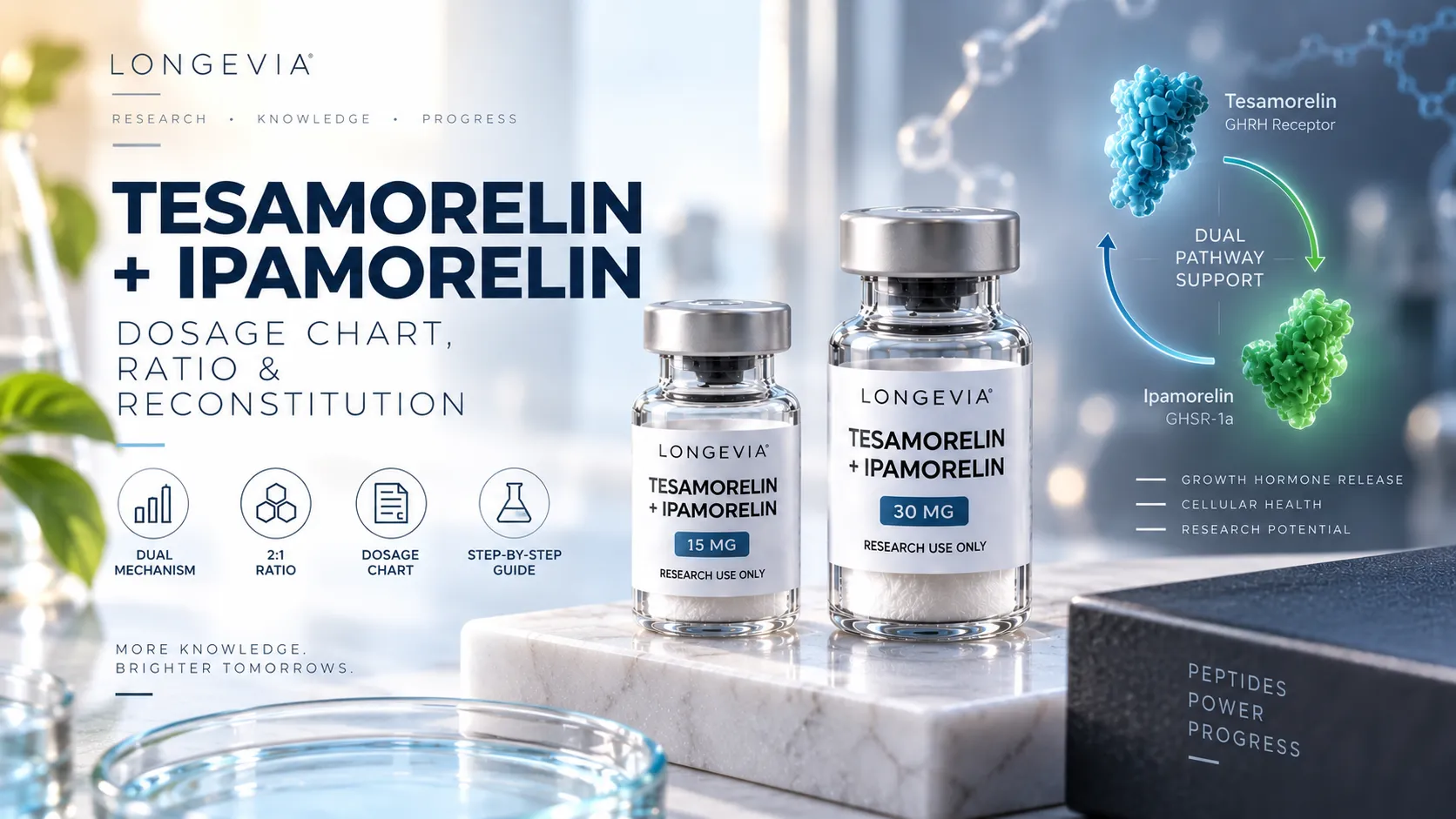
- Both SKUs use a fixed 2:1 ratio: 10 mg tesamorelin / 5 mg ipamorelin for 15 mg total, and 20 mg / 10 mg for 30 mg total.
- Tesamorelin signals through GHRHR via Gs and cAMP, while ipamorelin signals through GHSR-1a via Gq and calcium mobilization.
- Reconstituting the 15 mg vial with 3 mL gives 3.33 mg/mL tesamorelin and 1.67 mg/mL ipamorelin, placing 1 mg of tesamorelin at exactly 30 units on a U-100 syringe.
- Because the blend is co-lyophilized at a fixed ratio, the two components cannot be varied independently and single-agent controls require separate vials.
- A 2007 randomized trial of 412 patients reported a 15.2% reduction in visceral adipose tissue with tesamorelin as a single agent versus a 5.0% increase on placebo.
- Ipamorelin was characterized in 1998 as the first selective growth hormone secretagogue, releasing GH without significant ACTH or cortisol elevation.
- FDA-approved tesamorelin formulations specify different diluents — Sterile Water for EGRIFTA SV and Bacteriostatic Water for EGRIFTA WR — showing that diluent choice follows the formulation.
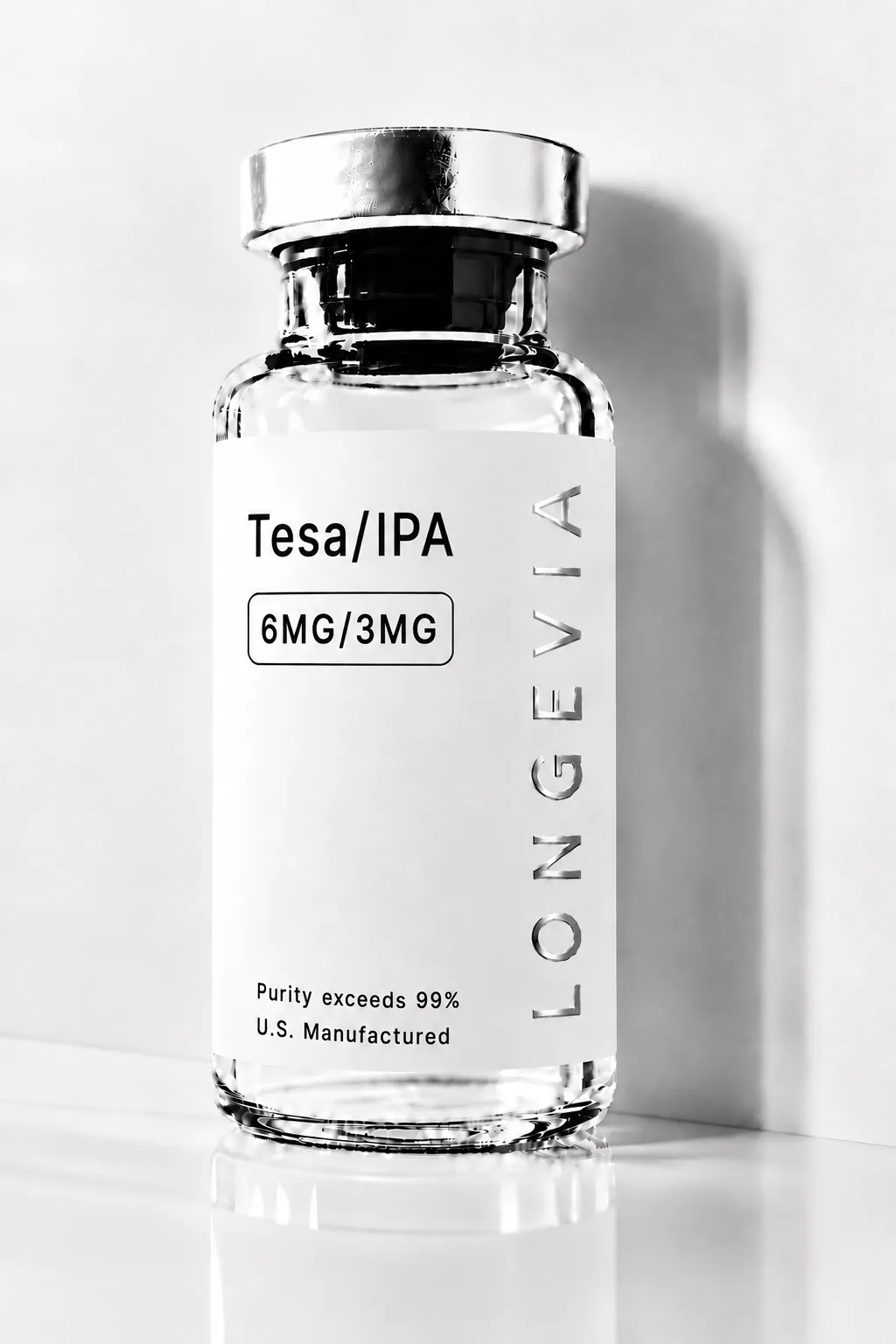
Tesa/IPA
Tesa/IPA — Tesamorelin and Ipamorelin combination research vials in 6mg/3mg and 13mg/3mg formats. GHRH-axis laboratory research compound supplied by Longevia Research for in-vitro use only.
Tesa/IPA
Tesa/IPA — Tesamorelin and Ipamorelin combination research vials in 6mg/3mg and 13mg/3mg formats. GHRH-axis laboratory research compound supplied by Longevia Research for in-vitro use only.
Unlike most peptide blends, this one publishes its numbers. Longevia's Tesamorelin / Ipamorelin ships in two vial sizes at a fixed 2:1 ratio, which means the reconstitution math actually resolves to a per-component figure instead of a lump total. That changes what you can calculate, and it also introduces a constraint worth understanding before you order: you cannot move one component without moving the other.
Tesamorelin / Ipamorelin is a research-grade dual growth hormone secretagogue blend combining a GHRH analog with a selective GHSR-1a agonist in a single lyophilized preparation. It is supplied in two SKUs at a fixed 2:1 ratio — 10 mg tesamorelin / 5 mg ipamorelin, and 20 mg / 10 mg — so a vial's total mass is 15 mg or 30 mg respectively. Both components are independently verified to at least 99% purity by third-party HPLC before co-lyophilization.
Two receptors, one vial
The somatotropic axis has two accessible entry points, and this blend uses both.
Tesamorelin is a stabilized 44-amino-acid GHRH analog carrying a trans-3-hexenoyl modification, which protects it from rapid enzymatic degradation. It signals through the GHRH receptor via Gs and cAMP. Ipamorelin is a selective pentapeptide agonist at GHSR-1a — the ghrelin receptor — signalling through Gq and calcium mobilization. Different receptors, different second messenger systems, converging on the same pituitary output.
Ipamorelin's defining characteristic in the original 1998 pharmacology work was selectivity. It released growth hormone with potency comparable to GHRP-6 while, unlike the earlier GHRPs, not producing significant elevations in ACTH or cortisol. That selectivity is the reason it appears in dual-mechanism blends rather than GHRP-2 or GHRP-6.
Tesamorelin has the larger human evidence base. A 2007 randomized trial in 412 patients with HIV-associated abdominal fat accumulation reported a 15.2% reduction in visceral adipose tissue against a 5.0% increase on placebo over 26 weeks, with IGF-1 rising 81%. A pooled analysis of two phase 3 trials covering 806 patients reproduced the effect. Those data describe tesamorelin as a single agent at a defined clinical dose, not this blend.
The 2:1 ratio and the two SKUs
SKU | Tesamorelin | Ipamorelin | Total mass | Ratio | Price |
|---|---|---|---|---|---|
Standard | 10 mg | 5 mg | 15 mg | 2:1 | $135 |
Double | 20 mg | 10 mg | 30 mg | 2:1 | $185 |
The larger vial is the same ratio at double the mass, so the only decision it represents is how much material you want per vial — not a different formulation. At $185 against $135, the 30 mg vial is meaningfully cheaper per mg, which matters for longer studies but works against you if the material will sit reconstituted for longer than it should.
The ratio is fixed by co-lyophilization. Every volume you draw carries tesamorelin and ipamorelin in a 2:1 proportion, and there is no way to adjust one component independently. Study designs that need to vary GHRH-pathway and ghrelin-pathway exposure separately require two single-entity vials, not a blend.
Reconstitution: from total mass to per-component concentration
The calculation is the standard one, run twice — once for the blend and once per component, which the disclosed ratio makes possible.
Concentration (mg/mL) = mass (mg) ÷ diluent volume (mL)
For the 15 mg vial (10 mg tesamorelin / 5 mg ipamorelin):
Diluent added | Total concentration | Tesamorelin | Ipamorelin | Per 1 unit (U-100) |
|---|---|---|---|---|
1 mL | 15 mg/mL | 10 mg/mL | 5 mg/mL | 150 mcg (100 / 50) |
2 mL | 7.5 mg/mL | 5 mg/mL | 2.5 mg/mL | 75 mcg (50 / 25) |
3 mL | 5 mg/mL | 3.33 mg/mL | 1.67 mg/mL | 50 mcg (33.3 / 16.7) |
5 mL | 3 mg/mL | 2 mg/mL | 1 mg/mL | 30 mcg (20 / 10) |
For the 30 mg vial (20 mg / 10 mg):
Diluent added | Total concentration | Tesamorelin | Ipamorelin | Per 1 unit (U-100) |
|---|---|---|---|---|
2 mL | 15 mg/mL | 10 mg/mL | 5 mg/mL | 150 mcg (100 / 50) |
3 mL | 10 mg/mL | 6.67 mg/mL | 3.33 mg/mL | 100 mcg (66.7 / 33.3) |
5 mL | 6 mg/mL | 4 mg/mL | 2 mg/mL | 60 mcg (40 / 20) |
On a U-100 insulin syringe, 100 units equals 1 mL and one unit equals 0.01 mL. That is the conversion doing all the work in the right-hand column.
Three millilitres into the 15 mg vial is the tidiest arrangement for most work: 1 mg of tesamorelin lands exactly on 30 units, carrying 0.5 mg of ipamorelin with it. Round numbers reduce arithmetic errors, and arithmetic errors are the most common failure mode in peptide preparation. Worked examples for single compounds are in our peptide dosage calculation guide.
Dosage chart
Read this as a concentration and volume reference for laboratory preparation. Both vials are assumed reconstituted with 3 mL.
Target tesamorelin | Ipamorelin carried | 15 mg vial + 3 mL | 30 mg vial + 3 mL |
|---|---|---|---|
0.5 mg | 0.25 mg | 15 units | 7.5 units |
1 mg | 0.5 mg | 30 units | 15 units |
1.5 mg | 0.75 mg | 45 units | 22.5 units |
2 mg | 1 mg | 60 units | 30 units |
Note what happens at the bottom of the chart. Two milligrams of tesamorelin drains two-thirds of a 15 mg vial in a few draws, while the same figure from the 30 mg vial at the same dilution sits at 30 units. Vial size and diluent volume together determine how many working quantities you get, which is worth deciding before reconstitution rather than after.
Handling steps
- Bring the vial to room temperature before opening.
- Wipe both stoppers with an alcohol prep and allow them to dry.
- Draw the calculated diluent volume into a sterile syringe.
- Angle the needle so the stream runs down the inside wall of the vial rather than striking the cake directly.
- Let it dissolve. Roll or swirl gently if needed — never shake.
- Inspect for clarity and absence of particulates.
- Label with per-component concentration, not just total, and add the date.
- Refrigerate.
Write both figures on the label — "3.33 / 1.67 mg/mL" rather than "5 mg/mL". The whole advantage of a disclosed-ratio blend is that per-component math is possible, and it disappears the moment the label only records the total.
Tesamorelin vs ipamorelin
Tesamorelin | Ipamorelin | |
|---|---|---|
Class | Stabilized GHRH(1-44) analog | Selective GHSR-1a agonist |
Size | 44 amino acids | Pentapeptide |
Receptor | GHRHR | GHSR-1a (ghrelin receptor) |
Signalling | Gs / cAMP | Gq / calcium |
Structural feature | Trans-3-hexenoyl modification | Aib-His-D-2-Nal-D-Phe-Lys-NH2 |
Human clinical data | Phase 3 trials, FDA-approved as a single agent | Early human PK work, no approved indication |
Role in the blend | GHRH-pathway arm | Ghrelin-pathway arm |
The mechanistic argument for pairing them is that a GHRH analog raises the amplitude of the pituitary's response while a ghrelin-receptor agonist acts on a separate input to the same cells. Neither substitutes for the other, and the comparison is not a ranking — they are answering different halves of the same question. A single-agent breakdown is in our Tesamorelin dosage and reconstitution guide.
How it compares to CJC-1295 + ipamorelin
The reference point almost everyone reaches for is CJC-1295 with ipamorelin, which pairs the same ghrelin-receptor arm with a different GHRH analog. The substantive difference sits in GHRH receptor kinetics: tesamorelin is a stabilized analog of the full 44-amino-acid GHRH sequence, while CJC-1295 is a modified GHRH(1-29) fragment. Those are different molecules with different clearance behaviour at the same receptor, which is precisely why comparative studies of the two combinations are worth running rather than assuming equivalence. Our CJC-1295 and Ipamorelin reconstitution guide covers that pairing's own math.
Tesamorelin clears quickly — prescribing information for approved formulations reports elimination in minutes rather than hours. The downstream GH and IGF-1 response outlasts the peptide's own presence in circulation by a wide margin, which is the reason short plasma half-life and once-daily clinical dosing coexist without contradiction.
Storage, diluent and stability
Lyophilized material is the stable form; store it cold, dry and out of light, and reconstitute only what the study will use. Once in solution, refrigerate and treat the preparation as short-lived.
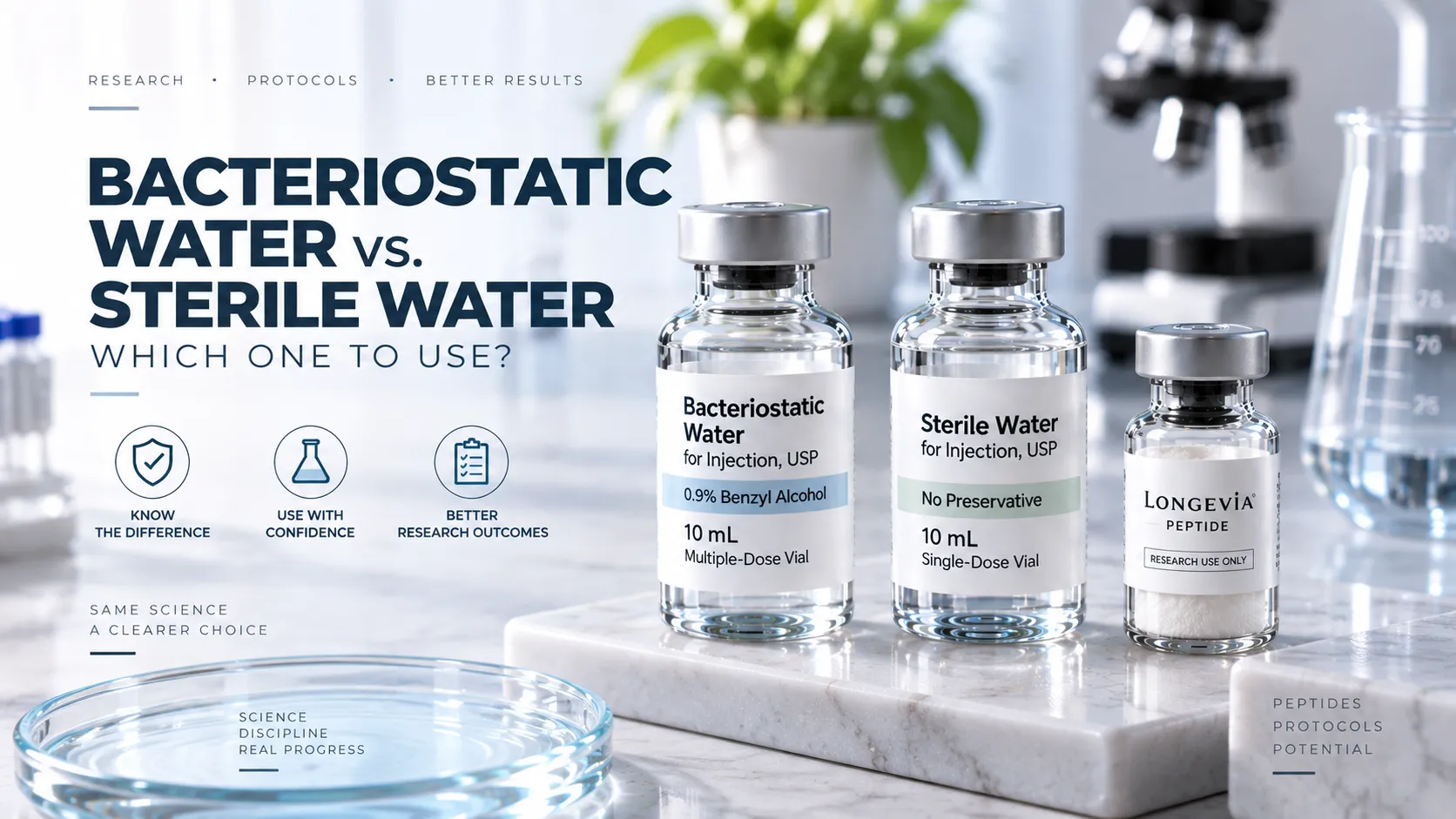
Diluent choice is not trivial, and the FDA labels for approved tesamorelin formulations make the point better than any general rule can. EGRIFTA SV is reconstituted with Sterile Water for Injection, 0.5 mL per vial. EGRIFTA WR is reconstituted with Bacteriostatic Water for Injection, 1.3 mL per vial. Same molecule, two formulations, two different specified diluents — because the diluent decision follows from the formulation and the intended number of withdrawals, not from the peptide's identity.
Bacteriostatic water contains 0.9% benzyl alcohol as a preservative, which inhibits microbial growth and permits repeated withdrawals from one vial under aseptic conditions. Pharmacopoeial practice caps preserved multiple-dose containers at 28 days after first puncture unless the manufacturer specifies otherwise. Sterile water has no preservative and suits single-withdrawal preparations. Neither extends the peptide's own chemical stability, which is a separate and usually shorter clock. Full detail is in our how long peptides last after reconstitution guide.
Study duration and what gets measured
Questions about cycle length come up constantly, and the published literature gives a clearer answer than any community convention does. The pivotal tesamorelin trials ran 26 weeks with a 26-week safety extension, and the visceral fat endpoint was measured at those intervals rather than weekly. That timescale tells you something useful about the biology: the downstream IGF-1 response moves quickly, the tissue-level changes it drives do not.
IGF-1 is the standard readout for GH-axis work because it integrates pulsatile GH secretion into a stable circulating measure. In the 2007 trial it rose 81% over 26 weeks against a 5% decline on placebo. For a dual-mechanism blend, the more interesting design measures GH pulse characteristics alongside IGF-1 — amplitude and frequency separate the GHRH-pathway contribution from the ghrelin-pathway one in a way that a single integrated marker cannot.
Ipamorelin's selectivity profile is also worth confirming rather than assuming in any given model. The 1998 characterization reported GH release without meaningful elevation of ACTH, cortisol, prolactin, FSH, LH or TSH, and that panel is a reasonable control set to run when the blend is introduced to a new system.
Where the blend is the wrong tool
A fixed-ratio co-lyophilized blend is efficient when the research question is about the combination. It is the wrong material in three situations, and recognizing them early saves a wasted arm of a study.
If you need a dose-response curve on one pathway while holding the other constant, the ratio makes that impossible. If you need single-agent controls — and any synergy claim requires them — you need separate vials regardless of what the blend contains. And if your endpoint depends on the molar concentration of one component at a precise value, working back from a shared total introduces rounding you don't need to accept.
None of that is an argument against the blend. It is an argument for knowing which question you're asking before the vial arrives.
Verification
Both components are independently verified to at least 99% purity by third-party HPLC before co-lyophilization. Confirm the lot number on your vial matches a published Certificate of Analysis, that the COA reports data for that specific lot, and that both component peptides appear in the analysis rather than a single aggregate figure. Every Longevia batch is independently HPLC/LC-MS tested, with lot-specific COAs published in the COA Library.
Frequently Asked Questions
- Falutz J, Allas S, Blot K, et al. Metabolic effects of a growth hormone-releasing factor in patients with HIV. N Engl J Med. 2007;357(23):2359-2370.
- Raun K, Hansen BS, Johansen NL, et al. Ipamorelin, the first selective growth hormone secretagogue. Eur J Endocrinol. 1998;139(5):552-561.
- Falutz J, Mamputu JC, Potvin D, et al. Effects of tesamorelin (TH9507) in HIV-infected patients with excess abdominal fat: a pooled analysis of two phase 3 trials. J Clin Endocrinol Metab. 2010;95(9):4291-4304.
- EGRIFTA SV (tesamorelin) for injection - prescribing information. DailyMed, U.S. National Library of Medicine.
- EGRIFTA WR (tesamorelin) for injection - prescribing information. DailyMed, U.S. National Library of Medicine.
- Bacteriostatic Water for Injection, USP - prescribing information, Hospira, Inc. DailyMed, U.S. National Library of Medicine.