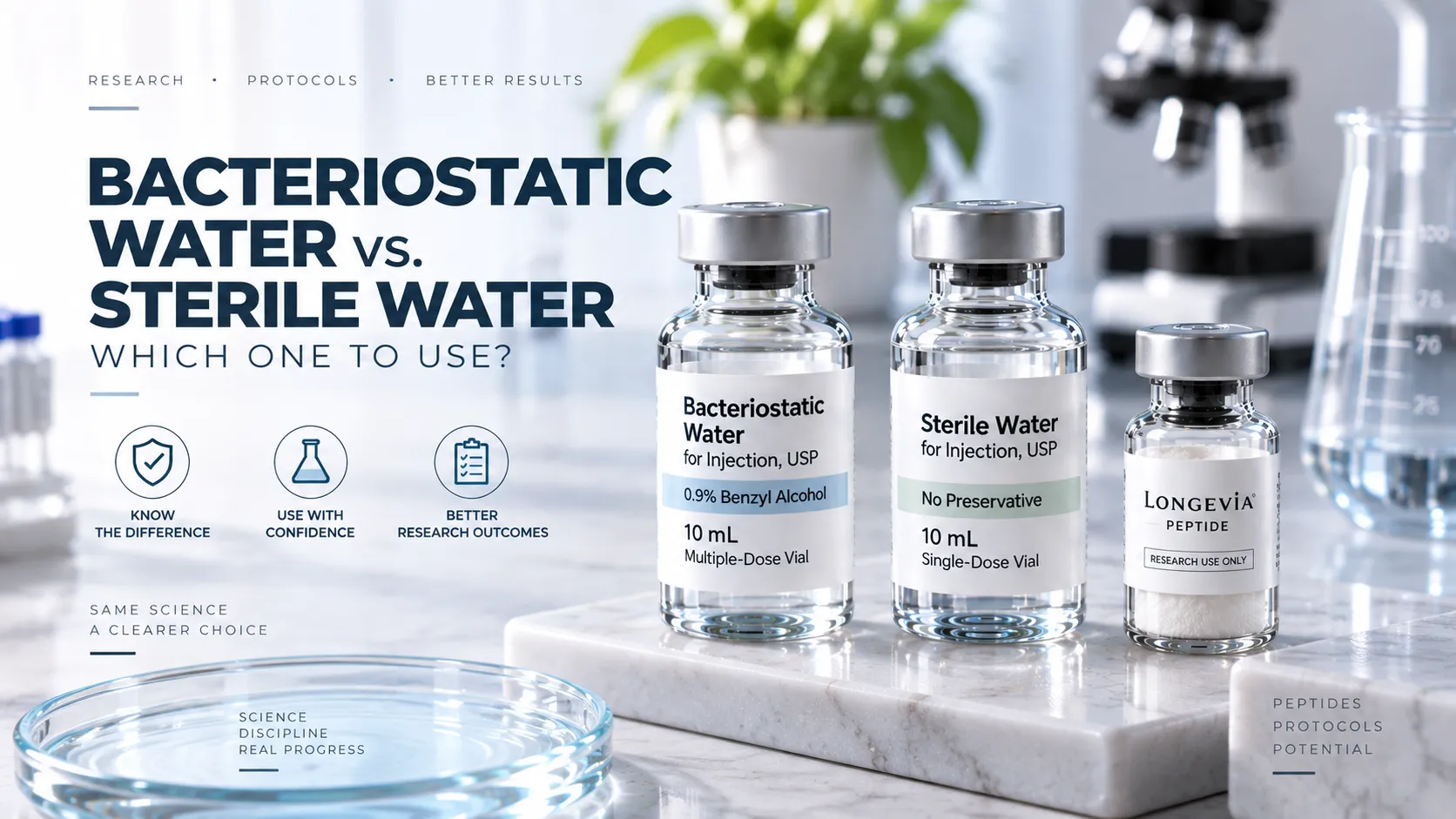
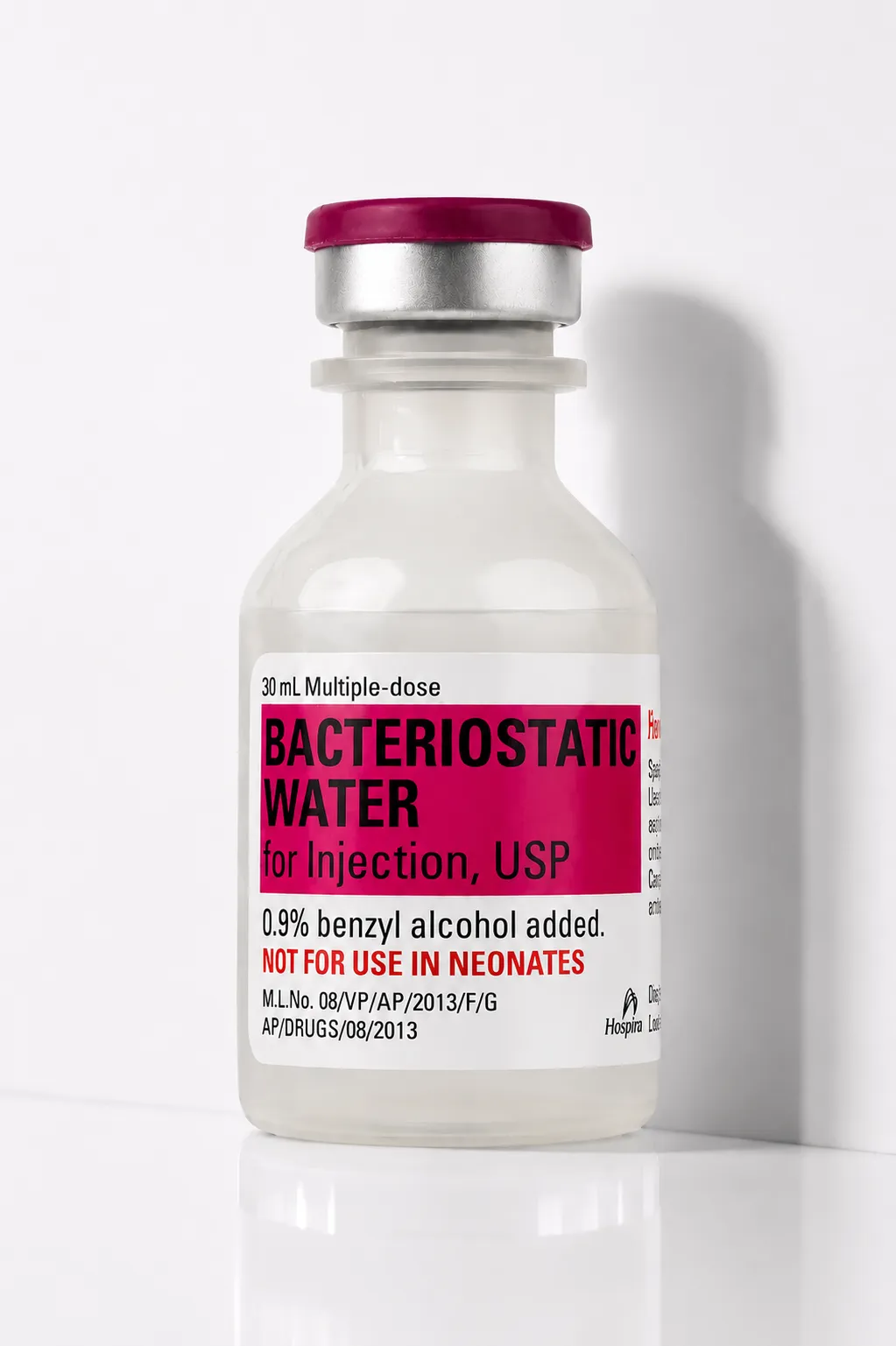
- Bacteriostatic water is sterile, non-pyrogenic water for injection containing 0.9% benzyl alcohol (9 mg/mL) as a preservative; sterile water contains no preservative.
- Bacteriostatic water is supplied in multiple-dose containers permitting repeated withdrawals, while sterile water is intended for single use.
- Preserved multiple-dose containers carry a 28-day beyond-use date after first puncture under USP <797>, unless the manufacturer's labeling specifies otherwise.
- Benzyl alcohol is bacteriostatic rather than bactericidal, inhibiting microbial growth rather than sterilizing an already contaminated solution.
- The preservative does nothing for chemical stability, so a reconstituted compound runs a separate and usually shorter degradation clock.
- Benzyl alcohol must not be used in neonates, following the 1982 report linking benzyl alcohol-preserved solutions to fatal gasping syndrome in premature infants.
- Sterile water or a defined buffer is preferred for cell culture work, because benzyl alcohol is not inert toward cultured cells.
- FDA labeling for two tesamorelin formulations specifies different diluents — Sterile Water for EGRIFTA SV and Bacteriostatic Water for EGRIFTA WR — showing the choice follows the use pattern.
Reconstitution Solution
Buy Reconstitution Solution for peptide reconstitution. 0.9% benzyl alcohol preserved, sterile filtered. Essential laboratory supply for research use only.
Reconstitution Solution
Buy Reconstitution Solution for peptide reconstitution. 0.9% benzyl alcohol preserved, sterile filtered. Essential laboratory supply for research use only.
Every lyophilized compound arrives with the same unanswered question attached: what goes in the vial. The choice is almost always between bacteriostatic water and sterile water, the two look identical, and the difference between them is one ingredient that changes how long the solution stays usable. This is the foundational decision, and it applies regardless of what you're reconstituting.
Bacteriostatic water is sterile, non-pyrogenic water for injection containing 0.9% benzyl alcohol as a preservative, supplied in multiple-dose containers that permit repeated withdrawals. Sterile water contains no preservative and is intended for single use. Choose bacteriostatic water when one vial will be entered more than once over days or weeks; choose sterile water when the preparation is used immediately, or when benzyl alcohol would interfere with the work.
What each one actually is
Bacteriostatic Water for Injection, USP is a sterile, nonpyrogenic preparation of water for injection containing benzyl alcohol added as a bacteriostatic preservative, at 0.9% (9 mg/mL) or in some products 1.1% (11 mg/mL). It is supplied in a multiple-dose container from which repeated withdrawals may be made to dilute or dissolve compounds. The pH sits at 5.7, with a specification range of 4.5 to 7.0.
Sterile Water for Injection, USP is the same water held to the same purity and pyrogen standards, minus the preservative. Nothing in it inhibits microbial growth. Once the seal is broken and the contents are exposed, any organism introduced by a needle or by air has an unopposed environment.
That single difference cascades into everything else — how many times you can enter the vial, how long the contents last, and which applications each is appropriate for.
What "water for injection" and "non-pyrogenic" mean
Both products start from the same base material, and the base material is not ordinary purified water. Water for Injection is a compendial grade held to defined limits for conductivity, total organic carbon and bacterial endotoxins, produced by distillation or an equivalent purification process. "Non-pyrogenic" refers specifically to that endotoxin limit — the absence of fever-inducing bacterial cell wall fragments, which survive sterilization and are not removed by filtration alone.
This is why deionized, distilled or laboratory-grade water is not an acceptable substitute for either product. Sterility and pyrogen control are separate specifications, and a water that is sterile is not automatically non-pyrogenic. When a protocol calls for water for injection, the grade is part of the specification rather than a formality.
Side-by-side
Bacteriostatic water | Sterile water | |
|---|---|---|
Preservative | 0.9% benzyl alcohol (9 mg/mL) | None |
Container type | Multiple-dose | Single-dose |
Repeated withdrawals | Yes, under aseptic technique | No |
Shelf life after first puncture | 28 days, unless labeling states otherwise | Use immediately; discard remainder |
Microbial control after opening | Preservative inhibits growth | None |
Typical pH | 5.7 (range 4.5-7.0) | Approximately neutral, unbuffered |
Best for | Preparations entered repeatedly over days or weeks | Single-withdrawal preparations, cell culture work |
Not suitable for | Neonates; applications where benzyl alcohol interferes | Multi-withdrawal storage |
Longevia SKUs | Reconstitution Solution, 3 mL ($8) and 10 mL ($12) | — |
That table is the answer to most of the question. The rest is the reasoning behind each row, which matters when your situation doesn't sit neatly in either column.
How benzyl alcohol works, and what it doesn't do
Benzyl alcohol is bacteriostatic rather than bactericidal. It inhibits microbial growth rather than sterilizing a contaminated solution — the distinction is not pedantic. A vial that picks up contamination through sloppy technique is not rescued by the preservative; the preservative only suppresses proliferation of what gets in. Aseptic technique is still the primary control, and the preservative is the backstop.
It also does nothing for chemical stability. A peptide in solution degrades through hydrolysis, oxidation, deamidation and aggregation regardless of whether benzyl alcohol is present. Two separate clocks run on any reconstituted vial: a microbial one governed by the preservative, and a chemical one governed by the compound's own stability in solution. For most peptides the chemical clock is the shorter of the two, which means a preserved diluent buys you multi-withdrawal convenience, not a longer usable life.
Benzyl alcohol must not be used in neonates. The restriction traces to a 1982 New England Journal of Medicine report linking benzyl alcohol-preserved solutions to fatal gasping syndrome in premature infants, which prompted an FDA warning. Product labeling for bacteriostatic water carries an explicit "not for use in neonates" warning as a result.
How long does bacteriostatic water last after opening?
The working answer is 28 days from first puncture, unless the manufacturer's labeling specifies something shorter.
That figure comes from pharmacopoeial practice for preserved multiple-dose containers. USP General Chapter <797> assigns a beyond-use date of 28 days after a multiple-dose container is initially entered or punctured, unless otherwise specified by the manufacturer, on the basis that such containers are formulated with antimicrobial preservatives tested under USP <51>. Some commercial labels shorten this — 30-day discard instructions and "refrigerate after opening" appear on certain products — and where labeling and the general rule disagree, the label wins.
Unopened, the vial is good until its printed expiration date, stored at controlled room temperature.
Two practical habits follow. Write the puncture date on the vial the first time you enter it, because a 28-day window is unenforceable if nobody knows when day one was. And track the diluent's date independently of the reconstituted compound's date — they are different clocks, and the reconstituted material almost always expires first.
Can you use sterile water instead of bacteriostatic water?
Yes, in the right circumstances, and the clearest evidence that this is a real decision rather than a preference comes from two FDA labels for the same molecule.
Formulation | Specified diluent | Volume | Why |
|---|---|---|---|
EGRIFTA SV (tesamorelin) | Sterile Water for Injection | 0.5 mL per vial | Single-use reconstitution |
EGRIFTA WR (tesamorelin) | Bacteriostatic Water for Injection, USP | 1.3 mL per vial | Multi-withdrawal formulation |
Same active compound, two formulations, two different specified diluents. The diluent follows from how the preparation will be used, not from the identity of what's being dissolved.
Sterile water is the right call when the solution is consumed in a single withdrawal, when the preparation is diluted immediately into buffer or culture medium, or when benzyl alcohol would interfere with the experiment. It is the wrong call whenever a vial will be entered repeatedly over days, because there is nothing in it to suppress growth between withdrawals.
When benzyl alcohol is the wrong diluent
Three situations where preserved water is a poor choice, beyond the neonatal restriction above.
Cell culture work is the big one. Benzyl alcohol is not inert toward cultured cells, and a preserved diluent introduces a variable into cytotoxicity, proliferation and viability assays that has nothing to do with the compound under study. In vitro protocols generally specify sterile water, PBS, or a defined buffer for exactly this reason. If your endpoint is cell viability, your diluent should not be capable of affecting it.
Assay interference is the second. Any analytical method sensitive to organic content — certain chromatographic or spectroscopic readouts — can pick up the preservative. If you are quantifying at low concentrations, an unpreserved diluent removes an avoidable confounder.
Buffer-dependent solubility is the third. Bacteriostatic water is unbuffered and mildly acidic at pH 5.7. Compounds requiring a defined pH for solubility or stability are usually reconstituted in PBS at pH 7.0-7.4 instead, and no amount of preservative compensates for a peptide that drops out of solution.
Reconstitution practice
The mechanics are the same regardless of which diluent you choose.
- Bring both vials to room temperature before opening anything.
- Wipe both stoppers with an alcohol prep and let them dry — wet alcohol carried into the vial on a needle is its own problem.
- Draw the calculated diluent volume into a sterile syringe.
- Angle the needle so the stream runs down the inside wall of the compound vial. A jet fired directly into a lyophilized cake causes unnecessary foaming and stress.
- Let it dissolve on its own. Most cakes go into solution within a minute or two.
- Swirl or roll gently if material remains. Do not shake.
- Inspect against light for clarity and absence of particulates. Do not use a cloudy solution.
- Label with concentration and date, then refrigerate.
Vial size is a practical decision, not a cosmetic one. A 3 mL vial is right when you reconstitute small amounts or infrequently, because you'll finish it inside the 28-day window. A 10 mL vial is more economical per millilitre but only if the volume actually gets used before the window closes — otherwise you're paying less per mL to discard more of it.
Getting the full 28 days out of a vial
A preserved multiple-dose vial reaches its labeled window only under aseptic technique, and technique is where most vials fail early.
Use a fresh sterile needle for every entry. Reusing a needle between the diluent vial and a compound vial, or leaving a needle parked in the stopper between withdrawals, defeats the purpose of a preserved container — the preservative suppresses growth, it does not neutralize whatever a used needle carries in.
Swab the stopper before every puncture, not just the first. Stoppers accumulate whatever is in the room air between uses, and a single alcohol wipe on day one does nothing for day nine.
Let the alcohol dry. Pushing a needle through a wet stopper carries alcohol into the vial, which is both a contamination route and an unnecessary addition to the solution.
Minimize the number of entries. Each puncture is a coring risk and a contamination opportunity, and stoppers are not infinitely self-sealing. Drawing one larger volume that gets aliquoted is usually better practice than a dozen small withdrawals from the same septum.
Inspect before each use. Cloudiness, visible particulates or a compromised seal mean the vial is finished regardless of what the date on the label says.
Storage and handling
Store unopened bacteriostatic water at controlled room temperature, 20 to 25°C. Some labels direct refrigeration after opening; follow the specific label in front of you. Keep vials out of direct light, check the solution is clear before every use, and discard any vial whose seal integrity is in doubt or whose contents look cloudy.
Reconstituted compounds are a separate storage question entirely. The diluent's 28-day preservative window says nothing about how long the dissolved compound remains chemically intact, which varies by molecule and is usually shorter. Our how long peptides last after reconstitution guide covers that side of it, and the volume-and-concentration math is in our peptide dosage calculation guide.
Does the compound change the answer?
Usually less than people expect. The diluent decision is driven mostly by how the preparation will be used rather than by what's in the vial, which is why a general-purpose answer holds across compounds.
There are exceptions worth checking. Compounds with a narrow solubility window may specify a buffered vehicle at a defined pH rather than unbuffered water. Some products carry a manufacturer-specified diluent in their documentation, and where that exists it overrides any general rule. And compounds intended for immediate single use rarely benefit from a preservative at all, since the material never sits long enough for microbial control to matter.
The default remains straightforward: multi-withdrawal means preserved, single-use means unpreserved, and anything with its own documented diluent follows its own documentation.
Choosing, in one paragraph
If a vial will be entered more than once, use bacteriostatic water and date it. If the preparation is single-use, immediately diluted, or destined for a cell-based assay, use sterile water or an appropriate buffer. If you are working with anything where benzyl alcohol could plausibly touch your endpoint, remove it from the equation rather than arguing about whether the concentration is low enough to matter.
Longevia's Reconstitution Solution is a sterile, non-pyrogenic preparation of water for injection with 0.9% benzyl alcohol, supplied in 3 mL and 10 mL vials, and it is the standard choice for multi-withdrawal peptide reconstitution under aseptic conditions.
Frequently Asked Questions
- Bacteriostatic Water for Injection, USP - prescribing information, Hospira, Inc. DailyMed, U.S. National Library of Medicine.
- Gershanik J, Boecler B, Ensley H, McCloskey S, George W. The gasping syndrome and benzyl alcohol poisoning. N Engl J Med. 1982;307(22):1384-1388.
- United States Pharmacopeia. General Chapter <797> Pharmaceutical Compounding - Sterile Preparations: beyond-use dating for multiple-dose containers.
- EGRIFTA SV (tesamorelin) for injection - prescribing information. DailyMed, U.S. National Library of Medicine.
- EGRIFTA WR (tesamorelin) for injection - prescribing information. DailyMed, U.S. National Library of Medicine.