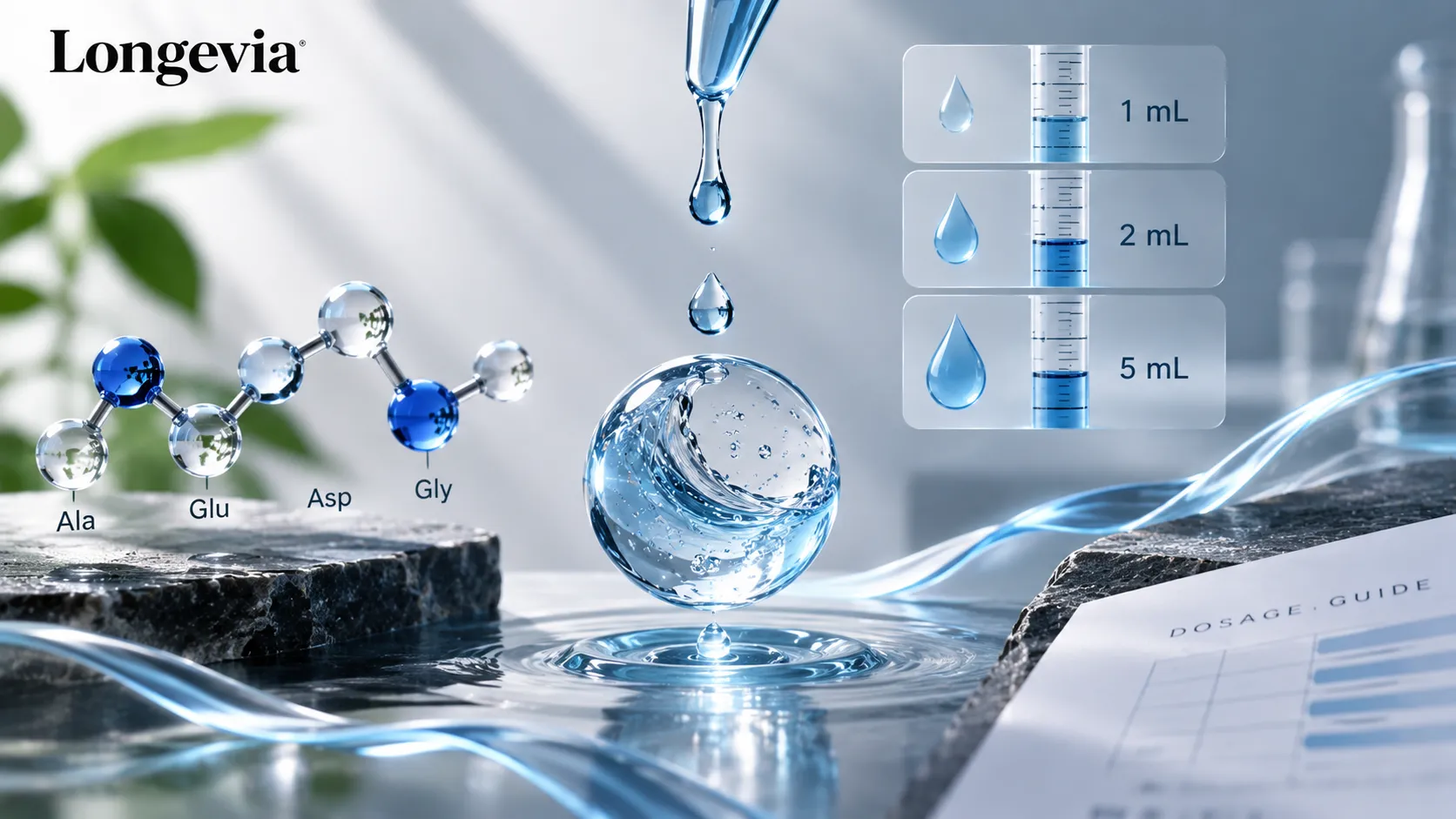
- Epithalon (Epitalon) is the synthetic tetrapeptide Ala-Glu-Asp-Gly, with a molecular weight of 390.35 g/mol for the free peptide.
- The peer-reviewed human study of synthetic Epitalon reviewed here (Korkushko et al., 2007) used 10 mcg intramuscularly once daily for 10 days, a 0.1 mg course.
- Published human programs using 10 mg injections studied Epithalamin, a bovine pineal extract, not synthetic Epitalon.
- Circulating Epithalon protocols of 5–10 mg per day for 10–20 days are community convention with no cited trial behind them.
- Reconstituted concentration equals vial mass divided by diluent volume, so 10 mg in 2 mL gives 5 mg/mL.
- A 10 mcg amount becomes measurable after serial dilution to 0.1 mg/mL, where it equals 0.1 mL.
- No compound-specific published stability study for reconstituted Epitalon was identified, so quoted shelf-life windows reflect general peptide practice.
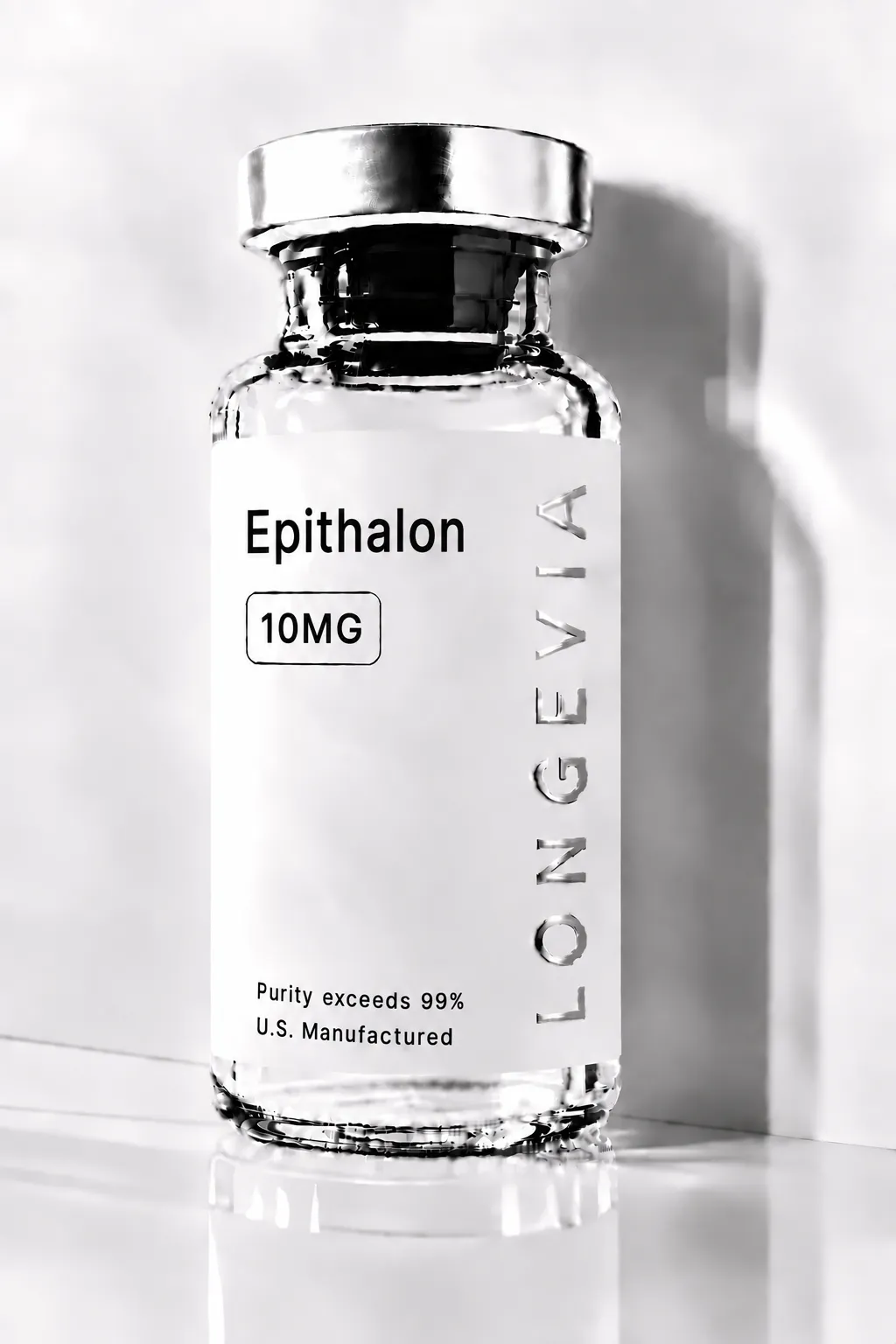
Epithalon
Epithalon (Epitalon) is a synthetic tetrapeptide investigated in research involving telomerase activation, telomere biology, pineal gland peptide pharmacology, and aging biology research models. Available in 10mg and 50mg vials. Research Use Only — Longevia Research.
Epithalon
Epithalon (Epitalon) is a synthetic tetrapeptide investigated in research involving telomerase activation, telomere biology, pineal gland peptide pharmacology, and aging biology research models. Available in 10mg and 50mg vials. Research Use Only — Longevia Research.
Epithalon (also spelled Epitalon) is a synthetic tetrapeptide, and the question of dosage has two very different answers depending on where you look. The published literature on the synthetic peptide describes microgram-level schedules. The figures circulating in research communities sit in the milligram range, roughly a thousand times higher. This guide lays out both, labels each one by its evidence basis, and then walks through the reconstitution math that turns a vial of lyophilized powder into a known concentration and a measurable volume. For mechanism, telomere findings and regulatory status, see Longevia's companion post, the Epithalon research guide, telomeres and regulatory status.
Quick answer: Adding 1 mL of bacteriostatic water to a 10 mg Epithalon vial gives 10 mg/mL, 2 mL gives 5 mg/mL, and 5 mL gives 2 mg/mL. The peer-reviewed human study of synthetic Epitalon cited in this guide used 10 mcg per day for 10 days, a 0.1 mg course. The 5–10 mg daily figures quoted widely online are community convention, not values from a cited trial.
What Is Epithalon, and Why Does Its Identity Change the Dosage Math?
Epithalon is the tetrapeptide Ala-Glu-Asp-Gly (AEDG), and separating it from the pineal extract Epithalamin is the single most important step in reading any dosage figure correctly.
The synthetic peptide has the molecular formula C14H22N4O9 and a molecular weight of 390.35 g/mol for the free peptide, as listed in its original US patent. It was synthesized based on the amino acid composition of Epithalamin, a polypeptide complex extracted from bovine pineal glands. Both were developed at the St. Petersburg Institute of Bioregulation and Gerontology under Vladimir Khavinson, and most published research on either compound comes from that group and its collaborators. Independent in-vitro work has started to appear, including a 2025 telomere study from Brunel University London.
Here's why the distinction matters for dosing. Epithalamin is a mixture of peptides, so a 10 mg injection of the extract delivers 10 mg of many different molecules. Epitalon is a single defined sequence. When the 2007 Korkushko study gave both preparations to elderly volunteers, the authors reported a comparable effect on night-time melatonin from a 0.1 mg Epitalon course and a 50 mg Epithalamin course. They described that as a 1:500 dose ratio.
Epithalamin vs. Epitalon at a glance
Property | Epithalamin | Epitalon (Epithalon) |
|---|---|---|
What it is | Polypeptide complex extracted from bovine pineal glands | Synthetic tetrapeptide Ala-Glu-Asp-Gly |
Composition | Mixture of peptides | One defined sequence, 390.35 g/mol |
Typical published human injection | 10 mg | 10 mcg |
Published human course totals | 50–100 mg | 0.1 mg |
Two practical consequences follow for anyone doing reconstitution math. First, a milligram figure borrowed from Epithalamin research cannot be treated as an Epitalon figure. Second, the mass printed on a vial is usually a gross lyophilized mass. Commercial Epitalon is commonly supplied as an acetate or trifluoroacetate (TFA) salt, and the original patent batch listed about 5% residual moisture, so the net peptide content can sit slightly below the label mass. For molar work, 1 mg of free Epitalon equals about 2.56 µmol. The name varies too: Epitalon, Epithalon and Epithalone all describe the same AEDG sequence, and some papers use only the sequence name, so search for all four when checking a source.
Epithalon Dosage Chart: Every Figure Labeled by Evidence Basis
An Epithalon dosage chart is only useful when each row states where its number comes from, so the chart below separates peer-reviewed studies, a patent disclosure, animal and cell work, and community convention.
Researchers searching "how much Epithalon" usually find one blended answer, and that's the core problem. The figures actually come from at least four different kinds of source, and they don't carry equal weight. A peer-reviewed human study, a patent example, a lifelong mouse experiment and a forum protocol can all be quoted as "the Epithalon dose" without any label attached. The table keeps them apart.
Source | Substance | Model | Amount per administration | Course length and repeats | Course total | Evidence basis |
|---|---|---|---|---|---|---|
Korkushko et al., 2007 | Epitalon | Elderly humans, n = 15 | 10 mcg IM, once daily | 10 days; authors proposed 2–3 courses per year | 0.1 mg | Verified published study |
Korkushko et al., 2007 | Epitalon | Old rhesus monkeys | 10 mcg per animal IM, once daily | 10 days | 0.1 mg | Verified published study (primate) |
US Patent 6,727,227 | Epitalon | Patients, n = 14 and n = 11 | 10 mcg IM, once daily | 10 days | 0.1 mg | Patent disclosure, not peer-reviewed |
Anisimov et al., 2003 | Epitalon | Female SHR mice | 1 mcg per mouse SC (about 30–40 mcg/kg) | 5 consecutive days every month, lifelong | 5 mcg per monthly run | Verified published study (rodent) |
Al-dulaimi et al., 2025 | Epitalon | Human cell lines | 0.1–1 mcg/mL in culture | 4 days to 3 weeks | Not applicable | Verified published study (in vitro) |
Khavinson & Morozov, 2003 (St. Petersburg arm) | Epithalamin | Elderly humans | 10 mg IM, once daily | 10 days, repeated after 1 year | 100 mg | Verified published study, different substance |
Khavinson & Morozov, 2003 (Kiev arm) | Epithalamin | Elderly humans | 10 mg IM per injection | 5 injections every 2–3 days, every 5–6 months for 3 years | 50 mg | Verified published study, different substance |
Community practice | Epitalon | Not a study | 5–10 mg SC, once daily | 10–20 days, 1–2 runs per year | 50–200 mg | Circulating convention, no cited trial |
Read down the "Course total" column and the pattern is hard to miss. Every schedule that used synthetic Epitalon in humans or primates totals 0.1 mg per course. The milligram-scale human numbers belong to the extract, and the largest milligram figures of all belong to the community row. A 10-day run at 5 mg per day totals 50 mg, which is 500 times the published Epitalon course. A 20-day run at 10 mg per day totals 200 mg, or 2,000 times.
The "Model" column matters just as much. A per-kilogram mouse dose doesn't convert to another species by simple body-weight multiplication, and a cell culture concentration in mcg/mL isn't a dose at all. Routes differ as well: the human and primate studies injected intramuscularly, the mouse study used subcutaneous injection, and community protocols almost always describe subcutaneous use. Each of those differences changes how directly one row can be compared with another.
None of this says which schedule a given research design should use. It says what each number is, so a protocol can be built on a figure whose origin is known.
What the Published Epithalon Studies Actually Tested
Peer-reviewed human data on synthetic Epitalon is small: one 2007 study gave 15 elderly volunteers 10 mcg per day for 10 days, while the larger and longer human programs used the Epithalamin extract at milligram doses.
Korkushko et al., 2007: the synthetic peptide in humans
This study, published in Russian in Advances in Gerontology with an English abstract, screened healthy people aged 60–79 and randomized them into three groups. Fifteen received Epithalamin, 15 received Epitalon and 10 received saline placebo. The Epitalon group got 0.01 mg (10 mcg) in 2 mL of saline, injected intramuscularly at 10 a.m. every day for ten injections. Plasma melatonin was measured by radioimmunoassay across a 24-hour sampling schedule before and after the course.
Among the 12 Epitalon subjects classed as having reduced pineal melatonin output, mean plasma melatonin at 3 a.m. rose from 20 to 49 pg/mL. It didn't change in the three subjects whose pineal output was already normal. The methods section doesn't describe blinding, and the sample is small. The authors suggested repeating the 10-day course two to three times a year, but that recommendation wasn't itself tested as a multi-year schedule in this paper.
Primate and rodent schedules
The same paper reported a monkey arm using 10 mcg per animal, intramuscularly, once daily for 10 days. In old rhesus monkeys aged 20–26 years, evening melatonin at 10 p.m. rose from 45 to 81 pg/mL, while young monkeys showed no change.
Anisimov and colleagues took a different approach in mice. Female SHR mice received 1 mcg of Epitalon per mouse, about 30–40 mcg/kg, subcutaneously on five consecutive days every month from three months of age until natural death, with 54 animals per group. Epitalon didn't change mean lifespan, body weight or food consumption. It did reduce chromosome aberrations in bone marrow cells by 17.1% and extended the lifespan of the longest-lived 10% of animals by 13.3%.
Epithalamin figures are not Epitalon figures
Khavinson and Morozov's 2003 report covered 266 elderly people followed for six to eight years, but every dose in it was Epithalamin or the thymic extract Thymalin. The St. Petersburg arm used 10 mg daily for 10 days per course. The Kiev arm used five 10 mg injections at 2–3 day intervals, repeated every five to six months for three years.
The US patent for the tetrapeptide sits in its own category. It describes 10 mcg daily for 10 days in 14 patients aged 34 to 69 and a separate group of 11, and it claims a broad range of 0.01–100 mcg/kg for 10–40 days. A patent is a disclosure, not a peer-reviewed trial.
Where the 5–10 mg per Day Epithalon Figures Come From
The 5–10 mg per day Epithalon figures, typically run for 10–20 days once or twice a year, are community convention: they circulate widely on dosing sites and forums, but no peer-reviewed trial located for this guide tested them.
That doesn't make the numbers invented. It means their origin can't be traced to a cited study, and they should be labeled that way. A researcher who reads "10 mg daily for 20 days" on a protocol page is looking at practice that has spread through repetition, not a schedule with published outcome data behind it.
Trial data vs. circulating convention: The only human schedules for synthetic Epitalon found in the peer-reviewed and patent literature for this guide use 10 mcg per day. Milligram-per-day Epitalon protocols have no cited trial behind them. Milligram-scale human data exists only for Epithalamin, a different preparation, and those figures don't transfer to the synthetic peptide.
One plausible explanation for the gap is that the 10 mg injection size from Epithalamin studies was carried over to the synthetic peptide. Treat that as an inference, though, not a documented history. It fits the numbers neatly, but nobody has published the lineage of the convention.
Several other details differ between convention and the literature. Community protocols usually specify subcutaneous administration in the evening, often justified by melatonin's night-time rhythm. The 2007 human study gave Epitalon intramuscularly at 10 a.m., a timing the authors selected for the Epithalamin arm based on earlier chronopharmacology work. Convention commonly runs 1–2 cycles per year, whereas the study authors proposed 2–3 short courses. Cycle length also varies: circulating protocols range from 10 to 20 days, while every published Epitalon human and primate course found here lasted 10 days.
Absence of trial data cuts both ways. It isn't evidence that milligram amounts do something the microgram schedule doesn't, and it isn't evidence of harm either. The patent's acute toxicity test found no deaths in mice after single intramuscular doses of 1–5 mg/kg, but a single-dose mouse finding says nothing definitive about repeated milligram exposure in other models. The honest position is that the milligram range is uncharacterized in published research.
Epithalon Reconstitution: How to Calculate Concentration
Epithalon concentration equals vial mass divided by diluent volume, so a 10 mg vial reconstituted with 2 mL of diluent gives 5 mg/mL, which is 5,000 mcg/mL.
The math is simple. The choices around it matter more, because the diluent volume you pick decides whether your target amount lands in a measurable volume. The general steps used in most labs look like this:
- Confirm the vial mass on the label and match the lot number to its Certificate of Analysis.
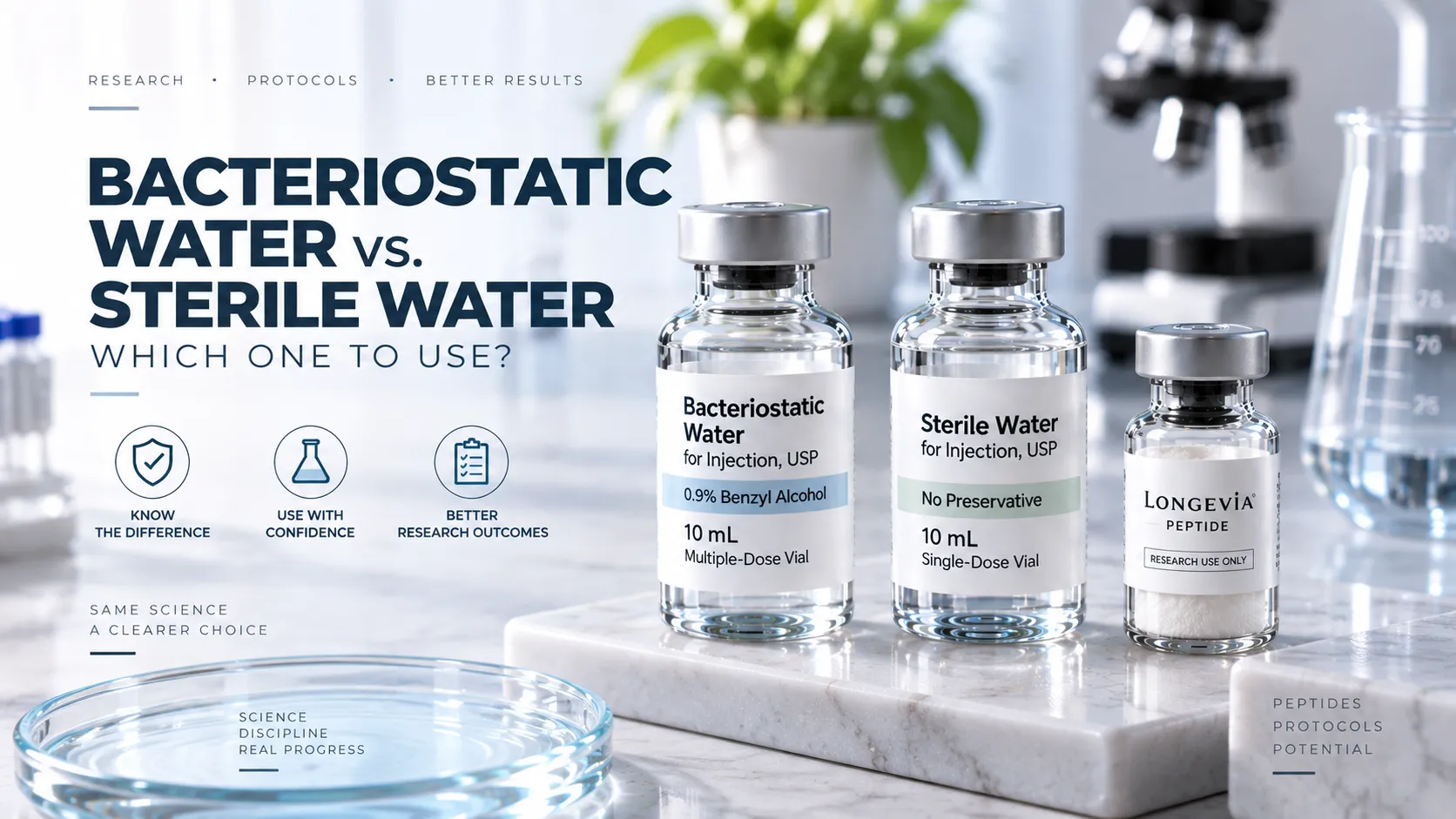
- Choose the diluent: bacteriostatic water (sterile water with 0.9% benzyl alcohol) for a vial that will be drawn from more than once, or sterile water for single-use preparations.
- Pick a diluent volume that puts your working amount in an easily measured range, using the table below. More diluent lowers the concentration, which makes small amounts easier to measure but means larger volumes for big ones.
- Add the diluent slowly down the inside wall of the vial rather than directly onto the powder.
- Swirl gently until the solution is clear; vigorous shaking is commonly avoided with peptides.
- Label the vial with the concentration, the diluent used and the date of reconstitution.
Vial mass | Diluent added | Concentration (mg/mL) | Concentration (mcg/mL) | Amount in 0.1 mL (10 units, U-100) |
|---|---|---|---|---|
10 mg | 1 mL | 10 | 10,000 | 1,000 mcg |
10 mg | 2 mL | 5 | 5,000 | 500 mcg |
10 mg | 3 mL | 3.33 | 3,333 | 333 mcg |
10 mg | 5 mL | 2 | 2,000 | 200 mcg |
10 mg | 10 mL | 1 | 1,000 | 100 mcg |
50 mg | 2 mL | 25 | 25,000 | 2,500 mcg |
50 mg | 5 mL | 10 | 10,000 | 1,000 mcg |
50 mg | 10 mL | 5 | 5,000 | 500 mcg |
A few notes keep the table honest. Epitalon is sold in several vial sizes, with 10 mg and 50 mg among the most common, so always calculate from the mass printed on your specific vial. Larger diluent volumes may exceed the physical capacity of a small vial; check fill volume before planning a 10 mL reconstitution. And because label mass is usually gross mass, these concentrations are nominal. If a study design needs exact molar dosing, correct using the net peptide content from the COA.
For the general formulas behind these numbers, including how to rework them for any vial size, see the peptide dosage calculation guide.
How Many Units of Epithalon per Dose? Volume Conversions from mcg to mL
The volume to draw equals the target amount divided by the concentration, so 5 mg from a 5 mg/mL solution is 1.0 mL, or 100 units on a U-100 syringe where 1 unit equals 0.01 mL.
This is where the microgram-versus-milligram split becomes a practical measuring problem. Milligram amounts fit comfortably into standard concentrations. The 10 mcg amount used in published Epitalon research doesn't, because at typical stock strengths it's a fraction of a single syringe unit.
Target amount | At 10 mg/mL | At 5 mg/mL | At 1 mg/mL | At 0.1 mg/mL |
|---|---|---|---|---|
10 mcg | 0.001 mL (0.1 unit) | 0.002 mL (0.2 unit) | 0.01 mL (1 unit) | 0.1 mL (10 units) |
100 mcg | 0.01 mL (1 unit) | 0.02 mL (2 units) | 0.1 mL (10 units) | 1.0 mL (100 units) |
1 mg | 0.1 mL (10 units) | 0.2 mL (20 units) | 1.0 mL (100 units) | 10 mL (not practical) |
5 mg | 0.5 mL (50 units) | 1.0 mL (100 units) | 5 mL (not practical) | 50 mL (not practical) |
10 mg | 1.0 mL (100 units) | 2.0 mL (200 units) | 10 mL (not practical) | 100 mL (not practical) |
Look at the top row. A 10 mcg amount drawn from a 10 mg/mL stock is 0.001 mL, far below what a standard U-100 syringe can measure reliably. Even at 1 mg/mL it's a single unit, where small graduation errors become a large percentage of the total.
Measuring microgram amounts: Serial dilution solves the 10 mcg problem. Reconstitute a 10 mg vial with 10 mL to make a 1 mg/mL stock, then mix 0.1 mL of that stock with 0.9 mL of diluent. The result is 1.0 mL at 0.1 mg/mL, where 10 mcg is a readable 0.1 mL (10 units).
For cell culture, the conversion runs through molarity instead of syringe units. The 2025 Brunel study treated human cell lines with 0.1–1 mcg/mL of Epitalon, and 1 mcg/mL of the free peptide equals about 2.56 µM. Likewise, a 10 mcg amount contains roughly 25.6 nmol of peptide.
Milligram math works the same way in reverse. A 10 mg amount from a 50 mg vial reconstituted with 5 mL is 1.0 mL. A 10-day run at that amount needs 100 mg in total, which means two 50 mg vials or ten 10 mg vials, a useful check when planning supply.
Double-check every calculation before preparing a solution. A misplaced decimal between mg and mcg is a thousandfold error, and in Epithalon's case that's exactly the size of the gap between the literature and convention.
How Long Does Reconstituted Epithalon Last, and How Should It Be Stored?
Lyophilized Epithalon is commonly stored cold and away from light, and reconstituted solution is typically refrigerated at 2–8 °C, but the shelf-life windows quoted for Epithalon are general peptide-handling conventions rather than results from a compound-specific published stability study.
That caveat deserves to sit up front. No peer-reviewed stability study for reconstituted Epitalon was identified in preparing this guide, so any specific day count you see for it is borrowed from general peptide practice. The handling principles themselves are well established across peptide work, though, and they're worth following closely.
Handling practices that protect the solution
Bacteriostatic water is the usual choice for multi-draw vials because its benzyl alcohol content inhibits microbial growth each time the stopper is punctured. Sterile water has no preservative, which makes it better suited to single-use preparations. Repeated freeze-thaw cycles are generally avoided with dissolved peptides, so labs that need longer storage often split a fresh solution into single-use aliquots before freezing. Keep vials out of direct light, wipe stoppers before each draw, and discard any solution that turns cloudy or shows particles.
Labeling isn't optional. Record the concentration, the diluent, the reconstitution date and the lot number on every vial, and do the same for any serial dilution, since a 0.1 mg/mL working solution looks identical to a 1 mg/mL stock.
For timelines and a broader comparison across compounds, see the how long peptides last after reconstitution guide.
Check the COA before you calculate
Every calculation in this guide assumes the vial contains what the label says. Every Longevia Research batch is independently tested by HPLC and LC-MS, and the lot-specific COA is published in the site's COA Library. Before reconstituting, match the lot number on the vial to its COA, confirm the HPLC purity figure, and check that the mass spectrometry result is consistent with Epitalon's expected mass of about 390 Da for the free peptide. If net peptide content is reported, use it for any precise molar work.
Frequently Asked Questions
- Khavinson VKh, Bondarev IE, Butyugov AA. Epithalon peptide induces telomerase activity and telomere elongation in human somatic cells. Bull Exp Biol Med. 2003;135(6):590-592. doi:10.1023/A:1025493705728
- Khavinson VKh, Morozov VG. Peptides of pineal gland and thymus prolong human life. Neuro Endocrinol Lett. 2003;24(3-4):233-240.
- Korkushko OV, Lapin BA, Goncharova ND, Khavinson VKh, Shatilo VB, Vengerin AA, Antoniuk-Shcheglova IA, Magdich LV. Normalizing effect of the pineal gland peptides on the daily melatonin rhythm in old monkeys and elderly people. Adv Gerontol. 2007;20(1):74-85. [Article in Russian]
- Anisimov VN, Khavinson VKh, Popovich IG, Zabezhinski MA, Alimova IN, Rosenfeld SV, Zavarzina NY, Semenchenko AV, Yashin AI. Effect of Epitalon on biomarkers of aging, life span and spontaneous tumor incidence in female Swiss-derived SHR mice. Biogerontology. 2003;4(4):193-202. doi:10.1023/A:1025114230714
- Araj SK, Brzezik J, Madra-Gackowska K, Szeleszczuk L. Overview of Epitalon—Highly Bioactive Pineal Tetrapeptide with Promising Properties. Int J Mol Sci. 2025;26(6):2691.
- Al-dulaimi S, Thomas R, Matta S, Roberts T. Epitalon increases telomere length in human cell lines through telomerase upregulation or ALT activity. Biogerontology. 2025;26(5):178. doi:10.1007/s10522-025-10315-x
- Khavinson VKh. Tetrapeptide revealing geroprotective effect, pharmacological substance on its basis, and the method of its application. US Patent 6,727,227 B1.