- Epithalon (Ala-Glu-Asp-Gly) is a Khavinson-lab synthetic analog of Epithalamin, a bovine pineal-extract peptide.
- Its core research finding is a 2003 study showing induced hTERT expression and telomere elongation in cultured human fibroblasts — an in vitro finding, not a human clinical trial result.
- No Phase 2 or 3 controlled human efficacy trial for Epithalon has been published in the PubMed-indexed literature as of this writing.
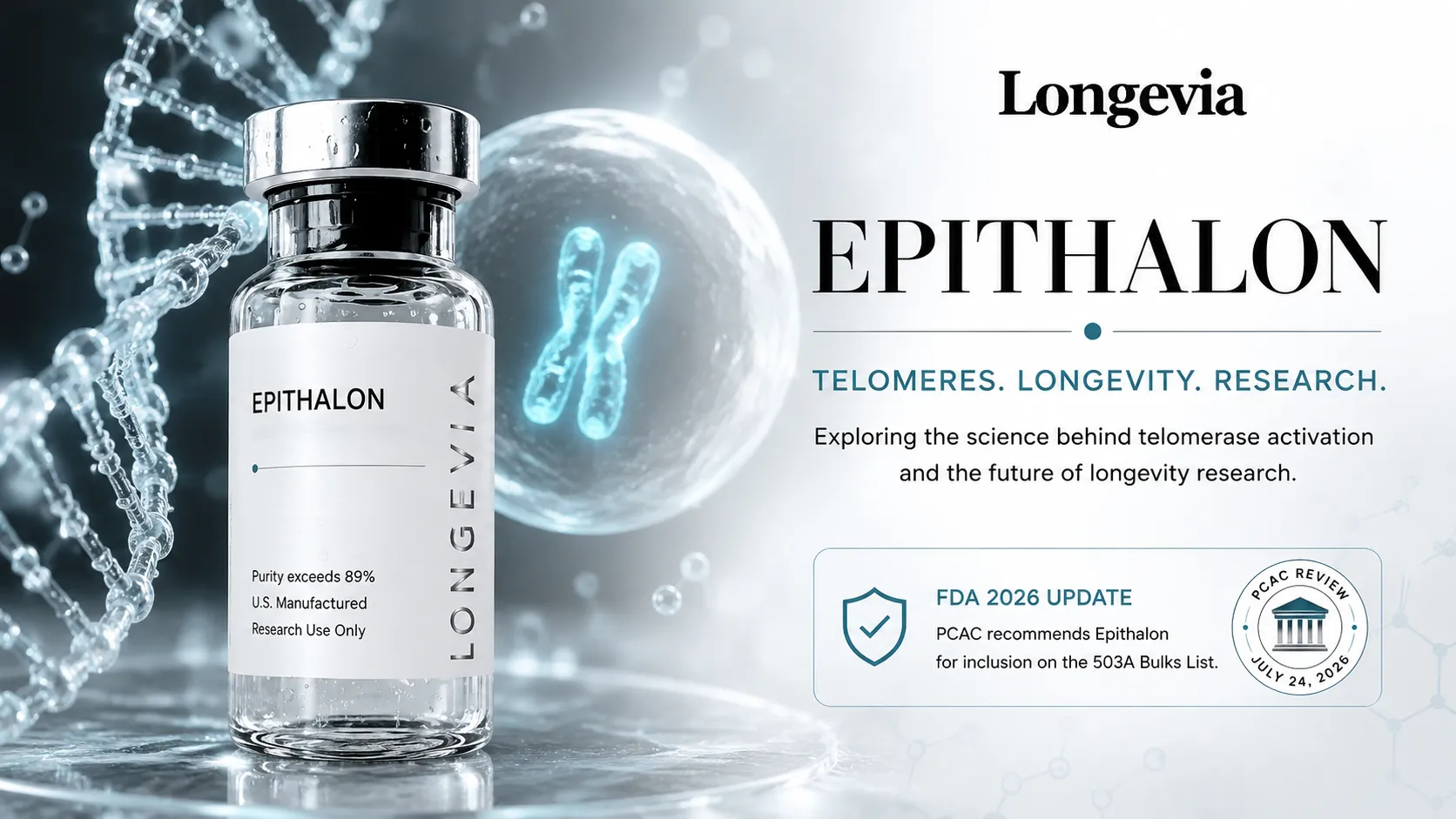
- On July 24, 2026, the FDA's Pharmacy Compounding Advisory Committee voted 7-4 (one abstention) to recommend Epithalon-related substances for the 503A Bulks List — an advisory recommendation, not an approval.
- Epithalon and Pinealon share a research lineage and target tissue but have distinct proposed mechanisms and should not be treated as interchangeable.
- A certificate of analysis verifies identity and purity but is independent of the compound's regulatory review status.
- Separate Russian observational cohort studies report reduced mortality in elderly subjects using Epithalamin (the natural extract), a distinct evidence stream from the synthetic Epithalon in vitro study, neither replicated at Western Phase 3 standard.
Epithalon
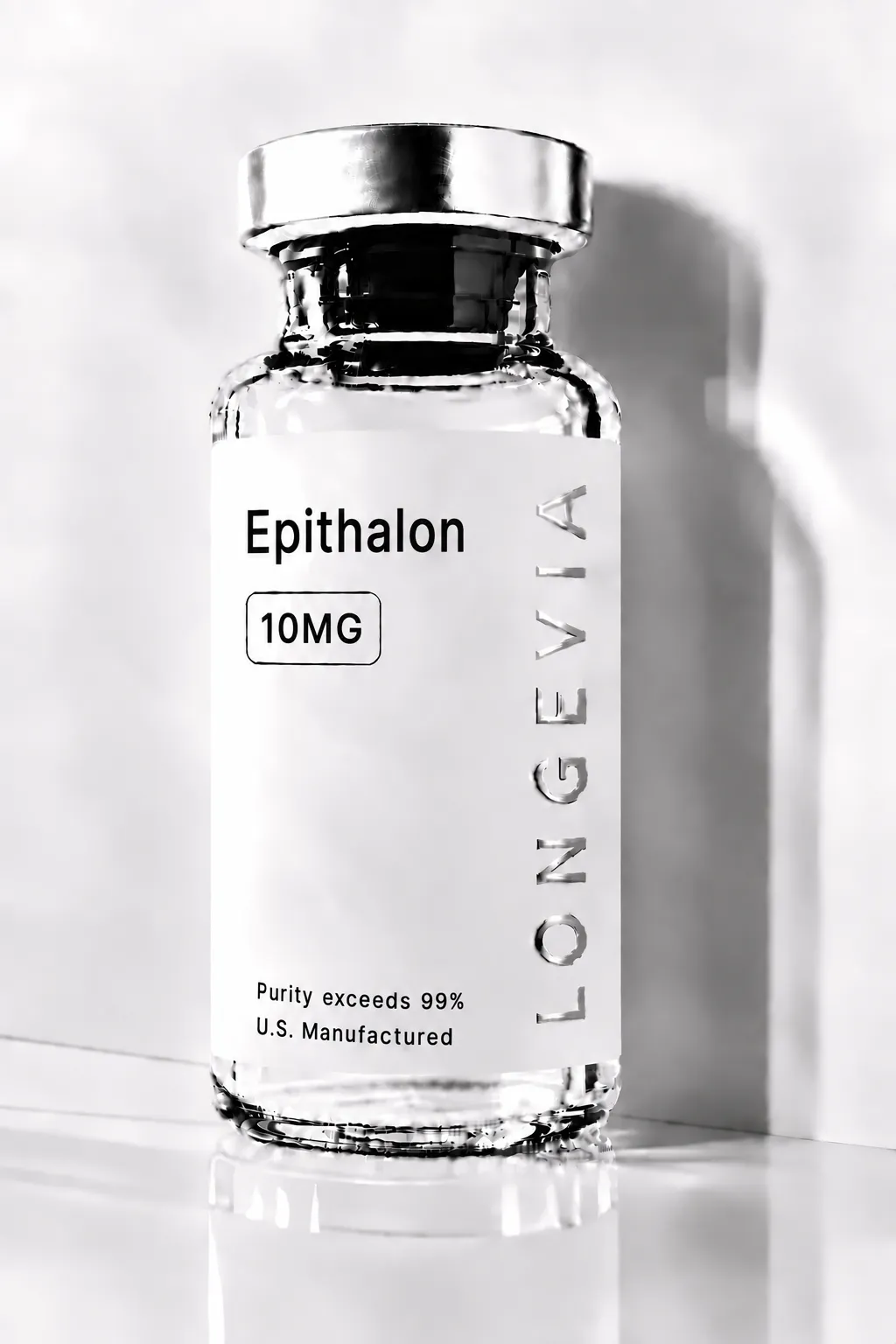
Epithalon (Epitalon) is a synthetic tetrapeptide investigated in research involving telomerase activation, telomere biology, pineal gland peptide pharmacology, and aging biology research models. Available in 10mg and 50mg vials. Research Use Only — Longevia Research.
Epithalon
Epithalon (Epitalon) is a synthetic tetrapeptide investigated in research involving telomerase activation, telomere biology, pineal gland peptide pharmacology, and aging biology research models. Available in 10mg and 50mg vials. Research Use Only — Longevia Research.
Epithalon sits at the exact intersection of two forces currently reshaping the research-peptide landscape: explosive growth in longevity-focused search interest, and an active 2026 FDA regulatory review that will determine its legal compounding status going forward. Few compounds in this category have both a genuinely interesting primary research finding and a live, dated regulatory news hook at the same time — Epithalon has both, and researchers evaluating it deserve a guide that treats each with the specificity it requires rather than blending them into generic "longevity peptide" marketing language.
Epithalon (also written Epitalon) is a synthetic tetrapeptide with the amino acid sequence alanine-glutamic acid-aspartic acid-glycine (Ala-Glu-Asp-Gly, AEDG). It was developed at the St. Petersburg Institute of Bioregulation and Gerontology under Professor Vladimir Khavinson as a simplified synthetic analog of Epithalamin, a peptide extract originally isolated from bovine pineal gland tissue. [1] Epithalon belongs to the same Khavinson bioregulator peptide family as Pinealon — see Longevia's Pinealon research guide for a related compound from the same research program with a distinct target tissue and mechanism.
The core research finding: telomerase activation
The finding responsible for essentially all of Epithalon's current research and commercial interest is a single, frequently cited 2003 paper published in the Bulletin of Experimental Biology and Medicine. Khavinson, Bondarev, and Butyugov reported that applying Epithalon to cultured telomerase-negative human fetal fibroblasts induced expression of the catalytic subunit of telomerase (hTERT), restored measurable telomerase enzymatic activity via TRAP assay, and was associated with telomere elongation across the culture period. [2]
This finding matters because telomere shortening is one of the most extensively studied hallmarks of cellular aging: telomeres, the protective caps at the ends of chromosomes, shorten with each cell division, and their critical shortening is mechanistically linked to replicative senescence. A compound that could reliably restore telomerase activity and elongate telomeres in human cells would represent a genuinely significant finding in aging biology — which is precisely why this single 2003 paper has generated over two decades of downstream research interest and product development.
As of April 2026, no Phase 2 or Phase 3 controlled human efficacy trial for Epithalon has been completed or published in a peer-reviewed journal indexed in PubMed. The foundational finding remains an in vitro cell-culture result; it has not been replicated in a controlled human clinical trial published in the mainstream indexed literature.
What the evidence does and does not establish
It is worth being precise about what the 2003 in vitro finding actually demonstrates, because secondary sources routinely overstate it. The study showed that Epithalon exposure was associated with hTERT expression and telomerase activity restoration in a specific cultured human cell line under specific laboratory conditions. It did not demonstrate: a dose-response relationship suitable for translating to human administration, an effect in living human tissue rather than cultured cells, a downstream effect on organismal aging or lifespan, or safety data from controlled human trials.
Claim | Evidence status |
|---|---|
Epithalon induces hTERT expression in cultured human fibroblasts | Supported by the 2003 primary study [2] |
Epithalon elongates telomeres in cultured cells | Supported by the same study, same limitations |
Epithalon extends human lifespan | Not established by controlled human trial data |
Epithalon is FDA-approved for any indication | False; not approved for any indication |
Epithalon has an established human dosing protocol | Not established by the peer-reviewed indexed literature |
This gap between the foundational cell-culture finding and the extensive secondary marketing built on top of it is one of the most important things for a researcher to understand before evaluating Epithalon-related claims critically.
The 2026 FDA regulatory review
Epithalon's regulatory position shifted meaningfully in 2026. The compound was scheduled for review by the FDA's Pharmacy Compounding Advisory Committee (PCAC) on July 24, 2026, as part of the agency's ongoing evaluation of substances nominated for the Section 503A Bulk Drug Substances List — the list governing which substances may legally be used as active ingredients in compounded (patient-specific, pharmacy-prepared) medications. [3]
On that date, the PCAC voted 7 to 4, with one abstention, to recommend Epithalon-related bulk drug substances for inclusion on the 503A Bulks List. [3] This is a genuinely significant regulatory development, but it requires precise interpretation: a PCAC recommendation is an advisory vote within a longer regulatory process, not a final approval or a determination that the compound is safe and effective for any specific indication. It signals that the committee did not find sufficient basis to categorically reject the substance for eligibility consideration — a materially different, and narrower, finding than "the FDA has approved Epithalon."
Track the FDA's actual published Federal Register determination following a PCAC vote, not just the committee's recommendation. Committee votes are one input into a longer agency decision process, and the final outcome can differ from the advisory recommendation.
Semax, discussed on Longevia's Semax vs. Selank comparison, was reviewed in the same July 24, 2026 PCAC session for separate indications, reflecting a broader wave of regulatory attention on Russian-origin bioregulator and nootropic peptides during this review cycle.
Why longevity-peptide search interest is accelerating
Epithalon's search and commercial growth did not happen in isolation — it is part of a broader surge in longevity-focused peptide research interest that has grown substantially faster than the peptide research category overall in recent search-trend analysis, alongside compounds like NAD+ and other mitochondrial- and cellular-aging-focused research targets. See Longevia's NAD+ research guide for a related but mechanistically distinct longevity-research compound, and our 2026 peptide research trends guide for the broader context behind this category's growth.
Two factors specific to Epithalon compound this general trend. First, the compound has a genuinely citable, decades-old primary study rather than purely anecdotal backing, which gives it more content substance than many trending compounds. Second, its live 2026 FDA review adds a timely news dimension that keeps it circulating in current discussion independent of any change in the underlying science. Researchers should recognize that regulatory-news attention and scientific-evidence strength are separate variables — a compound can be very much in the news without its evidence base having changed at all, and Epithalon in 2026 is a clear example of that pattern.
Epithalon within the Khavinson bioregulator family
Epithalon is one of several short peptide bioregulators developed by the Khavinson research program, each associated with a specific target tissue and proposed mechanism. Understanding the family helps clarify what makes Epithalon's research angle distinct from superficially similar compounds.
Peptide | Sequence | Proposed target tissue | Primary research association |
|---|---|---|---|
Epithalon | Ala-Glu-Asp-Gly | Pineal gland, telomere biology | Telomerase activation, circadian regulation |
Pinealon | Glu-Asp-Arg | Pineal gland, CNS | Neuroprotection, direct DNA interaction |
Thymalin | Multiple amino acid mix | Thymus | Immune system regulation |
Epithalon and Pinealon are both associated with the pineal gland but are studied for substantively different downstream mechanisms — Epithalon for telomerase and circadian-pathway research, Pinealon for direct DNA-interaction and neuroprotective research — which is why they should not be treated as redundant compounds within a research protocol despite their shared tissue association and shared research lineage.
Longer-term observational data: Epithalamin versus Epithalon
Beyond the 2003 telomerase study, the Khavinson research program has published longer-term observational cohort data using Epithalamin — the original bovine pineal-gland peptide extract from which the synthetic tetrapeptide Epithalon was later derived. In these cohort studies, elderly subjects treated with Epithalamin over two to three years showed a reported 1.6 to 1.8-fold decrease in mortality compared with untreated control groups, with additional multi-year observational data (six to eight years of follow-up) reporting reduced mortality when Epithalamin was combined with Thymalin, a separate thymus-targeted bioregulator from the same research program. [4]
This mortality data is specifically associated with Epithalamin — the natural pineal-extract preparation — in Russian observational cohort studies, not necessarily with the synthetic Epithalon tetrapeptide sold as a research compound today. The studies are methodologically heterogeneous, published predominantly in Russian-language literature, and have not been replicated at the randomized, controlled, Phase 3 standard expected by Western regulatory agencies. Treat this as an important but distinct evidence stream from the 2003 in vitro telomerase finding, not as a confirmation of it.
For researchers designing protocols, the Khavinson group's own published dosing pattern for Epithalon in shorter-course research contexts describes 5 to 10 mg administered subcutaneously once daily for 10 to 20 days as a single course, with courses repeated two to four times per year, typically spaced three to six months apart. This is documented literature describing a research protocol pattern, not a Longevia-endorsed dosing recommendation, and it originates from the same non-Western-standard evidence base described above.
Pineal gland and circadian research angle
Beyond telomere biology, Epithalon has a secondary research association tied to its pineal-gland origin: proposed effects on melatonin regulation and circadian rhythm normalization, particularly in the context of age-related pineal gland calcification, which is documented to reduce endogenous melatonin production with advancing age. This research angle is mechanistically plausible given Epithalon's origin as a simplified analog of a pineal-extract peptide, but like the telomerase finding, the melatonin-regulation research base is considerably thinner than the foundational cell-culture telomerase work and should be weighted accordingly when evaluating claims.
Reconstitution and quality documentation
Where Epithalon is used in laboratory research, the same documentation principles apply as with any lyophilized peptide bioregulator: record lot number, nominal vial amount, diluent identity and volume, and the calculated concentration shown as an explicit equation. Longevia's peptide dosage calculations guide and peptide calculator cover this arithmetic, and our reconstitution and storage guide covers general stability documentation.
A certificate of analysis confirming identity and purity via HPLC and mass spectrometry remains the baseline expectation for any research batch, independent of the compound's regulatory review status — purity documentation and regulatory status answer entirely different questions, and neither substitutes for the other. See Longevia's purity guide for how to evaluate a supplier's documentation.
Common misunderstandings
Longevity-peptide content is especially prone to conflating adjacent-but-distinct evidence streams into a single narrative, and Epithalon's literature has at least three separate strands worth keeping apart: the 2003 in vitro telomerase finding, the Epithalamin observational mortality cohorts, and the 2026 FDA regulatory review. Each is real, each is worth citing accurately, and none substitutes for the others.
The most frequent error is treating the 2003 in vitro finding as though it were a completed human clinical trial demonstrating anti-aging efficacy — it is a cell-culture study, foundational and frequently cited, but categorically different from clinical trial evidence. A second common error is treating the July 2026 PCAC recommendation vote as equivalent to FDA approval; a recommendation to include a substance on a bulk compounding list is a narrower, different regulatory action than approving a specific drug product for a specific indication. A third mistake is conflating Epithalon with Pinealon simply because both originate from the same research program and target the same gland — their proposed mechanisms and research literatures are substantively different.
Practical research checklist
- Distinguish the foundational 2003 in vitro telomerase finding from any downstream claim about human aging or lifespan.
- Track the FDA's actual published determination following the July 2026 PCAC vote, rather than treating the committee recommendation as a final outcome.
- Do not conflate Epithalon with Pinealon or other Khavinson-family bioregulators; each has a distinct proposed mechanism.
- Request lot-specific COA documentation regardless of the compound's regulatory review status.
- Cite the primary 2003 study directly when referencing the telomerase finding, rather than a secondary source's paraphrase of it.
References and evidence limits
The foundational telomerase-activation finding for Epithalon comes from a single 2003 in vitro study in cultured human fibroblasts. [2] No Phase 2 or Phase 3 controlled human efficacy trial has been published in the PubMed-indexed literature as of this writing. The July 24, 2026 FDA PCAC vote recommending Epithalon-related substances for the 503A Bulks List is a documented regulatory development, but represents an advisory recommendation within a longer process, not a final approval. [3] Research Use Only material has not been evaluated by the FDA for safety or efficacy. See Longevia's research-use disclaimer for the complete compliance position.
Frequently Asked Questions
- Khavinson VKh biography and Epithalon/Epithalamin development context, St. Petersburg Institute of Bioregulation and Gerontology.
- Khavinson VKh, Bondarev IE, Butyugov AA. Epithalon peptide induces telomerase activity and telomere elongation in human somatic cells. Bulletin of Experimental Biology and Medicine. 2003;135(6):590-592.
- FDA Pharmacy Compounding Advisory Committee, July 24 2026 review and vote on Epithalon-related bulk drug substances.
- Khavinson group observational cohort data on Epithalamin and Thymalin combination therapy and mortality in elderly subjects; Epithalon research dosing course pattern.