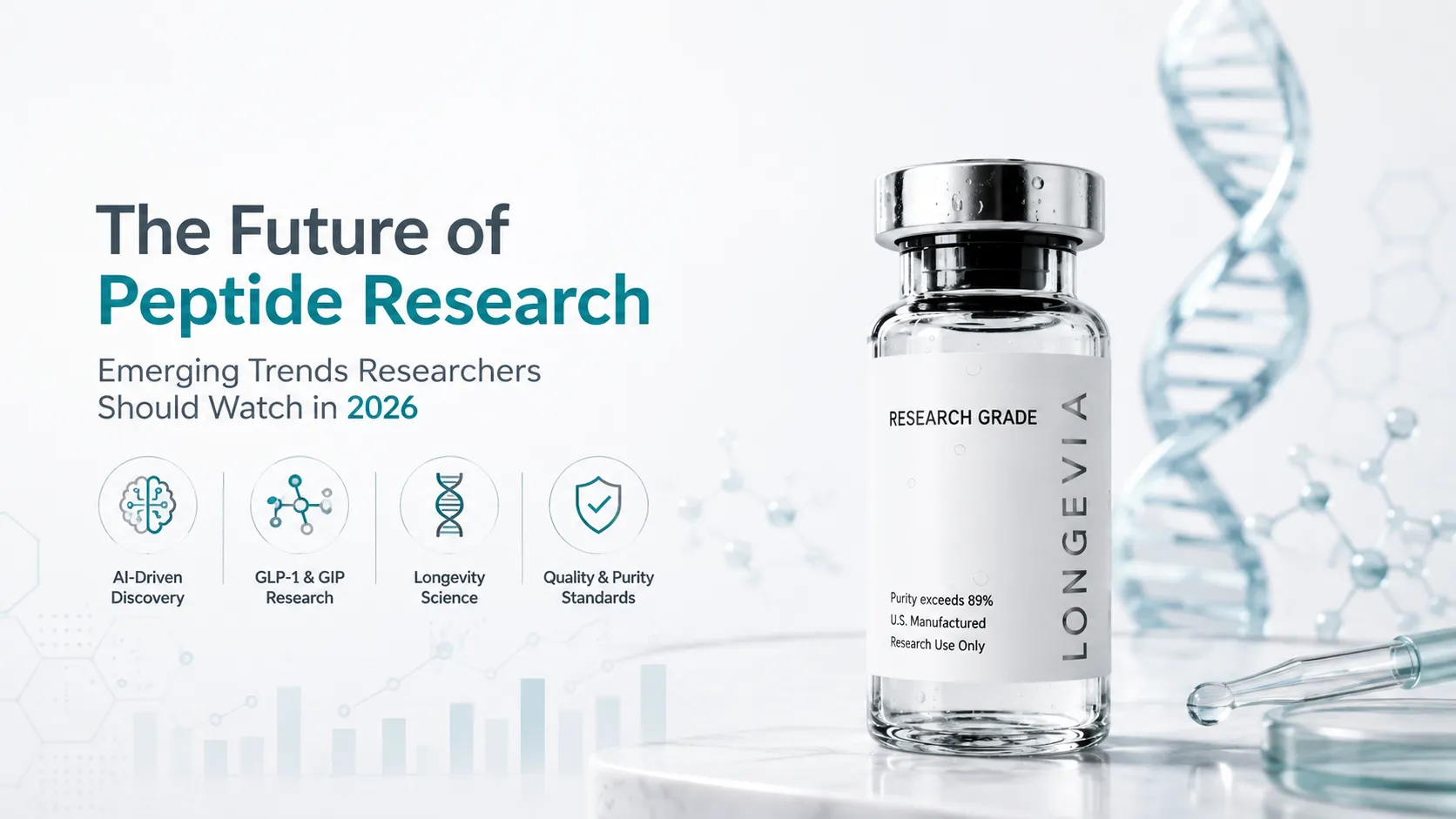
- AI peptide design and computational modeling are compressing discovery timelines across nearly every research peptide category.
- GLP-1 and GIP/GLP-1 dual agonist research remains one of the fastest-moving areas in metabolic peptide research.
- Longevity and bioregulator research is expanding, but evidence maturity still varies widely by compound.
- Cyclic and PEGylated peptide structures are gaining research attention for improved stability and half-life.
- Purity verification — HPLC plus mass spectrometry, backed by a documented COA — is becoming the baseline expectation, not a differentiator.
- Antimicrobial and vaccine peptide research are earlier-stage but growing areas worth watching through 2026 and beyond.
Peptide research doesn't sit still, and 2026 is proving that more than most years. If you're trying to keep a lab's compound list current, evaluate a new supplier, or simply understand where the field is heading, the pace of change can feel harder to track than the science itself. New compound classes appear faster than journals can review them, AI tools are reshaping how candidates get identified before a single sample is synthesized, and purity standards keep tightening as more labs demand documentation they can actually verify.
This guide walks through the peptide research trends 2026 is defined by — six shifts researchers, procurement teams, and lab managers should have on their radar, along with what each one means in practical terms. Everything here is written for research use only (RUO) and does not describe or recommend any human dosing or clinical application.
Why Peptide Research Is Entering a New Phase in 2026
For most of the last decade, peptide research advancements moved in fairly predictable steps: a compound class showed promise, synthesis methods improved, and purity testing slowly standardized around it. 2026 looks different. Three forces are converging at once — computational drug design, a maturing GLP-1/GIP research pipeline, and rising scrutiny around sourcing and documentation — and together they're compressing timelines that used to take years into months.
Key Takeaway — In 2026, the future of peptide research is being shaped less by any single breakthrough compound and more by the infrastructure around research: AI-assisted design, tighter purity verification, and clearer regulatory expectations.
Understanding these shifts matters whether you're reading primary literature, comparing research peptide vendors, or drafting a protocol that depends on batch-to-batch consistency.
Trend 1: AI and Machine Learning Are Reshaping Peptide Discovery
AI peptide design is arguably the single biggest structural change in emerging peptide research trends this year. Instead of screening thousands of candidate sequences in a wet lab first, computational biology teams now use generative protein design and in silico peptide modeling to narrow the field before synthesis even begins.
How Generative AI Models Predict Peptide Structure and Function
Protein structure prediction tools — descendants of AlphaFold protein modeling — estimate how a candidate sequence will fold, which receptors it may bind, and how stable it's likely to be, all before a chemist touches a resin. Combine that with predictive ADMET modeling (absorption, distribution, metabolism, excretion, toxicity estimates) and researchers can rule out weak candidates earlier, saving both time and reagents.
- Machine learning peptide discovery platforms can screen candidate libraries orders of magnitude faster than manual sequence-by-sequence review.
- Computational peptide design is increasingly used to optimize stability and receptor selectivity before synthesis.
- Bioinformatics research pipelines now routinely cross-reference candidate sequences against PubMed and NCBI databases for prior art and known activity.
What This Means for Researchers Sourcing Novel Compounds
For labs, this shift means the pool of novel peptide compounds research teams are asked to evaluate is growing faster than purity-testing infrastructure can always keep pace with. That makes independent verification — HPLC-verified peptides, third-party lab-tested peptides, and a documented certificate of analysis — more important than ever when a compound is new to market.
Trend 2: GLP-1 and GIP Receptor Peptide Research Continues to Accelerate
GLP-1 peptide research trends remain one of the most active areas in the field, and 2026 is seeing continued expansion into GIP/GLP-1 dual agonist research alongside the original GLP-1 analog work. Metabolic peptide research broadly is drawing significant attention from both established pharmaceutical and biotech research programs.
GLP-1 vs. GIP Receptor Peptides: A Quick Comparison
Attribute | GLP-1 Receptor Peptides | GIP/GLP-1 Dual Agonists |
|---|---|---|
Primary receptor target | GLP-1 receptor | GLP-1 and GIP receptors |
Research focus | Metabolic regulation, appetite signaling studies | Combined incretin pathway research |
Research maturity (2026) | Well-established literature base | Rapidly expanding, newer study designs |
Common research applications | Obesity and glucose regulation research | Comparative incretin pathway research |
Researchers comparing these compound classes should note that dual-agonist studies are still a newer field with a faster-moving literature base, which is exactly the kind of area where checking publication dates and peer-reviewed sourcing matters most. Browse research peptides in our shop if you're sourcing compounds for this work.
Trend 3: Longevity and Peptide Bioregulator Research Is Gaining Momentum
Longevity peptide research has moved from a niche interest to one of the more heavily discussed clusters in the field. Peptide bioregulators — short sequences studied for their role in cellular signaling research — sit at the center of this trend, alongside growing interest in tissue repair peptide research and cognitive peptide research.
- Anti-aging peptide research is increasingly framed around geroscience — the study of biological aging mechanisms — rather than isolated compound effects.
- Tissue repair peptide research spans wound-healing research and regenerative research applications, both active areas of academic study.
- Cognitive peptide research remains earlier-stage, with most current evidence limited to preclinical and in vitro study designs.
A Note on Evidence Maturity
Not every compound generating interest in longevity science has an equally mature evidence base. Researchers evaluating bioregulator peptides for a new study should treat search-engine visibility and actual peer-reviewed volume as two different things — one reflects public interest, the other reflects scientific support.
Trend 4: Novel Peptide Classes and Structural Innovation
Beyond specific compounds, 2026 is seeing structural innovation in how peptides are designed and built. Cyclic peptide research continues to expand because cyclic peptide structure tends to offer better stability and resistance to enzymatic breakdown compared with linear peptide backbones. PEGylated peptides research is following a similar logic — attaching polyethylene glycol chains to extend a compound's usable window in a research setting by improving peptide half-life studies outcomes.
Peptide compound libraries — curated collections used in structure-activity relationship (SAR) work — are also growing, supported by peptide synthesis innovations 2026 is bringing to both solid-phase peptide synthesis (SPPS) and liquid-phase peptide synthesis workflows. Peptide receptor binding studies increasingly pair with these libraries to map how small sequence changes shift binding affinity and receptor agonist or receptor antagonist behavior.
Trend 5: Rising Standards for Purity, Testing, and Compliance
As the compound pool grows, so does scrutiny around research peptide vendors. Third-party tested peptides, GMP-compliant manufacturing, and a documented peptide certificate of analysis are shifting from a nice-to-have to a baseline expectation across the industry.
HPLC vs. Mass Spectrometry: Purity Verification Methods
Method | What It Verifies | Typical Turnaround |
|---|---|---|
HPLC (High-Performance Liquid Chromatography) | Purity percentage, batch consistency testing | 1-3 business days |
Mass Spectrometry | Molecular weight confirmation, sequence verification | 2-5 business days |
Key Takeaway — A 98%+ purity claim is only as trustworthy as the documentation behind it. Researchers should expect both HPLC and mass spectrometry data, not one or the other, before treating a new compound source as reliable. See our [guide to reading a peptide COA](/journal/peptide-coa-hplc-purity-testing-guide) for the full breakdown.
FDA peptide regulations and broader research chemical compliance frameworks are also getting more explicit in 2026, particularly around Research Use Only (RUO) labeling and vial packaging standards. Suppliers that publish clear compliance policies alongside their COAs are increasingly the ones building trust with academic and biotech research buyers alike.
Trend 6: Antimicrobial and Vaccine Peptide Research Expands
Antimicrobial peptide research is drawing renewed funding attention as drug-resistant bacteria research becomes a higher public-health priority. These compounds are studied for their distinct mechanism — disrupting microbial cell membranes rather than targeting internal bacterial processes — which makes them a genuinely different research angle from traditional antibiotic compound classes.
Peptide vaccine research is following a related trajectory, building on the immune modulation research that expanded rapidly over the last several years. Oncology peptide research and neurodegenerative disease research are two more areas where peptide-based approaches are showing up more frequently in current literature, though both remain earlier-stage relative to metabolic and longevity peptide work.
What These Trends Mean for Choosing a Research Peptide Supplier in 2026
Every trend above points toward the same practical conclusion: as the pool of research peptides for sale grows, sourcing decisions matter more, not less. A reliable research peptide vendor in 2026 should be able to answer the following without hesitation.
- Does every batch ship with an independent, dated certificate of analysis?
- Is purity confirmed by both HPLC and mass spectrometry, not just one method?
- Is the peptide manufactured under GMP-compliant conditions, and is that documented?
- Are storage, cold-chain shipping, and vial packaging standards clearly explained?
- Is the Research Use Only (RUO) framing clear and consistent across product pages and documentation?
Longevia's research peptides are positioned around exactly this checklist — US-manufactured, third-party tested, and shipped with documentation researchers can independently verify. Learn more about our lab standards, or contact our research team with sourcing questions.
Best Practices for Researchers Following These Trends
Staying current with peptide research industry trends doesn't require reading every new preprint. A short, repeatable evaluation process covers most of what matters when a new compound or supplier crosses your desk.
- Check the certificate of analysis before ordering — confirm purity percentage, batch number, and testing method.
- Cross-reference new compound claims against PubMed, ClinicalTrials.gov, or NCBI before treating them as established.
- Verify storage and reconstitution guidance matches the specific peptide, not a generic template — our reconstitution and storage guide covers the general principles.
- Ask whether pricing reflects independent third-party testing or only in-house quality claims.
- Re-evaluate suppliers periodically — GMP compliance and testing practices can change year to year.
Common Mistakes Researchers Make When Sourcing Emerging Peptides
A few avoidable errors show up repeatedly as new peptide classes and new suppliers enter the market:
- Treating search visibility as a proxy for evidence quality — a compound can trend in searches long before peer-reviewed research catches up.
- Skipping the certificate of analysis because a supplier's marketing already claims high purity.
- Assuming lyophilized peptides for research have an indefinite shelf life regardless of storage conditions.
- Overlooking peptide degradation prevention basics, like light and temperature exposure during shipping.
- Confusing research peptides with pharmaceutical-grade or compounding-pharmacy peptides, which follow entirely different regulatory pathways.
Compliance note: This article is written for research and informational purposes only. No content here constitutes dosing guidance, medical advice, or a recommendation for human or animal use. All referenced compounds are Research Use Only (RUO) — see our full research-use disclaimer.