- Glow Blend is a lyophilized multi-peptide research preparation formulated for laboratory study of skin regeneration biology, collagen pathways, and oxidative stress signaling.
- Longevia does not publish the individual component peptides or mg ratios in Glow Blend, so reconstitution math works from the vial's total blend mass.
- Glow Blend is verified to at least 99% aggregate purity by independent third-party HPLC analysis, with a Certificate of Analysis per batch.
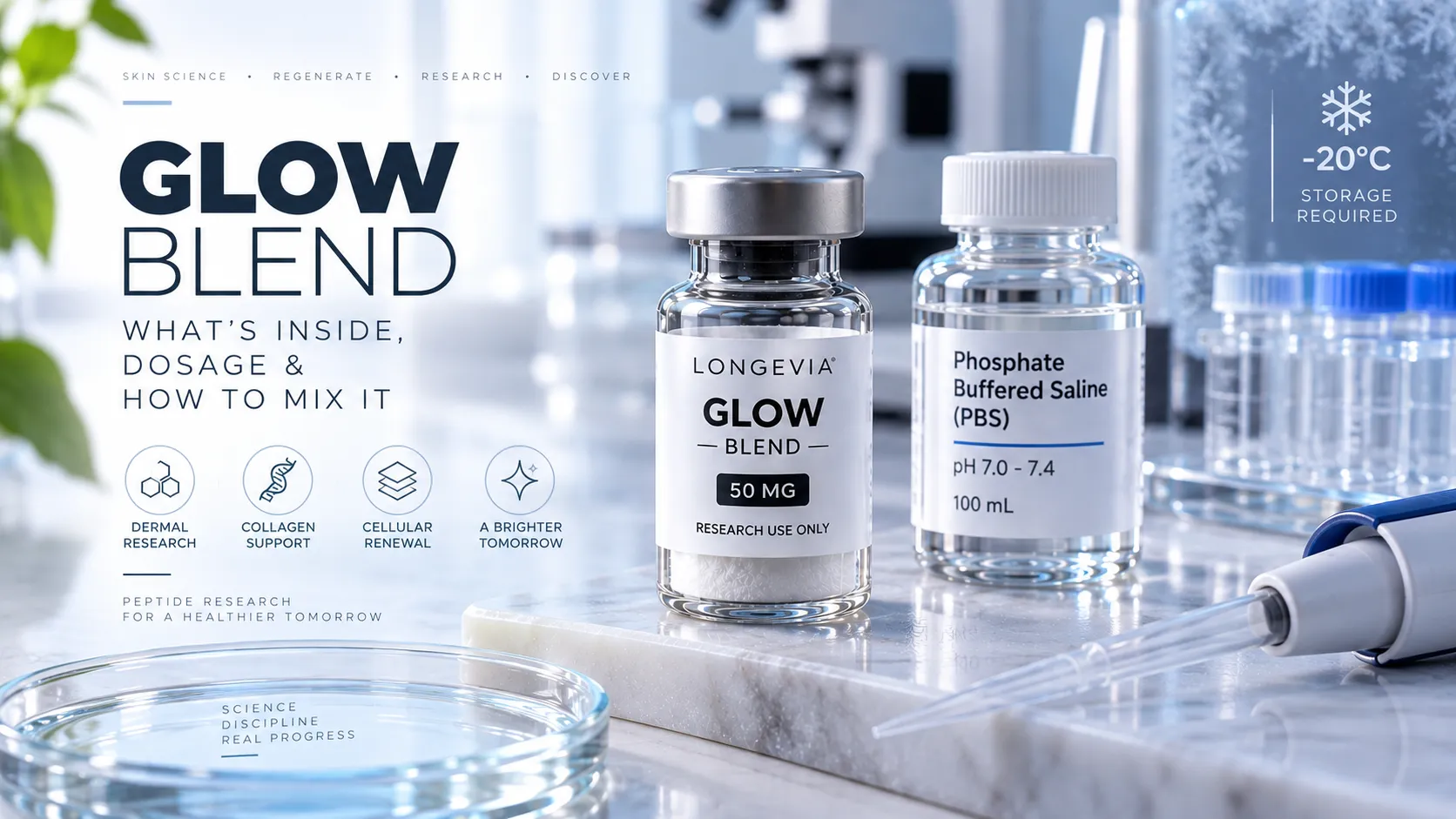
- Lyophilized Glow Blend requires -20°C storage, which is stricter than the 2-8°C specification used by many lyophilized peptides.
- Once reconstituted in sterile water or PBS at pH 7.0-7.4, Glow Blend is used within 24-48 hours or stored at 4°C.
- Concentration equals total blend mass in mg divided by diluent volume in mL, and a U-100 syringe unit equals 0.01 mL.
- Quantities drawn from the blend represent total blend mass, not a defined amount of any individual component peptide.
- There is no peer-reviewed clinical literature on Glow Blend as a blend; measurable endpoints belong to in vitro and preclinical assay models.
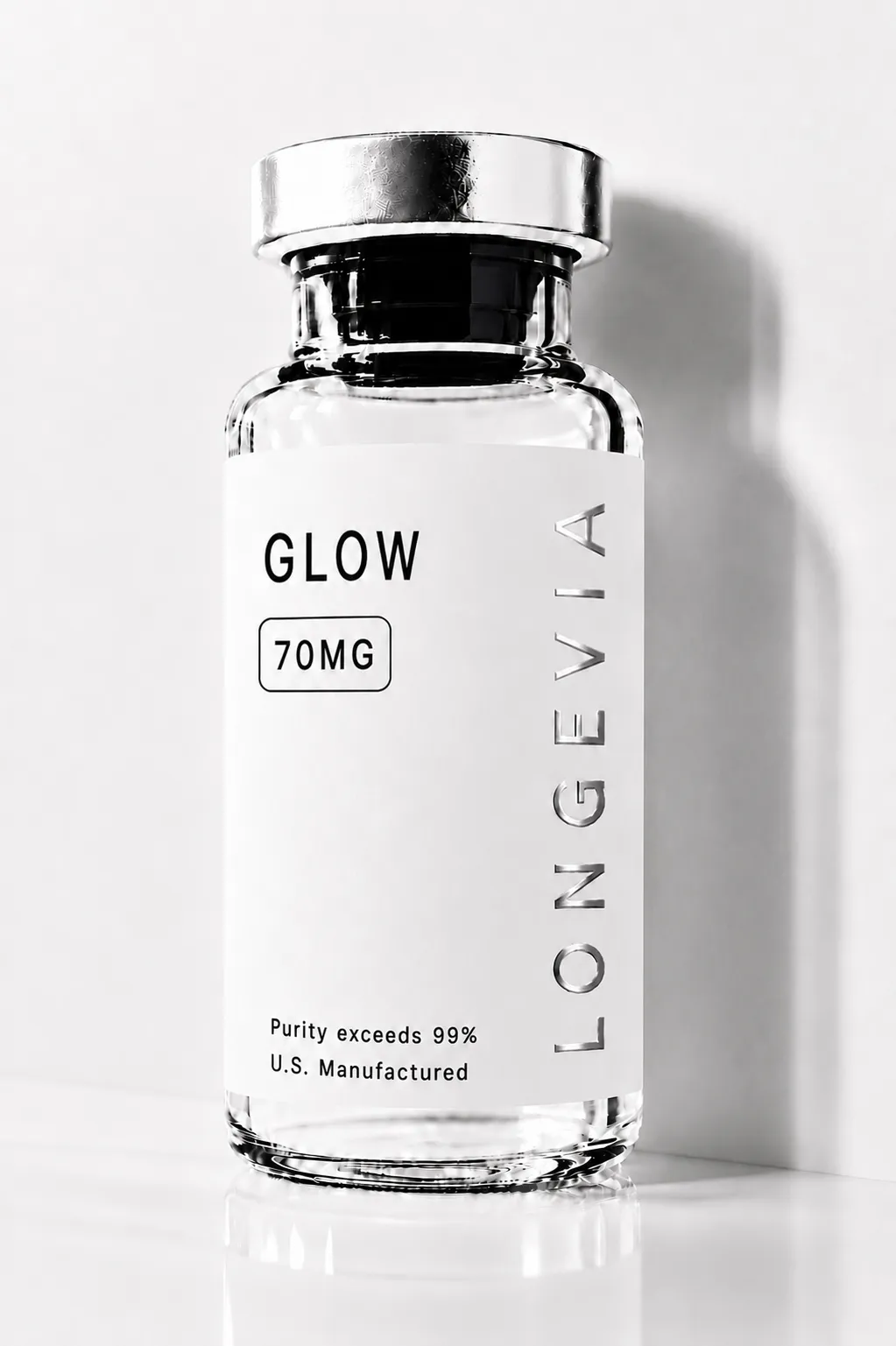
GLOW — 70mg Blend Vial
GLOW is a 70mg research blend containing GHK-Cu (50mg), BPC-157 (10mg), and TB-500 (10mg) — three peptides investigated in copper metallopeptide chemistry, angiogenesis signaling, actin biology, and extracellular matrix research models. Research Use Only — Longevia Research.
GLOW — 70mg Blend Vial
GLOW is a 70mg research blend containing GHK-Cu (50mg), BPC-157 (10mg), and TB-500 (10mg) — three peptides investigated in copper metallopeptide chemistry, angiogenesis signaling, actin biology, and extracellular matrix research models. Research Use Only — Longevia Research.
Glow Blend is a lyophilized multi-peptide preparation built for dermal biology research, and it comes with a handling requirement most peptide products don't: -20°C storage for the dry powder and a hard 24-48 hour window once it's in solution. Get that part wrong and the rest of your protocol doesn't matter. This covers what the product is, how to reconstitute it from total blend mass, and what can honestly be said about results.
Glow Blend is a proprietary research-grade peptide blend formulated for laboratory investigation of skin regeneration biology, collagen synthesis pathways, extracellular matrix signaling, and oxidative stress response. Longevia does not publish the individual component peptides or their ratios, so reconstitution and concentration calculations work from the vial's total blend mass. Lyophilized Glow is stored at -20°C; once reconstituted in sterile water or PBS at pH 7.0-7.4 it is used within 24-48 hours or held at 4°C.
What Glow Blend is
Glow Blend combines individually COA-verified component peptides into a single lyophilized preparation, engineered for researchers studying the convergent mechanisms behind cellular renewal, dermal tissue integrity, and oxidative stress response in controlled experimental settings. Each vial is independently verified to at least 99% aggregate purity by third-party HPLC analysis.
The component peptides are synthesized separately by Solid-Phase Peptide Synthesis (SPPS) and each is subjected to independent HPLC purity verification before blending. That sequence matters: purity is established per component and then confirmed in aggregate, rather than a single purity figure being assigned to a mixture after the fact.
The rationale for a blend rather than a single compound is experimental, not commercial. Single-entity compounds isolate one receptor interaction. A blend lets you probe synergistic receptor interactions and compounded downstream signaling — questions you cannot ask of a single molecule, and questions that only produce interpretable answers when the blend runs against single-peptide controls in the same model.
Glow's stated applications are specific: collagen synthesis assays, extracellular matrix remodeling studies, MMP activity experiments, oxidative stress and antioxidant signaling research, keratinocyte proliferation assays, and wound healing models.
What's in the vial
Longevia does not disclose the individual component peptides in Glow Blend, and does not publish the mg ratio between them. The formulation is proprietary.
That is worth stating plainly because "glow blend ingredients" returns a lot of confident answers, most of them describing different vendors' products that happen to share a name. Product names are not regulated identifiers. Two vials labelled Glow from two suppliers can be entirely different formulations, and adopting someone else's component list as your own documentation means your records describe a product you never received.
What is verifiable for your specific vial: the lot number, the third-party HPLC purity result for that lot, the aggregate purity figure of at least 99%, and the total blend mass on the label.
Do not import a component list or mg ratio from a third-party "Glow blend" page into your protocol. The batch Certificate of Analysis and the vial label are the only defensible record of what you are working with.
Reconstitution: working from total mass
Because the ratio between components isn't published, every calculation starts and ends with the vial's total blend mass. That is sufficient for concentration work and insufficient for anything requiring the molarity of a named peptide — a real constraint worth designing around rather than around.
Concentration (mg/mL) = total blend mass (mg) ÷ diluent volume (mL)
Volume needed (mL) = target quantity (mg) ÷ concentration (mg/mL)
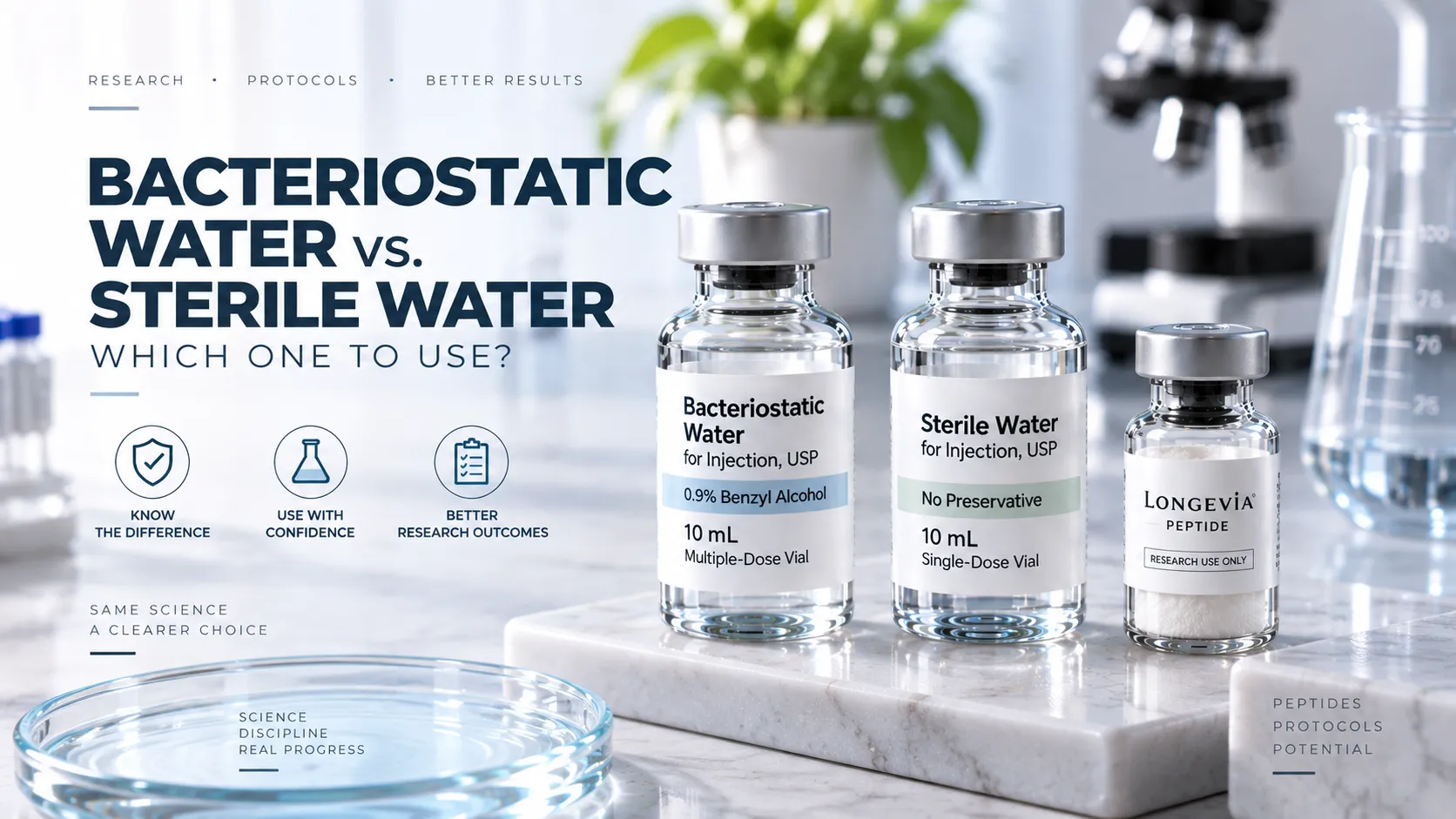
Glow's own storage guidance names sterile water or PBS buffered to pH 7.0-7.4 as the reconstitution medium. PBS is the usual choice when the downstream assay needs a physiologically buffered environment; sterile water is the simpler option when the peptide solution will be diluted into culture medium anyway. Bacteriostatic water is the preserved alternative where repeated withdrawals from one vial are needed, though it does not extend the peptide's own chemical stability.
Total blend mass | + 1 mL | + 2 mL | + 3 mL | + 5 mL |
|---|---|---|---|---|
10 mg | 10 mg/mL | 5 mg/mL | 3.33 mg/mL | 2 mg/mL |
20 mg | 20 mg/mL | 10 mg/mL | 6.67 mg/mL | 4 mg/mL |
30 mg | 30 mg/mL | 15 mg/mL | 10 mg/mL | 6 mg/mL |
50 mg | 50 mg/mL | 25 mg/mL | 16.67 mg/mL | 10 mg/mL |
70 mg | 70 mg/mL | 35 mg/mL | 23.33 mg/mL | 14 mg/mL |
Given the 24-48 hour usable window after reconstitution, there's an argument for reconstituting less material more often rather than putting a whole vial into solution at once. Splitting into aliquots at the point of reconstitution is usually smarter than repeatedly entering one vial across two days.
Step by step
- Let the vial warm to room temperature before opening — going straight from -20°C to open air pulls condensation into the cake.
- Wipe both stoppers with an alcohol prep and let them dry.
- Draw the calculated diluent volume into a sterile syringe.
- Angle the needle against the inside wall so the liquid runs down the glass rather than striking the powder.
- Wait. Most lyophilized cakes dissolve unaided within a minute or two.
- Swirl or roll gently if anything remains. Never shake.
- Hold the vial to the light and check for clarity and absence of particulates.
- Label with concentration and date, then store at 4°C and use within the stated window.
The temperature transition is where Glow differs from most peptides you'll handle. Moving the vial from -20°C storage to room temperature before breaking the seal, rather than opening it cold, prevents moisture condensing into the powder and starting hydrolysis before you've added a drop of diluent.
Dosage chart in syringe units
A U-100 insulin syringe is marked so that 100 units equals 1 mL, making one unit 0.01 mL. That single conversion translates a concentration into a measurable volume.
Concentration | Per 1 unit | For 250 mcg | For 500 mcg | For 1 mg |
|---|---|---|---|---|
2 mg/mL | 20 mcg | 12.5 units | 25 units | 50 units |
5 mg/mL | 50 mcg | 5 units | 10 units | 20 units |
10 mg/mL | 100 mcg | 2.5 units | 5 units | 10 units |
20 mg/mL | 200 mcg | 1.25 units | 2.5 units | 5 units |
25 mg/mL | 250 mcg | 1 unit | 2 units | 4 units |
Every value above describes total blend mass. Drawing 10 units of a 10 mg/mL preparation gives 1 mg of blend, not 1 mg of any single component. Worked examples for single-entity compounds are in our peptide dosage calculation guide.
Concentration choice is a trade-off between measurement precision and storage volume. Very concentrated preparations make small quantities hard to draw accurately; very dilute ones produce more solution than a 24-48 hour window can reasonably consume.
Storage: why -20°C and why the short window
Lyophilized Glow is stored at -20°C, dry and protected from light. That is stricter than the 2-8°C specification carried by many lyophilized peptides, and it should be checked against your freezer capacity before an order arrives rather than after.
Once reconstituted, the guidance is 24-48 hours of use or storage at 4°C. Two separate clocks are running at that point. One is microbial: an unpreserved solution in sterile water or PBS offers no barrier to growth, which is why preserved diluents exist and why pharmacopoeial practice caps preserved multiple-dose containers at 28 days after first puncture. The other is chemical: peptides in solution are subject to hydrolysis, oxidation, and aggregation in ways the dry state largely prevents. For Glow, the chemical clock is the binding one.
Practical consequences: aliquot at reconstitution if you plan repeat sampling, keep solutions cold and dark, avoid repeated freeze-thaw cycles, and date every vial. An undated vial is an unusable vial.
Aliquoting, and when it earns the extra work
Aliquoting adds handling steps, and every additional transfer is another chance to contaminate something. It's still usually worth it here. A 24-48 hour usable window means a single vial reconstituted whole either gets consumed fast or gets wasted, and the alternative — entering the same vial repeatedly across two days — trades chemical stability risk for microbial risk without solving either.
Split into single-use volumes at the moment of reconstitution, label each with concentration and date, and you remove the repeat-entry problem entirely. Where a study runs across more than two days, reconstituting a portion of the vial rather than all of it keeps the remainder in the dry state, which is the only state where the material is genuinely stable long term.
Oxidative stress as a research axis
Glow's positioning treats oxidative stress as a driver of matrix degradation rather than an unrelated variable. That framing has a basis in ECM biology: reactive oxygen species shift the balance between matrix synthesis and matrix-degrading protease activity, and reduced fibroblast viability under oxidative load compounds the effect. Assays that pair a collagen or MMP readout with an antioxidant response marker tend to produce a more complete picture than either measured alone, which is why the product's stated applications list both.
Glow vs KLOW Blend
Glow Blend | KLOW Blend | |
|---|---|---|
Research focus | Dermal biology, barrier integrity, collagen pathways, oxidative stress | Tissue regeneration, collagen remodeling, ECM support, fibroblast activity |
Purity standard | >=99% aggregate, third-party HPLC | >99%, COA per lot |
Verification | SPPS, independent third-party HPLC | SPPS, preparative HPLC, ESI-MS per component |
Lyophilized storage | -20°C, dry, protected from light | 2-8°C, protected from light and moisture |
Reconstituted | 24-48 hours, or 4°C | Refrigerate, use promptly |
Named diluent | Sterile water or PBS, pH 7.0-7.4 | Bacteriostatic or sterile water |
Price | $125 | $128 |
The cleanest way to describe the difference: Glow is scoped to skin, and it treats oxidative stress as a driver of matrix degradation rather than a side consideration. KLOW is broader across connective tissue and repair signaling. Neither publishes a component list, and neither is a substitute for the other in an assay designed around the other's endpoints. The companion breakdown is in our KLOW Blend composition and dosage guide.
"Before and after": what's actually measurable
Queries about Glow blend before-and-after results are common, and the honest answer is that this is research-use-only material with no peer-reviewed clinical literature on the blend as a blend. There are no human outcome data to report, and photographic before-and-after content that circulates for products with similar names is not evidence about this formulation.
What is measurable sits in the assay endpoints the product is formulated around: procollagen and collagen type I output in fibroblast culture, MMP-1 and MMP-3 activity against matrix substrates, keratinocyte proliferation rates, markers of oxidative stress and antioxidant response, and closure rate in scratch-wound models. Matrix metalloproteinases are well characterized as active regulators of tissue remodeling and repair, and the extracellular matrix itself is understood as a signaling environment rather than inert scaffolding — which is why ECM-focused assays are the right place to look for a signal.
Those endpoints belong to in vitro and preclinical models. Framing them as outcomes would be a category error.
Verification before you start
Confirm three things before a vial enters a protocol: that the lot number on the label matches a published Certificate of Analysis, that the COA reports a third-party HPLC result for that exact lot rather than a generic product specification, and that the stated aggregate purity meets the 99% threshold. Every Longevia batch is independently HPLC/LC-MS tested with lot-specific COAs published in the COA Library.
Checking documentation takes a few minutes. Discovering a purity problem halfway through a time-course study costs considerably more.
Frequently Asked Questions
- Merrifield RB. Solid Phase Peptide Synthesis. I. The Synthesis of a Tetrapeptide. J Am Chem Soc. 1963;85(14):2149-2154.
- Frantz C, Stewart KM, Weaver VM. The extracellular matrix at a glance. J Cell Sci. 2010;123(Pt 24):4195-4200.
- Page-McCaw A, Ewald AJ, Werb Z. Matrix metalloproteinases and the regulation of tissue remodelling. Nat Rev Mol Cell Biol. 2007;8(3):221-233.
- United States Pharmacopeia. General Chapter <797> Pharmaceutical Compounding - Sterile Preparations: beyond-use dating for multiple-dose containers.
- Bacteriostatic Water for Injection, USP - prescribing information, Hospira, Inc. DailyMed, U.S. National Library of Medicine.