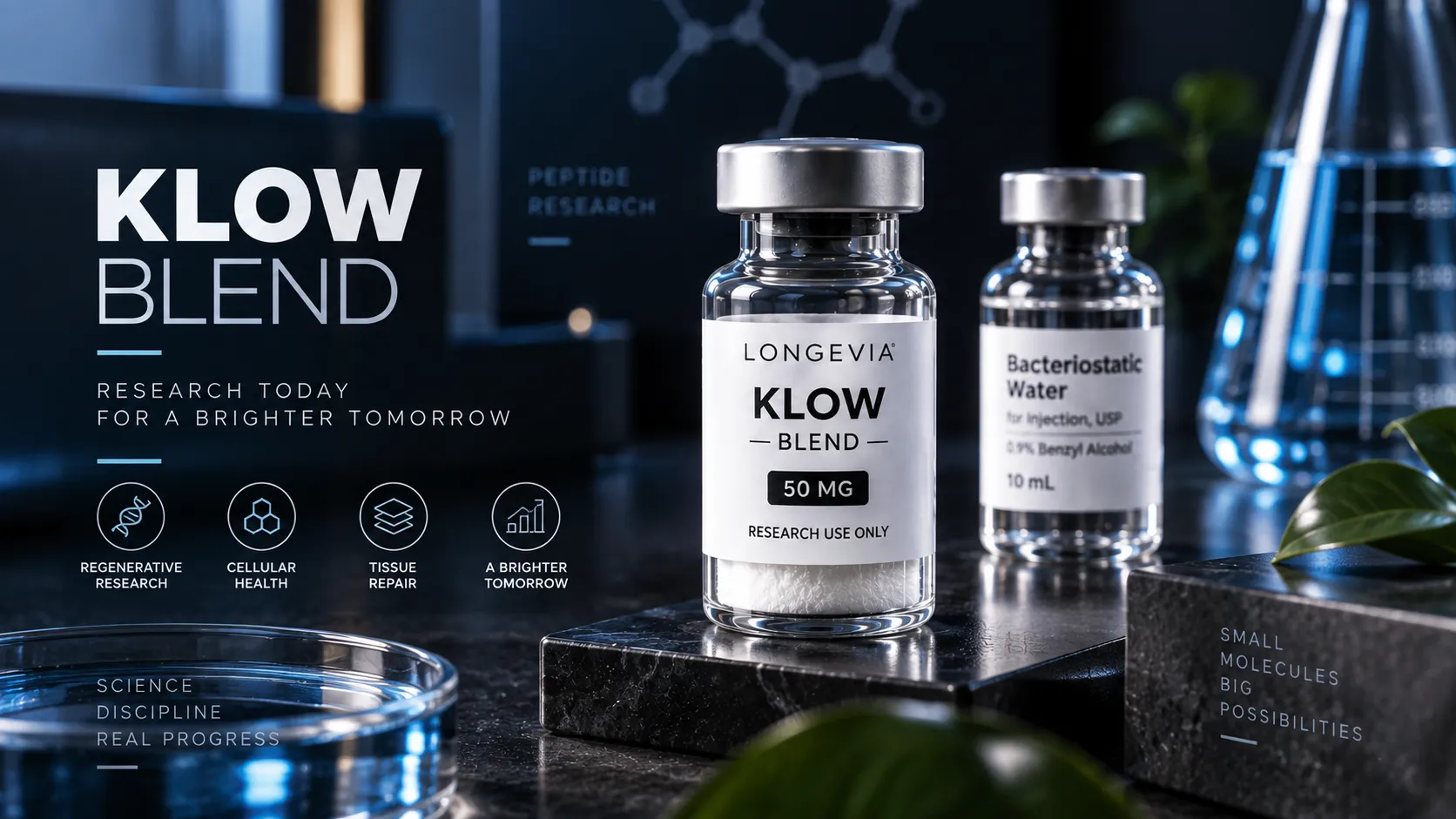
- KLOW Blend is a lyophilized multi-peptide research blend formulated for laboratory study of tissue regeneration, collagen remodeling, and cellular recovery signaling.
- Longevia does not publish the individual component peptides or mg ratios in KLOW Blend, so all reconstitution math works from the vial's total blend mass.
- Reconstitution concentration is calculated as total blend mass in mg divided by diluent volume in mL.
- On a U-100 insulin syringe, 100 units equals 1 mL, so a 10 mg/mL preparation delivers 100 mcg of total blend per unit.
- Every component peptide in KLOW Blend is synthesized by SPPS, purified by preparative HPLC, and confirmed by ESI-MS, with a Certificate of Analysis issued per lot.
- Lyophilized KLOW Blend is stored at 2-8°C protected from light and moisture, while reconstituted solution is refrigerated and treated as short-lived.
- KLOW Blend is focused on connective tissue and repair signaling, while Glow Blend is scoped to dermal models and oxidative stress pathways.
- Quantities drawn from a blend represent total blend mass, not a defined amount of any single component peptide.
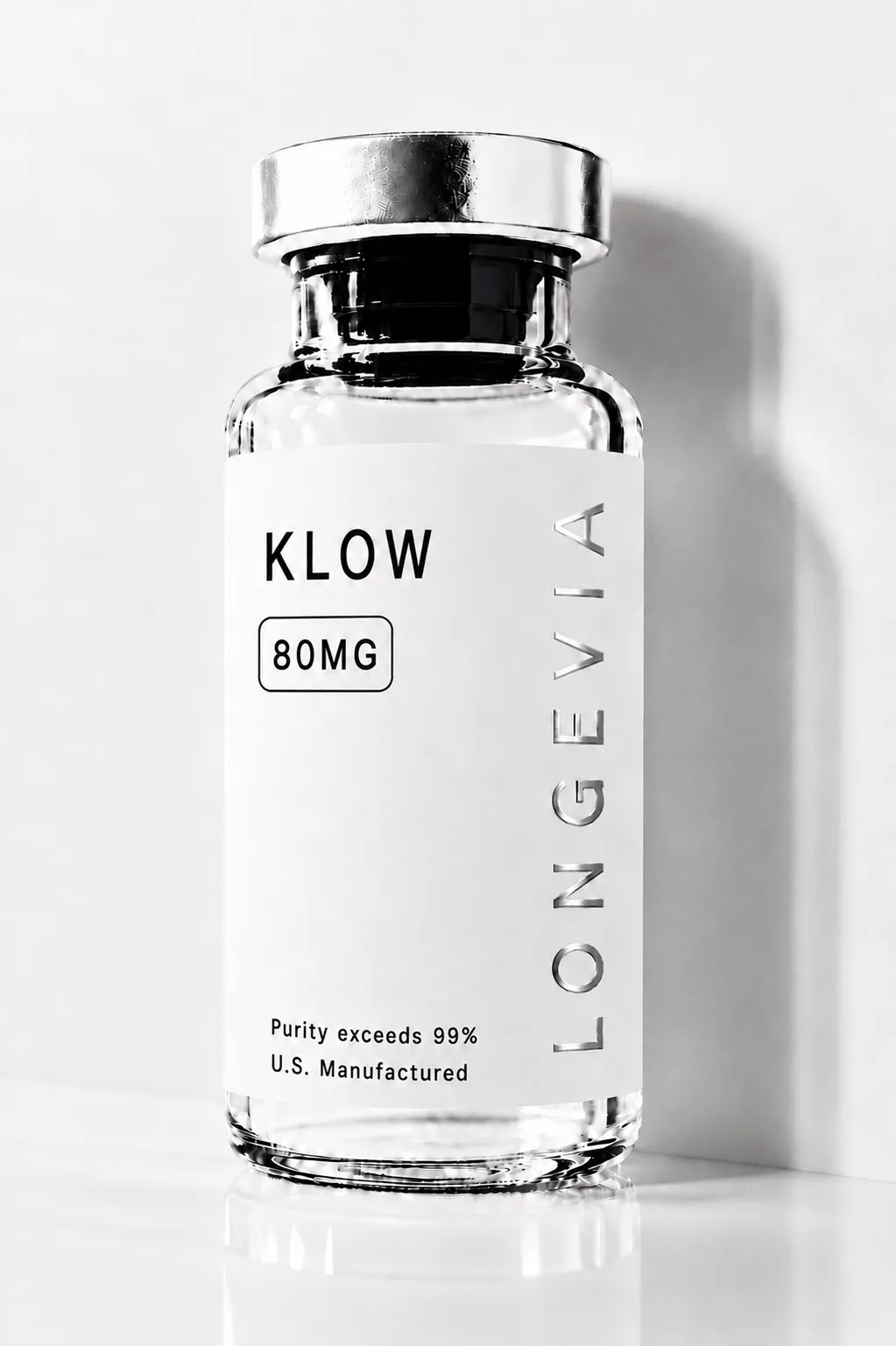
KLOW Blend
Buy KLOW Blend, a laboratory-grade regenerative peptide blend with COA-verified purity. HPLC-tested, batch-traceable, research use only.
KLOW Blend
Buy KLOW Blend, a laboratory-grade regenerative peptide blend with COA-verified purity. HPLC-tested, batch-traceable, research use only.
KLOW Blend ships as a lyophilized powder in a single vial, and most researchers arrive here with one of two questions: what is actually in it, and how much bacteriostatic water goes in. Both get answered below. The composition answer is shorter than you might want, and the reason for that is worth understanding before you go hunting for an ingredient list somewhere else on the internet.
KLOW Blend is a multi-peptide research blend supplied as a lyophilized powder for laboratory investigation of tissue regeneration, collagen remodeling, and cellular recovery signaling. Longevia does not publish the individual component peptides or their mg ratios, so every concentration and volume calculation works from the vial's total blend mass rather than a per-component breakdown. The powder is reconstituted with bacteriostatic or sterile water immediately before experimental use and held at 2-8°C until then.
What KLOW Blend is
KLOW Blend combines several research peptides selected for their proposed roles in tissue repair, collagen signaling, and regenerative cellular communication. Each constituent is synthesized independently by Solid-Phase Peptide Synthesis (SPPS) and purified by preparative HPLC before the components are formulated together, so the finished blend reflects documented ratios rather than approximate mixing. Identity and molecular weight of every component are confirmed by Electrospray Ionization Mass Spectrometry (ESI-MS), and each lot ships with its own Certificate of Analysis at a guaranteed purity above 99%.
The format matters as much as the chemistry. Lyophilized powder is far more stable than solution, which is why peptides are shipped dry and reconstituted at the bench rather than sold pre-mixed.
Why use a blend at all? Single-molecule compounds are the right tool when you want to isolate one signaling pathway. A blend is the right tool when the question is whether two or more pathways do something together that neither does alone. That design only works if the blend is run alongside single-peptide controls, which is exactly the comparative setup KLOW is formulated for: dermal and connective-tissue models, fibroblast activity, extracellular matrix support, localized recovery signaling, and modulation of inflammatory response pathways.
What's inside the vial, and what gets published
Longevia's product listing for KLOW Blend does not name the individual component peptides and does not disclose the mg split between them. That is a deliberate formulation decision, not an oversight in the copy.
This matters practically. Search "klow peptide blend ingredients" and you will find pages confidently listing four specific peptides, because several vendors sell products under similar names. Those pages describe those vendors' formulations. A shared product name across suppliers guarantees nothing about shared composition, and importing someone else's ingredient list into your protocol notes means you are documenting a formulation you have no evidence for.
What you can verify for your specific vial:
- The lot number on the label, matched against the Certificate of Analysis in the COA Library
- Purity above 99% by HPLC for that lot
- Confirmed molecular weight for each component peptide by ESI-MS
- Total blend mass per vial, printed on the label
Never carry a component list or mg ratio from a third-party page into your own records for this product. The COA for your lot number and the vial label are the only defensible sources for what you are working with.
Reconstitution: the math, not a rule of thumb
There is no universal "add 2 mL" answer, and anyone who gives you one is guessing at your vial. Reconstitution is a two-line calculation.
Concentration (mg/mL) = total blend mass (mg) ÷ diluent volume (mL)
Volume needed (mL) = target quantity (mg) ÷ concentration (mg/mL)
Read the total blend mass off the vial label before you touch anything. Because the component ratios aren't disclosed, that total mass is the only figure your math can be built on — which is fine for concentration work, and a real limitation for anything requiring per-component molarity. More on that below.
The grid below gives the resulting concentration for common vial masses and diluent volumes.
Total blend mass | + 1 mL | + 2 mL | + 3 mL | + 5 mL |
|---|---|---|---|---|
10 mg | 10 mg/mL | 5 mg/mL | 3.33 mg/mL | 2 mg/mL |
20 mg | 20 mg/mL | 10 mg/mL | 6.67 mg/mL | 4 mg/mL |
30 mg | 30 mg/mL | 15 mg/mL | 10 mg/mL | 6 mg/mL |
50 mg | 50 mg/mL | 25 mg/mL | 16.67 mg/mL | 10 mg/mL |
70 mg | 70 mg/mL | 35 mg/mL | 23.33 mg/mL | 14 mg/mL |
Less diluent means a more concentrated solution and smaller measured volumes, which magnifies pipetting or syringe error. More diluent means easier measurement and a larger volume to store. For most bench work, landing somewhere that puts your working quantity between 10 and 40 units on a U-100 syringe is the sweet spot.
Step by step
- Bring the vial to room temperature before opening anything — cold glass and condensation make a mess of the cake.
- Wipe both the peptide vial stopper and the diluent stopper with an alcohol prep.
- Draw your calculated volume of bacteriostatic water into a sterile syringe.
- Angle the needle so the stream runs down the inside wall of the vial. Do not fire it directly into the powder.
- Let it sit. Most lyophilized cakes dissolve on their own within a minute or two.
- If material remains, roll or swirl the vial gently between your fingers. Never shake it.
- Inspect against light: the solution should be clear and free of visible particulates.
- Label the vial with the concentration and the reconstitution date, then refrigerate.
Agitation is the single most common handling error with lyophilized peptides. Shaking introduces shear and air-liquid interface stress that can degrade peptide structure. If the cake hasn't dissolved after gentle swirling, wait another few minutes rather than working the vial harder.
Dosage chart: reading concentration off a syringe
Insulin syringes are marked in units, not millilitres. On a standard U-100 syringe, 100 units equals 1 mL, so one unit is 0.01 mL. That conversion is what turns a concentration into something you can actually measure.
Concentration | Per 1 unit | For 250 mcg | For 500 mcg | For 1 mg |
|---|---|---|---|---|
2 mg/mL | 20 mcg | 12.5 units | 25 units | 50 units |
5 mg/mL | 50 mcg | 5 units | 10 units | 20 units |
10 mg/mL | 100 mcg | 2.5 units | 5 units | 10 units |
20 mg/mL | 200 mcg | 1.25 units | 2.5 units | 5 units |
25 mg/mL | 250 mcg | 1 unit | 2 units | 4 units |
Every figure in that table refers to total blend mass. Drawing 5 units of a 10 mg/mL preparation gives you 500 mcg of blend — not 500 mcg of any single component within it. If your experimental design needs a defined molar concentration of a specific peptide, a blend is the wrong material for that arm of the study and a single-entity compound is the right one. Use the blend where the question is about the combination. Full worked examples for single compounds are covered in our peptide dosage calculation guide.
KLOW vs Glow Blend
These two get compared constantly, and the useful differences are in research focus and handling rather than in any claimed potency ranking.
KLOW Blend | Glow Blend | |
|---|---|---|
Primary research focus | Tissue regeneration, collagen remodeling, ECM support, fibroblast activity | Skin regeneration biology, barrier integrity, collagen pathways, oxidative stress |
Purity standard | >99%, COA per lot | >=99% aggregate, COA per batch |
Verification | SPPS, preparative HPLC, ESI-MS per component | SPPS, independent third-party HPLC |
Lyophilized storage | 2-8°C, protected from light and moisture | -20°C, dry, protected from light |
After reconstitution | Refrigerate, use promptly | 24-48 hours, or 4°C |
Price | $128 | $125 |
Component disclosure | Not published | Not published |
The practical split: KLOW is oriented toward connective tissue and repair signaling across tissue types, while Glow is scoped tightly to dermal models and adds oxidative stress and antioxidant defense as an explicit axis. Glow also carries the stricter storage requirement of the two, which is worth knowing before it arrives. Neither publishes a component list. Details on the second product are in the Glow Blend composition and dosage guide.
Running both against single-peptide controls in the same model is the only way to make a real comparison, and it is a more informative experiment than either blend alone.
Where the math usually goes wrong
Three errors account for most of the bad numbers researchers end up with. The first is assuming a vial mass instead of reading it, usually because a forum post or a calculator page defaulted to a figure from a different product. The second is mixing units mid-calculation — working in mcg for the target and mg for the vial, then losing a factor of a thousand. The third is treating syringe units as if they were millilitres, which inflates every measured volume by 100x.
A thirty-second check catches all three. Recalculate the total number of doses your vial should yield at your chosen concentration and see whether it matches the volume you actually put in. If a 50 mg vial reconstituted to 2 mL is supposed to give you twenty 2.5 mg working quantities, the arithmetic should close cleanly. When it doesn't, the error is almost always in the unit conversion rather than the concentration.
Storage, stability and shelf life
Lyophilized KLOW Blend is stored at 2-8°C, protected from light and moisture, until it is reconstituted. The dry state is the stable state — lyophilization is what makes extended shelf stability possible in the first place.
Once liquid, the clock starts. Reconstituted peptide solutions are refrigerated and treated as short-lived. Bacteriostatic water contains 0.9% benzyl alcohol as a preservative, which inhibits microbial growth and permits repeated withdrawals from the same vial under aseptic conditions. Pharmacopoeial practice assigns a 28-day limit to preserved multiple-dose containers after first puncture unless the manufacturer specifies otherwise, and that ceiling is a reasonable working anchor for preserved diluent. Chemical stability of the dissolved peptide is a separate question from microbial control, and it is usually the shorter of the two.
A few habits that protect material: minimize freeze-thaw cycles by aliquoting if you will be sampling repeatedly, keep vials out of light, and write the reconstitution date on the label every time. Vials with no date on them get discarded, which is cheaper than a contaminated dataset.
What the literature covers, and what it doesn't
There is no peer-reviewed clinical literature on this blend as a blend. There is substantial published work on the biology it is formulated to interrogate: extracellular matrix composition and signaling, matrix metalloproteinase regulation of tissue remodeling, and fibroblast behavior in repair models. That distinction is the honest framing for any multi-peptide research preparation.
Researchers working with material of this type typically measure collagen I and III expression, hydroxyproline content, MMP and TIMP activity, fibroblast migration in scratch-wound assays, and inflammatory mediator output. Those are endpoints, not outcomes, and they belong to in vitro and preclinical models.
"Side effects" is a clinical concept and does not apply to research-use-only material, which is not for human or veterinary use. The relevant safety considerations in a lab setting are ordinary handling ones: aseptic technique, appropriate PPE, and the recognized precautions around benzyl alcohol-preserved diluents.
Sourcing and verification checklist
Before a vial enters a protocol, confirm the lot number on the label matches a published Certificate of Analysis, that the COA reports HPLC purity for that specific lot rather than a generic specification sheet, and that mass spectrometry data confirms molecular weight for each component. Every Longevia batch is independently HPLC/LC-MS tested with lot-specific COAs published in the COA Library.
A blend is only as trustworthy as its documentation, and documentation is the one thing you can check before you spend a month on an assay.
Frequently Asked Questions
- Merrifield RB. Solid Phase Peptide Synthesis. I. The Synthesis of a Tetrapeptide. J Am Chem Soc. 1963;85(14):2149-2154.
- Frantz C, Stewart KM, Weaver VM. The extracellular matrix at a glance. J Cell Sci. 2010;123(Pt 24):4195-4200.
- Page-McCaw A, Ewald AJ, Werb Z. Matrix metalloproteinases and the regulation of tissue remodelling. Nat Rev Mol Cell Biol. 2007;8(3):221-233.
- Bacteriostatic Water for Injection, USP - prescribing information, Hospira, Inc. DailyMed, U.S. National Library of Medicine.
- United States Pharmacopeia. General Chapter <797> Pharmaceutical Compounding - Sterile Preparations: beyond-use dating for multiple-dose containers.