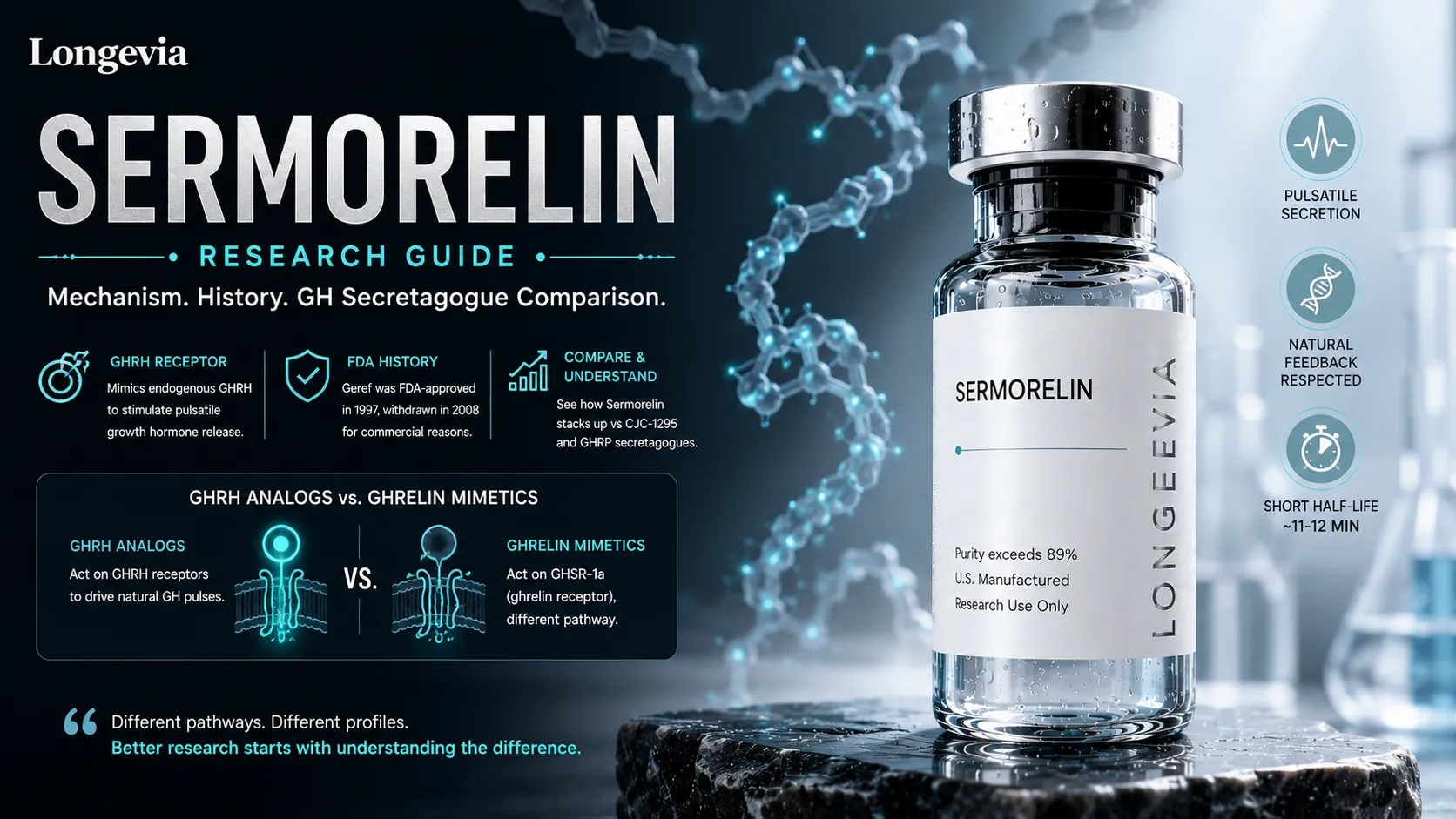
- Sermorelin was FDA-approved as Geref from 1997 to 2008, discontinued for commercial reasons, not safety findings — confirmed by the FDA in 2013.
- Sermorelin binds the GHRH receptor directly, triggering a cAMP-mediated cascade that stimulates pulsatile, physiologically-regulated GH release.
- Sermorelin has a very short half-life (11-12 minutes), dramatically shorter than CJC-1295 without DAC (~30 minutes) or DAC-modified CJC-1295 (several days).
- GHRH analogs (Sermorelin, CJC-1295, Tesamorelin) and ghrelin mimetics/GHRPs (Ipamorelin, GHRP-2, GHRP-6) act through separate receptors.
- Combining two GHRH analogs produces an additive, not synergistic, effect since they compete for the same receptor.
- No currently marketed Sermorelin product carries active FDA approval; research-grade material is properly classified Research Use Only.
- A controlled study in healthy elderly men found nightly GHRH(1-29) significantly improved GH secretion and slow-wave sleep architecture, but did not significantly change body composition measures in that trial.
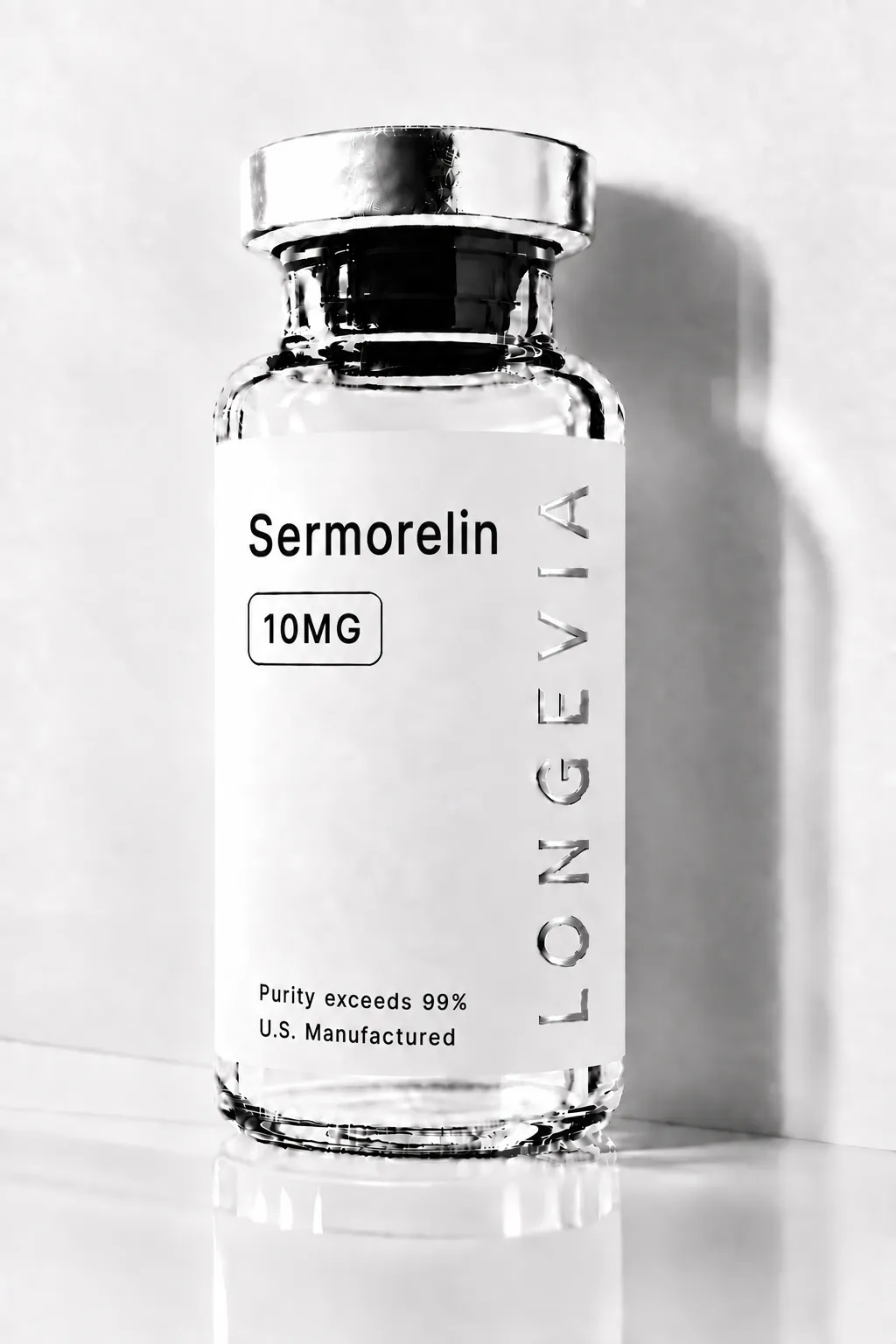
Sermorelin
Sermorelin is a synthetic 29-amino-acid analogue of growth hormone-releasing hormone (GHRH) investigated in research involving GHRH receptor pharmacology, pituitary somatotroph signaling, and GH/IGF-1 axis biology. Available in 10mg and 20mg vials. Research Use Only — Longevia Research.
Sermorelin
Sermorelin is a synthetic 29-amino-acid analogue of growth hormone-releasing hormone (GHRH) investigated in research involving GHRH receptor pharmacology, pituitary somatotroph signaling, and GH/IGF-1 axis biology. Available in 10mg and 20mg vials. Research Use Only — Longevia Research.
Among growth-hormone-releasing compounds discussed in research settings, Sermorelin holds a distinction that separates it from almost every other growth-hormone secretagogue discussed in research contexts: it is not merely a compound with promising preclinical data — it was an FDA-approved pharmaceutical, marketed as Geref, from 1997 until its manufacturer voluntarily discontinued it in 2008 for commercial rather than safety or efficacy reasons. [1] That regulatory history is directly relevant to how researchers should evaluate the compound today, and it is routinely omitted from research-peptide content that treats Sermorelin as functionally interchangeable with never-approved secretagogues, when in fact its approval-and-discontinuation history is one of the more information-dense regulatory case studies available in this entire compound category.
Sermorelin is a synthetic peptide corresponding to the first 29 amino acids of naturally occurring human growth-hormone-releasing hormone (GHRH), often designated GRF(1-29). This fragment retains the full biological activity of the complete 44-amino-acid native hormone while being significantly easier to synthesize reliably — making it, historically, one of the first GHRH-pathway compounds practical to manufacture at pharmaceutical scale. [2]
Mechanism of action
Understanding that mechanism in detail is the foundation for every comparison later in this guide.
Sermorelin binds directly to GHRH receptors on somatotroph cells in the anterior pituitary, mimicking the endogenous ligand's activity. Receptor binding initiates an intracellular cAMP signaling cascade that drives growth hormone gene transcription and secretion. [2] Because Sermorelin acts through the same receptor as the body's own GHRH, it stimulates growth hormone release in a pulsatile pattern that respects the natural negative-feedback relationship between GH, IGF-1, and somatostatin — a physiological characteristic that distinguishes GHRH-pathway compounds from mechanisms that bypass this feedback loop entirely.
Pharmacokinetically, subcutaneous Sermorelin reaches peak plasma concentration within 5 to 20 minutes, with an extremely short elimination half-life of approximately 11 to 12 minutes. [2] This rapid clearance is a defining pharmacokinetic characteristic: Sermorelin produces a sharp, short-lived stimulus rather than a sustained receptor-occupancy period, which has direct implications for how it is studied and compared against longer-acting GHRH analogs.
Sermorelin's structure — GRF(1-29) — represents the shortest GHRH fragment that retains full receptor-binding bioactivity. Shorter fragments lose activity; the full 44-amino-acid hormone is not meaningfully more potent for receptor activation but is substantially harder to manufacture at scale.
Sermorelin's FDA history: Geref
The FDA approved Sermorelin under the brand name Geref in 1997, for the diagnosis and treatment of growth hormone deficiency in children — making it the first GHRH analog to receive U.S. regulatory approval. [1] Its manufacturer withdrew Geref from the market in 2008, and critically, the FDA's own subsequent 2013 determination confirmed explicitly that the withdrawal was for commercial reasons, not because of any safety or efficacy finding. [1] This distinction matters enormously for how the compound should be evaluated: an approved drug withdrawn for business reasons carries a fundamentally different regulatory history than a compound that failed a safety review or was never submitted for approval at all.
Geref's discontinuation was a business decision by its manufacturer, not a regulatory safety action. This is a materially different history from a drug withdrawn for adverse findings, and research content that fails to distinguish the two is providing an inaccurate risk signal.
Despite this approval history, no version of Sermorelin currently carries active FDA approval for any indication — Geref is no longer marketed, and research-grade Sermorelin sold today has not been evaluated by the FDA as a currently marketed product. Researchers should treat it as Research Use Only material with a historically significant but currently lapsed approval status, not as a presently approved drug.
GHRH analogs versus ghrelin mimetics
One of the most consequential distinctions in growth-hormone secretagogue research is the difference between two entirely separate pharmacological families that are frequently discussed together as though they were one category:
Family | Mechanism | Example compounds |
|---|---|---|
GHRH analogs | Bind the GHRH receptor directly, mimicking endogenous GHRH | Sermorelin, CJC-1295, Tesamorelin |
Ghrelin mimetics (GHRPs) | Activate the growth-hormone secretagogue receptor (GHSR-1a), a distinct pathway | Ipamorelin, GHRP-2, GHRP-6, Hexarelin |
This distinction is not academic. Two GHRH analogs — Sermorelin and CJC-1295, for example — compete for the same pituitary receptor, so combining them does not produce a synergistic effect; their actions are additive at best, since they are drawing on the same finite receptor pool. [3] A GHRH analog paired with a ghrelin mimetic, by contrast, activates two mechanistically distinct pathways simultaneously, which is the actual pharmacological rationale behind combination protocols like CJC-1295 with Ipamorelin — see Longevia's CJC-1295 and Ipamorelin reconstitution guide for the documentation principles that apply to that specific combination.
Sermorelin versus CJC-1295: pharmacokinetic comparison
Both compounds are GHRH analogs acting through the identical receptor, but they differ substantially in one variable: duration of action. Sermorelin's elimination half-life of roughly 11 to 12 minutes is dramatically shorter than CJC-1295 without DAC's approximately 30-minute half-life, and shorter still compared with DAC-modified CJC-1295, which was specifically engineered to extend exposure to multiple days. [3][4]
Attribute | Sermorelin | CJC-1295 (no DAC) | CJC-1295 (DAC) |
|---|---|---|---|
Receptor | GHRH receptor | GHRH receptor | GHRH receptor |
Approximate half-life | 11-12 minutes | ~30 minutes | Several days |
GH release pattern | Sharp, short pulse | Moderate-duration pulse | Sustained elevation |
FDA history | Approved 1997-2008 (Geref) | Never FDA-approved | Never FDA-approved |
This pharmacokinetic spread is why the three compounds are studied for different research questions despite sharing a receptor: Sermorelin's brief pulse is useful for studying acute, physiologically-timed GH release; DAC-modified CJC-1295's extended exposure is useful for studying sustained-elevation effects — and the two are not interchangeable substitutes for the same experimental design.
Documented research applications
Beyond its historical pediatric growth-hormone-deficiency indication, Sermorelin research has extended into adult growth-hormone secretion studies, where it has been used diagnostically to assess pituitary GH-releasing capacity — a somatotroph function test rather than a therapeutic application. Its short half-life makes it particularly suited to this diagnostic use case, since a rapid, well-characterized pulse is easier to measure and interpret against a fixed time course than a sustained-release compound would be.
Aging and sleep architecture research
GH secretion is predominantly tied to slow-wave sleep (SWS), the deepest stage of the sleep cycle, and both GH pulse amplitude and total daily secretion decline measurably from the fifth decade of life onward, alongside corresponding reductions in IGF-1. [5] This age-related decline is the basis for a specific line of GHRH-analog research: whether restoring GH pulsatility through nightly GHRH administration measurably changes sleep architecture or downstream metabolic markers in older adults.
A controlled study of healthy older men receiving single nightly GHRH(1-29) injections found the treatment significantly increased 24-hour integrated GH concentrations and improved slow-wave sleep architecture, with those effects sustained across the full treatment period. [5] Notably — and this is a distinction that much secondary content on this topic omits — the same study found no significant change in body weight, BMI, waist-to-hip ratio, or DEXA-measured muscle and fat composition. The GH and sleep-architecture effect was real and measurable; a body-composition effect in that specific trial was not. [5]
When researching Sermorelin's aging-related literature, distinguish claims about GH secretion and sleep architecture (where controlled trial evidence is reasonably direct) from claims about body composition change (where the same trial found no significant effect). Secondary sources frequently blur this distinction.
This finding illustrates why primary-source verification matters more than aggregated secondary summaries: several popular peptide-information sites cite this research area as demonstrating body-composition improvement, when the controlled trial data specifically available on this point did not find one. The GH-secretion and sleep-quality findings remain the better-supported research angle for this compound in an aging-research context.
Diagnostic use as a somatotroph function test
Sermorelin's original approved use extended beyond simple hormone replacement into diagnostic testing: because it acts as a direct, well-characterized GHRH-receptor agonist, it has been used in research and clinical settings to assess whether the pituitary gland retains the capacity to secrete growth hormone when appropriately stimulated. This is mechanistically different from testing baseline GH levels, which fluctuate too much throughout the day to be diagnostically meaningful on their own — a stimulation test instead measures the pituitary's peak response to a known, standardized trigger.
This diagnostic framing is relevant to research design more broadly: a GHRH stimulation test protocol requires precise timing of blood sampling relative to compound administration, typically at multiple points across the following one to two hours, since the GH pulse Sermorelin triggers is both rapid in onset and short in duration given the compound's own brief half-life. Researchers designing any protocol using Sermorelin as a stimulation agent, rather than studying its own pharmacokinetics, should treat the sampling schedule as being driven by the compound's clearance profile.
Reconstitution and quality documentation
Sermorelin is supplied as a lyophilized powder requiring reconstitution before use in research settings. The same documentation discipline applies as with any peptide: record the lot number, nominal vial amount, diluent identity and volume, and calculated concentration as an explicit equation. Longevia's peptide dosage calculations guide and peptide calculator cover this arithmetic in detail, and our general reconstitution and storage guide covers stability documentation principles that apply broadly across compounds.
Given Sermorelin's rapid clearance, timing documentation is particularly important: the interval between reconstitution, preparation, and any research use should be recorded precisely, since a compound with an 11-to-12-minute half-life is far more sensitive to handling-time variability affecting interpretation than a longer-acting compound would be. A certificate of analysis verifying identity and purity via HPLC and mass spectrometry remains a baseline requirement regardless of the compound's pharmacokinetic profile — see Longevia's purity guide for how to evaluate that documentation.
Storage documentation
Like most lyophilized peptides, unreconstituted Sermorelin is generally documented as stable when frozen and protected from light, while reconstituted solution has a substantially shorter documented window and should be refrigerated. Because Sermorelin's own biological half-life is measured in minutes, its shelf-life as a prepared solution is governed by chemical and microbial stability considerations, not by its pharmacokinetic clearance — these are two entirely separate concepts that are easy to conflate.
Preparation state | Typical documented storage | Key consideration |
|---|---|---|
Lyophilized powder | Frozen, protected from light | Long-term stability prior to use |
Reconstituted solution | Refrigerated (2-8°C) | Chemical/microbial stability window, unrelated to the compound's minutes-long biological half-life |
Common comparison mistakes
Comparison content for growth-hormone secretagogues is unusually prone to conflating mechanism, duration, and regulatory status into one another, so it is worth separating them explicitly one more time before summarizing the most common errors. Mechanism determines which receptor a compound engages and therefore which other compounds it can meaningfully combine with. Duration of action determines what research question a given compound is actually suited to answering. Regulatory status determines what evidentiary weight its human data carries. None of the three predicts the other two.
The most frequent error is treating "GHRH analog" as a single interchangeable category rather than recognizing that half-life differences between Sermorelin, CJC-1295, and Tesamorelin represent genuinely different research tools suited to different questions. A second common error is assuming that pairing Sermorelin with another GHRH analog produces a synergistic effect — because both compete for the same receptor, the combination is additive at best, unlike a GHRH-analog-plus-ghrelin-mimetic pairing. A third mistake is treating Sermorelin's historical FDA approval as current approval status; Geref is no longer marketed, and research-grade material available today carries no active FDA evaluation.
References and evidence limits
Sermorelin's approval history as Geref (1997-2008) and the FDA's 2013 confirmation that its discontinuation was commercial rather than safety-related is documented regulatory history. [1] Its receptor mechanism and pharmacokinetic profile are supported by pharmacology literature on GHRH receptor signaling. [2] The GHRH-analog versus ghrelin-mimetic mechanistic distinction, and the additive-rather-than-synergistic nature of same-pathway combinations, reflects established growth-hormone-secretagogue pharmacology. [3][4] This article is educational and does not establish a human dosing protocol. See Longevia's research-use disclaimer for the complete compliance position governing RUO compounds.
Frequently Asked Questions
- FDA approval history of Sermorelin (Geref), 1997 approval and 2008 commercial discontinuation, 2013 FDA confirmation of non-safety-related withdrawal.
- Sermorelin GHRH receptor mechanism, cAMP signaling cascade, and pharmacokinetic profile.
- Growth hormone-releasing hormone receptor (GHRH-R) and its signaling.
- Sermorelin vs. CJC-1295 pharmacokinetic and mechanistic comparison, GHRH analog vs. ghrelin mimetic receptor families.
- Vittone J, Blackman MR, Busby-Whitehead J, et al. Effects of single nightly injections of growth hormone-releasing hormone (GHRH 1-29) in healthy elderly men. Metabolism. 1997;46(1):89-96.