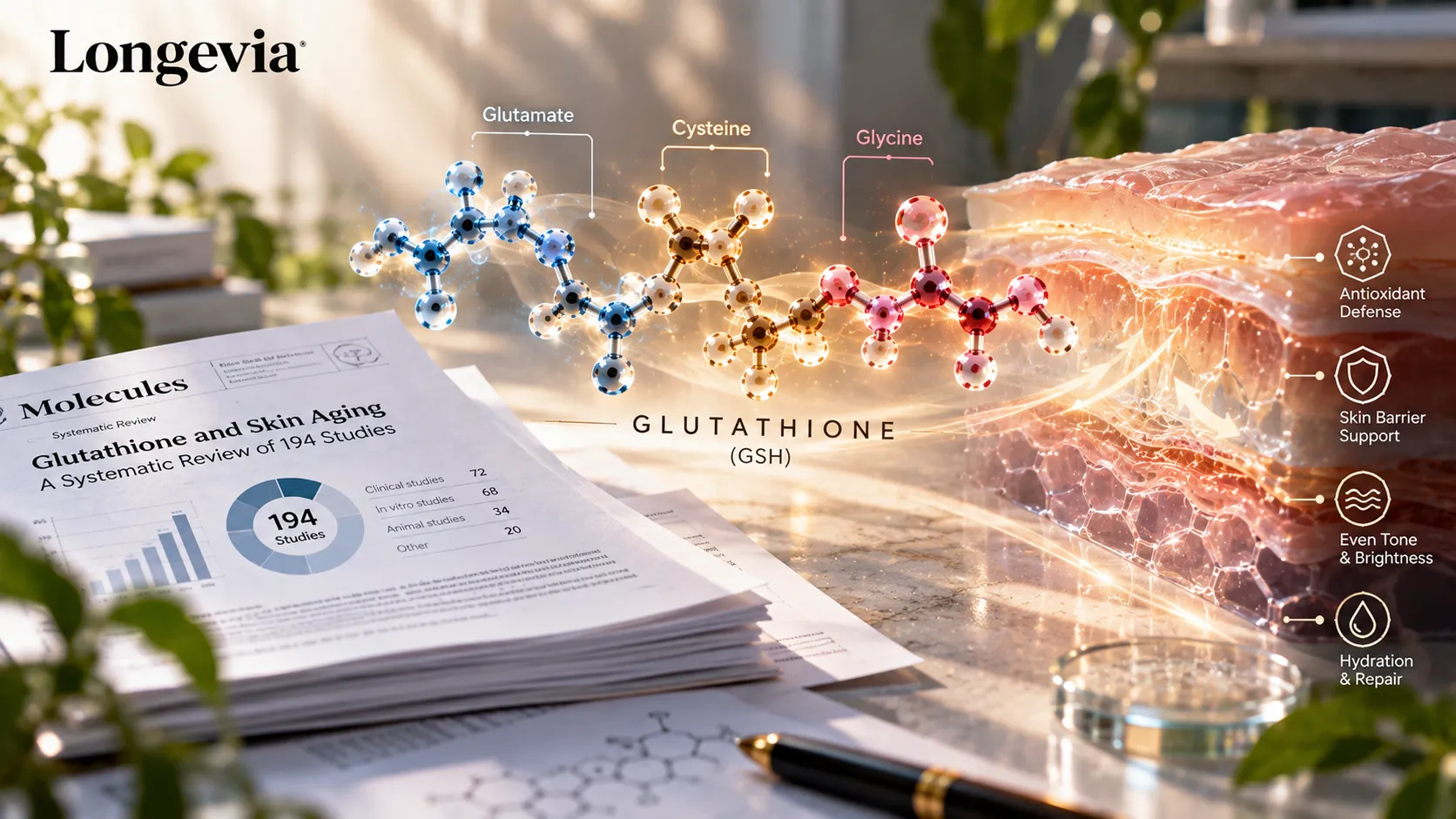
- A systematic review published in Molecules in March 2026 synthesized 194 studies on glutathione in skin aging and tissue regeneration, selected from 2,538 records across six databases.
- The review used narrative synthesis rather than meta-analysis, so it reports direction and consistency of findings rather than any pooled effect size.
- Topical and oral glutathione showed favorable effects on pigmentation, skin brightness, hydration and oxidative stress markers in the included human trials.
- The proposed pigmentation mechanism is tyrosinase inhibition plus a shift from eumelanin toward pheomelanin, which the authors label as proposed rather than settled.
- The review concluded that injectable and intravenous formulations cannot be recommended as evidence-based interventions for cutaneous aging or regenerative indications.
- Stated limitations include trials of four to twelve weeks, small single-center samples, narrow endpoints and an absence of standardized formulations across routes.
- Every human finding in the review belongs to topical, oral or injectable administration, which are different routes from a lyophilized compound reconstituted for laboratory use.
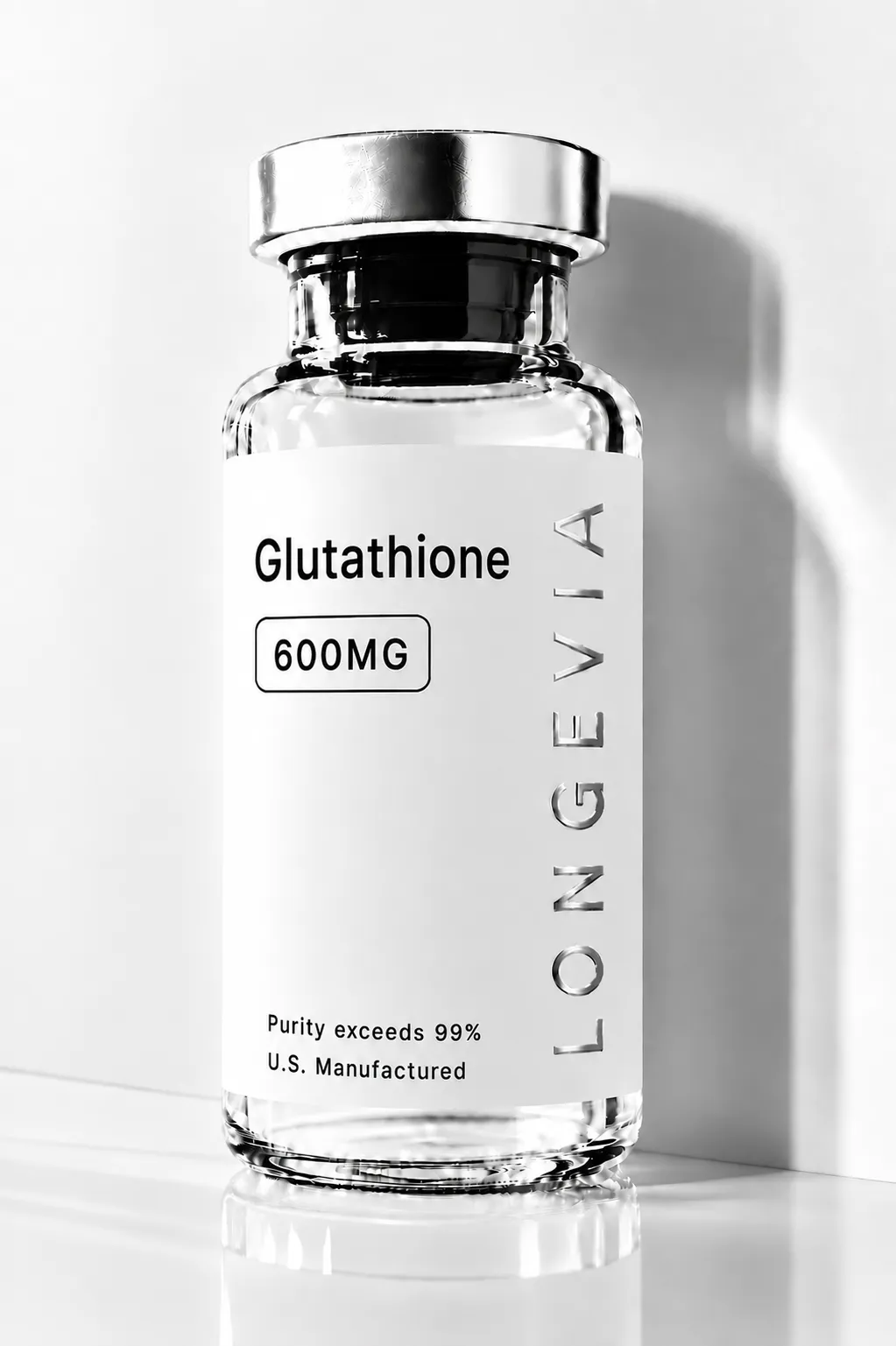
Glutathione
Glutathione (GSH) is a naturally occurring tripeptide antioxidant investigated in research involving oxidative stress biology, glutathione redox cycling, cellular thiol biochemistry, and antioxidant enzyme systems. 600mg and 1500mg vial. Research Use Only — Longevia Research.
Glutathione
Glutathione (GSH) is a naturally occurring tripeptide antioxidant investigated in research involving oxidative stress biology, glutathione redox cycling, cellular thiol biochemistry, and antioxidant enzyme systems. 600mg and 1500mg vial. Research Use Only — Longevia Research.
Researchers at Dunarea de Jos University screened 2,538 records and kept 194 of them. That synthesis appeared in the journal Molecules in March 2026. Any glutathione skin research review of that size is worth reading carefully, because most web content on this compound predates it. The review graded its evidence by delivery route, which matters more than it first appears.
Most of the human data it covers concerns topical creams and oral supplements. Longevia supplies glutathione as a lyophilized research compound for laboratory reconstitution, a different route entirely. Nothing below should be read across from a cream study to that material. Each finding here carries its route label for exactly that reason.
Quick answer. A March 2026 systematic review in Molecules synthesized 194 studies on glutathione in skin aging and tissue regeneration. Topical and oral glutathione showed favorable effects on pigmentation, skin brightness, hydration and oxidative stress markers. Injectable glutathione raised systemic levels quickly, though the authors tied it to short lived effects and safety concerns.
What did this glutathione skin research review actually cover?
It covered 194 studies on glutathione in skin aging and tissue regeneration, published between 2000 and 2025. The stated scope was molecular mechanisms, redox modulation and biomedical implications across delivery routes.
Stanescu and colleagues followed PRISMA 2020 guidelines and searched six databases. Those were PubMed/MEDLINE, Scopus, Web of Science Core Collection, Embase, the Cochrane Library and Google Scholar. Their search window ran from January 2000 to September 2025. The queries returned 2,538 records in total. After screening, 472 full text articles went forward for eligibility assessment, and 194 met every inclusion criterion.
Two reviewers screened records and extracted data independently. A third reviewer settled disagreements that discussion could not resolve. Randomized controlled trials were appraised with the Cochrane Risk of Bias 2 tool across its five domains. Non-randomized clinical work, animal studies and in vitro work were graded against design-appropriate criteria instead.
Exclusions tell you something as well. The authors dropped non-English articles, anything published before 2000, and abstract-only publications. They also excluded studies that reported global oxidative stress markers without measuring glutathione or a redox-regulated pathway specifically.
One methodological choice shapes how every result below reads. The authors used narrative synthesis rather than meta-analysis, because designs, populations and endpoints varied too widely to pool. No summary effect size appears anywhere in the paper. They also analyzed clinical, animal and mechanistic in vitro evidence in separate layers. That separation stops a cell culture result from being read as a human one.
A systematic review is not a trial. It generates no new laboratory or clinical data of its own. Instead it defines a question, searches databases to a protocol, applies stated inclusion rules, and appraises what it finds. Its value rests entirely on the quality of the studies underneath it. A large included count signals breadth of search, not strength of individual evidence.
What is the redox mechanism the review describes?
Glutathione acts as the cell's main intracellular thiol buffer, and the review treats that role as the foundation for everything else. Its described skin effects follow from redox control rather than from any single receptor.
The molecule is a tripeptide of glutamate, cysteine and glycine. An unusual gamma peptide bond links the first two residues, and the cysteine thiol group carries the redox activity. That single chemical feature explains most of what follows.
Cells hold glutathione mostly in its reduced form, GSH. Neutralizing reactive oxygen species oxidizes it to glutathione disulfide, GSSG. Glutathione reductase converts GSSG back using NADPH as a cofactor. The ratio between the two forms serves as a widely used indicator of cellular redox status.
Two enzyme families do much of the work described. Glutathione peroxidases use GSH as an electron donor to reduce hydrogen peroxide and lipid peroxides. The S-transferase family conjugates GSH to electrophilic compounds, raising their solubility and helping excretion. Redox cycling also regenerates vitamin C and vitamin E, which extends glutathione's reach beyond its own molecules.
Skin aging enters the picture through the extracellular matrix. Reactive oxygen species and ultraviolet exposure upregulate matrix metalloproteinases, particularly MMP-1 and MMP-9. Those enzymes fragment dermal collagen, which the reviewed literature links to reduced tensile strength and slower wound healing. Depleted glutathione tracks with fibroblast senescence and impaired keratinocyte turnover in the same body of work.
Pigmentation runs on a proposed mechanism rather than a settled one. Raised intracellular GSH has been reported to inhibit tyrosinase, the rate limiting enzyme in melanin synthesis. The reviewed work also describes a shift from darker eumelanin toward the lighter pheomelanin pathway. Its authors state plainly that precise intracellular dynamics and tissue specific effects remain insufficiently characterized in human skin.
Proposed mechanism | What drives it | Skin-level effect described in the literature |
|---|---|---|
Redox buffering | GSH and GSSG cycling, driven by glutathione reductase and NADPH | Less oxidative damage to lipids, proteins and DNA. Evidence type: in vitro and animal work, plus human oxidative stress markers |
Melanin synthesis shift | Tyrosinase inhibition and a eumelanin to pheomelanin shift | Reduced melanin output. Evidence type: proposed mechanism from in vitro work, with human topical and oral outcome trials alongside it |
Extracellular matrix protection | Lower MMP-1 and MMP-9 activation, preserved fibroblast viability | Less collagen fragmentation, better re-epithelialization. Evidence type: in vitro and animal work |
Antioxidant regeneration | Redox cycling that restores vitamin C and vitamin E | Broader antioxidant capacity in tissue. Evidence type: biochemical and in vitro work |
What did the review find for topical glutathione?
Topical application produced the review's most consistent cosmetic signal, covering skin brightness, hydration and texture. Every finding in this section comes from human topical studies, and from no other route.
Watanabe and colleagues ran a double-blind, placebo-controlled trial of topical oxidized glutathione in healthy women. Skin brightness and moisture content improved against placebo across a ten week period. The review reports visibly reduced hyperpigmentation and no serious adverse effects in that trial.
A second randomized trial, by Grandi and colleagues, tested an S-acyl glutathione cream on UVB-irradiated skin. The review reports reduced erythema and improved texture, and attributes part of that to the S-acylated form itself. That derivative is more stable and more lipophilic than reduced glutathione, which aids penetration and intracellular delivery.
Cui and colleagues took a different approach, applying glutathione precursors rather than glutathione. Their topical N-acetylcysteine and glycine protected skin against oxidative and environmental stressors in the review's account. Precursor strategies aim to stimulate endogenous synthesis in situ, sidestepping the stability problem entirely.
Delivery is where topical work keeps running aground. The stratum corneum presents a real barrier to transdermal glutathione, and the molecule degrades readily in aqueous formulation. Oxidation, light and temperature all reduce its antioxidant capacity before it reaches target tissue. Liposomes, nanoemulsions, nanostructured lipid carriers and hydrogels exist to address those limits, though the review describes their supporting studies as small scale.
What did the review find for oral glutathione?
Oral administration produced measurable but modest and inconsistent effects on pigmentation across the included human trials. Bioavailability is the recurring constraint, and the review returns to it repeatedly.
Arjinpathana and Asawanonda ran a randomized, double-blind, placebo-controlled trial in 60 healthy adults over four weeks. Melanin indices fell at all six measured sites in the oral glutathione group. The difference against placebo reached statistical significance at two sites only, the right side of the face and the sun-exposed left forearm. Their own conclusion was cautious, describing lightening in a small number of subjects and long term safety as unestablished.
Handog and colleagues ran an open-label trial in Filipino women, reporting skin lightening with wide individual variation. Some participants improved markedly and others barely changed, which the review attributes to differences in absorption, metabolism and baseline oxidative status. Duperray and colleagues tested an oral combination of L-cystine and reduced L-glutathione against placebo, in a twelve week randomized trial of 124 Asian women.
Whether oral glutathione raises body stores at all was the older and more basic question. Richie and colleagues addressed it in a six month randomized, double-blinded, placebo-controlled trial in 54 non-smoking adults. Glutathione rose in blood, erythrocytes, plasma, lymphocytes and buccal cells, in a dose and time dependent pattern. Levels returned to baseline after a one month washout period.
Absorption remains the weak link across this route. Intestinal gamma-glutamyltransferase hydrolyzes glutathione rapidly, and first pass hepatic metabolism removes a further share. Modified forms such as S-acetyl glutathione and liposomal encapsulation exist to work around both obstacles. We covered what glutathione does and does not do in skin in an earlier piece.
What does the review say about injectable use, and why does that matter here?
The review treats injectable glutathione as the weakest evidence base of the three routes, and it discourages the practice for cosmetic purposes. Its conclusion is stated more strongly than its abstract suggests.
Intravenous delivery bypasses the gastrointestinal tract, giving it the highest bioavailability of any route covered. The review pairs that advantage with short lived effects and evidence it describes as limited and inconsistent. Some studies suggest improvements in skin clarity, elasticity and pigmentation, though the authors do not treat those reports as established.
Regulators have acted on reports of severe adverse events. The review cites warnings from the United States and Philippine Food and Drug Administrations. Those followed reports of renal failure, thyroid dysfunction and Stevens-Johnson syndrome. Sonthalia and colleagues, in a source the review draws on, found no controlled trial evidence supporting intravenous use for depigmentation. That earlier review also raised ethical concerns about marketing skin whitening in societies where colorism shapes demand.
The 2026 conclusions section puts the position in one line. Injectable and intravenous formulations cannot be recommended as evidence-based interventions for cutaneous aging or regenerative indications, pending more rigorous trials.
Route matters for reading this section correctly. Longevia supplies glutathione as a lyophilized research compound intended for reconstitution and laboratory use. That is a different context from any human parenteral administration described in the clinical literature above. Nothing in this section describes, recommends or endorses such use, and preparation methods sit outside the scope of this article.
Route | What the review reports | Evidence strength or caveat noted |
|---|---|---|
Topical | Favorable effects on skin brightness, hydration and pigmentation in the included human trials | Small and short trials. The stratum corneum limits penetration, and formulation drives the result |
Oral | Favorable effects on pigmentation and oxidative stress markers, with raised body stores in a six month trial | Effects modest and variable between individuals. Intestinal hydrolysis and first pass metabolism limit absorption |
Injectable or intravenous | Rapid rise in systemic levels, and the highest bioavailability of the three routes | Effects short lived. Evidence limited and inconsistent, regulatory warnings issued, and the route is not recommended by the authors |
Route distinction. Every human finding above belongs to topical, oral or injectable administration in a clinical or cosmetic setting. Longevia's glutathione is a lyophilized research compound for laboratory reconstitution, which is none of those three. A result from a cream or a capsule does not transfer to it.
What gaps does this glutathione skin research review still leave?
The authors are direct about the shortfalls. Short trials, small samples, single-center designs and narrow endpoints limit almost everything in the clinical layer.
Most included trials ran four to twelve weeks. They measured narrow outcomes such as the melanin index or subjective brightness ratings. Long term safety, sustained efficacy and histological change went largely unassessed. Variation in formulation, regimen and participant demographics makes comparison between studies unreliable.
Standardization is missing across all three routes. The review describes wide variation in protocols, treatment duration and product quality, and names that variation as a barrier to reproducible research.
Pharmacovigilance carries its own gaps. Adverse events are likely underreported, product composition varies between suppliers, and regulatory enforcement is uneven across jurisdictions. Attributing a reaction to glutathione itself, rather than to a contaminant or a formulation inconsistency, becomes difficult under those conditions.
A redox paradox complicates the picture further. Glutathione protects normal cells from oxidative DNA damage, yet tumor cells often upregulate it to survive oxidative stress and resist therapy. None of the included dermatologic studies reported oncologic adverse events. The authors still flag the theoretical risk for high dose or long term systemic use, and ask for safety work in populations at risk.
What the authors want next is specific. They call for randomized controlled trials, standardized formulations, validated dermatologic endpoints and longitudinal multicenter designs.
Read the limitations section first. A review's own limitations paragraph usually states the ceiling on every claim inside it. Reading that before the abstract tells you how much weight the findings can actually carry.
How should a researcher use this review?
Treat it as a map of the literature, not as a source of effect sizes. Its narrative synthesis summarizes direction and consistency, and never a pooled estimate.
Three habits make it more useful in practice. Check which delivery route a cited effect came from before repeating it anywhere. Separate mechanism level findings from clinical outcome claims, since the review keeps those layers apart deliberately. Read the methodology section before citing any specific figure from the paper.
Going back to the primary source is worth the time it costs. This review describes the Arjinpathana and Asawanonda trial as showing a significant reduction in the melanin index after four weeks. The trial itself reported significance against placebo at two of six measured sites. That compressed version is not false, though only the full one tells you how strong the result was.
Citation practice follows from that difference. Cite the primary trial when you need the result, and cite the review when you need the shape of the field. Our earlier overview of glutathione for skin, and where reconstitution limits apply covers adjacent ground.
Where does Longevia's glutathione research material fit into this?
Longevia supplies glutathione as a lyophilized research compound. Every batch is independently tested by HPLC and LC-MS. Lot-specific Certificates of Analysis are published in the COA Library, so any listed lot can be checked against its own documentation. Identity and purity are what that documentation covers.
Nothing in the review above describes this material or its performance. The studies it synthesized used topical, oral and parenteral preparations in human participants, which is a separate context from laboratory research material. Readers comparing the two should keep that separation intact.
Research use only. This material is intended for laboratory research use only. It is not for human or veterinary use. It is not intended to diagnose, treat, cure or prevent any disease. The human findings summarized above concern topical, oral or injectable administration, which are different routes from a lyophilized compound reconstituted for laboratory use.
Frequently Asked Questions
- Stanescu C, Chiscop I, Boev M, Stanescu GD, Matei MN. Glutathione in Skin Aging and Tissue Regeneration: A Systematic Review of Molecular Mechanisms, Redox Modulation, and Biomedical Implications. Molecules. 2026;31(6):981. PMID: 41900080.
- Arjinpathana N, Asawanonda P. Glutathione as an oral whitening agent: a randomized, double-blind, placebo-controlled study. J Dermatolog Treat. 2012;23(2):97-102. PMID: 20524875.
- Richie JP Jr, Nichenametla S, Neidig W, Calcagnotto A, Haley JS, Schell TD, Muscat JE. Randomized controlled trial of oral glutathione supplementation on body stores of glutathione. Eur J Nutr. 2015;54(2):251-263. PMID: 24791752.
- Sonthalia S, Daulatabad D, Sarkar R. Glutathione as a skin whitening agent: facts, myths, evidence and controversies. Indian J Dermatol Venereol Leprol. 2016;82(3):262-272. PMID: 27088927.