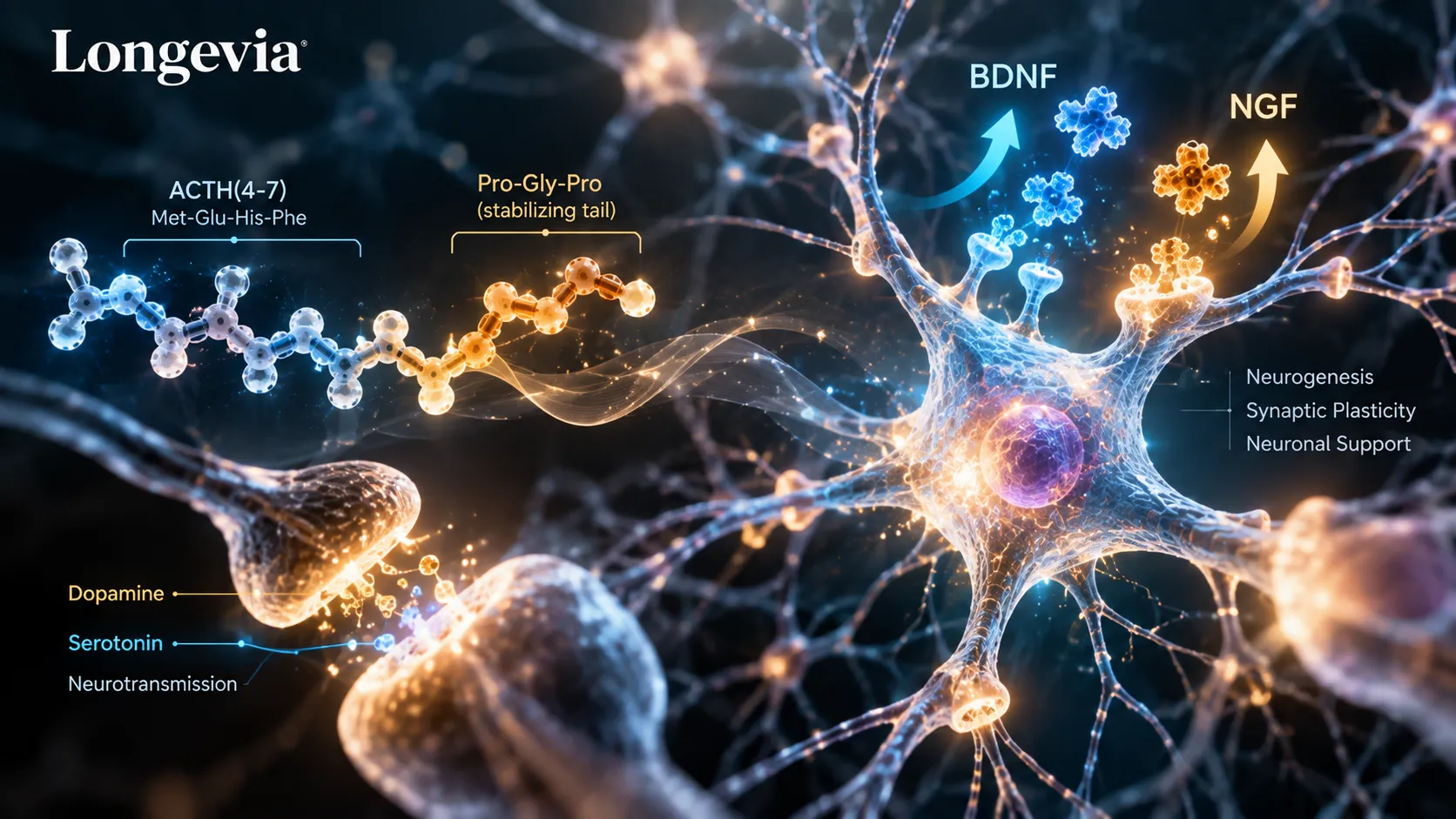
- Semax is a synthetic heptapeptide, Met-Glu-His-Phe-Pro-Gly-Pro, combining an ACTH(4-7) fragment with a synthetic Pro-Gly-Pro tail.
- The Pro-Gly-Pro tail's documented job is resisting enzymatic breakdown, which lets the peptide remain present longer.
- Semax lacks ACTH's classic adrenal-stimulating hormonal activity, according to the published literature.
- Semax's best-documented effect is raising BDNF and NGF expression, shown mainly in animal and cell culture studies.
- Semax also modulates dopamine and serotonin turnover in animal models, through a separate, less understood pathway.
- Human research on Semax is real but far smaller than the animal literature, concentrated mostly in Russian stroke studies.
- No independently confirmed receptor for Semax's mechanism has been identified in the published literature.
- Evidence type, cell, animal, or human, should always be checked before citing any Semax mechanism claim.
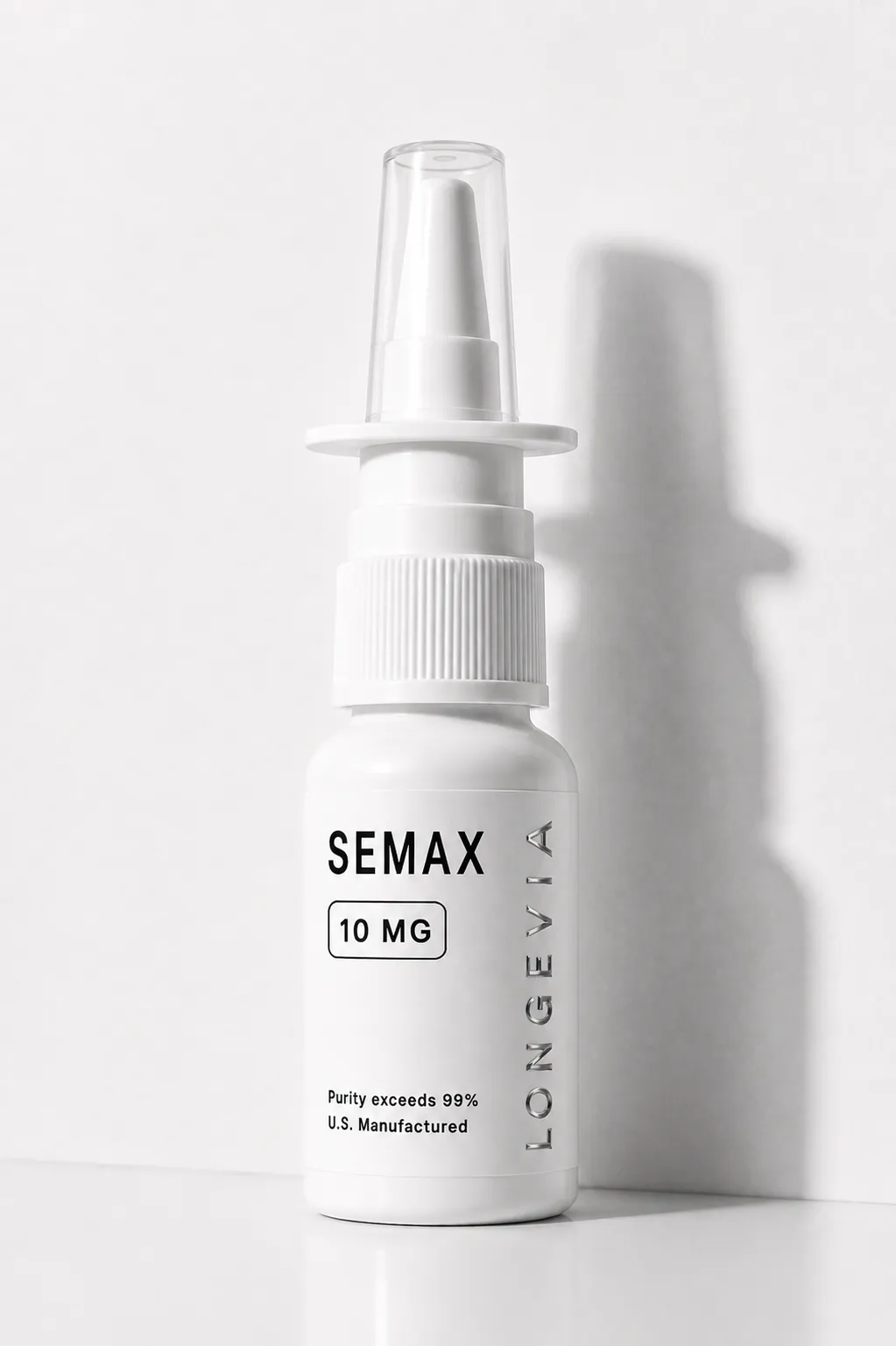
Semax Spray
Buy Semax Spray, a research-grade nootropic neuropeptide preparation in a convenient spray format studied for BDNF modulation and neuroprotective signaling research. COA-verified. Research use only.
Semax Spray
Buy Semax Spray, a research-grade nootropic neuropeptide preparation in a convenient spray format studied for BDNF modulation and neuroprotective signaling research. COA-verified. Research use only.
Semax carries four amino acids lifted directly from a stress hormone. Then comes a synthetic three-residue cap, built to survive enzymes that would otherwise destroy the peptide in minutes. That combination, not some novel receptor system, explains most of what researchers observe when they study Semax. The semax mechanism of action really comes down to two separate stories. A fragment of ACTH does something ACTH was never built to do, while a protective tail keeps that fragment around long enough to do it. This article works through what the published research shows about Semax and BDNF, Semax and NGF, and its documented effect on dopamine and serotonin signaling. It also covers how thin the human evidence gets once separated from the animal work.
Semax is a synthetic heptapeptide built from an ACTH fragment plus a Pro-Gly-Pro extension. Its most consistently documented effect is raising BDNF and NGF expression in brain tissue. That evidence is overwhelmingly preclinical, with a smaller and largely non-English human record behind it.
What is Semax built from?
This is a seven-amino-acid peptide, Met-Glu-His-Phe-Pro-Gly-Pro, built around a fragment of a much larger hormone. The first four residues, Met-Glu-His-Phe, match ACTH(4-7) exactly. That is the same stretch found in adrenocorticotropic hormone itself. Researchers commonly call Semax an ACTH(4-10) analogue, since that region of ACTH is the design's reference point. The final three residues of Semax are not native ACTH sequence at all.
Those final three residues, Pro-Gly-Pro, form a synthetic tripeptide grafted onto the ACTH fragment. This is worth being precise about. Semax does not extend further into native ACTH sequence. It swaps in a manufactured tail that has nothing to do with what sits at ACTH positions 8 through 10 in the body.
ACTH itself is a corticotropin, a pituitary hormone that signals the adrenal cortex to produce cortisol. A paper in Medical Hypotheses described Semax as an ACTH(4-10) analogue that is completely devoid of hormonal activity. That distinction matters for anyone assuming this peptide behaves like a stress hormone in miniature. The region of ACTH responsible for adrenal stimulation sits outside the short stretch Semax borrows. That hormonal function does not carry over into the fragment.
The Pro-Gly-Pro tail has one specific structural job. It resists aminopeptidases and other enzymes that would otherwise break the peptide down within minutes of administration. That resistance to breakdown is a structural feature, not a mechanism of action on its own. Keeping the two ideas separate matters when reading any Semax study.
None of this makes Semax a receptor agonist in the classical sense. No discrete Semax-specific receptor has been identified in the literature. What the peptide appears to do instead is change gene expression patterns inside neurons and glial cells. That is a slower, more diffuse process than binding one receptor and triggering a single signal.
Segment | Source | Role |
|---|---|---|
Met-Glu-His-Phe | Native ACTH(4-7) sequence | Core fragment carried over from the parent hormone |
His-Phe-Pro | Extension toward ACTH(4-10) | Native residues that place Semax within the ACTH(4-10) region |
Pro-Gly-Pro | Synthetic tripeptide, not native ACTH(8-10) sequence | Enzymatic resistance, and independently studied as its own bioactive fragment |
Mechanism findings and clinical claims are two different literatures here. Gene expression and receptor data come almost entirely from animal and cell studies. Any claim about treating a named condition draws on a much thinner, mostly non-English clinical record.
How does Semax raise BDNF and NGF?
BDNF, brain-derived neurotrophic factor, is a protein that helps neurons survive, grow new connections, and adjust their signaling over time. NGF, nerve growth factor, does a related job, supporting the survival and maintenance of specific neuron populations, particularly in the basal forebrain. Both belong to the same neurotrophin family. Each is regulated at the level of gene expression, not switched on or off the way a receptor is.
Evidence for Semax raising these two neurotrophins is mostly animal work, with supporting cell culture data underneath it. In one early cell culture study, glial cells taken from newborn rat forebrain showed a striking response. BDNF mRNA rose eight-fold and NGF mRNA rose five-fold after thirty minutes of Semax exposure, according to a 2001 paper in Neuroscience Letters. In vivo, the pattern holds up. A single intranasal dose of Semax raised BDNF and trkB receptor expression in rat hippocampus within about an hour. That same 2006 Brain Research paper reported a 1.4-fold rise in BDNF protein alongside stronger trkB receptor activation. Rats given Semax in that study also produced more conditioned avoidance responses, a standard learning measure. That behavioral finding stays inside the animal model and should not be read as a statement about human memory.
Why the neurotrophin increase matters mechanically comes down to what BDNF does once its levels rise. BDNF signaling through its trkB receptor supports synaptic plasticity and long-term potentiation, the cellular process most closely tied to how neurons strengthen connections during learning. This is a mechanistic finding measured directly in brain tissue, not a claim that Semax improves memory in a person.
The time course reported across these studies is fast and regionally specific, not uniform. A follow-up study tracking gene expression at multiple time points found neurotrophin levels shifting within twenty minutes of dosing. Changes appeared in the hippocampus, the frontal cortex, and the retina, with the direction of change differing by region and timepoint. Hippocampal expression dropped at twenty minutes before rising later. Frontal cortex expression rose almost immediately instead. That regional and temporal complexity is itself worth noting, since Semax does not raise BDNF and NGF everywhere, all at once, in the same direction. A separate ischemia study found Semax and its own Pro-Gly-Pro tail both restoring neurotrophin transcription that injury had suppressed. The strongest protective signal in that study appeared in the hippocampus roughly twelve hours after the injury occurred.
What does Semax do to dopamine and serotonin signaling?
Semax has a separate, independently documented effect on monoamine systems, distinct from its action on neurotrophins. A 2005 study in Neurochemical Research measured striatal tissue in mice. Tissue levels of 5-HIAA, the main serotonin metabolite, rose 25 percent two hours after Semax administration. Extracellular 5-HIAA climbed further, reaching a 180 percent increase over the following hours. That same study found Semax alone did not shift baseline dopamine levels. Paired with amphetamine, though, Semax dramatically amplified the dopamine release and locomotor activity that amphetamine alone produced.
Mechanistically, this is a different system from the BDNF and NGF pathway described above. Raising a neurotrophin changes what genes a neuron transcribes, a process measured in minutes to hours. Modulating serotonin turnover and amplifying a dopamine-releasing drug's effect happens faster, closer to how classical neurotransmitter systems normally operate. Two separate signaling systems are being affected by one small molecule, through what still looks like two distinct routes.
What is not established is a specific receptor explaining how a seven-amino-acid peptide reaches into monoamine signaling at all. Researchers behind the 2005 study pointed to known anatomical and functional links between melanocortin systems and monoaminergic ones. A companion 2004 paper from the same research group reported similar dopaminergic and serotoninergic effects, reinforcing the pattern without pinning down a receptor. No discrete binding site for Semax has been confirmed, though. Treat any source that states a precise receptor mechanism for this effect as settled fact with some skepticism. The primary literature simply does not make that claim.
Reported effect | Model studied | Evidence type | Brain region or tissue |
|---|---|---|---|
BDNF upregulation | Rat, intranasal in vivo, and rat glial cell culture | Animal and cell culture | Hippocampus, frontal cortex, cerebellum |
NGF upregulation | Rat, intranasal in vivo, and rat glial cell culture | Animal and cell culture | Hippocampus, frontal cortex, retina |
Dopamine turnover change | Mouse, striatal microdialysis | Animal | Striatum |
Serotonin metabolite change (5-HIAA) | Mouse, striatal microdialysis | Animal | Striatum |
Human clinical finding, BDNF and functional recovery | Human, ischemic stroke patients | Human clinical study, comparative and open-label | Plasma and clinical assessment |
What does the human evidence for Semax actually look like?
Semax's human research base is real, but narrow. It looks nothing like the animal literature in scale. Most human studies come out of Russian clinical research, concentrated heavily on cerebral ischemia, meaning ischemic stroke. Independent replication in controlled trials run outside that research tradition remains far more limited.
A 2018 study in a Russian neurology journal followed 110 patients after ischemic stroke. Semax administration correlated with higher plasma BDNF levels and better functional recovery scores on the Barthel index, relative to patients who did not receive it. That effect held regardless of when rehabilitation started, according to the study's authors. An earlier study from 1997 reported similar functional gains in a separate group of acute stroke patients. That study tracked recovery with clinical rating scales and EEG mapping. A third study from 1999 examined immune and inflammatory markers in stroke patients given Semax. It reported a shift toward anti-inflammatory signaling during the post-stroke period.
These are genuine human clinical findings, not animal data, and that distinction matters. Still, a rigorous reader should check a few things before treating any single human Semax study as conclusive. Sample size is one factor: a trial with several dozen or a couple hundred patients is informative, not definitive. Whether the study was placebo-controlled is another, since open-label comparisons carry more risk of bias than blinded ones. A third factor is independent replication outside the original research group, and this is where the Semax literature runs thin. Much of the human work traces back to a small number of overlapping Russian research institutions.
None of this means the human findings are false. It means they sit on a far smaller evidentiary base than the animal and cell culture work on BDNF, NGF, and monoamine signaling. A specific regulatory approval status for Semax in any country is not verified here. General research context is described instead, rather than asserting a claim that cannot be checked against a primary source. Readers weighing a specific human study should locate the original paper. Check its patient count, its control arm, and its funding source before treating the result as settled.
Why do the enzymatic protections in Semax's design matter for research interpretation?
The Pro-Gly-Pro tail is not a minor design detail. It is the reason Semax can be studied intranasally at all, rather than being destroyed by peptidases before it reaches brain tissue. Much of the neuroprotection research built around Semax depends on this window of intact exposure. A peptide's resistance to breakdown changes how long it stays present to act. That shapes the size and duration of any effect a study measures. This is a design detail relevant to interpreting results, not a claim about how large any single effect turns out to be.
That point matters when comparing studies that used different doses, routes, or timepoints. A study measuring gene expression twenty minutes after dosing is not describing the same exposure window as one measuring it eight hours later. Reading the enzymatic stability of the compound into the study design helps explain why time-course papers report such different, occasionally opposite, directions of change.
The Pro-Gly-Pro tripeptide is also investigated on its own, apart from the full Semax molecule. A 2011 study in a Russian molecular biology journal examined Pro-Gly-Pro's independent effect on neurotrophin and receptor gene expression after experimental brain ischemia in rats. It found overlapping but not identical effects compared with full-length Semax. A related 2009 paper reported that Pro-Gly-Pro activated neurotrophin transcription in ischemic rat cortex on its own. Its pattern looked less region-specific than Semax's did, however. That evidence sits in the same cell and animal evidence tier as most Semax mechanism data. Treat the two molecules as related but distinct research subjects, not as interchangeable versions of one finding.
What research questions is Semax actually used to study?
Published Semax literature clusters around a specific set of research questions, rather than spanning a broad range of topics. Researchers have used it to investigate:
- Neurotrophin gene regulation following experimental ischemic injury in rodent brain models
- Gene expression profiling in cortical, hippocampal, and retinal tissue after acute or chronic peptide exposure
- Monoamine turnover, particularly serotonin metabolite levels and dopamine release under an amphetamine challenge
- Cell-survival and toxicity effects in embryonic stem cell models, alongside related regulatory peptides
- Comparative work against other Russian-developed nootropic-class peptides studied through a similar structural lineage
Semax is commonly discussed in the literature alongside Selank, a related peptide developed through comparable research groups. The two are proposed to act through different mechanisms. Selank's documented effects center more on anxiolytic and immune-related pathways than on the neurotrophin signaling most associated with Semax. One embryonic stem cell study directly compared the two peptides. It found Semax improved cell survival under serum deprivation, while Selank produced different effects on neuronal differentiation. Both peptides end in the same Pro-Gly-Pro tripeptide, a design choice from the same research tradition. That shared tail leads some secondary sources to lump the two together loosely, despite their distinct mechanisms. The comparison between the two peptides has its own depth of nuance. A dedicated Semax vs Selank comparison covers that ground and is not repeated at length here.
What should a researcher verify before citing Semax mechanism data?
Before citing any specific Semax finding, a few checks separate a careful citation from a loose one. Start by confirming whether the effect was measured in cell culture, animal tissue, or a human study. These are not interchangeable evidence tiers, and treating them as equivalent misrepresents the strength of a claim. Next, pin down the specific brain region or tissue involved. Semax's effects on BDNF and NGF have been shown to run in opposite directions in different regions at the same timepoint. Then check whether the study has been independently replicated outside the group that first reported it. Finally, look for the peptide identity and purity of the material used in the cited study, where that detail happens to be reported at all.
If a source states a mechanism claim without naming its evidence type, cell line, animal model, or human trial, treat that claim as unverified. Trace it back to the primary paper first.
Where does verified Semax material fit into this research?
For researchers working with Semax in a laboratory setting, material quality is a separate question from mechanism, but an important one. Longevia supplies Semax Spray as a research compound, with every batch independently tested by HPLC and LC-MS. Lot-specific Certificates of Analysis are published for each batch in the COA Library. Researchers can check the identity and purity of their material against the specific lot in hand, not take it on faith.
For laboratory research use only. Not for human or veterinary use. Not intended to diagnose, treat, cure, or prevent any disease.
Frequently Asked Questions
- Dolotov OV, Karpenko EA, Inozemtseva LS, et al. Semax, an analog of ACTH(4-10) with cognitive effects, regulates BDNF and trkB expression in the rat hippocampus. Brain Research. 2006;1117(1):54-60.
- Shadrina MI, Dolotov OV, Grivennikov IA, et al. Rapid induction of neurotrophin mRNAs in rat glial cell cultures by Semax, an adrenocorticotropic hormone analog. Neuroscience Letters. 2001;308(2):115-118.
- Eremin KO, Kudrin VS, Saransaari P, et al. Semax, an ACTH(4-10) analogue with nootropic properties, activates dopaminergic and serotoninergic brain systems in rodents. Neurochemical Research. 2005;30(12):1493-1500.
- Gusev EI, Martynov MY, Kostenko EV, Petrova LV, Bobyreva SN. The efficacy of semax in the treatment of patients at different stages of ischemic stroke. Zhurnal Nevrologii i Psikhiatrii imeni S.S. Korsakova. 2018;118(3-2):61-68.
- Tsai SJ. Semax, an analogue of adrenocorticotropin (4-10), is a potential agent for the treatment of attention-deficit hyperactivity disorder and Rett syndrome. Medical Hypotheses. 2006;68(5):1144-1146.
- Dmitrieva VG, Povarova OV, Skvortsova VI, Limborska SA, Myasoedov NF, Dergunova LV. Semax and Pro-Gly-Pro activate the transcription of neurotrophins and their receptor genes after cerebral ischemia. Cellular and Molecular Neurobiology. 2009;30(1):71-79.