- Pinealon is the tripeptide Glu-Asp-Arg (EDR), developed within Russian bioregulator peptide research.
- The strongest verified findings are cell-culture and animal studies from one research group: reduced oxidative stress in rat cerebellar cells and preserved dendritic spines in mouse Alzheimer's models.
- A 2011 in-vitro study reported labeled EDR entering HeLa cell nuclei, but no independent laboratory has replicated it.
- No peer-reviewed pharmacokinetic study of EDR exists in any species; blood-brain barrier crossing is hypothesized, not measured.
- Two small Russian human reports exist, covering 32 and 72 participants; neither is a randomized trial and neither has been independently replicated.
- The circulating figures of an 18 to 22 percent working memory gain, a 12.4-point RBANS improvement, and a 34 percent BDNF increase could not be verified against any checkable source.
- No published animal or human study located in this research measured BDNF changes after EDR exposure.
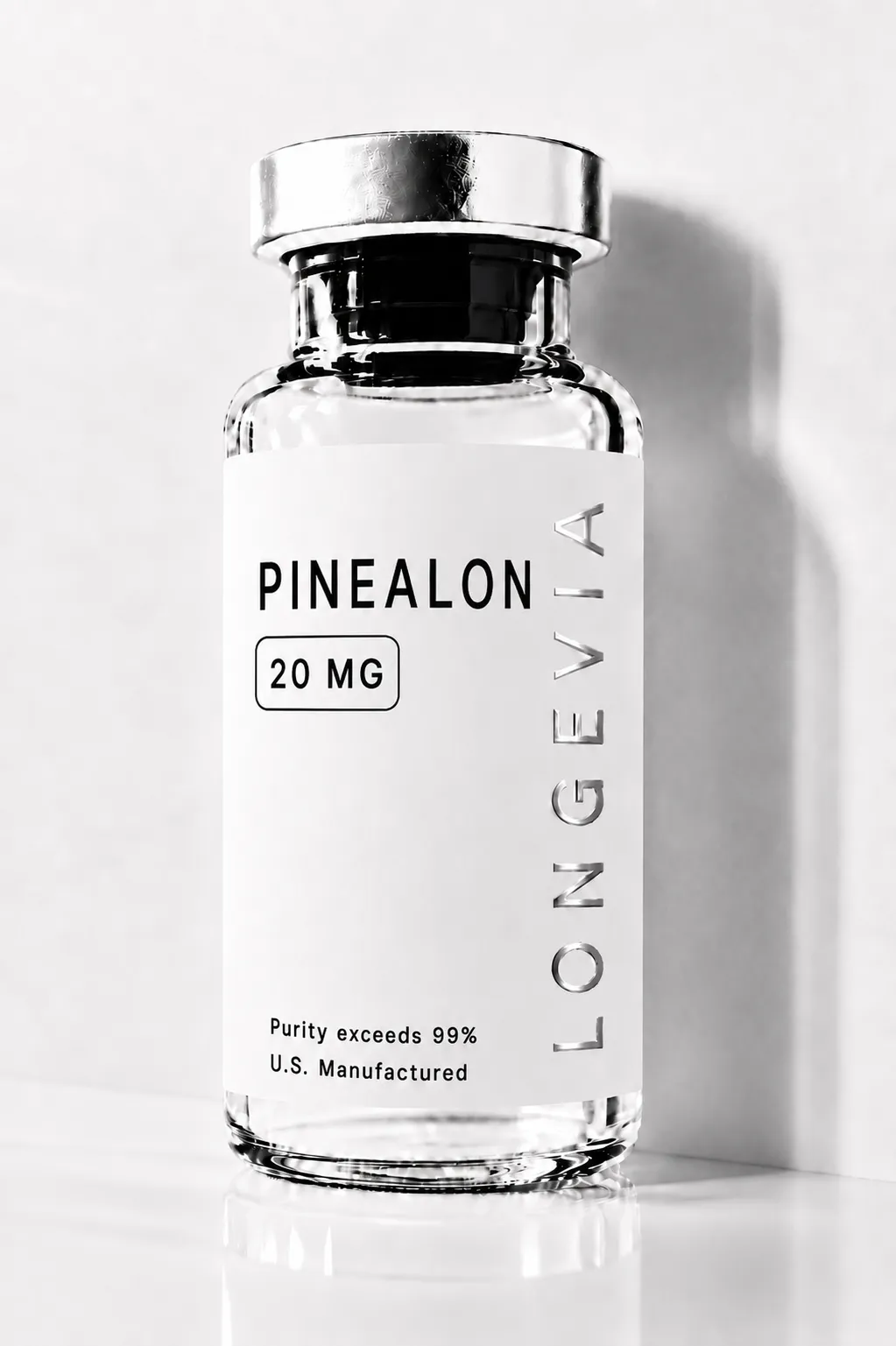
Pinealon
Buy 99%+ pure Pinealon research peptide, a synthetic tripeptide bioregulator studied for neuroprotection, retinal function, and pineal gland signaling research. Research use only.
Pinealon
Buy 99%+ pure Pinealon research peptide, a synthetic tripeptide bioregulator studied for neuroprotection, retinal function, and pineal gland signaling research. Research use only.
A 12.4-point gain on a cognitive test battery sounds like the kind of result that settles an argument. Several pages promoting Pinealon quote exactly that figure, a 12.4-point RBANS improvement against 1.8 for placebo, and pin it on a Phase II trial. So does Pinealon work? The trial behind the number cannot be found. No registry entry, no journal paper, and no author list surface when you go looking. This article separates what Pinealon research can actually document from what it cannot. The evidence is real but narrow, and the most specific numbers in circulation are the least verifiable of all.
Pinealon has a real but narrow evidence base, mostly preclinical and from one research tradition. Several specific efficacy figures circulating online could not be traced to any checkable source and should be treated as unverified.
What is Pinealon?
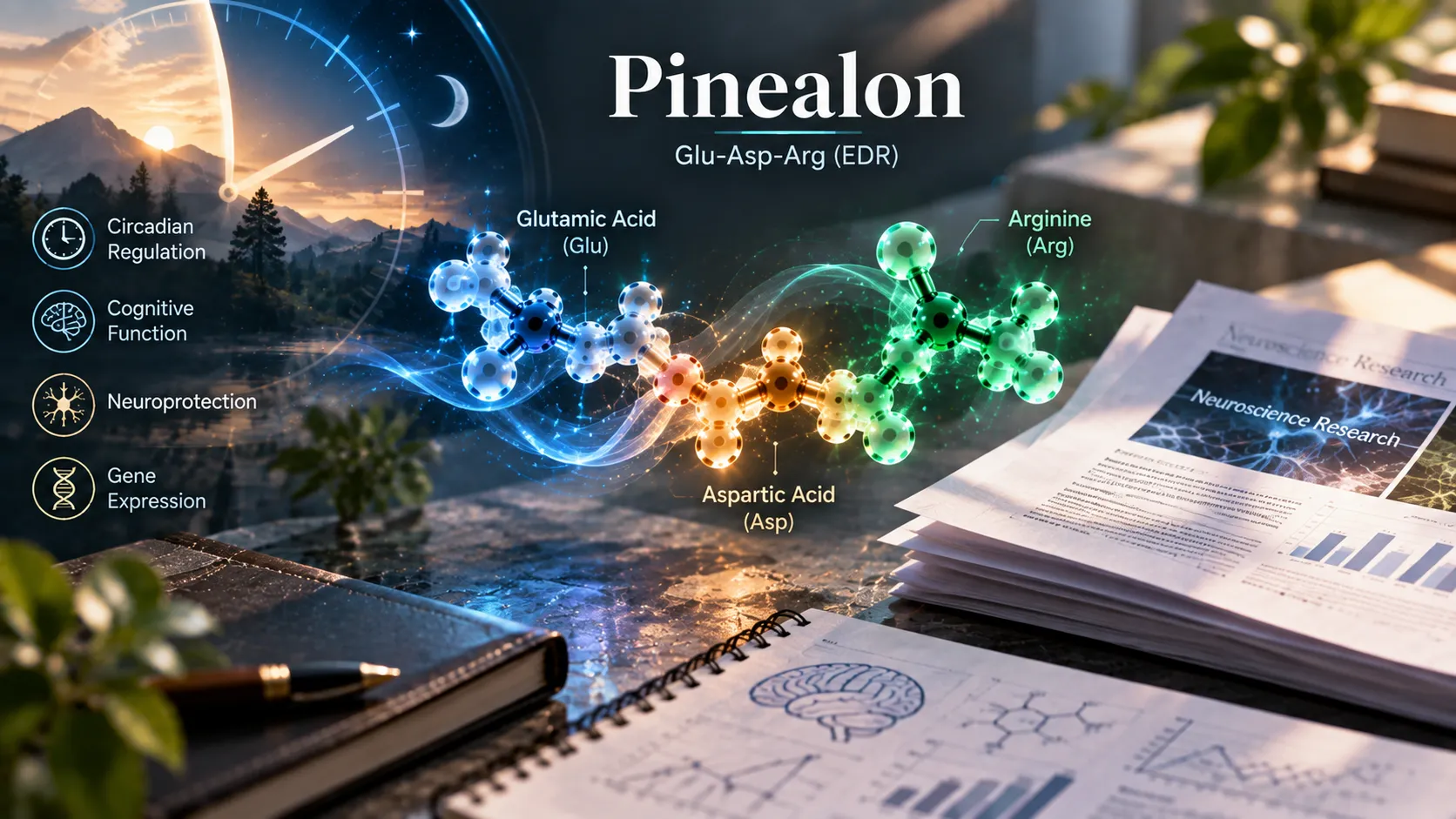
Pinealon is the tripeptide Glu-Asp-Arg, usually shortened to EDR. Three amino acids in a fixed order make up the whole molecule: glutamic acid, aspartic acid, and arginine. Its molar mass sits around 418.4 grams per mole, which places it among the smallest peptides ever studied for biological activity.
The pinealon EDR peptide comes out of Russian bioregulator peptide research, a program led by Vladimir Khavinson at the St. Petersburg Institute of Bioregulation and Gerontology. Pinealon bioregulator research sits inside that larger program. That group spent decades isolating short peptide fractions from animal tissues and then synthesizing the sequences they believed carried the activity. EDR was identified from fractions of Cortexin, a polypeptide preparation made from calf brain cortex, and then produced synthetically as a pure tripeptide. The group calls these molecules bioregulators, a term meaning short peptides proposed to fine-tune gene activity in specific tissues.
Researchers in that tradition propose that Pinealon acts on neuronal gene expression, circadian biology, and cellular aging processes. Those are proposals, not established facts. The mechanism the group suggests is unusual. Because the molecule is so small, the group theorizes it can enter cells and reach the nucleus. There it might interact with DNA and shift which genes get switched on. Whether that chain of events happens in a living brain remains unproven, which is exactly what the rest of this article examines.
What does the preclinical evidence actually report?
Cell and animal studies report antioxidant and neuroprotective effects, but every finding comes from the same research lineage and none has been independently replicated. At the level of cells and animals, the pinealon research evidence is strongest.
The most detailed cell-culture work is a 2011 study in Rejuvenation Research. They exposed rat cerebellar granule cells, neutrophils, and PC12 cells to oxidative stress and added the peptide at several concentrations. Pinealon restricted the buildup of reactive oxygen species in a dose-dependent way and reduced necrotic cell death measured by propidium iodide staining. In cells stressed with homocysteine, the peptide delayed ERK1/2 activation, shifting the peak from 2.5 minutes to 20 minutes after exposure. The authors read this pattern as a hint of direct interaction between the peptide and the cell genome. That reading is their interpretation, not a demonstrated fact.
A separate in-vitro study from the same network tested whether labeled EDR actually gets inside cells. Fluorescein-tagged Pinealon appeared in the cytoplasm, nucleus, and nucleolus of HeLa cells after incubation. The same study reported that the peptide binds preferentially to DNA sequences containing CNG and CAG motifs in test-tube assays. Two caveats should shape how you read that result. HeLa is an immortalized cervical cancer line, not a neuron, and no group outside the originating network has repeated the experiment.
In animals, a 2012 study gave Pinealon to pregnant rats with methionine-induced hyperhomocysteinemia. Their offspring scored better on tests of spatial orientation and learning than the offspring of untreated stressed mothers. Neurons isolated from the pups' cerebella also carried less reactive oxygen species and fewer necrotic cells. A 2021 mouse study in Pharmaceuticals tested EDR in 5xFAD mice, a standard Alzheimer's model. The mice received daily injections from two to four months of age. In female 5xFAD mice, EDR raised dendritic spine density in the CA1 hippocampus by 12 percent versus untreated 5xFAD mice, restoring it to control levels. The same paper used molecular docking to predict EDR binding sites. That computer simulation placed the peptide in promoter regions of genes including CASP3, SOD2, PPARA, and PPARG. Treat the docking result as in-silico evidence, not a measurement in tissue. In male 5xFAD mice the pattern differed, with EDR restoring mushroom spine numbers to control levels. The 2021 Molecules review also describes EDR preserving mushroom-shaped dendritic spines in mouse hippocampal neurons under modeled Alzheimer's conditions. A 2017 paper from the same group reported similar spine preservation in a mouse Huntington's model. Treat those as the review's summary of its own group's work rather than independent confirmation.
On the specific question of pinealon BDNF claims, no published study located during this research measured BDNF levels in animal tissue after EDR exposure. The claim that Pinealon raises BDNF in the brain is unverified marketing language until someone publishes the experiment.
No peer-reviewed pharmacokinetic study of EDR could be located in any species. Plasma half-life, tissue distribution, and measured brain exposure are all unknown. A 2021 paper discusses blood-brain barrier crossing as a hypothesis supported only by the observed neuroprotective effects, which is not the same as measuring it.
The table below summarizes what is and is not established.
Question | What the evidence supports | What it does not |
|---|---|---|
Do cell studies show antioxidant effects? | Yes. A 2011 study reported dose-dependent ROS reduction and less necrotic death in stressed rat cerebellar cells. | That these effects occur in human neurons or translate to cognitive outcomes. |
Does the peptide raise BDNF in animal tissue? | Nothing located. No published study measured BDNF after EDR exposure. | The claim of a 34 percent BDNF increase, which could not be verified. |
Is the pharmacokinetic profile established? | No. No peer-reviewed PK study exists in any species. | Claims about half-life, tissue distribution, or measured brain exposure. |
Does human efficacy stand proven? | Two small observational reports exist, with mixed signals and no control arms. | Any randomized, controlled, or independently replicated human result. |
What about the human trial claims circulating online?
The specific trial figures cannot be verified, but two small Russian human reports do exist, and they look nothing like the marketing numbers.
Three numbers do most of the selling. Online pages promise an 18 to 22 percent improvement in working memory. They also cite a 12.4-point RBANS gain against 1.8 for placebo, plus a 34 percent BDNF increase over 24 weeks. Each figure is tied to a named Phase II trial. I searched trial registries and the journal literature for each figure and for any Pinealon Phase II trial. Nothing checkable turned up in either search. No registry ID, no journal citation, no author list. A number with no source you can open is not data. It is a rumor with decimal places.
Treat the 18 to 22 percent, 12.4-point, and 34 percent figures as unverified marketing claims. None could be traced to a trial registry, a journal, or any other checkable source during research for this article.
Claim circulating online | Evidence type claimed | Independently verified in this research |
|---|---|---|
Working memory improved 18 to 22 percent | Phase II trial | Not verified. No registry entry, journal, or author list found. |
RBANS score up 12.4 points vs 1.8 for placebo | Phase II trial | Not verified. No registry entry, journal, or author list found. |
BDNF up 34 percent over 24 weeks | Phase II trial | Not verified. No study measuring BDNF after EDR exposure was located. |
ROS reduced and ERK1/2 activation delayed in stressed rat cerebellar cells | Cell-culture study | Verified. Reported in a 2011 peer-reviewed study (PMID 21978084). |
Dendritic spine density restored in mouse Alzheimer's model | Animal study | Verified. Reported in a 2021 peer-reviewed study (PMCID PMC8227791). |
That does not mean zero human data exists. A 2015 paper in Advances in Gerontology enrolled 32 adults aged 41 to 83 with chronic polymorbidity and organic brain syndrome in remission. Each participant received Pinealon together with Vesugen, a second short peptide. Those authors reported an anabolic effect and improved central nervous system activity. They also reported a slower rate of aging by biological-age indicators, with Vesugen showing the stronger effect. The paper also reported prooxidant activity on chemiluminescence testing and a drop in circulating CD34-positive cells, which the authors read as suppressed blood-cell formation. That paragraph deserves a second read. Two peptides at once make up the intervention. The sample is tiny, no control arm is described, and the biological signals point in more than one direction.
A second report covers 72 patients recovering from traumatic brain injury, summarized in the 2021 Molecules review. Oral Pinealon added to standard therapy was associated with better memory, shorter and milder headaches, and improved emotional balance. The design is observational with no control group, the paper is Russian-language, and the authors belong to the same research lineage. It is a lead, not a verdict.
Neither report is a randomized trial, and searches for pinealon clinical trials turn up no registry entries at all. Anyone typing 'is pinealon effective' into a search box will find marketing pages, not trials. So the honest human-evidence summary is this: two small observational reports from the originating group, no randomized data, and no independent replication.
Why is most of the evidence hard to independently check?
Nearly everything traces back to one Russian research lineage, and most of it was published where Western databases barely look.
The core papers come from Vladimir Khavinson's St. Petersburg Institute of Bioregulation and Gerontology and its collaborators. That is not an accusation against the scientists. It is a description of the literature's shape. When one group produces most of the data on a compound, independent verification has not happened yet by definition. That gap is the central weakness in pinealon independent research.
Publication venue adds a second barrier. Key papers sit in Russian-language journals such as Advances in Gerontology and the Bulletin of Experimental Biology and Medicine. Most pinealon Russian studies are indexed in PubMed, which is how this article located them. Full texts are often hard to obtain, and few Western laboratories read them. Several English-language papers exist as well, in Rejuvenation Research, Molecules, and Pharmaceuticals, which makes the central findings checkable if you know where to look.
The third barrier is the absence of trial registries. Modern clinical research leaves a paper trail: a registry entry before the first patient enrolls, a published protocol, a final report. Pinealon's human reports predate or bypass that system entirely. Without a registry ID, a later reader cannot confirm the study's design, its sample size, or whether the reported numbers match what was planned.
Language is the quietest barrier of all. Machine translation handles methods sections poorly, and subtle qualifiers in a Russian abstract can vanish in English. A Western researcher who cannot read the original is left trusting secondary summaries, which is exactly how unverified numbers enter circulation. None of this means the underlying work is fabricated. It means the work has not passed through the replication machinery that turns a finding into a fact.
What would count as stronger evidence for Pinealon?
A named trial you can look up, a peer-reviewed paper you can read, and a second laboratory that got the same result.
- Look for a searchable trial registry entry with a stated design, endpoints, and sample size recorded before results are known.
- Demand a peer-reviewed publication in an indexed journal, with methods detailed enough for another lab to repeat.
- Insist on a stated sample size and a control arm, so the effect can be separated from placebo response and the passage of time.
- Independent replication by researchers outside the originating group, working in a different laboratory.
- Pre-registered primary endpoints, so positive results cannot be selected after the fact.
Notice what is missing from that list. No impressive percentages, no confident marketing copy, and no long history of traditional use appear anywhere on it. Those things sell products, but they do not establish facts.
A specific-sounding number is not the same as a sourced number. Ask for the registry ID or the citation, and watch what happens next.
How should a researcher read a Pinealon claim skeptically?
Split every claim into two separate questions: what does it say, and what does it cite?
A precise percentage with no citation is a red flag, not evidence of precision. Real trials are messy and thoroughly documented. Their papers name the registry, list the authors, state the sample size, and show the control group. When a product page gives you a decimal point but no DOI, the decimal point is doing marketing work.
Read the primary literature yourself instead of trusting a summary. The abstracts on PubMed are free, and they usually state the model, the sample size, and the actual result in under 300 words. Vendor whitepapers deserve special caution from any serious reader. Several suppliers publish polished PDFs with tables of percentages and claimed trial results. Their reference lists point to internal documents or to each other, not to journals. A glossy layout is not peer review, and a citation that cannot be opened is not a citation. Apply the same skepticism to this article. Every claim here names its evidence type and its source, so check the ones that matter to you.
Where does verified Pinealon material fit into honest research?
A researcher who wants to work on EDR needs material whose identity is certain, because an unverified powder makes every downstream result suspect. Longevia supplies Pinealon as a research compound. Every batch is independently HPLC/LC-MS tested, and lot-specific Certificates of Analysis are published in the COA Library. Identity and purity are the parts of an experiment a supplier can actually guarantee. That is the full commercial statement, and it sits apart from every efficacy claim in this article by design.
For laboratory research use only. It is not for human or veterinary use, and it is not intended to diagnose, treat, cure, or prevent any disease.
Frequently Asked Questions
- Khavinson V, Ribakova Y, Kulebiakin K, Vladychenskaya E, Kozina L, Arutjunyan A, Boldyrev A. Pinealon increases cell viability by suppression of free radical levels and activating proliferative processes. Rejuvenation Research. 2011;14(5):535-541.
- Khavinson V, Linkova N, Kozhevnikova E, Trofimova S. EDR Peptide: Possible Mechanism of Gene Expression and Protein Synthesis Regulation Involved in the Pathogenesis of Alzheimer's Disease. Molecules. 2021;26(1):159.
- Arutjunyan A, Kozina L, Stvolinskiy S, Bulygina Y, Mashkina A, Khavinson V. Pinealon protects the rat offspring from prenatal hyperhomocysteinemia. International Journal of Clinical and Experimental Medicine. 2012;5(2):179-185.
- Khavinson V, Ilina A, Kraskovskaya N, Linkova N, Kolchina N, Mironova E, Erofeev A, Petukhov M. Neuroprotective Effects of Tripeptides—Epigenetic Regulators in Mouse Model of Alzheimer's Disease. Pharmaceuticals. 2021;14(6):515.
- Meshchaninov VN, Tkachenko EL, Zharkov SV, Gavrilov IV, Katyreva IE. [Effect of synthetic peptides on aging of patients with chronic polymorbidity and organic brain syndrome of the central nervous system in remission.] Advances in Gerontology. 2015;28(1):62-67.
- Fedoreyeva LI, Kireev II, Khavinson VK, Vanyushin BF. Penetration of short fluorescence labeled peptides into the nucleus in HeLa cells and in vitro specific interaction of the peptides with deoxyribooligonucleotides and DNA. Biochemistry (Moscow). 2011;76:1210-1219.