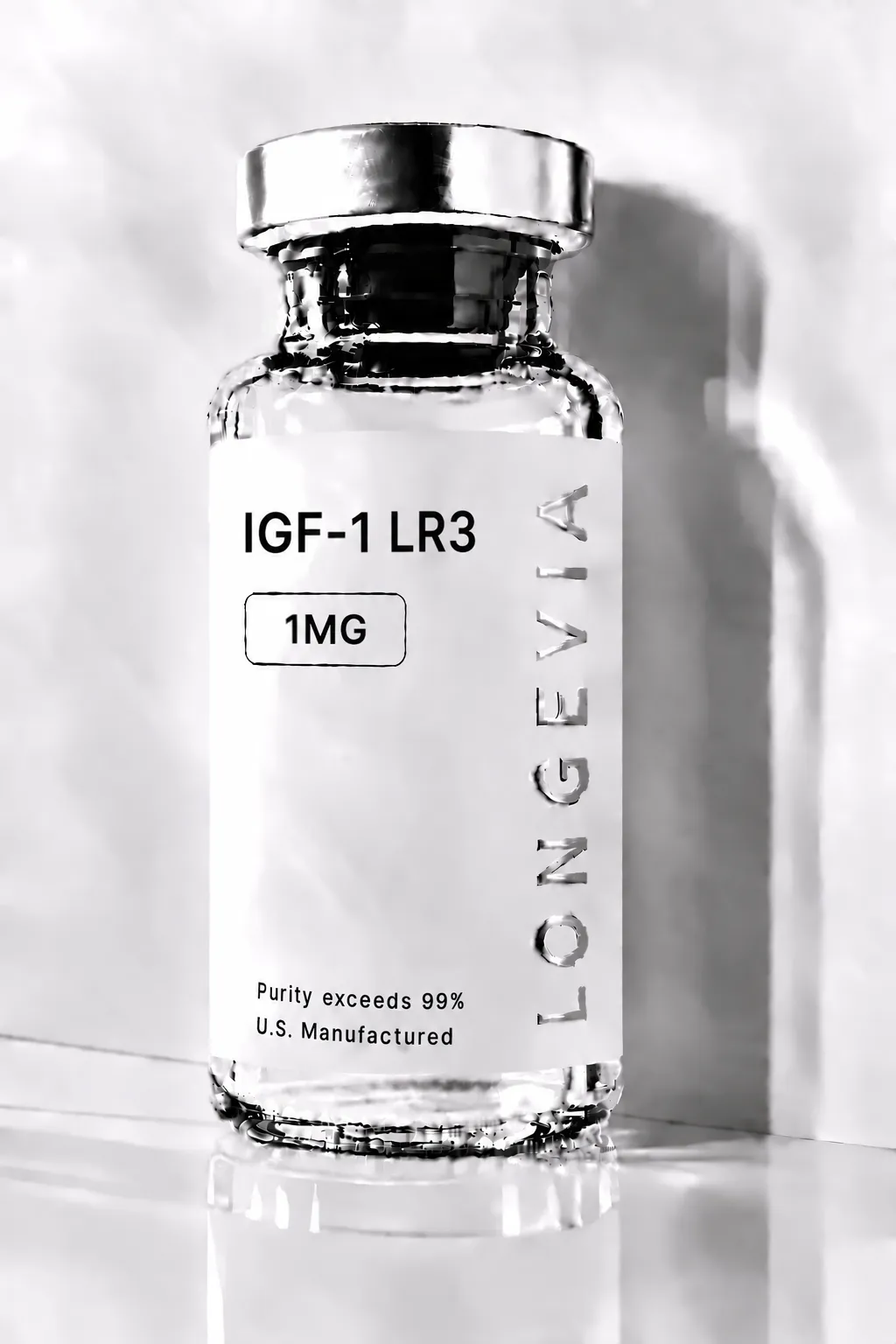
IGF-1 LR3
$153.00
1
Slide to Add
Purity≥99% Tested
TestingLC-MS Verified
LocationUS Based
IGF-1 LR3 (Long Arginine 3 IGF-1) is a synthetic 83-amino-acid analogue of human insulin-like growth factor 1 (IGF-1) designed to improve upon native IGF-1's research utility through two structural modifications: an arginine substitution at position 3 (replacing glutamic acid) and a 13-amino-acid N-terminal extension (MFPAMPLLSLFVN). These modifications substantially reduce binding affinity for insulin-like growth factor binding proteins (IGFBPs) — which sequester native IGF-1 in circulation — and extend the functional half-life from approximately 12–15 hours for native IGF-1 to approximately 20–30 hours for IGF-1 LR3 in experimental systems. Research has examined IGF-1 LR3 in IGF-1 receptor (IGF-1R) pharmacology, PI3K/AKT/mTOR signaling, cellular proliferation, and protein synthesis research models. Longevia Research supplies IGF-1 LR3 in a 1mg research-grade vial for qualified laboratory use. IGF-1 LR3 is distinct from native IGF-1 (70 amino acids, no N-terminal extension, Glu³) and from des(1-3)IGF-1 — another IGF-1 analogue with reduced IGFBP binding but different structural modifications. IGF-1 LR3 is widely used in cell culture and recombinant biopharmaceutical manufacturing research contexts as a serum-free media supplement supporting cell growth. This product is supplied for Research Use Only and is not intended for human or veterinary use.
Standard Delivery3-4 Working Days
Free ShippingOn all orders above $300
Product Details
Scientific identity. IGF-1 LR3 is a synthetic polypeptide comprising the complete 70-amino-acid sequence of mature human IGF-1 with two modifications: a Glu³→Arg³ substitution — the "R3" component — and a 13-residue N-terminal extension (Met-Phe-Pro-Ala-Met-Pro-Leu-Ser-Ser-Leu-Phe-Val-Asn) — the "Long" component — giving a total of 83 amino acids. The Glu³→Arg³ substitution reduces affinity for IGFBPs without substantially altering IGF-1R binding affinity. The N-terminal extension further reduces IGFBP binding and contributes to the extended half-life. Native IGF-1's three disulfide bridges — Cys⁶–Cys⁴⁸, Cys¹⁸–Cys⁶¹, and Cys⁴⁷–Cys⁵² (in native IGF-1 numbering) — are preserved in IGF-1 LR3. The compound is produced by recombinant expression in E. coli or by synthetic methods depending on the manufacturer.
Compound class. Synthetic modified polypeptide; insulin-like growth factor 1 analogue; IGFBP-resistant IGF-1 analogue; recombinant growth factor analogue.
Full amino acid sequence.
MFPAMPLLSL FVNGPRTLCG AELVDALQFV CGDRGFYFNK PTGYGSSSRR APQTGIVDEC CFRSCDLRRL EMYCAPLKPA KSA
Important note on molecular identifiers. Two CAS numbers appear across authoritative databases for IGF-1 LR3 — 946870-92-4 and 143045-27-6 — reflecting different database registrations for this recombinant analogue. The molecular formula C₄₀₀H₆₂₅N₁₁₁O₁₁₅S₉ and molecular weight 9117.60 g/mol are consistent across sources. The CAS number, molecular formula, and form applicable to this Longevia vial are confirmed on the batch Certificate of Analysis. Researchers should verify identifiers from the batch COA before use in assay calculations.
Primary receptor target. IGF-1 receptor (IGF-1R) — a receptor tyrosine kinase homologous to the insulin receptor, mediating autophosphorylation and activation of PI3K/AKT/mTOR and MAPK/ERK signaling cascades that drive cellular proliferation, differentiation, survival, and protein synthesis in experimental systems.
Research areas. IGF-1R receptor pharmacology, PI3K/AKT/mTOR signaling research, MAPK/ERK pathway biology, cellular proliferation and differentiation research, protein synthesis research, GH/IGF-1 axis biology, cell culture growth factor research, IGFBP biology.
Product quantity. 1mg per vial.
Physical form. Supplied as a lyophilised solid in a sealed research vial.
Purity. Greater than 99%, confirmed by HPLC and LC-MS analysis at the batch level.
Analytical documentation. A batch-specific Certificate of Analysis is available on the Longevia Research website, covering compound identity, purity, and lot traceability.
Research-use classification. For laboratory research use only. Not for human or veterinary use, clinical diagnostics, or any in-vivo application in humans.
Research Focus
IGF-1 Receptor Signaling
IGF-1R is a heterotetrameric receptor tyrosine kinase — comprising two extracellular α-subunits and two transmembrane β-subunits — that mediates the biological effects of IGF-1 and IGF-2. Ligand binding triggers autophosphorylation of the β-subunit intracellular kinase domains, recruiting insulin receptor substrate (IRS) proteins and initiating two primary downstream signaling cascades: the PI3K/AKT/mTOR pathway — mediating protein synthesis, glucose uptake, and cell survival — and the MAPK/ERK pathway — mediating cellular proliferation and differentiation. IGF-1 LR3 is studied as a potent, IGFBP-resistant IGF-1R agonist that produces more robust and sustained receptor activation in cell culture systems than native IGF-1, making it a preferred research tool for investigating IGF-1R signaling in defined experimental conditions.
IGFBP Independence and Research Utility
Native IGF-1 in biological systems is predominantly bound to insulin-like growth factor binding proteins (IGFBPs 1–6), which modulate its bioavailability, half-life, and tissue distribution. In cell culture systems, endogenous IGFBPs secreted by cells can sequester added native IGF-1, reducing its effective concentration and complicating dose-response characterisation. IGF-1 LR3's substantially reduced IGFBP binding affinity — a consequence of both the Arg³ substitution and the N-terminal extension — means that a greater proportion of added IGF-1 LR3 remains free in solution and available for IGF-1R engagement in cell culture experiments. This property makes IGF-1 LR3 a more experimentally controllable IGF-1R agonist than native IGF-1 in many cell-based research designs.
Cell Culture and Biopharmaceutical Research
IGF-1 LR3 has been extensively used as a serum-free media supplement in mammalian cell culture research — particularly in large-scale recombinant biopharmaceutical manufacturing contexts using CHO, HEK293, and other cell lines — where it supports cell growth and viability as an IGF-1R agonist substitute for serum-derived growth factors. This cell culture application represents a major legitimate research use of IGF-1 LR3 distinct from its pharmacological research applications.
GH/IGF-1 Axis Research
IGF-1 LR3 is used as a research tool for investigating the downstream effector arm of the GH/IGF-1 endocrine axis — the signaling pathway initiated when GH stimulates hepatic IGF-1 production. Research examining the consequences of sustained IGF-1R activation uses IGF-1 LR3 in cell-based and animal systems to characterise pathway-level responses independently of upstream GH/GHRH receptor engagement. This complements the GHRH analogue and GH secretagogue research tools available in the Longevia Research catalog.
Research Status
IGF-1 LR3 has no regulatory approval for human therapeutic use in any jurisdiction. Native IGF-1 (mecasermin, Increlex) holds FDA approval for specific growth disorders; IGF-1 LR3 is a separately modified analogue without equivalent pharmaceutical approval. It is widely used as a recombinant research protein and cell culture reagent. The Longevia Research vial is supplied for Research Use Only.
Quality & Purity
Reliable research begins with accurately characterised material. For an 83-amino-acid recombinant polypeptide such as IGF-1 LR3, that means confirming full sequence integrity — including the N-terminal extension, Arg³ substitution, and three disulfide bridge formation — and purity at the batch level. Misfolded forms lacking correct disulfide bridge formation, truncated sequences, or aggregated material can retain partial IGF-1R binding but produce substantially different signaling profiles that confound receptor pharmacology and cell-based growth assays.
Purity assessment. Each production lot is characterised to greater than 99% purity by high-performance liquid chromatography (HPLC). Chromatographic purity data is reported on the batch Certificate of Analysis.
Identity confirmation. Protein identity, sequence integrity, and molecular weight consistent with the 83-amino-acid fully modified form are confirmed by mass spectrometry (LC-MS). HPLC and LC-MS data together confirm that the material supplied corresponds to the labelled compound at the labelled purity.
Batch traceability and Certificate of Analysis. Every vial of IGF-1 LR3 1mg is traceable to a specific production lot. A batch-specific Certificate of Analysis is accessible directly on the Longevia Research website, covering purity, identity, and lot information. Researchers evaluating this material for cell culture or receptor assay work are encouraged to review the current batch documentation before use, since analytical specifications are applied at the lot level.
Handling. This material should be handled by qualified personnel using appropriate laboratory technique and personal protective equipment, consistent with institutional protocols for research-grade recombinant growth factor proteins. IGF-1 LR3 should be handled to minimise repeated freeze-thaw cycling, which can promote aggregation and reduce biological activity in cell-based assays.
Compliance Notice
Longevia Research supplies IGF-1 LR3 1mg for laboratory and in-vitro research use only. The product is intended for use by qualified researchers and trained laboratory personnel in appropriate controlled research environments.
IGF-1 LR3 is a synthetic research polypeptide supplied strictly as a research tool. It is not a drug, not a dietary supplement, not a food or food ingredient, and not a cosmetic. While native IGF-1 (mecasermin) holds FDA approval for specific growth disorders under the brand name Increlex, IGF-1 LR3 is a separately modified analogue with no equivalent pharmaceutical approval in any jurisdiction. No regulatory authority has approved IGF-1 LR3 for human or veterinary therapeutic use, and Longevia does not supply it for administration to humans or animals, for clinical diagnostics, or for any therapeutic purpose.
Longevia provides no dosing instructions, administration guidance, treatment protocols, or reconstitution recommendations for this compound. The scientific literature summarised on this product page describes experimental observations in defined cell-based and animal model systems. Those findings are not medical claims and should not be interpreted as evidence of human efficacy, human safety, or fitness for any clinical application.
The purchaser assumes full responsibility for lawful acquisition, handling, storage, use, and disposal of this material, and for compliance with all applicable local, state, federal, and institutional regulations. By purchasing this product, the buyer confirms that it will be used solely for legitimate laboratory research purposes by qualified personnel, and that its acquisition and intended use comply with applicable laws in the buyer's jurisdiction.
Continue Exploring
Also Considered.
VIP Spray
Longevia Research supplies VIP (Vasoactive Intestinal Peptide, CAS 40077-57-4) 10mg in a 90-spray research format. A naturally occurring 28-amino-acid endogenous neuropeptide studied in VPAC1/VPAC2 receptor pharmacology, gastrointestinal neurobiology, vascular signaling, neuroendocrine research, circadian biology, and immunological signaling. Research Use Only.
$211.50
Slide to add
Tirzepatide — Spray
Longevia Research supplies Tirzepatide (LY3298176, CAS 2023788-19-2) in 10mg, 20mg, 30mg, and 60mg quantities in a 45-spray research format. A synthetic 39-amino-acid dual GIP and GLP-1 receptor agonist peptide investigated in incretin biology, pancreatic islet signaling, glucose homeostasis, metabolic research, and cardiometabolic pharmacology. Research Use Only.
$144.00
Slide to add
Thymosin Alpha-1 — Spray
Longevia Research supplies Thymosin Alpha-1 (Tα1 / TA-1, CAS 62304-98-7) 10mg in a 45-spray research format. A synthetic 28-amino-acid N-terminally acetylated peptide corresponding to the N-terminal region of prothymosin alpha, studied in TLR signaling, innate immunity, adaptive immune responses, dendritic cell biology, and clinical immunology research. Research Use Only.
$189.00
Slide to add
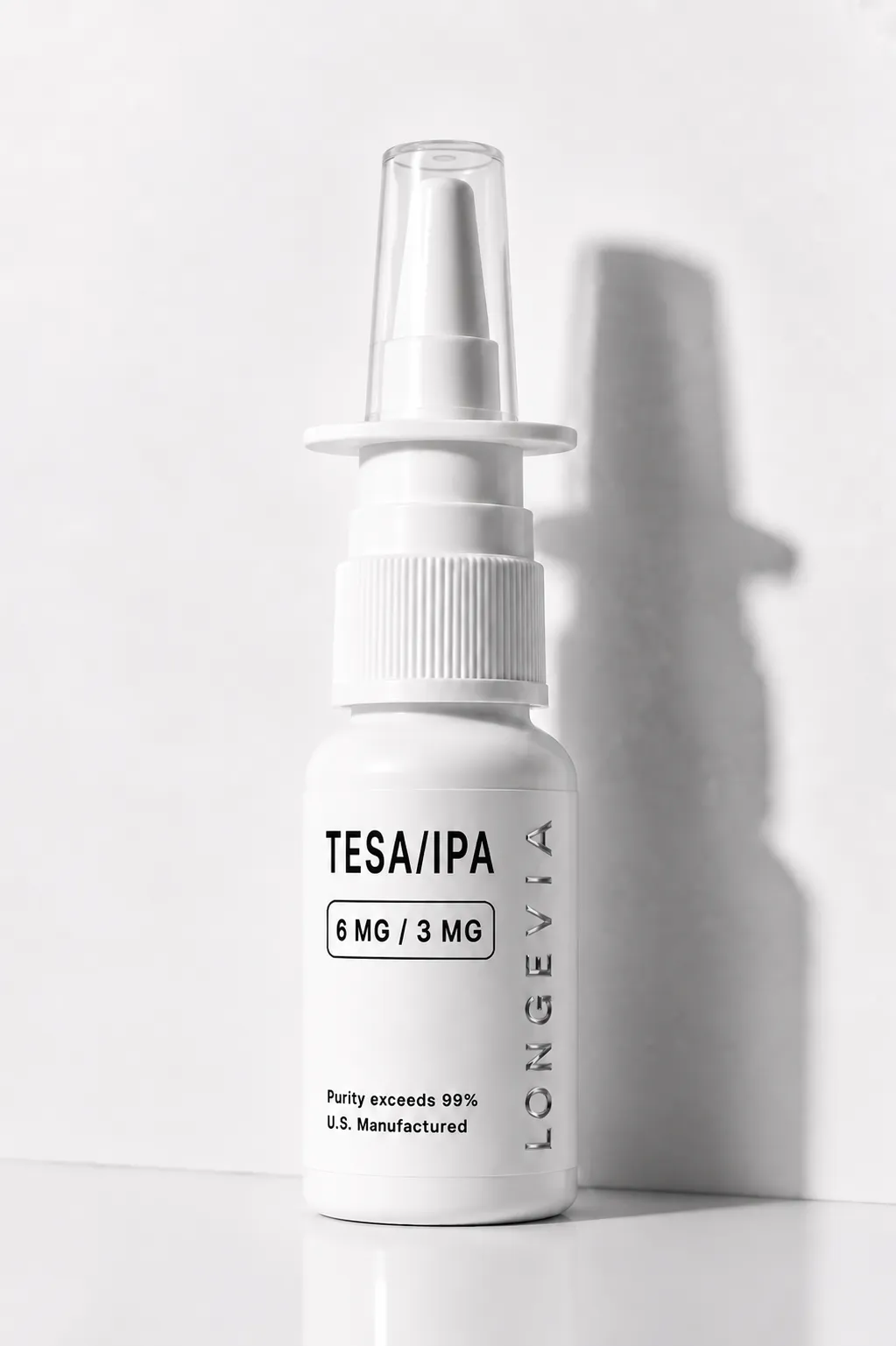
Tesa/IPA — Spray
Longevia Research supplies Tesa/IPA — a two-peptide research formulation containing Tesamorelin (CAS 218949-48-5), a synthetic GHRH analog, and Ipamorelin (CAS 170851-70-4), a growth hormone secretagogue associated with GHS-R/ghrelin receptor signaling. Available in 6mg/3mg and 13mg/3mg compositions, 45 sprays. Research Use Only.
$225.00
Slide to add
Product FAQs
Find answers to common questions regarding storage, reconstitution, and testing guidelines for this specific compound.