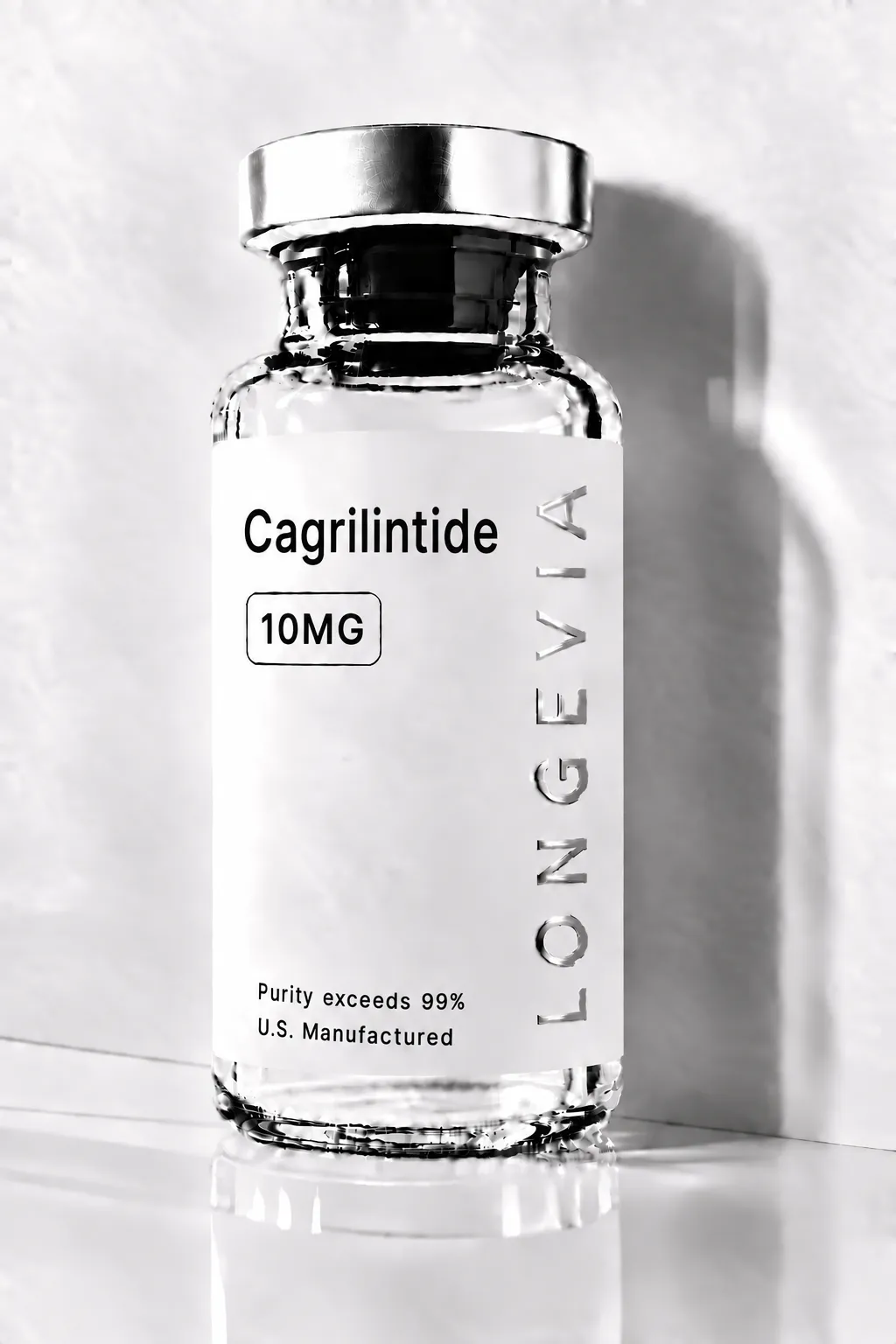
Cagrilintide
$157.50
1
Slide to Add
Purity≥99% Tested
TestingLC-MS Verified
LocationUS Based
Cagrilintide is a synthetic long-acting amylin analogue developed by Novo Nordisk and investigated in research involving amylin receptor pharmacology, calcitonin receptor family signalling, satiety biology, and metabolic signalling in experimental and clinical systems. Structurally, it is an amylin analogue with modifications that confer extended half-life via fatty acid conjugation — enabling once-weekly dosing in clinical research contexts. Research has examined cagrilintide in relation to amylin receptor complex activation, glucagon suppression, gastric emptying, and energy homeostasis biology. Longevia Research supplies cagrilintide in a 10mg research-grade vial for qualified laboratory use.
Standard Delivery3-4 Working Days
Free ShippingOn all orders above $300
Comprehensive Product Details
Scientific identity: Cagrilintide is a synthetic amylin analogue — a modified version of human amylin (islet amyloid polypeptide, IAPP) — engineered for extended half-life via fatty acid conjugation. Human amylin is a 37-amino-acid peptide co-secreted with insulin from pancreatic beta cells. Cagrilintide incorporates amino acid substitutions that reduce amyloidogenic tendency relative to native amylin and human IAPP, alongside a fatty acid side chain conjugate enabling albumin binding and extended circulating half-life consistent with once-weekly dosing intervals in clinical research. The precise substitution pattern and fatty acid linker composition are documented in Novo Nordisk's patent literature.
Peptide class: Synthetic long-acting amylin analogue; fatty acid-conjugated amyloidogenesis-reduced IAPP analogue; amylin receptor agonist.
Primary receptor targets: Amylin receptor complexes — heterodimers of the calcitonin receptor (CTR) with receptor activity-modifying proteins (RAMP1, RAMP2, RAMP3) — designated AMY1, AMY2, and AMY3 respectively. These receptor complexes are expressed in the area postrema, hypothalamus, nucleus tractus solitarius, and peripheral metabolic tissues. Cagrilintide also shows activity at the calcitonin receptor itself (CTR) and at CGRP receptor complexes at higher concentrations — receptor selectivity considerations relevant to experimental design.
Research areas: Amylin receptor pharmacology, calcitonin receptor family biology, satiety and energy homeostasis research, gastric emptying research models, glucagon suppression biology, pancreatic beta cell co-secretion research, fatty acid-conjugated peptide pharmacology, GLP-1/amylin dual pathway research.
Product quantity: 10mg per vial.
Purity: Greater than 99%, confirmed by HPLC and LC-MS analysis at the batch level.
Analytical documentation: A batch-specific Certificate of Analysis is available on the Longevia Research website, covering compound identity, purity, and lot traceability.
Research-use classification: For laboratory research use only. Not for human or veterinary use, clinical diagnostics, compounding, or any in-vivo application in humans.
Advanced Research Focus
Amylin Receptor Biology
Amylin (IAPP) is a 37-amino-acid peptide co-secreted with insulin from pancreatic beta cells in response to nutrient ingestion. It acts through amylin receptor complexes — heterodimers of the calcitonin receptor (CTR) with one of three receptor activity-modifying proteins (RAMP1, RAMP2, RAMP3) — forming AMY1, AMY2, and AMY3 receptor subtypes respectively. These complexes are expressed in the area postrema and nucleus tractus solitarius in the brainstem — regions involved in satiety signaling — as well as in the hypothalamus and peripheral metabolic tissues. Amylin receptor activation reduces food intake, slows gastric emptying, and suppresses post-prandial glucagon secretion in experimental and clinical systems. Cagrilintide is studied as a potent, long-acting amylin receptor agonist tool compound in research examining this receptor family's pharmacology.
Distinction from Pramlintide
Pramlintide (Symlin) is the first-generation synthetic amylin analogue with FDA approval for adjunct therapy in type 1 and type 2 diabetes. It carries three proline substitutions relative to native human amylin that reduce amyloidogenic tendency and is administered by injection three times daily due to its short half-life of approximately 48 minutes. Cagrilintide differs substantially: it incorporates additional amino acid modifications beyond the pramlintide substitution pattern, reduces amyloidogenic propensity further, and carries a fatty acid conjugate enabling albumin binding and a half-life consistent with once-weekly dosing in clinical research. The two compounds are distinct research tools with separate pharmacological profiles, half-lives, and clinical development histories.
CagriSema and Dual Pathway Research
Cagrilintide has been investigated as the amylin component of CagriSema — a fixed-ratio combination with semaglutide (GLP-1R agonist) developed by Novo Nordisk. Research has examined whether simultaneous amylin receptor and GLP-1R activation produces additive or synergistic effects on satiety and energy homeostasis endpoints in clinical trials. The REDEFINE clinical trial programme examined CagriSema in adults with obesity and type 2 diabetes. Published Phase 3 findings reported weight reduction outcomes with CagriSema exceeding those of either component alone in defined trial populations. These clinical findings concern the pharmaceutical CagriSema combination under regulated trial conditions and do not establish the properties of the standalone Longevia Research cagrilintide vial.
Human Clinical Research
Phase 2 monotherapy research examined cagrilintide in adults with overweight or obesity, with findings characterising amylin receptor pharmacodynamics and weight-related endpoints over 26-week treatment periods. Phase 3 research has primarily examined cagrilintide as the amylin component of CagriSema rather than as a standalone agent. Novo Nordisk submitted an NDA for CagriSema to the FDA in December 2025; an FDA decision is anticipated in late 2026. All human clinical findings concern pharmaceutical-grade formulations under regulated trial conditions and do not establish the safety, efficacy, pharmacokinetic equivalence, or bioavailability of the Longevia Research research vial.
Research Status
Cagrilintide holds no standalone regulatory approval in any jurisdiction as of the date of this publication. The CagriSema NDA is under FDA review. As a research compound, cagrilintide is used in amylin receptor pharmacology, calcitonin receptor family biology, and metabolic signaling research. The Longevia Research vial is supplied for Research Use Only with no pharmaceutical designation.
Uncompromising Quality Standards
Reliable research begins with accurately characterised material. For a 37-amino-acid fatty acid-conjugated amylin analogue such as cagrilintide, that means confirming sequence integrity, fatty acid conjugation completeness, and purity at the batch level — because an unconjugated or partially modified form produces a compound with a substantially different half-life and receptor engagement profile that can confound amylin receptor pharmacology and metabolic signaling experiments. The multiple amino acid substitutions relative to native IAPP also require sequence-level verification to confirm the correct modification pattern is present.
Purity assessment: Each production lot is characterised to greater than 99% purity by high-performance liquid chromatography (HPLC). Chromatographic purity data is reported on the batch Certificate of Analysis.
Identity confirmation: Peptide identity, amino acid substitution pattern, and fatty acid conjugation are confirmed by mass spectrometry (LC-MS), providing molecular-weight verification consistent with the fully modified form. HPLC and LC-MS data together confirm that the material supplied corresponds to the labelled compound at the labelled purity.
Batch traceability and Certificate of Analysis: Every vial of Cagrilintide 10mg is traceable to a specific production lot. A batch-specific Certificate of Analysis is accessible directly on the Longevia Research website, covering purity, identity, and lot information. Researchers evaluating this material for assay work are encouraged to review the current batch documentation before use, since analytical specifications are applied at the lot level.
Handling: This material should be handled by qualified personnel using appropriate laboratory technique and personal protective equipment, consistent with institutional protocols for research-grade fatty acid-conjugated synthetic peptides.
Legal & Compliance Notice
Longevia Research supplies Cagrilintide 10mg for laboratory and in-vitro research use only. The product is intended for use by qualified researchers and trained laboratory personnel in appropriate controlled research environments.
Cagrilintide is a synthetic research peptide supplied strictly as a research tool. It is not a drug, not a dietary supplement, not a food or food ingredient, and not a cosmetic. Cagrilintide is an investigational compound under active clinical development by Novo Nordisk; it holds no standalone FDA or EMA approval for any therapeutic indication as of the date of this publication. The CagriSema NDA submitted to the FDA in December 2025 concerns a fixed-ratio cagrilintide/semaglutide pharmaceutical combination under regulated review — not standalone cagrilintide, and not the Longevia Research research vial, which is not a pharmaceutical product and has not been evaluated by any regulatory authority for safety or efficacy in this formulation.
This product is not supplied for compounding, reformulation, or preparation for human administration. Longevia provides no dosing instructions, administration guidance, treatment protocols, or reconstitution recommendations for this compound. The scientific and clinical literature summarised on this product page describes observations from defined preclinical and regulated clinical research systems. Those findings are not medical claims and should not be interpreted as evidence of human efficacy, human safety, or fitness for any clinical application from this product.
The purchaser assumes full responsibility for lawful acquisition, handling, storage, use, and disposal of this material, and for compliance with all applicable local, state, federal, and institutional regulations — including regulations specific to the handling of investigational pharmaceutical active ingredients as research compounds. By purchasing this product, the buyer confirms that it will be used solely for legitimate laboratory research purposes by qualified personnel, and that its acquisition and intended use comply with applicable laws in the buyer's jurisdiction.
Continue Exploring
Also Considered.
VIP Spray
Longevia Research supplies VIP (Vasoactive Intestinal Peptide, CAS 40077-57-4) 10mg in a 90-spray research format. A naturally occurring 28-amino-acid endogenous neuropeptide studied in VPAC1/VPAC2 receptor pharmacology, gastrointestinal neurobiology, vascular signaling, neuroendocrine research, circadian biology, and immunological signaling. Research Use Only.
$211.50
Slide to add
Tirzepatide — Spray
Longevia Research supplies Tirzepatide (LY3298176, CAS 2023788-19-2) in 10mg, 20mg, 30mg, and 60mg quantities in a 45-spray research format. A synthetic 39-amino-acid dual GIP and GLP-1 receptor agonist peptide investigated in incretin biology, pancreatic islet signaling, glucose homeostasis, metabolic research, and cardiometabolic pharmacology. Research Use Only.
$144.00
Slide to add
Thymosin Alpha-1 — Spray
Longevia Research supplies Thymosin Alpha-1 (Tα1 / TA-1, CAS 62304-98-7) 10mg in a 45-spray research format. A synthetic 28-amino-acid N-terminally acetylated peptide corresponding to the N-terminal region of prothymosin alpha, studied in TLR signaling, innate immunity, adaptive immune responses, dendritic cell biology, and clinical immunology research. Research Use Only.
$189.00
Slide to add
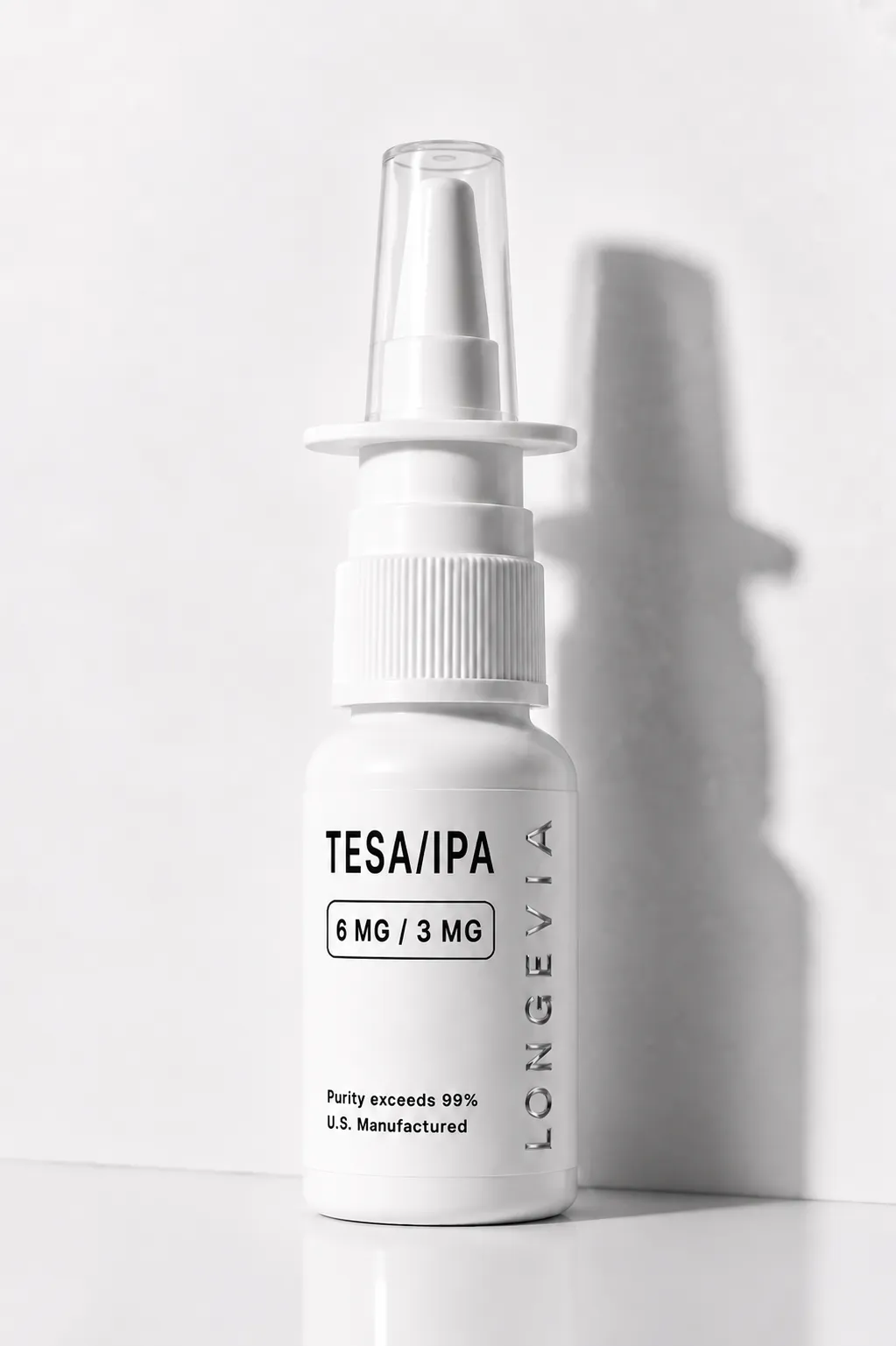
Tesa/IPA — Spray
Longevia Research supplies Tesa/IPA — a two-peptide research formulation containing Tesamorelin (CAS 218949-48-5), a synthetic GHRH analog, and Ipamorelin (CAS 170851-70-4), a growth hormone secretagogue associated with GHS-R/ghrelin receptor signaling. Available in 6mg/3mg and 13mg/3mg compositions, 45 sprays. Research Use Only.
$225.00
Slide to add
Product FAQs
Find answers to common questions regarding storage, reconstitution, and testing guidelines for this specific compound.