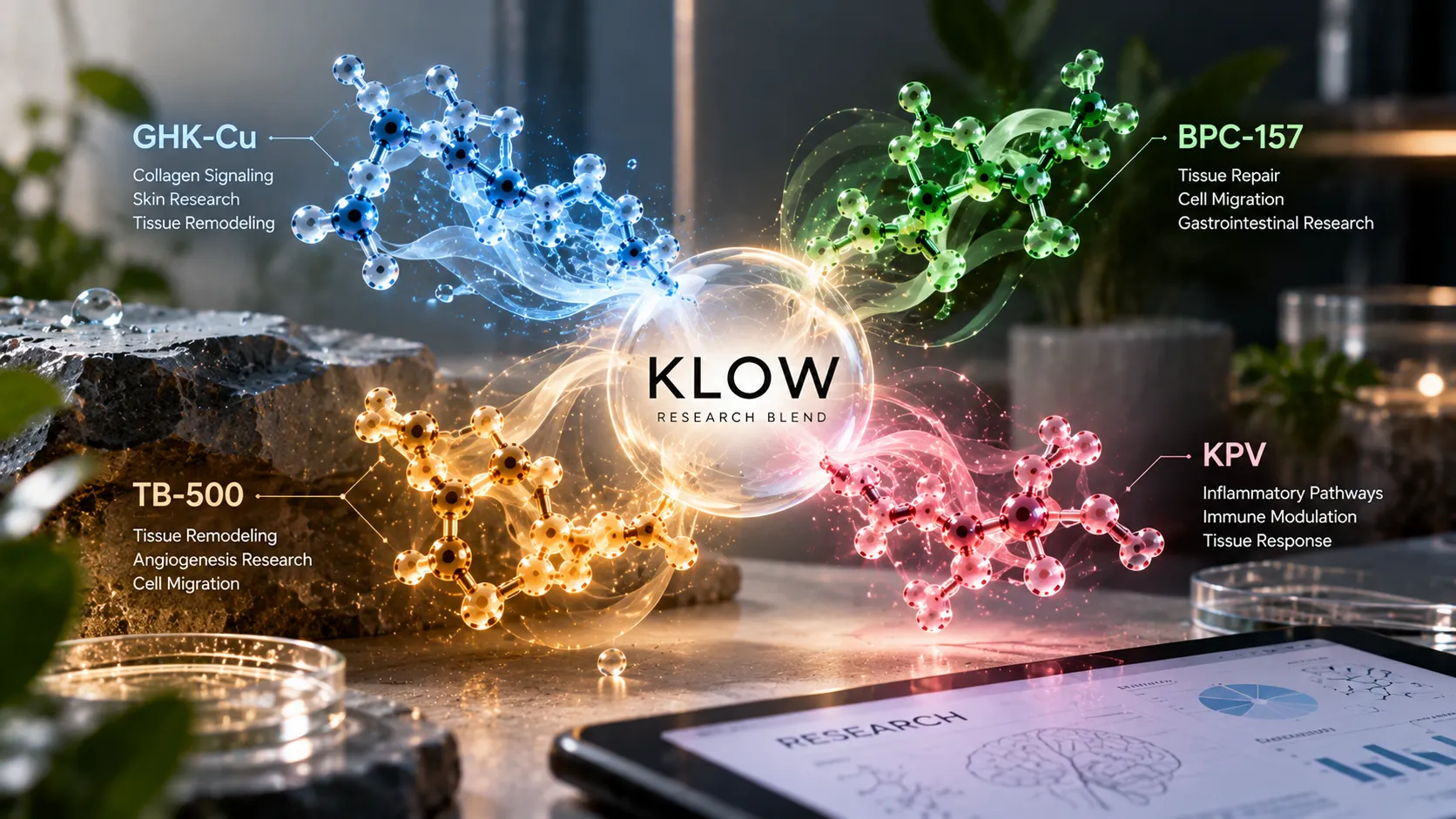
- KLOW is a market name, not a standardized formulation; the commonly cited blend is GHK-Cu, BPC-157, TB-500, and KPV, often stated as 50/10/10/10 mg.
- No published study has tested the four-component combination as a single formulation; all evidence is component-level.
- GHK-Cu has the strongest human evidence, limited to topical use: a 2016 randomized trial (n=40) found reduced wrinkle volume and depth over eight weeks.
- BPC-157, TB-500 (as thymosin beta-4), and KPV rest on animal and cell-culture studies; no human trials establish their effects.
- In July 2026, an FDA advisory committee recommended BPC-157, TB-500, and KPV for the 503A bulks list; the recommendation is non-binding and not drug approval.
- GHK-Cu (injectable) awaits a separate committee review expected before the end of February 2027.
- Component amounts vary by vendor under the KLOW name; a lot-specific Certificate of Analysis is the only reliable record of a specific vial's contents.
- Longevia does not publish a component breakdown for its KLOW Blend.
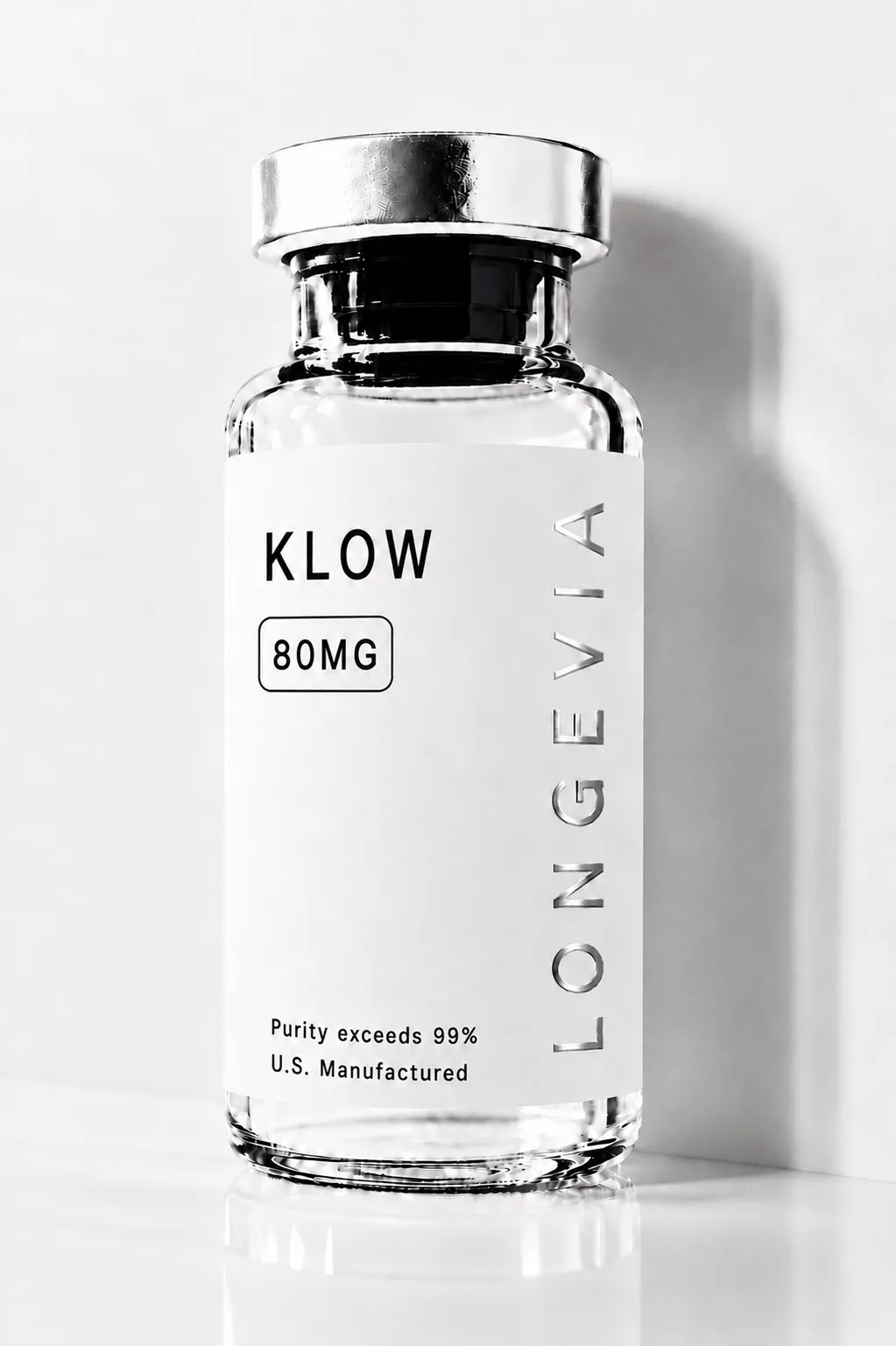
KLOW Blend
Buy KLOW Blend, a laboratory-grade regenerative peptide blend with COA-verified purity. HPLC-tested, batch-traceable, research use only.
KLOW Blend
Buy KLOW Blend, a laboratory-grade regenerative peptide blend with COA-verified purity. HPLC-tested, batch-traceable, research use only.
Search results for KLOW look settled at first glance. Nearly every page names the same four peptides in the same 80 mg vial and moves on. That confidence is misleading, because KLOW is a market name with no fixed definition, not a registered formulation. Anyone asking what is KLOW peptide deserves a more careful answer than a copied ingredient list. This article covers what the term commonly refers to across the research-peptide market and what the published research actually covers. It also states what Longevia's own KLOW Blend listing does and does not disclose. The short version is that the name means different things at different vendors. No study has tested the commonly described combination as a single formulation. What Longevia discloses about its own blend is covered below.
Longevia does not publish a component breakdown or ratio for its KLOW Blend. The four-component composition described in this article reflects what the wider market commonly states about products sold under this name. It is not a statement about what Longevia's KLOW Blend contains.
KLOW is a market term commonly used for a four-component research blend, often described as GHK-Cu, BPC-157, TB-500, and KPV. No study has tested that combination directly, component amounts vary by vendor, and Longevia's own KLOW Blend listing does not publish a specific formulation.
What does the research community commonly mean by KLOW?
When vendors use the name KLOW, they usually mean a four-component research blend. The composition commonly described across the wider market is GHK-Cu, BPC-157, TB-500, and KPV. Listings often state a 50/10/10/10 mg split in an 80 mg vial. That description belongs to the market, not to any single product. It is how other vendors describe products sold under this name.
No regulator defines the term KLOW. It appears in no pharmacopeia monograph and no compendial standard. The name is a label of convenience that stuck. That convenience hides real variation between vendors. Component amounts differ between vendors, and some listings include different components entirely. A researcher comparing two KLOW products may be comparing two different materials.
The 50/10/10/10 split shows up so often that it reads like a formula, but it is not one. It is the most repeated listing convention, and repetition is not standardization. Some vendors state different totals for the vial. Others keep the 80 mg total with different ratios. A few use the KLOW name for blends with different component counts. None of them are wrong in a regulatory sense, because there is no regulation to be wrong against. They are simply using the same word for different products.
Questions about klow peptide components therefore have no universal answer. There is only the commonly cited version and whatever a specific vendor actually ships. Searches for klow blend ingredients usually return the four-peptide list with total confidence. Treat that confidence as a description of market habit, not a specification. The honest starting point is that KLOW names a category of similarly labeled blends. That label alone tells you very little about the vial.
What is each commonly cited component studied for?
Four peptides appear in the commonly cited composition. Each has its own literature, its own models, and its own limits. None of that literature tested the four together.
GHK-Cu, collagen signaling, and the strongest human evidence
GHK-Cu is a copper-binding tripeptide studied for collagen and extracellular matrix signaling. A 2016 randomized, double-blind trial applied it topically in a lipid nano-carrier to 40 women over eight weeks. Wrinkle volume fell significantly against both the control serum and a commercial peptide product. The same study found increased collagen and elastin production in cultured human dermal fibroblasts. All of the human evidence is topical and cosmetic in design. No published human trial has tested injected GHK-Cu for any endpoint. This evidence describes GHK-Cu alone, not a four-peptide blend.
The peptide occurs naturally in human plasma, and its levels decline with age. That fact explains much of the research interest. Most published work focuses on skin cells, wound models, and gene expression related to remodeling. A 2026 systematic review counted 20 studies of GHK-Cu in aesthetic medicine, 18 of them preclinical and two of them randomized trials. The review found consistent effects on collagen synthesis and wrinkle measures, alongside wide variation in methods. Topical application remains the only route with human data.
BPC-157 and preclinical tissue repair models
BPC-157 is a 15-amino-acid peptide studied for tissue repair and vascular signaling. A 2003 study in the Journal of Orthopaedic Research tested it in rats with transected Achilles tendons. Treated animals showed faster functional recovery and better organized tendon fibers than controls. The same paper reported stimulated growth of cultured tendon cells. Most of the wider literature follows the same pattern. It is preclinical, largely from one research network, and centered on rodent injury models. This evidence describes BPC-157 alone, not a four-peptide blend.
The peptide comes from a sequence found in a human gastric protein. Research groups have tested it in models of tendon, muscle, gut, and nerve injury. Reported mechanisms include angiogenesis signaling and nitric oxide pathway modulation. The literature is unusually concentrated in one network. One network centered in Croatia produced most of the published work, which means independent replication is thinner than the publication count suggests. Human data remain limited to small early studies.
TB-500 and cell migration research tied to thymosin beta-4
TB-500 is the market name for a synthetic fragment related to thymosin beta-4, a 43-amino-acid protein involved in cell structure. A 1999 study in the Journal of Investigative Dermatology tested thymosin beta-4 in a rat full-thickness wound model. Treated wounds reepithelialized 42 percent faster at day four than saline controls. By day seven the advantage reached 61 percent. The researchers also observed increased collagen deposition and new blood vessel formation. Separately, the peptide stimulated keratinocyte migration in cell culture. This evidence describes thymosin beta-4 alone. It does not describe TB-500 as a specific fragment, and it does not describe a four-peptide blend.
Thymosin beta-4 is a naturally occurring protein, and the fragment sold as TB-500 corresponds to part of its sequence. The distinction matters because studies of the full protein do not automatically describe the fragment. Published work on thymosin beta-4 spans wound healing, angiogenesis, and cell migration models. Almost all of it is preclinical. The fragment itself has far less published research behind it than the parent molecule.
KPV and inflammatory signaling research
KPV is a three-amino-acid fragment of alpha-MSH studied for inflammatory signaling. A 2008 study in Gastroenterology showed it enters intestinal cells through the PepT1 transporter. Inside the cells it suppressed NF-kB and MAPK signaling pathways. The researchers also tested it in two mouse models of colitis and observed reduced inflammatory markers. Human intestinal cell lines and mice served as the test systems. No published human trial of KPV exists. This evidence describes KPV alone, not a four-peptide blend.
It is the shortest of the four, just three amino acids from the tail of alpha-MSH. The parent hormone affects pigmentation and appetite through melanocortin receptors, which KPV does not. Its anti-inflammatory effects run through different machinery, mainly intracellular signaling rather than cell-surface receptors. That separation is why researchers study it as its own subject instead of a weaker alpha-MSH. Independent groups have replicated the colitis findings in mice.
Component (as commonly described in the market) | What it is studied for | Evidence type | Strongest evidence route |
|---|---|---|---|
GHK-Cu | Collagen and extracellular matrix signaling | Cell culture, animal, human topical | Topical, randomized double-blind trial (n=40) |
BPC-157 | Tissue repair and vascular signaling | Cell culture, animal | Animal, rat tendon transection model |
TB-500 | Cell migration, related to thymosin beta-4 | Cell culture, animal | Animal, rat full-thickness wound model |
KPV | Inflammatory signaling | Cell culture, animal | Animal, mouse colitis models |
The table above reflects the composition as commonly described across the wider market, not a statement about any specific Longevia product.
Has the four-component combination itself been studied?
No published study has tested GHK-Cu, BPC-157, TB-500, and KPV together as a single formulation. Literature searches return studies of each peptide on its own. They return nothing on the four together. Not one study.
That absence matters more than it might seem. A claim about the combination cannot currently be traced to a study of the combination. Each component was tested in different models, at different doses, by different groups, for different endpoints. Stacking their results does not create evidence for the stack. Interactions between the four remain unstudied. One peptide could blunt another's effect or amplify it, and the literature would not tell you.
This is the central limit on klow research evidence. Real published work sits behind the components. The blend as a blend has none. Any statement about what KLOW does as a whole is therefore extrapolation, not evidence. Researchers should treat the four-component literature as four separate files that happen to share a market name.
Lack of research is not the problem. The issue is what happens when research on parts gets quoted as research on a whole. A reader sees four studied peptides and assumes the blend inherits all four evidence bases. The blend does not inherit them. Doses differ, models differ, and nothing in the literature tests whether the four remain stable or active in one vial. Combination pharmacology is its own field precisely because mixtures surprise people. Until someone runs the mixture, the honest description is four separate evidence files.
Why does component amount vary between vendors?
Unregulated market names drift over time. When no authority defines a term, each vendor defines it for their own catalog. One supplier's 80 mg vial may hold the commonly cited 50/10/10/10 split. Another may use different ratios or substitute components while keeping the name. Nothing in the market stops either practice. The name on the label is doing marketing work, not specification work.
That is why comparing KLOW products by name alone misleads. Two vials with the same label can contain different materials in different amounts. The fix is to stop reading the name and start reading the documentation. A lot-specific Certificate of Analysis identifies what is actually in a specific vial and at what purity. The market name cannot do that job. This is also the practical answer to is klow standardized. It is not, and no vendor's usage can standardize it alone.
Two vendors can both sell KLOW in good faith with different contents. Neither is mislabeling in a legal sense, because the label was never defined. This is the quiet risk in comparing prices or reviews across sellers. A lower price may reflect a different ratio rather than a better deal. Glowing reviews may describe a different formulation than the one in your cart. The only comparison that survives these problems is documentation against documentation.
Before comparing any two KLOW products, match the lot number on each vial to its lot-specific Certificate of Analysis. That document describes the material you actually hold. The market name only describes a habit.
What is KLOW's regulatory status in 2026?
There is no such thing as KLOW's FDA status as a single product. Regulators evaluate individual bulk substances, not market blend names. The klow FDA status question therefore breaks into four smaller questions, one per commonly cited component.
In July 2026 the FDA's Pharmacy Compounding Advisory Committee reviewed seven peptide bulk substances over two days. For BPC-157, TB-500, and KPV, the committee voted to recommend adding them to the 503A bulks list. The votes were divided, and the committee went against its own FDA staff scientists, who had recommended against all seven substances. A committee recommendation is advisory only. It is not a rule, and it is not drug approval. The FDA must still complete formal rulemaking before any of these substances can be compounded under section 503A. As of this writing that rulemaking has not begun. None of the three is an FDA-approved drug.
Section 503A covers a specific legal pathway. It lets state-licensed pharmacies compound drugs from bulk substances on an FDA-maintained list. A substance reaches that list only after notice-and-comment rulemaking, which takes months at minimum. The July vote started none of that. It produced a recommendation, and recommendations wait for agency action. Until a final rule appears, the legal position of these peptides is unchanged from before the meeting.
GHK-Cu sits on a separate track. Its injectable form was removed from the FDA's Category 2 list in April 2026. The removal followed a withdrawn nomination, a procedural step rather than a safety verdict. A committee review is expected before the end of February 2027. None of this changes the klow 503A status of research material. A favorable advisory vote does not convert research-use-only compounds into approved drugs, and it does not authorize any specific blend. The regulatory picture to carry forward is narrow. Three commonly cited components received a non-binding recommendation. One component awaits its own review. The blend itself has no status at all.
Component | 2026 status | What that status does and does not mean |
|---|---|---|
BPC-157 | PCAC recommended for 503A bulks list, July 2026 | Advisory recommendation only, rulemaking pending, not FDA approval |
TB-500 | PCAC recommended for 503A bulks list, July 2026 | Advisory recommendation only, rulemaking pending, not FDA approval |
KPV | PCAC recommended for 503A bulks list, July 2026 | Advisory recommendation only, rulemaking pending, not FDA approval |
GHK-Cu | Removed from Category 2 (injectable), April 2026, PCAC review expected before end of February 2027 | Procedural removal after withdrawn nomination, not a safety verdict, not approval |
How is KLOW different from GLOW?
Market listings draw the line with one ingredient. GLOW is commonly described across vendor listings as GHK-Cu, BPC-157, and TB-500 without KPV. KLOW is commonly described as those same three plus KPV. That is the entire distinction as the market tells it. Most klow vs glow searches are really asking about that one-ingredient difference.
The same caution from the rest of this article applies here. GLOW is no more standardized than KLOW. Component amounts vary by vendor under that name too. No study has tested the three-component GLOW combination as a single formulation either. The market answer is simple enough. KLOW adds a fourth commonly cited component. The real answer is considerably messier. Neither name guarantees its commonly cited contents. A researcher comparing the two should apply the same test. Ignore the name, read the lot documentation, and check what the literature says about each component on its own.
Some listings blur the two names further by adding qualifiers or version numbers. Those variants inherit the same problem. A name with a suffix is still an unregulated name. Researchers choosing between blends should rest the decision on documentation for the specific vials under consideration. Names point at market habits, while paperwork points at the material itself. A companion piece covers the Glow Blend dosage and reconstitution guide under the same non-disclosure rule.
What does Longevia actually publish about its KLOW Blend?
Longevia's KLOW Blend listing does not publish a component breakdown or ratio. The company describes this as a deliberate choice, not an omission. Descriptions of a four-peptide composition in this article reflect what the wider market commonly states. They are not statements about what Longevia's vial contains.
For the material actually supplied, the accurate reference is the lot-specific Certificate of Analysis. That document confirms identity and purity for the specific vial in hand. Market descriptions cannot do that job, no matter how confidently they are written.
The company supplies KLOW Blend as a lyophilized research blend. Every batch is independently HPLC and LC-MS tested, with lot-specific Certificates of Analysis published in the COA Library. A separate KLOW Blend dosage chart covers reconstitution math for the blend as supplied. That chart works from total blend mass, which is the figure the label provides.
This material is for laboratory research use only. It is not for human or veterinary use. Nor is it intended to diagnose, treat, cure, or prevent any disease.
Frequently Asked Questions
- Badenhorst T, Svirskis D, Merrilees M, Bolke L, Wu Z. Effects of GHK-Cu on MMP and TIMP Expression, Collagen and Elastin Production, and Facial Wrinkle Parameters. J Aging Sci. 2016;4:166. doi:10.4172/2329-8847.1000166
- Staresinic M, et al. Gastric pentadecapeptide BPC 157 accelerates healing of transected rat Achilles tendon and in vitro stimulates tendocytes growth. J Orthop Res. 2003;21(6):976-983. PMID: 14554208
- Malinda KM, et al. Thymosin beta4 accelerates wound healing. J Invest Dermatol. 1999;113(3):364-368. PMID: 10469335
- Dalmasso G, et al. PepT1-mediated tripeptide KPV uptake reduces intestinal inflammation. Gastroenterology. 2008;134(1):166-178. PMID: 18061177
- Mokhtar J, et al. The Regenerative Potential of GHK-Cu in Aesthetic Medicine. Aesthet Surg J. 2026. doi:10.1093/asj/sjag169. PMID: 42619529
- Orrick, Herrington & Sutcliffe LLP. FDA Announces Removal of 12 Peptides from Category 2 and Schedules PCAC Meetings to Consider Adding Peptides to 503A Bulk Drug Substances List. April 16, 2026.
- Frier Levitt. FDA PCAC Peptide Vote: What the 503A Recommendations Mean. 2026.