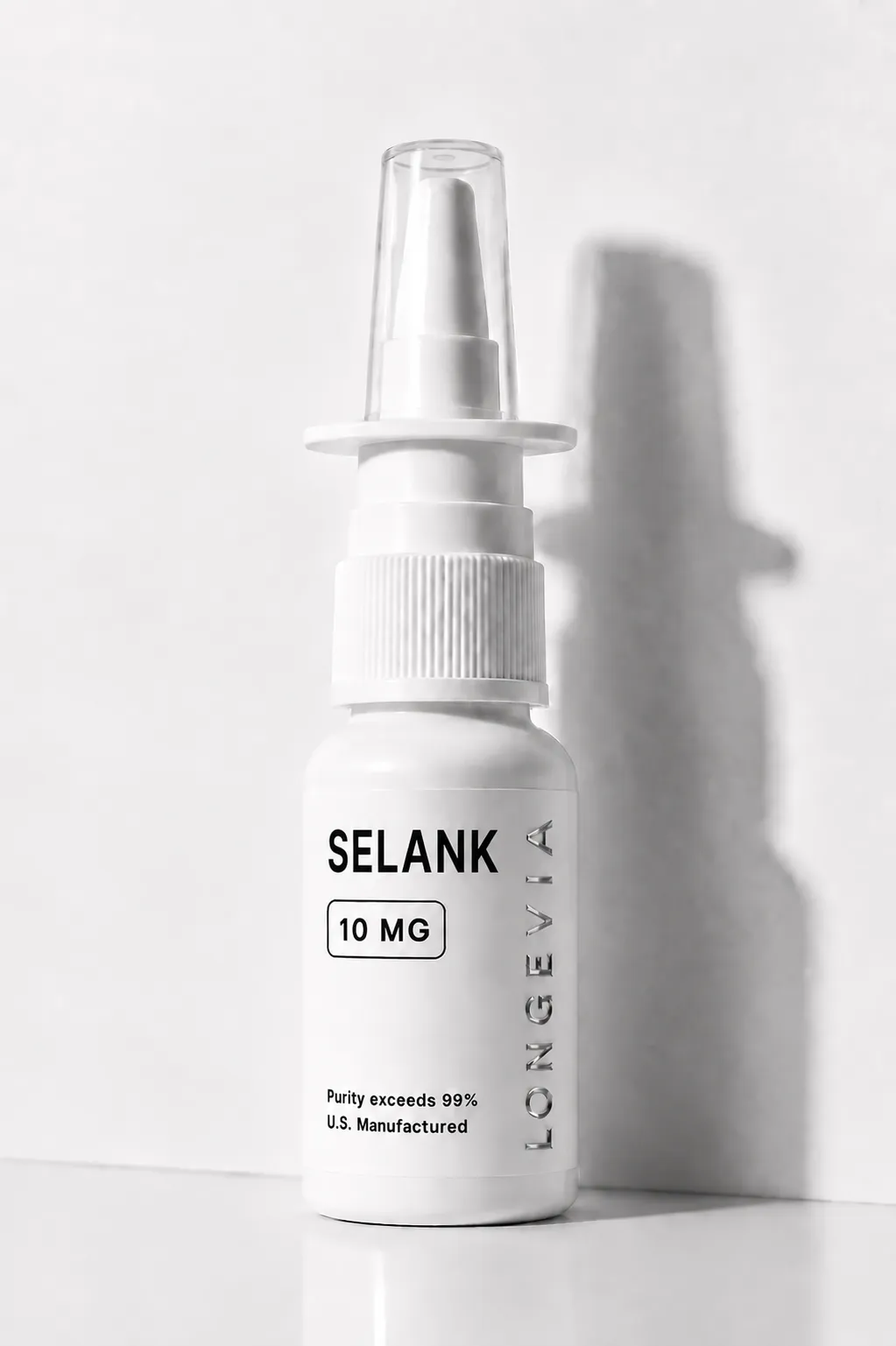
Cognitive & NootropicImmune Regulation
Selank — Spray
$148.50
1
Slide to Add
Purity≥99% Tested
TestingLC-MS Verified
LocationUS Based
Selank is a synthetic heptapeptide analogue related to tuftsin — a naturally occurring immunomodulatory tetrapeptide derived from the Fc region of immunoglobulin G (IgG). Selank retains the four-amino-acid tuftsin core sequence (Thr-Lys-Pro-Arg) and extends it with a C-terminal Pro-Gly-Pro tripeptide that confers greater resistance to peptidase degradation in experimental systems relative to the rapidly degradable tuftsin parent sequence. Originally developed at the Institute of Molecular Genetics of the Russian Academy of Sciences, Selank has been investigated across several experimental biological domains — including neurobiological signaling, GABAergic and enkephalin-related neurotransmitter research, neuroimmune interactions, cytokine-related biology, stress-related behavioral neuroscience, and gene-expression studies — primarily in biochemical, cell-based, and animal model systems, with a more limited human research literature originating predominantly from the Russian scientific community. No single definitive mechanism has been established for Selank, and experimental findings should be understood as research observations in specific model systems rather than validated effects in humans. Longevia Research supplies Selank as 10mg per bottle in a liquid spray format — 90 sprays per bottle — for qualified laboratory and scientific research purposes only.
Standard Delivery3-4 Working Days
Free ShippingOn all orders above $300
Product Details
Scientific identity: Selank (CAS 129954-34-3); sequence Thr-Lys-Pro-Arg-Pro-Gly-Pro (TKPRPGP); molecular formula C₃₃H₅₇N₁₁O₉; molecular weight 751.87 g/mol; 7-residue linear heptapeptide with free N- and C-termini.
Compound class: Synthetic heptapeptide; tuftsin analogue; Research Use Only — not a drug, dietary supplement, food, or cosmetic.
Structural relationship to tuftsin
Tuftsin (Thr-Lys-Pro-Arg) is a naturally occurring tetrapeptide cleaved from IgG by specific enzymes, studied in relation to phagocyte stimulation and immune signaling; Selank incorporates this tuftsin core at positions 1–4 and appends a C-terminal Pro-Gly-Pro tripeptide at positions 5–7 reported to provide greater resistance to enzymatic degradation; the proline-rich composition — four of seven residues being proline or proline-adjacent — imposes conformational constraints that influence peptidase resistance; Selank and tuftsin are structurally related but distinct compounds whose biological activities in any given experimental system should not be assumed to be identical.
Distinction from Semax: Selank is distinct from Semax — another synthetic neuropeptide developed within the same Russian research program — which has a different sequence, receptor profile, and independent research literature; research on Semax should not be attributed to Selank.
Product content: 10mg per bottle; 90 sprays per bottle.
Physical form: Liquid research spray.
Purity: Research-grade.
Analytical documentation
A batch-specific Certificate of Analysis is available on the Longevia Research website, covering peptide identity, purity, and lot traceability; identity confirmation should include mass spectrometric verification at 751.87 g/mol and chromatographic purity assessment separating Selank from tuftsin, related sequence fragments, and synthesis-related impurities.
Regulatory note: Selank is registered as a pharmaceutical intranasal spray preparation in Russia; this registration reflects that jurisdiction's regulatory standards and does not constitute FDA, EMA, or equivalent approval in most jurisdictions; the Longevia Research preparation is not equivalent to any registered pharmaceutical Selank preparation.
Research-use classification
Research Use Only; not approved for human or veterinary use in any major jurisdiction outside Russia; not intended for administration to humans or animals.
Research Focus & Mechanism Overview
Research background
Selank was developed building on earlier research interest in the endogenous tetrapeptide tuftsin and its reported immunomodulatory properties in experimental systems. The scientific rationale behind extending the tuftsin sequence with a C-terminal Pro-Gly-Pro addition was to develop a compound with improved stability in biological media while retaining or extending its experimental biological activity profile — reflecting a broader strategy in synthetic peptide pharmacology of modifying naturally occurring sequences to address metabolic instability. Research since its development has encompassed biochemical and molecular studies, cell-based investigations, extensive animal behavioral research, and a body of clinical literature emerging primarily from Russian scientific institutions across the 1990s through 2010s.
Neurochemical research and proposed mechanisms
Among the neurochemical research on Selank, the relationship with inhibitory neurotransmitter biology has received substantial attention — particularly proposed associations with GABAergic signaling and enkephalin-related pathways in rodent animal models. Published experimental proposals include suggestions that Selank may influence enkephalin catabolism, potentially affecting the balance between endogenous enkephalin synthesis and degradation in specific brain regions, and that it may influence GABA-A receptor-associated signaling in animal brain preparations. Serotonin-related neurochemical changes have also been examined in some Selank animal studies. These are experimental research observations from animal models and biochemical assays — no single definitive mechanism has been established, proposed mechanisms remain under active investigation, and these observations do not establish that Selank produces specific neurochemical changes in the human brain.
Key research areas
Stress-related behavioral neuroscience research using rodent paradigms — including open-field tests, elevated-plus-maze assays, and forced-swim tests — has generated observations about Selank's effects on behavioral endpoints relevant to stress and anxiety research; these paradigms assess animal behavior under defined laboratory conditions and should not be used as direct proxies for human psychological experiences. Animal learning and memory research using spatial learning tasks, passive and active avoidance conditioning, and other behavioral assays has examined Selank's effects on learning-related behavioral outcomes in specific rodent experimental models. Neuroimmune research has investigated Selank's effects on cytokine-related biology — including IL-6 and TNF-α in immune cell preparations and animal models — reflecting its structural derivation from the immunologically relevant tuftsin. Molecular biology studies have examined transcriptional responses using microarray and qPCR approaches in specific brain regions and immune tissues of rodents; these gene-expression findings are specific to the tissue, species, timepoint, dose, and experimental conditions of each study and do not automatically translate to specific physiological or clinical outcomes.
Human research and regulatory context
A clinical literature on Selank has been published primarily in Russian-language and regional journals, examining defined populations including individuals with anxiety-related conditions and stress-related symptoms in the Russian healthcare context. Key limitations apply to this evidence base: studies have generally involved small sample sizes; methodological standards vary; blinding and control procedures differ across studies; the evidence has not been replicated in large independent randomized controlled trials meeting current international standards; and Russian regulatory standards differ from those of the FDA or EMA. These are factual observations about the evidence base rather than a dismissal of the research — the published literature provides a basis for further investigation but does not constitute regulatory-quality evidence for approval by major Western regulatory agencies. Selank is not approved by the FDA, EMA, or equivalent agencies in most jurisdictions, and the Longevia Research preparation does not carry regulatory approval in any jurisdiction.
Quality & Purity Standards
For a synthetic heptapeptide such as Selank, research-grade quality depends on accurate confirmation of the peptide sequence, molecular identity, and purity — particularly given the structural relationship between Selank and the closely related peptide Semax, which shares some compositional similarities and is part of the same Russian neuropeptide research program. Accurate identity confirmation ensures that research conducted with Longevia Research Selank addresses the correct molecular entity.
Research-grade quality assessment for Selank appropriately involves:
Peptide identity and sequence verification: Confirmation of the seven-residue sequence Thr-Lys-Pro-Arg-Pro-Gly-Pro using LC-MS/MS tandem mass spectrometry or equivalent analytical methods capable of verifying sequence identity and distinguishing Selank from structurally related peptides.
Molecular mass confirmation: High-resolution mass spectrometry (HRMS) to confirm the molecular formula C₃₃H₅₇N₁₁O₉ and molecular weight of 751.87 g/mol.
Purity assessment: Reversed-phase HPLC or UHPLC to evaluate chemical purity, quantify related substances, and identify synthesis-related impurities or truncation sequences.
Proline residue integrity: Given Selank's proline-rich composition (four proline residues in seven amino acids), analytical confirmation that the proline residue configuration is correct and that no post-synthetic modifications or degradation have occurred at these positions.
Batch documentation and traceability: Provision of batch-specific analytical records enabling traceability from synthesis through supply.
Longevia Research's quality approach is oriented toward providing researchers with well-characterized peptides supported by appropriate analytical documentation. Researchers should consult current product documentation and available certificates of analysis for batch-specific data.
No specific purity grade, third-party certification, cGMP status, or independent laboratory verification is stated for this listing. Researchers requiring documentation of specific quality parameters should contact Longevia Research directly.
Compliance Notice
FOR RESEARCH USE ONLY. NOT FOR HUMAN CONSUMPTION. NOT FOR VETERINARY USE.
Selank 10mg — 90 Sprays, as supplied by Longevia Research, is intended exclusively for qualified laboratory and scientific research conducted by trained professionals in appropriate research settings. This product is not a drug, dietary supplement, food, or cosmetic. It has not been evaluated or approved by the U.S. Food and Drug Administration, the European Medicines Agency, or any other regulatory authority in most jurisdictions for use as a therapeutic, prophylactic, or diagnostic agent in humans or animals.
This product is not intended to diagnose, treat, cure, or prevent any disease, condition, or health-related outcome.
Jurisdictional regulatory distinction: While Selank has a registration history in Russia as a pharmaceutical nasal spray, this Russian registration applies to the specific pharmaceutical preparation registered in that jurisdiction and does not constitute FDA approval, EMA approval, or regulatory approval in the United States, European Union, United Kingdom, or most other countries. The Longevia Research Selank spray is a research compound, not a pharmaceutical product, and is not equivalent to any registered pharmaceutical Selank preparation.
Evidence scope: Published experimental and clinical research involving Selank — including Russian clinical literature — does not establish the safety, efficacy, bioavailability, or pharmacokinetics of this specific Longevia Research spray product. Research findings concerning formulations administered by nasal spray in Russian clinical trials are specific to those formulations, populations, and regulatory contexts; they do not apply to this product. Animal and cell-based research findings do not establish human efficacy or safety.
No neuropsychiatric, cognitive, or immune claims: Research examining Selank in experimental stress models, behavioral paradigms, or immune signaling contexts does not establish that this product produces neuropsychiatric, cognitive, anxiolytic, immunological, or therapeutic effects in human users.
Purchasers are solely responsible for ensuring that acquisition, possession, storage, handling, use, and disposal of this product comply with all applicable local, state, national, and international laws and regulations governing research compounds. Longevia Research makes no warranties regarding the suitability of this product for any specific research application. This product should be handled by qualified personnel following appropriate laboratory safety protocols.
By purchasing this product, the purchaser confirms that they are a qualified researcher or research professional acquiring this compound for legitimate scientific research purposes only.
Continue Exploring
Also Considered.
LL-37 1mg — 45 Sprays
LL-37 is the 37-residue mature cathelicidin peptide released from hCAP18, the only mature cathelicidin peptide humans produce. Investigated in membrane biology, innate immune signaling, and epithelial research. Available from Longevia Research as 1mg — 45 sprays — for qualified laboratory research use only.
$157.50
Slide to add
DSIP 10mg — 90 Sprays
DSIP (Delta Sleep-Inducing Peptide) is a research-grade nonapeptide investigated in experimental studies examining sleep-related biology, neurobiology, and neuroendocrine systems. Available from Longevia Research as a 10mg spray — 90 sprays — for qualified laboratory research use only.
$171.00
Slide to add
Dihexa 10mg — 45 Sprays
Dihexa 10mg spray — 45 sprays of the synthetic peptidomimetic research compound (PNB-0408, CAS 1401708-83-5, ~504.66 Da). Supplied by Longevia Research for laboratory use only. Batch COA available.
$171.00
Slide to add
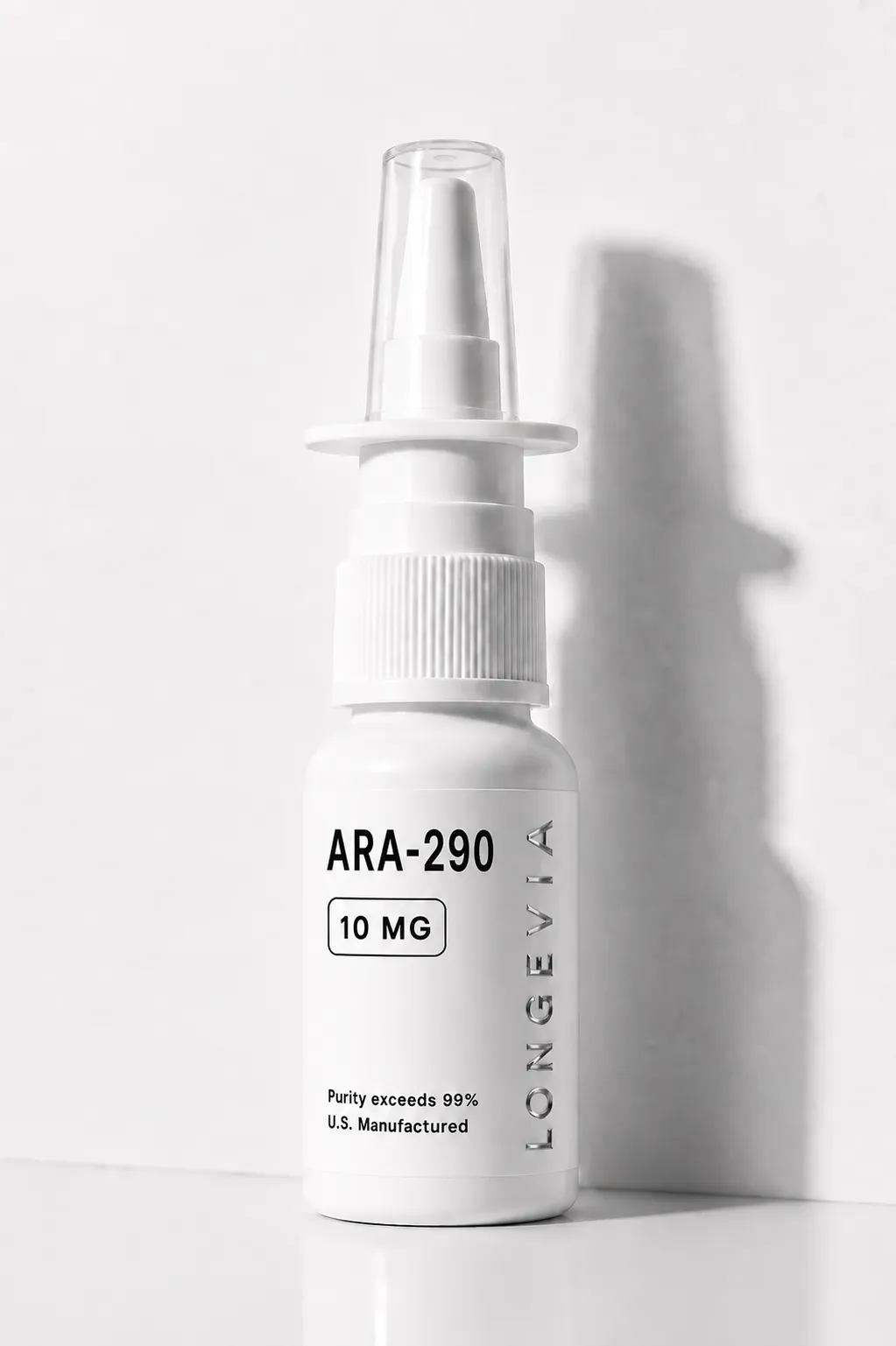
ARA-290 10mg — 45 Sprays
ARA-290 (cibinetide) 10mg spray — 45 sprays of the synthetic 11-residue EPO helix-B surface peptide. CAS 1208243-50-8. Supplied by Longevia Research for laboratory use only.
$90.00
Slide to add
Product FAQs
Find answers to common questions regarding storage, reconstitution, and testing guidelines for this specific compound.