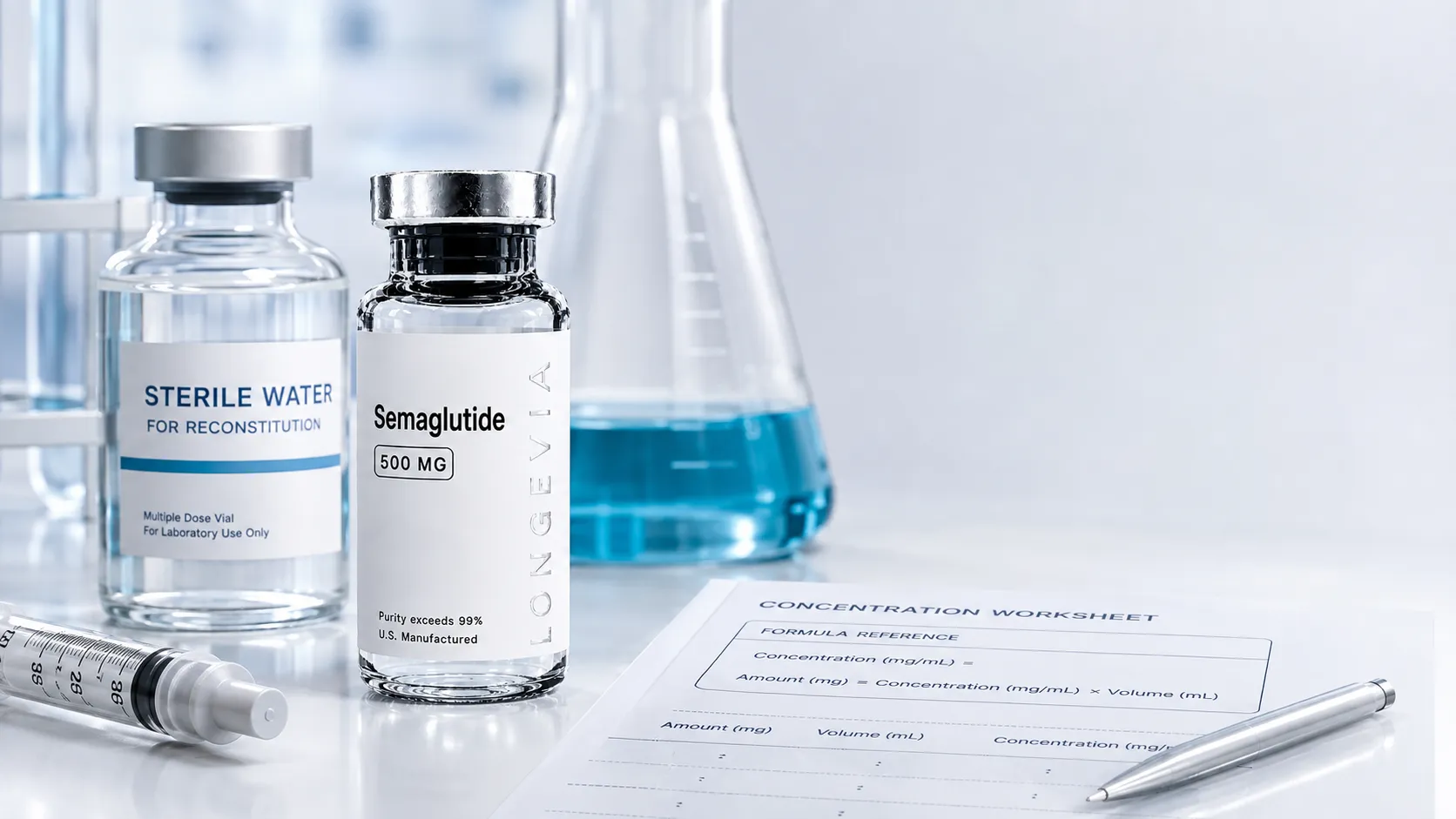
- Semaglutide volume depends on the exact concentration, not merely the total amount in a vial.
- Concentration is calculated by dividing total semaglutide amount by final solution volume.
- Milligrams, millilitres, and syringe units are different measurements and must not be treated as interchangeable.
- The FDA has reported serious dosing errors involving compounded injectable semaglutide.
- Approved prefilled semaglutide pens are not automatically equivalent to compounded multi-dose vials.
- Bacteriostatic water is not a universal diluent for every semaglutide preparation.
- A clear solution does not prove sterility, stability, or suitability for injection.
- Any concentration discrepancy should be resolved with the dispensing pharmacy or prescribing clinician before use.
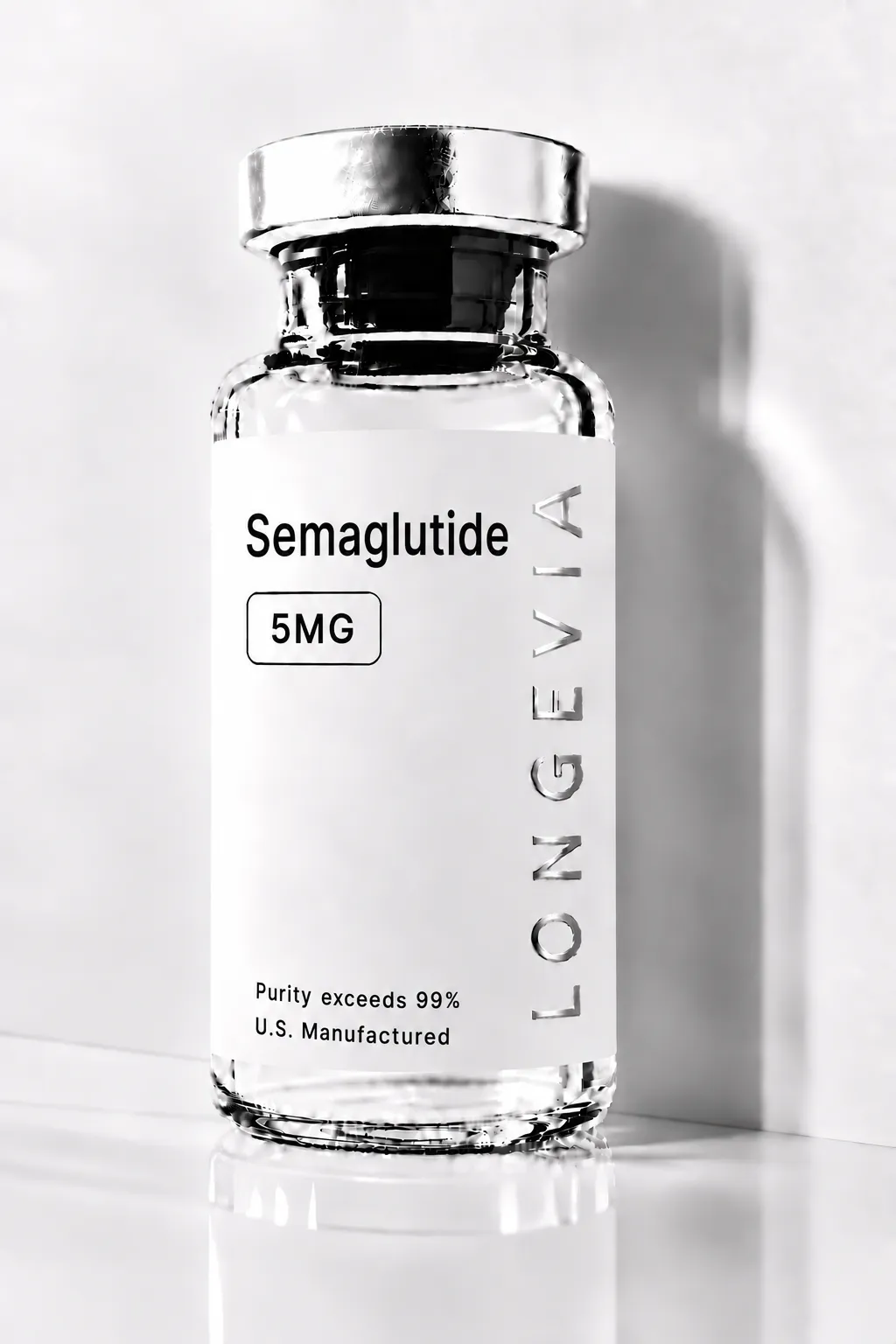
Semaglutide
Semaglutide is a synthetic fatty acid-conjugated GLP-1 receptor agonist peptide investigated in research involving GLP-1R pharmacology, glucose-dependent insulin secretion, pancreatic beta cell biology, and incretin signaling. Available in 5mg, 10mg, 20mg, and 30mg vials. Research Use Only — Longevia Research.
Semaglutide
Semaglutide is a synthetic fatty acid-conjugated GLP-1 receptor agonist peptide investigated in research involving GLP-1R pharmacology, glucose-dependent insulin secretion, pancreatic beta cell biology, and incretin signaling. Available in 5mg, 10mg, 20mg, and 30mg vials. Research Use Only — Longevia Research.
Semaglutide reconstitution questions often focus on BAC water ratios, syringe markings, and how many millilitres correspond to a labelled dose. The first safety principle is that semaglutide concentration is product-specific. A calculation cannot be completed safely until the vial label, total drug amount, final volume, formulation, intended use, and dispensing instructions have been verified.
This article explains the mathematics and documentation principles used to review a semaglutide preparation. It does not provide a self-injection schedule or authorize the reconstitution of an unapproved product. Approved semaglutide products are supplied in defined presentations, while compounded products may have different concentrations and packaging. The FDA has reported adverse events and hospitalizations associated with dosing errors involving compounded injectable semaglutide, including confusion between milligrams, millilitres, and syringe units. [34][47] For a broader comparison of semaglutide against other GLP-1 research compounds, see Longevia's Semaglutide vs. Tirzepatide vs. GLP-3 (Rt) comparison.
Why semaglutide concentration matters
Semaglutide dose is an amount of active ingredient, usually expressed in milligrams. Liquid volume is expressed in millilitres. Syringe graduations may be expressed in millilitres or device-specific units. These are different measurements and must not be treated as interchangeable.
The basic concentration equation is:
Concentration = total semaglutide amount ÷ final solution volume
If a preparation contains M milligrams in a final volume of V millilitres, then:
C = M ÷ V mg/mL
The corresponding volume for a defined amount is:
Volume = target amount ÷ concentration
If the target amount is D milligrams and concentration is C milligrams per millilitre, then:
Volume = D ÷ C mL
A final conversion into syringe markings should only be made after confirming the exact syringe scale. The FDA has specifically identified conversion errors involving milligrams, millilitres, and “units” as a contributor to semaglutide overdoses. [47]
A mathematical example
Assume a hypothetical laboratory sample contains 10 mg of semaglutide in a documented final volume of 2 mL. The nominal concentration is:
10 mg ÷ 2 mL = 5 mg/mL
A hypothetical analytical aliquot of 0.5 mg would correspond to:
0.5 mg ÷ 5 mg/mL = 0.1 mL
This example demonstrates concentration mathematics only. It does not establish that the sample is sterile, stable, approved, suitable for injection, or appropriate for a particular patient. Longevia's peptide dosage calculator can help check similar mg-to-mL arithmetic once a concentration has been independently verified.
Never infer a semaglutide volume from the vial size alone. Verify the labelled drug amount, final concentration, syringe scale, and written instructions with the dispensing pharmacy or prescribing clinician.
What BAC water means
“BAC water” is a common abbreviation for bacteriostatic water for injection. In the United States, bacteriostatic water for injection typically contains sterile water with a preservative such as benzyl alcohol, but product composition, labelling, compatibility, and intended use must be verified from the actual manufacturer’s label.
Bacteriostatic water is not a universal solvent for every peptide or injectable drug. The presence of a preservative does not guarantee compatibility, stability, sterility after repeated puncture, or suitability for a particular preparation. A pharmacy or product label should specify the correct diluent when reconstitution is permitted.
Approved semaglutide presentations should be handled according to their prescribing information. A prefilled product is not automatically equivalent to a powder-filled vial, and the instructions for an approved pen should not be transferred to a compounded preparation.
Approved products versus compounded vials
The FDA-approved Wegovy injection is supplied as a clear, colourless solution in single-dose, prefilled pens with defined strengths. Current FDA labelling lists presentations such as 0.25 mg/0.5 mL and 0.5 mg/0.5 mL, with additional pen strengths for prescribed doses. [46]
A compounded product may instead be supplied in a multi-dose vial with a concentration selected by the compounder. That concentration may differ from another pharmacy’s concentration even when both labels display the same total vial amount. Consequently, an online “units chart” can be wrong for a specific vial.
Product or preparation type | Typical concentration source | Main verification requirement |
|---|---|---|
Approved prefilled pen | Manufacturer’s product label | Confirm pen strength and prescribed dose. |
Compounded multi-dose vial | Pharmacy label and dispensing instructions | Confirm mg/mL and syringe instructions. |
Research-use material | Supplier documentation and institutional protocol | Confirm intended research use, identity, purity, and approval status. |
Reconstituted laboratory sample | Validated preparation record | Confirm total amount, final volume, assay, and stability. |
The FDA has reported that compounded semaglutide products can have varying concentrations and that unfamiliarity with vial withdrawal and unit conversions has contributed to dosing errors. [47]
How to audit a semaglutide label
Before performing any calculation, record the exact wording on the label. Do not rely on memory or a generic internet chart. The review should capture:
- Active ingredient name and form.
- Total amount of semaglutide in the container.
- Concentration in mg/mL, if already supplied as a solution.
- Required diluent, if reconstitution is permitted.
- Final volume after preparation.
- Beyond-use date or manufacturer expiry date.
- Storage instructions.
- Route and dispensing instructions.
- Pharmacy contact information.
- Lot number and preparation identifier.
If the label states only a total amount but does not state the final concentration, the user should obtain clarification before measuring a dose. If the pharmacy provides both mg/mL and syringe-unit instructions, those instructions should be checked for internal consistency by a qualified professional.
The three-unit error
The most dangerous misunderstanding occurs when a person assumes that a syringe “unit” is a universal drug quantity. A unit is a volume marking on a particular syringe scale, not a fixed amount of semaglutide. The amount of semaglutide represented by a marking depends on the preparation’s concentration.
For a syringe calibrated so that 100 markings represent 1 mL, the volume represented by one marking would be 0.01 mL. However, the semaglutide amount still depends on mg/mL. A different syringe scale or concentration changes the result.
This is why a written instruction should preferably state the drug amount in milligrams and the liquid volume in millilitres, with the syringe type identified separately. The FDA’s alert describes reports in which patients administered five to ten times the intended dose because of these conversion problems. [47]
Reconstitution as a controlled process
When a pharmacy or research laboratory reconstitutes a lyophilized compound, the process should be treated as a controlled preparation rather than an informal mixing step. The record should identify the validated diluent, its lot number, the volume added, the final concentration, the operator, the preparation date, and the applicable stability period.
A vial should not be vigorously shaken unless the product-specific instructions expressly allow it. The preparation should be inspected for unexpected colour, particles, haze, precipitation, or incomplete dissolution. Any abnormal appearance should be reported and quarantined rather than used based on assumption.
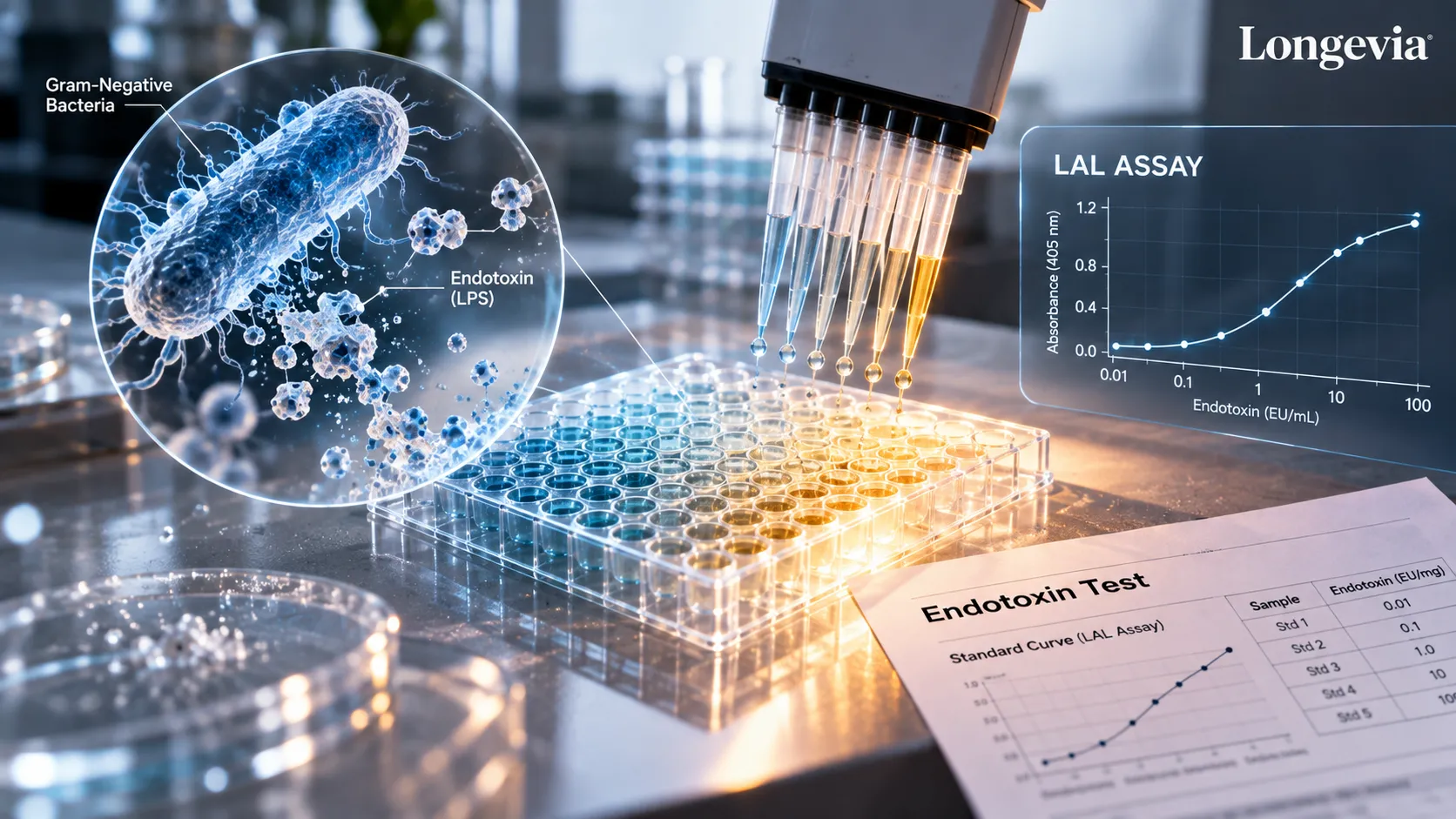
A sterile diluent does not transform a non-sterile starting material into a sterile injectable product. Sterility, endotoxin control, container closure, aseptic processing, and in-use stability are separate quality considerations.
Use the actual pharmacy label and dispensing instructions as the primary source. Use online calculators only to check arithmetic after the concentration has been independently verified.
Storage and beyond-use dates
Semaglutide stability depends on formulation, concentration, pH, container, temperature, light exposure, microbial controls, and time after first puncture. A storage period published for an approved product cannot automatically be applied to a compounded vial or a research preparation.
The preparation record should distinguish the manufacturer’s expiry date from the pharmacy’s beyond-use date. It should also note when a multi-dose vial was first accessed, whether it was exposed to unsuitable temperatures, and whether the solution’s appearance changed.
A solution should not be frozen or refrigerated solely because an online peptide chart recommends it. Storage must follow the product label, pharmacy instructions, or validated stability data. Temperature excursions should be documented and reviewed by the responsible pharmacist or laboratory supervisor.
Semaglutide dose escalation and evidence
Approved semaglutide products use structured prescribing schedules designed to reduce adverse gastrointestinal reactions. The FDA’s Wegovy information states that treatment is initiated at 0.25 mg once weekly and escalated at four-week intervals according to the approved schedule. [46]
Those instructions apply to the approved product and its labelled indications. They do not authorize users to create their own schedule from a compounded vial, alter the concentration, or substitute a research material for an approved medicine.
A patient with persistent vomiting, severe abdominal pain, dehydration, fainting, allergic symptoms, or other concerning effects should seek prompt medical care. Questions about a missed dose, a suspected overdose, or a concentration discrepancy should be directed to the prescribing clinician, pharmacist, poison centre, or emergency service as appropriate.
Quality documentation for research
Researchers handling semaglutide should maintain a complete lot record. Useful fields include supplier, lot number, certificate of analysis, identity testing, assay, sterility status, endotoxin testing, storage conditions, preparation date, diluent, final volume, and disposal record.
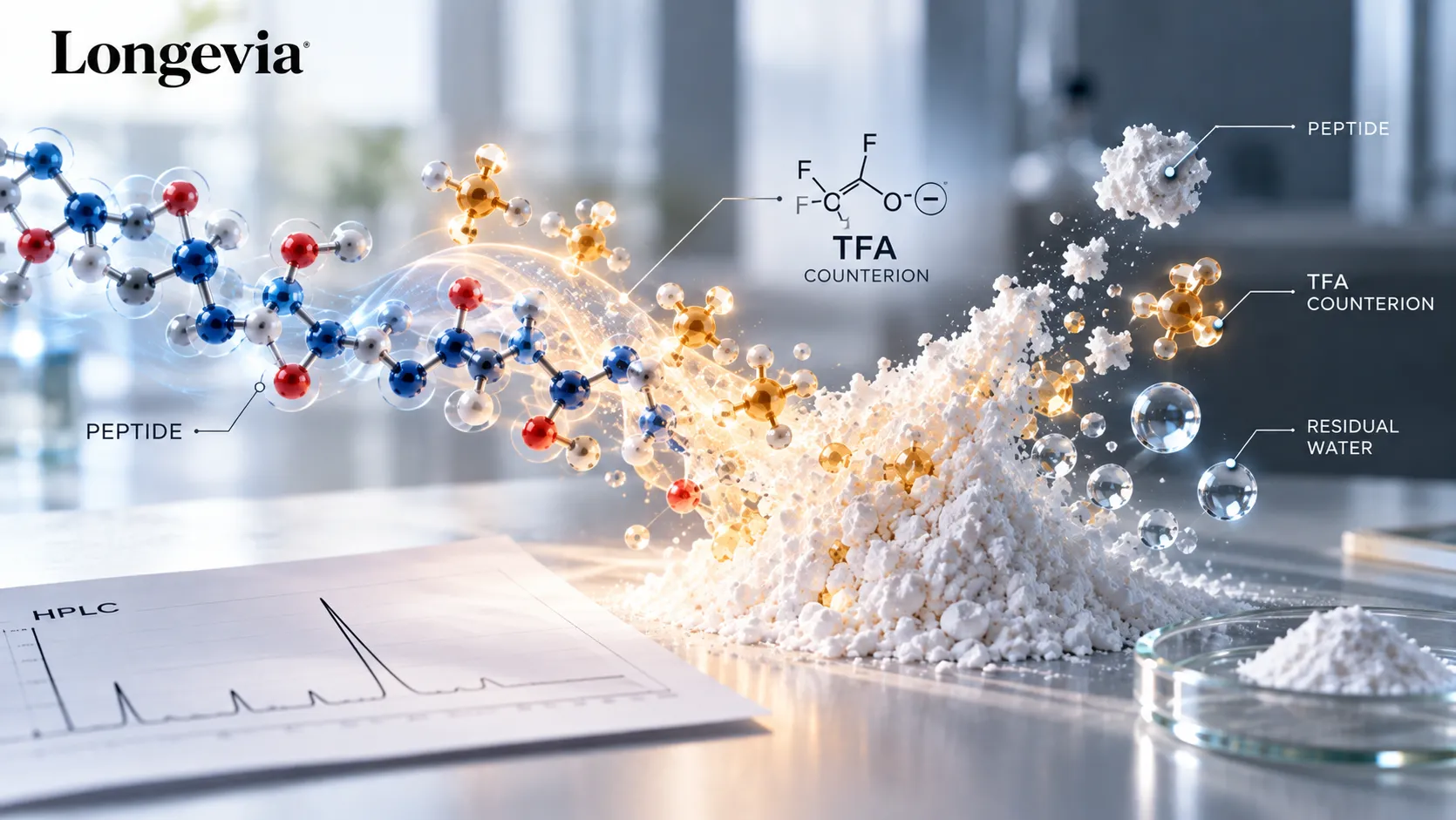
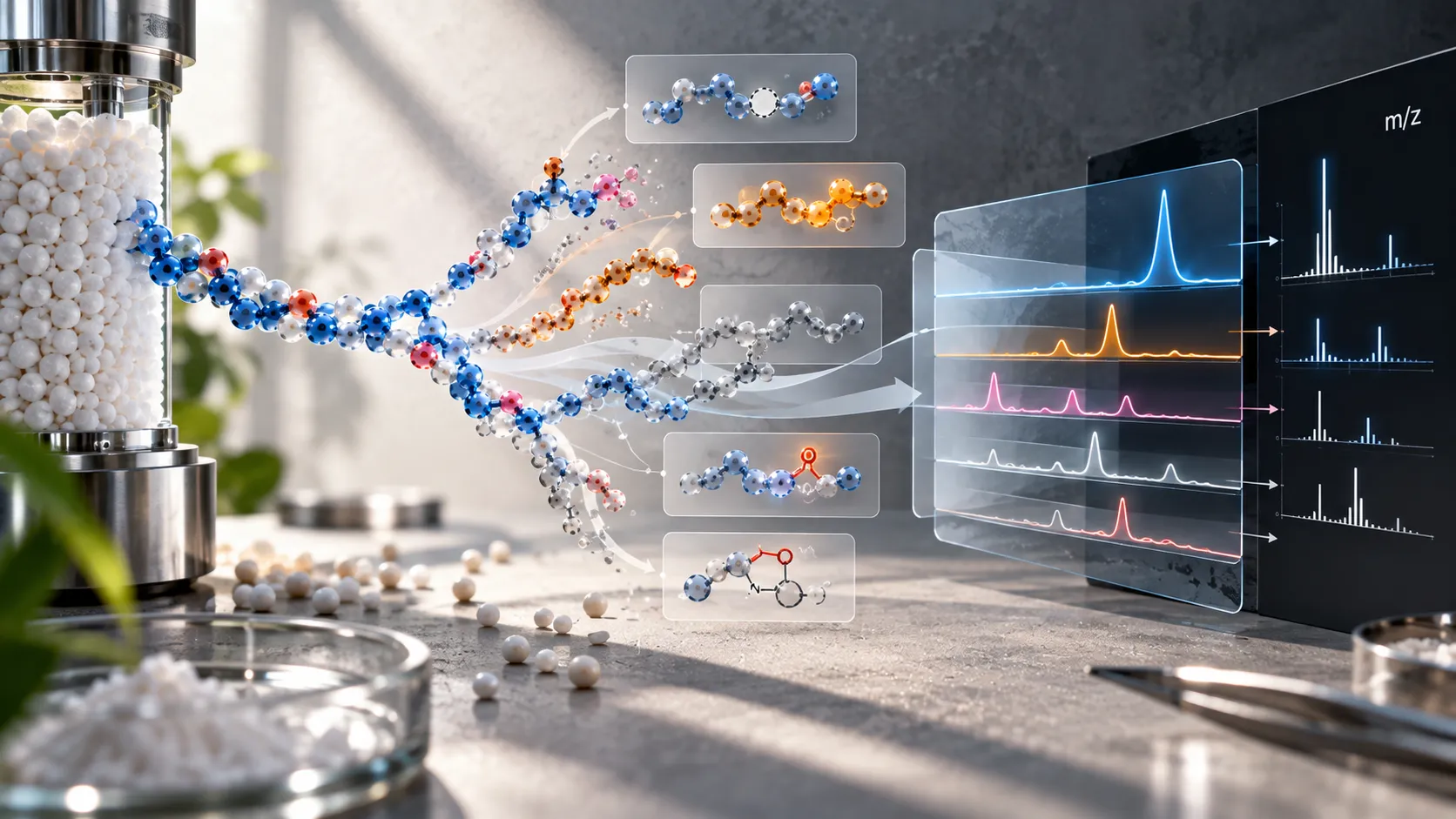
HPLC or LC-MS results should not be presented as proof of clinical safety. Analytical purity, molecular identity, sterility, endotoxin control, and stability answer different questions. Research protocols should specify which tests are required for the intended experiment.
If the material is labelled for research use only, that designation must remain visible in the article and study documentation. Research-use material is not automatically permitted for human administration, and a supplier certificate does not replace regulatory authorization.
Common semaglutide calculation mistakes
The first mistake is using the vial’s total milligrams as though they were milligrams per millilitre. The second mistake is copying a concentration from another pharmacy’s label. The third mistake is treating syringe units as a universal dose. The fourth mistake is rounding a small volume beyond the accuracy of the device.
Another error occurs when a person changes the final volume without recalculating concentration. Adding more diluent reduces concentration, while adding less diluent increases concentration. The amount of drug in the vial does not change, but the amount contained in each millilitre does.
A final error is assuming that a visually clear solution is necessarily stable and sterile. Appearance is useful as a basic inspection but cannot replace validated testing or qualified preparation controls.
A safe review checklist
- Confirm whether the product is approved, compounded, or research-use only.
- Read the exact vial or pen label.
- Confirm the total semaglutide amount and concentration.
- Verify the diluent and final volume from an authoritative instruction.
- Keep milligrams and millilitres separate throughout the calculation.
- Identify the syringe scale before converting volume into markings.
- Have a pharmacist or clinician independently verify the result for human use.
- Record lot number, preparation date, storage condition, and beyond-use date.
- Do not use a product with unexplained particles, haze, precipitation, or label discrepancies.
- Seek urgent advice after a suspected overdose or serious adverse reaction.
The most useful semaglutide reconstitution guide is not a generic mixing chart. It is a verification system that makes the concentration visible, prevents unit confusion, distinguishes approved products from compounded preparations, and directs unresolved questions to a qualified professional. The FDA’s reports of five- to ten-fold dosing errors show why every milligram-to-millilitre conversion deserves independent review. [47]
References and evidence limits
The FDA-approved Wegovy label provides product-specific information for approved presentations, dosing escalation, and administration. [46] FDA safety communications describe the risks of concentration variability and conversion errors associated with compounded injectable semaglutide. [34][47]
This article should not be used to create a personal treatment schedule or to reconstitute an injectable product without authoritative instructions. Product-specific labelling, pharmacy directions, clinical oversight, and applicable regulations take priority over general educational content. See Longevia's research-use disclaimer for the site's compliance position on research-use materials discussed elsewhere on this site.
Frequently Asked Questions
- U.S. Food and Drug Administration. WEGOVY prescribing information, current FDA label.
- U.S. Food and Drug Administration. Compounding Risk Alerts: dosing errors associated with compounded injectable semaglutide products.
- U.S. Food and Drug Administration semaglutide dosing-error safety communication, July 26, 2024.