- Oxytocin is a cyclic nonapeptide binding the widely-distributed oxytocin receptor (OXTR), producing effects across central social-behavioral and peripheral physiological systems.
- A systematic review found consistent evidence for oxytocin's influence on trust, social recognition, and bonding-related processing across multiple human study designs.
- The "universal bonding hormone" framing oversimplifies a literature that documents context-dependent, sometimes bidirectional social effects.
- Oxytocin and the structurally similar peptide vasopressin bind distinct receptors, providing a useful comparative research angle, particularly in autism-spectrum research.
- Oxytocin's disulfide bridge is essential to receptor binding and a specific storage-stability consideration given its susceptibility to oxidative degradation.
- Oxytocin's well-established peripheral physiology (uterine contraction, milk ejection) predates and is distinct in evidence maturity from its newer social-neuroscience research.
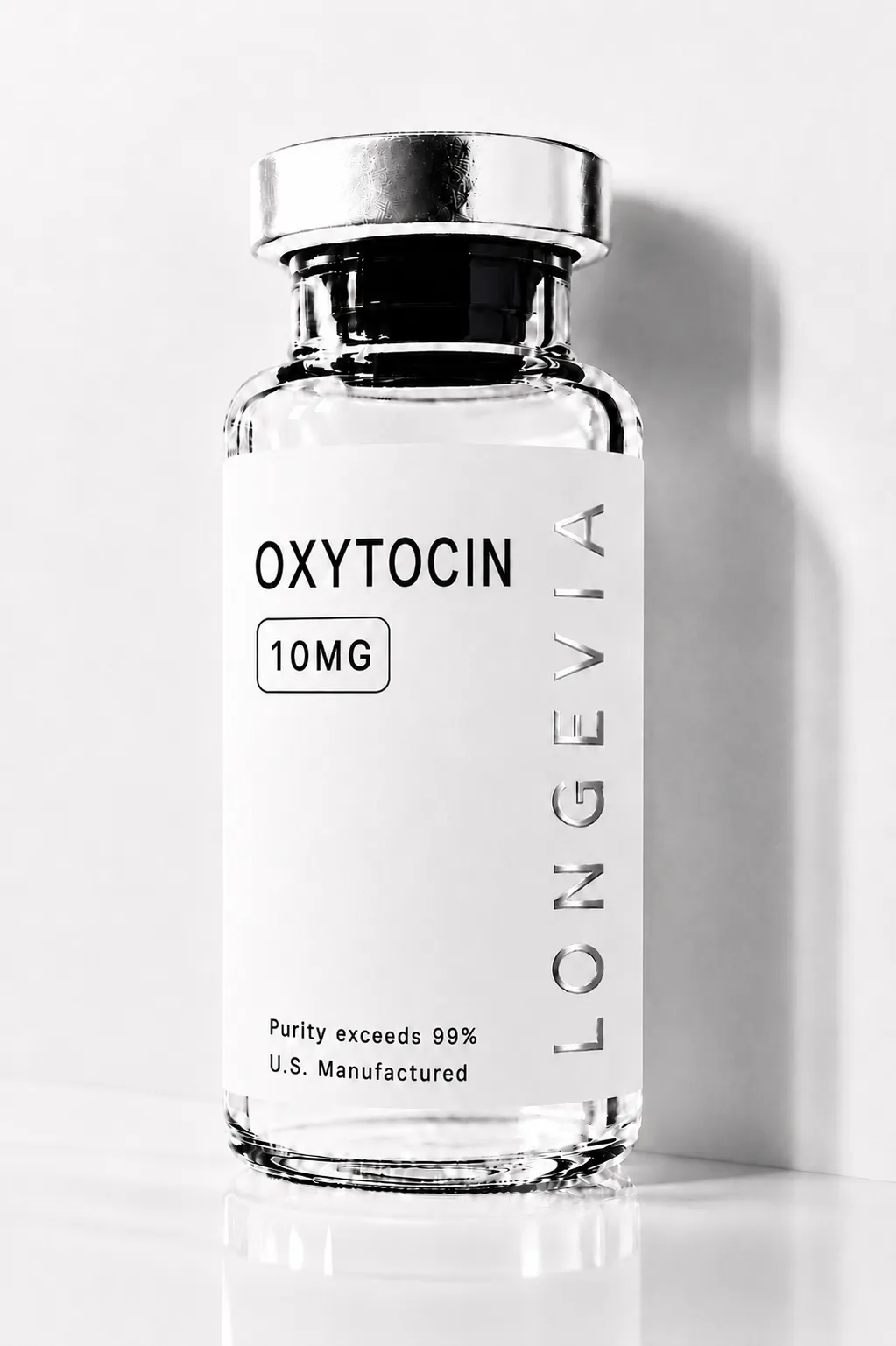
Oxytocin
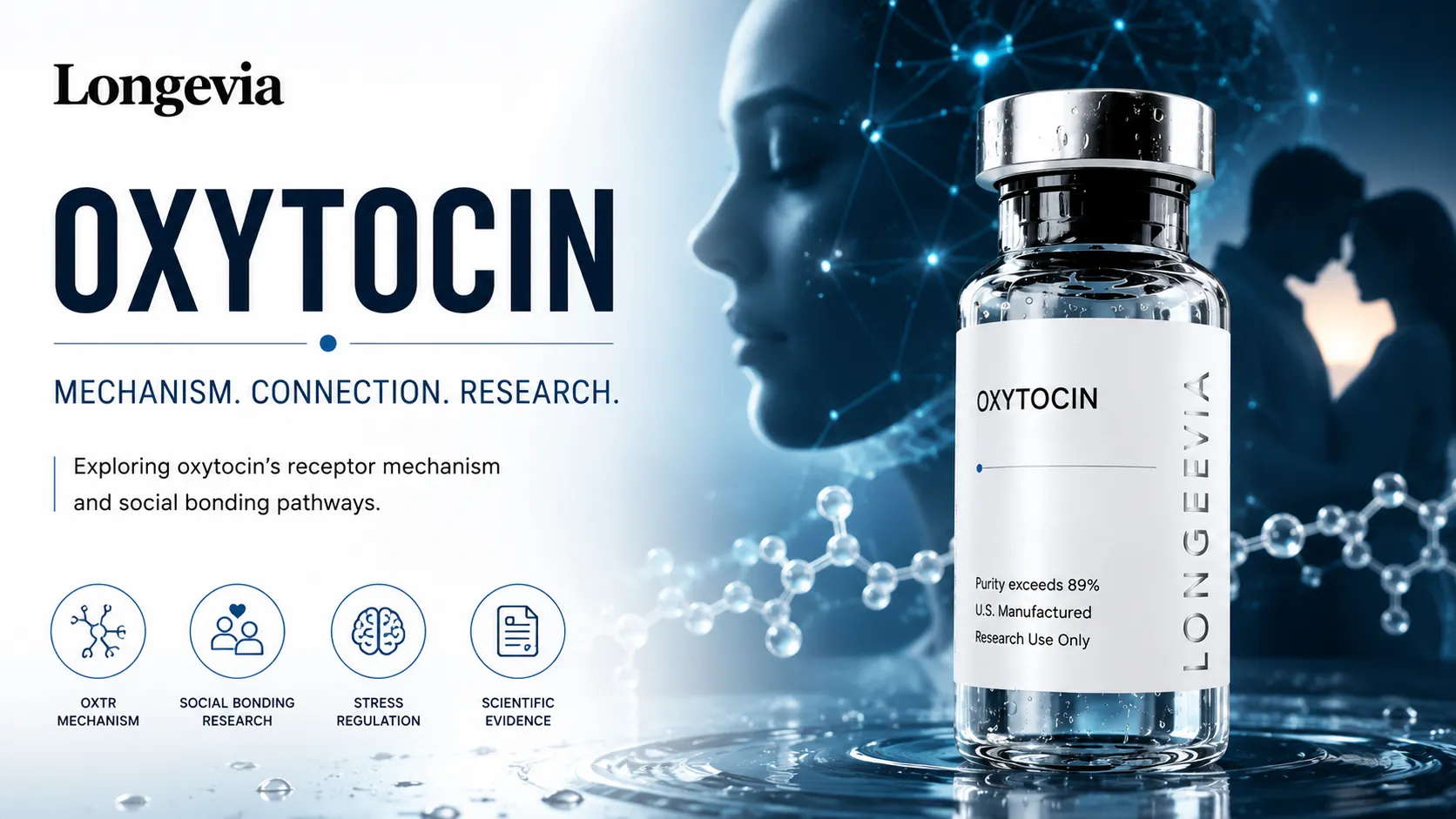
Oxytocin is a cyclic nonapeptide and endogenous neuropeptide hormone investigated in research involving oxytocin receptor signalling, social behavior neuroscience, hypothalamic-pituitary biology, and neuroendocrine regulation. 10mg vial. Research Use Only — Longevia Research.
Oxytocin
Oxytocin is a cyclic nonapeptide and endogenous neuropeptide hormone investigated in research involving oxytocin receptor signalling, social behavior neuroscience, hypothalamic-pituitary biology, and neuroendocrine regulation. 10mg vial. Research Use Only — Longevia Research.
Oxytocin is unusual among research peptides in that its core physiology has been understood for over a century — it was first characterized for its role in uterine contraction and milk-ejection reflex — while its role as a broader social-neurobiology signaling molecule has become one of the most actively expanding research areas in behavioral neuroscience only in the last two decades. That combination of century-old foundational physiology and genuinely cutting-edge current research is what makes Oxytocin a distinctive compound to research accurately, and also one of the most frequently oversimplified in popular science coverage — a compound whose real evidence base is both stronger and more nuanced than either its "love hormone" reputation or its occasional dismissal as overhyped would suggest.
Oxytocin is a cyclic nonapeptide with the sequence Cys-Tyr-Ile-Gln-Asn-Cys-Pro-Leu-Gly-NH₂, synthesized primarily in the hypothalamus and released both centrally, within the brain, and peripherally, into systemic circulation via the posterior pituitary. [2] A disulfide bridge connecting positions 1 and 6 of the sequence forms the peptide's characteristic ring structure, which is essential to its biological activity — without this bridge, the molecule loses its ability to bind its receptor effectively.
Receptor mechanism
Oxytocin's effects are mediated through the oxytocin receptor (OXTR), a class I G-protein-coupled receptor with notably wide tissue distribution. Centrally, OXTR is expressed across limbic brain structures, the hypothalamus, and brainstem regions associated with emotional processing and social behavior. Peripherally, the same receptor is expressed in the uterus, mammary tissue, and cardiovascular system, which is why a single signaling molecule produces effects across reproductive physiology, cardiovascular regulation, and social-behavioral domains simultaneously. [1]
This receptor distribution pattern is the mechanistic explanation for why oxytocin research spans such an unusually broad range of study areas — reproductive endocrinology, cardiovascular research, and social neuroscience are not separate research programs studying different molecules; they are separate research programs studying the same receptor system in different tissues.
Oxytocin's disulfide bridge between cysteine residues at positions 1 and 6 is not incidental structure — it creates the cyclic conformation required for high-affinity receptor binding. A linear, unbridged version of the same amino acid sequence does not reproduce oxytocin's biological activity.
Social bonding and prosocial research
The research area responsible for oxytocin's current popular-science visibility is its documented role in social bonding and prosocial behavior. A systematic review of oxytocin's prosocial effects in humans found consistent evidence across multiple study designs that oxytocin administration influences trust behavior, social recognition, and interpersonal bonding-related processing. [3] Oxytocin's central actions extend from modulating basic neuroendocrine reflexes to shaping complex social and bonding behaviors specifically associated with reproduction and offspring care, and it exerts measurable antistress effects that researchers propose may facilitate pair-bond formation. [4]
Documented behavioral research effects include changes in social decision-making, altered processing of social stimuli, effects on specifically social behaviors such as eye contact duration, and effects on social memory formation and recall. [5] These findings span a genuinely wide range of experimental paradigms — economic trust games, facial-recognition tasks, eye-tracking studies, and pair-bonding models in both human and animal research — which is part of why the oxytocin social-neuroscience literature is considered unusually robust compared with many other proposed "social" or "bonding" compounds.
What the prosocial literature does not establish
It is important to be precise about the boundaries of this evidence. The prosocial-effects literature demonstrates that oxytocin administration measurably influences specific social-cognitive processes under specific experimental conditions — it does not establish oxytocin as a general "love hormone" that reliably produces bonding or trust in all contexts, a popular-science framing the primary literature itself does not support. Effects are frequently context-dependent, influenced by baseline individual differences, and in some experimental paradigms show effects in the opposite direction from popular expectation (for example, increased in-group favoritism alongside reduced out-group trust in certain study designs) rather than a uniform "more prosocial" effect.
The "oxytocin as universal bonding hormone" framing common in popular coverage oversimplifies a literature that consistently reports context-dependent, sometimes bidirectional effects. Citing the systematic review data specifically, rather than a secondary summary of it, is important for avoiding this overstatement. [3]
Intranasal administration and the blood-brain barrier question
Because oxytocin is a peptide, it does not cross the blood-brain barrier efficiently via standard systemic routes, which has made intranasal administration the dominant route in human social-neuroscience research specifically because of a proposed alternate delivery pathway. Evidence from animal studies, including direct quantification of labeled oxytocin in rhesus macaque brain tissue following intranasal (but not intravenous) administration, supports the hypothesis that intranasal delivery reaches the brain via olfactory and trigeminal nerve pathways rather than through systemic circulation. [8] Labeled oxytocin has been detected in brain regions — including the orbitofrontal cortex, striatum, brainstem, and thalamus — that lie along the anatomical trajectories of these specific nerve pathways, which is consistent with, though not direct proof of, this delivery mechanism in humans specifically.
The nose-to-brain delivery hypothesis for intranasal oxytocin is well-supported in animal models but has not been directly confirmed in humans via PET imaging, which remains an open methodological gap researchers should account for when interpreting human intranasal-oxytocin study results.
Autism spectrum research: a mixed evidence picture
Intranasal oxytocin has been studied specifically in autism spectrum disorder research as a potential intervention for social-communication difficulties, and the resulting evidence base is genuinely mixed rather than uniformly positive — a distinction worth stating plainly given how often single positive findings are cited without this context. A randomized, placebo-controlled trial in children with autism found oxytocin improved scores on the Social Responsiveness Scale relative to placebo, with fewer adverse effects reported in the oxytocin group. [9] A separate randomized crossover trial using a novel breath-powered intranasal delivery device in adults with autism reported dose-dependent social-cognitive effects. [10]
Against these positive findings, other randomized trials have reported no substantial effect: one study found no significant modulation of empathy-related neural activation by intranasal oxytocin in autism, and reported an unexpected finding of increased amygdala responsiveness during a pain-processing task with no other treatment effects observed. [11] Researchers reviewing this literature have concluded that while subclinical and clinical studies provide converging evidence for oxytocin's effects on anxiety and social symptoms in some contexts, results are not consistent across trials, and the optimal human dose remains undetermined. [11]
Study type | Reported outcome |
|---|---|
RCT, children with ASD, SRS outcome measure | Improved social responsiveness scores vs. placebo [9] |
RCT crossover, adults with ASD, breath-powered device | Dose-dependent social-cognitive effects [10] |
RCT, empathy-related neural activation | No substantial modulation found; unexpected amygdala finding [11] |
This mixed picture is not a reason to dismiss the research area — it is a reason to cite specific trial results rather than a generalized "oxytocin helps autism" claim, which the aggregate evidence does not cleanly support.
Receptor system and neural circuitry research
More recent research has focused on mapping how oxytocin and the structurally related peptide vasopressin interact with broader social neurocircuits, extending beyond the receptor-binding question into how these signals propagate through connected brain regions to produce behavioral output. [6] This circuit-level research direction represents a meaningfully more mechanistic research question than the earlier behavioral-effect literature, aiming to explain not just that oxytocin influences social behavior, but the specific neural pathway architecture through which that influence occurs.
Comparative research on oxytocin and vasopressin — a closely related nonapeptide differing by only two amino acids — has been particularly informative for autism-spectrum research, where both peptide systems have been investigated for their role in pair-bonding-relevant neural circuitry and social-cognitive processing differences. [7] This comparative angle is scientifically useful because oxytocin and vasopressin's close structural similarity but distinct receptor targets (OXTR versus vasopressin receptors) provides a natural experimental contrast for isolating which specific neural effects are oxytocin-receptor-specific.
Oxytocin receptor distribution and research domains
Tissue/region | Primary documented association |
|---|---|
Hypothalamus, limbic structures | Social bonding, stress regulation, emotional processing |
Posterior pituitary | Systemic release into circulation |
Uterus | Contraction signaling (historical foundational physiology) |
Mammary tissue | Milk-ejection reflex |
Cardiovascular system | Peripheral cardiovascular regulation research |
Brainstem | Autonomic and neuroendocrine reflex modulation |
Stress regulation research
Beyond social bonding specifically, oxytocin's antistress effects represent a distinct but related research thread. Research indicates oxytocin can attenuate physiological stress responses, an effect proposed to work synergistically with its bonding-related actions — the hypothesis being that reduced stress reactivity during social interaction may be part of the same integrated system that facilitates bond formation, rather than two unrelated effects occurring in parallel. [4] This stress-regulation angle is one of the more mechanistically coherent explanations for why oxytocin's effects span both emotional-regulation and social-behavioral domains rather than being restricted to one or the other.
Reconstitution and quality documentation
Where Oxytocin is used in laboratory research, the same documentation standards apply as with any peptide: record lot number, nominal vial amount, diluent identity and volume, and the calculated concentration as an explicit equation. Longevia's peptide dosage calculations guide and peptide calculator cover the underlying arithmetic, and our reconstitution and storage guide covers general stability documentation principles.
Oxytocin's disulfide-bridged structure is a specific stability consideration: oxidative degradation of the disulfide bond is a documented pathway by which the peptide can lose biological activity, making light exposure and oxidative stress during storage particularly relevant variables to document compared with peptides lacking this structural feature. A certificate of analysis confirming identity and purity via HPLC and mass spectrometry remains the baseline documentation standard — see Longevia's purity guide for interpretation principles.
Common research mistakes
Several of the errors below recur specifically because oxytocin's popular reputation outpaces the nuance of its actual evidence base, which makes precise sourcing more important for this compound than for many others in this research category.
The most frequent error is citing oxytocin as a uniform "bonding hormone" without acknowledging the documented context-dependency and occasional bidirectional effects reported in the primary literature — the systematic review data supports a more nuanced picture than popular framing suggests. [3] A second common error is failing to distinguish oxytocin's century-old, well-established peripheral physiology (uterine contraction, milk ejection) from its comparatively newer and still-developing central social-neuroscience literature; both are real, but they represent different maturity levels of evidence. A third mistake is treating oxytocin and vasopressin as interchangeable given their structural similarity — their distinct receptor targets produce meaningfully different downstream effects, which is precisely why comparative research between them has research value.
Taken together, these findings argue for a research posture toward oxytocin that is neither dismissive nor uncritically enthusiastic: the receptor pharmacology is solid, the prosocial-effects literature is genuinely substantial, and the clinical translation into specific applications like autism intervention remains an open, actively contested research question rather than a settled result in either direction.
Practical research checklist
- Cite the specific study design (systematic review, RCT, animal model) when referencing oxytocin's social-behavioral effects, rather than generic "research shows" framing.
- Document whether a proposed protocol is investigating central/behavioral effects or peripheral/physiological effects, since these engage different aspects of the same receptor system.
- Record storage conditions with attention to light and oxidative exposure, given the disulfide-bridge stability consideration.
- Avoid uniform "bonding hormone" framing; note context-dependency documented in the primary literature.
- Request lot-specific COA documentation confirming identity and purity for any research batch.
References and evidence limits
Oxytocin's receptor mechanism and wide tissue distribution are well-established pharmacology. [1][2] The prosocial and social-bonding effects literature is supported by a systematic review across multiple human study designs, though effects are documented as context-dependent rather than uniform. [3][4][5] Neural circuit-level and comparative vasopressin/autism research represents an actively developing area rather than settled mechanistic detail. [6][7] Intranasal-route and autism-specific clinical trial evidence is genuinely mixed across studies rather than uniformly positive. [8][9][10][11] This article summarizes published research findings; it does not establish a human administration protocol. See Longevia's research-use disclaimer for the complete compliance position governing Research Use Only material discussed across this site.
Frequently Asked Questions
- Oxytocin receptor (OXTR) structure, function, and tissue distribution.
- Oxytocin cyclic nonapeptide structure and disulfide-bridge dependent receptor binding.
- The peptide that binds: a systematic review of oxytocin and its prosocial effects in humans.
- Oxytocin and Social Relationships: From Attachment to Bond Disruption.
- Oxytocin, Neural Plasticity, and Social Behavior.
- Oxytocin and vasopressin: linking pituitary neuropeptides and their receptors to social neurocircuits.
- Oxytocin, vasopressin and pair bonding: implications for autism.
- Labeled oxytocin administered via the intranasal route reaches the brain in rhesus macaques.
- Intranasal oxytocin treatment for social deficits and biomarkers of response in children with autism.
- Dose-dependent social-cognitive effects of intranasal oxytocin delivered with novel Breath Powered device in adults with autism spectrum disorder: a randomized placebo-controlled double-blind crossover trial.
- Randomized clinical trial shows no substantial modulation of empathy-related neural activation by intranasal oxytocin in autism.