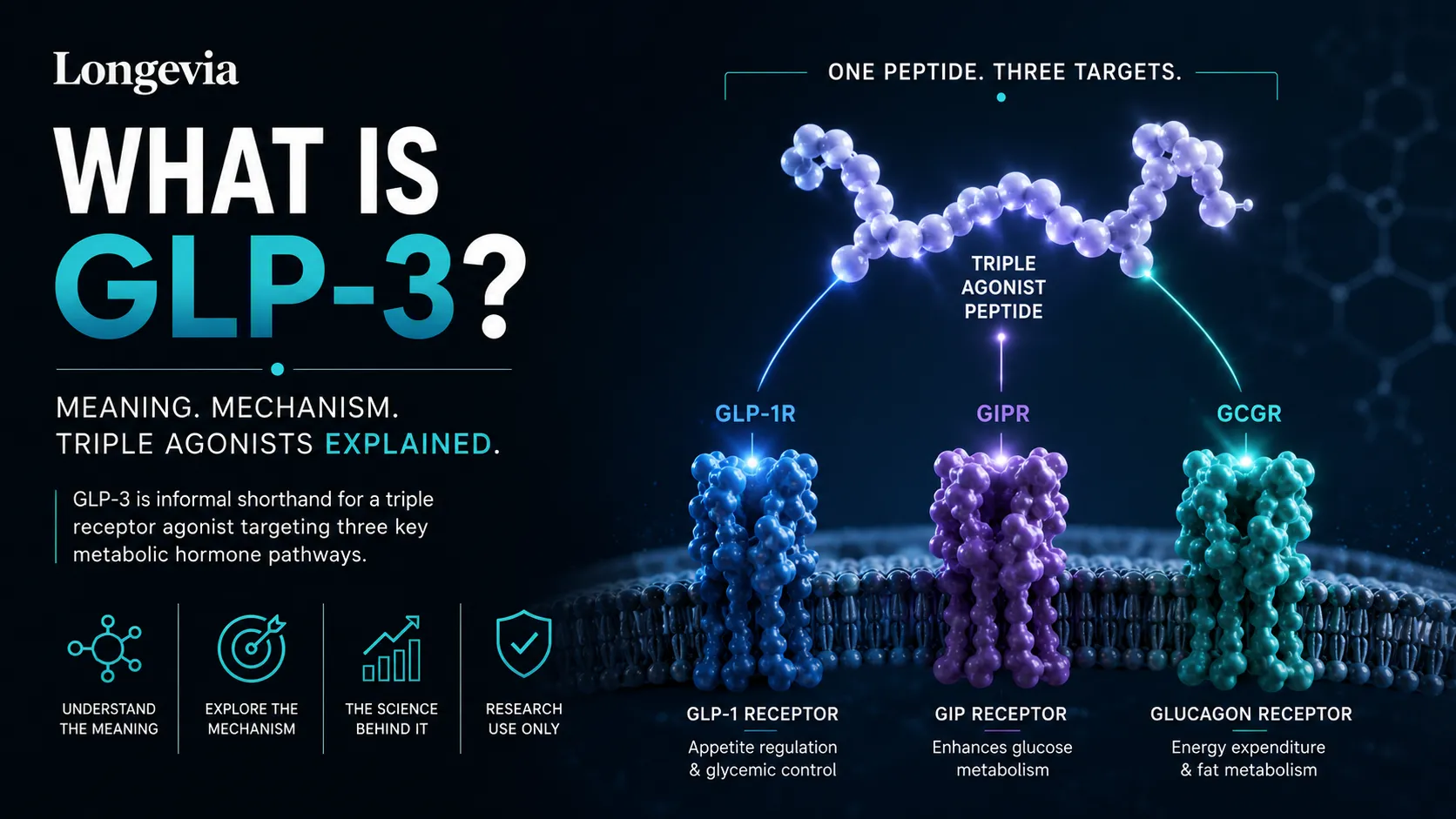
- GLP-3 is informal shorthand for a triple receptor agonist and is not a recognized endogenous hormone.
- No GLP-3 receptor exists; a GLP-3 agonist activates the GIP, GLP-1, and glucagon receptors within one molecule.
- GLP-1 and GLP-2 are real proglucagon-derived hormones, and the numbering does not extend to a third peptide.
- The reference compound for the class is retatrutide (LY3437943), supplied for research as GLP-3 (Rt).
- The glucagon receptor arm is the mechanistic differentiator, acting on hepatic substrate handling and energy expenditure.
- Coskun and colleagues reported balanced glucagon and GLP-1 receptor activity with greater GIP receptor activity for retatrutide.
- Retatrutide has a reported half-life of approximately six days, supporting weekly dosing intervals in trial protocols.
- Retatrutide remains investigational and unapproved, and research material is supplied strictly for Research Use Only.
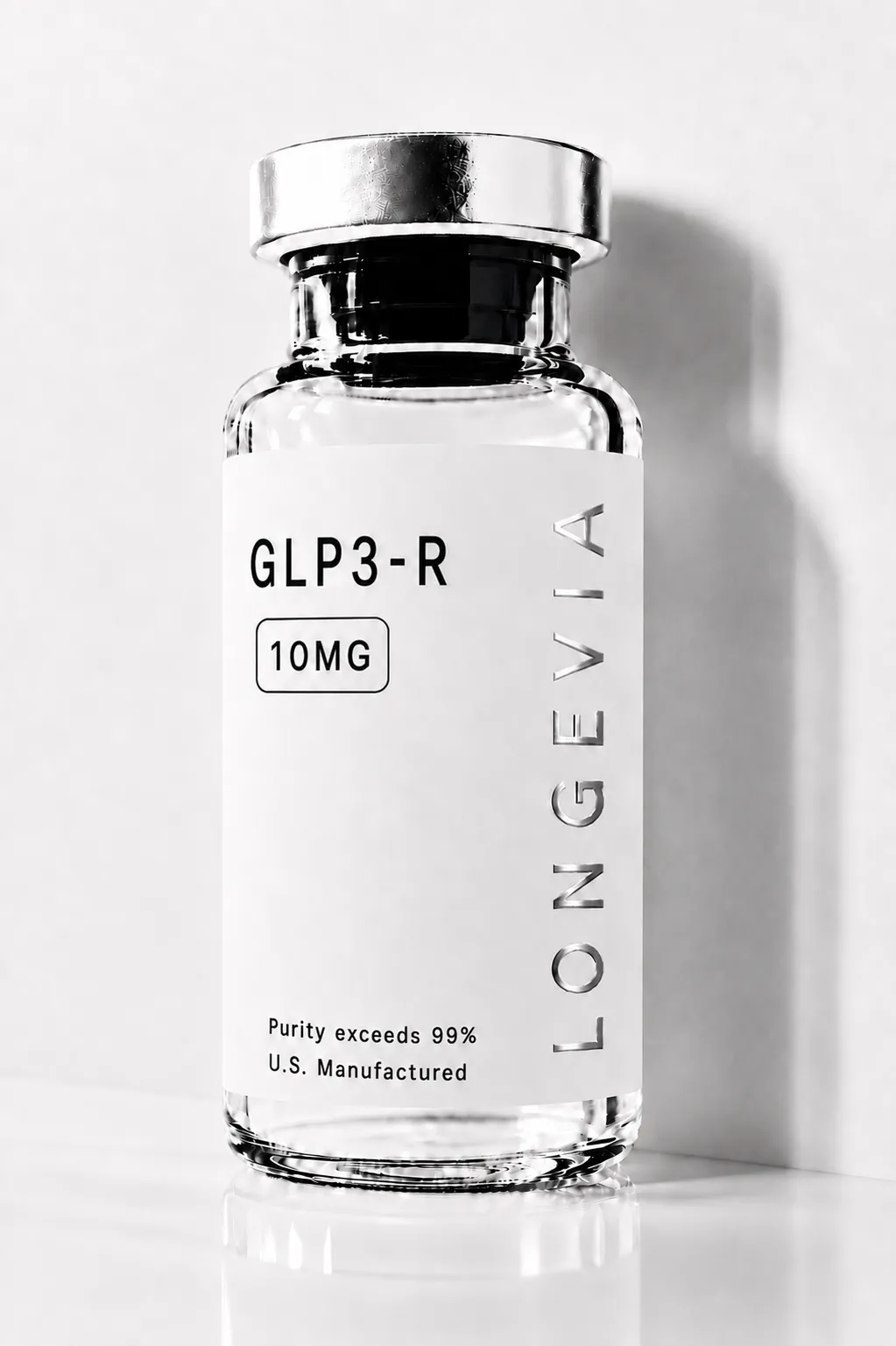
GLP-3 (Rt)
Explore GLP-3 (Rt) — a high-purity, COA-verified research peptide targeting GLP-1, GIP, and glucagon receptors. Lyophilized, batch-tested. Research use only.
GLP-3 (Rt)
Explore GLP-3 (Rt) — a high-purity, COA-verified research peptide targeting GLP-1, GIP, and glucagon receptors. Lyophilized, batch-tested. Research use only.
GLP-3 is one of the most searched terms in metabolic peptide research, and it is also one of the most misunderstood. The label does not name a hormone the human body produces. It is informal shorthand for a class of engineered molecules known as triple receptor agonists, which activate three metabolic hormone receptors simultaneously rather than one or two. This article answers the plain-English question of what GLP-3 means, breaks down each of the three receptors involved, explains how triple agonism differs mechanistically from dual and single receptor agonism, and points toward deeper technical resources for researchers who need mechanism-level detail or handling protocols. Every compound discussed here is supplied for Research Use Only and is not for human consumption.
What Does GLP-3 Stand For?
GLP-3 does not stand for a formally recognized hormone, and no endogenous peptide called glucagon-like peptide-3 exists in mammalian physiology. The numbering in GLP-1 and GLP-2 describes two specific peptides cleaved from a single precursor protein called proglucagon, not a generational product roadmap. Proglucagon is processed differently depending on the tissue and the enzymes involved, yielding glucagon, glicentin, oxyntomodulin, GLP-1, and GLP-2. There is no third glucagon-like peptide waiting at the end of that sequence.
The term entered circulation because researchers and suppliers needed a compact way to describe a molecule that engages three metabolic receptors at once. Semaglutide activates the GLP-1 receptor alone. Tirzepatide activates the GIP and GLP-1 receptors together. The next design step adds glucagon receptor activity on top of both, and the informal label GLP-3 attached itself to that step. The shorthand is convenient, but it describes a receptor-count generation, not a newly discovered hormone.
This distinction matters for anyone reading the literature. Searching PubMed for GLP-3 returns almost nothing useful, because published mechanism papers use the receptor nomenclature instead: GIPR, GLP-1R, and GCGR. The compound most often meant by GLP-3 in a research catalog context is retatrutide (LY3437943), which Longevia Research supplies under the designation GLP-3 (Rt), where Rt denotes the retatrutide identity.
What people search | What it actually refers to | Formal terminology |
|---|---|---|
GLP-3, GLP 3, glp3 | A triple receptor agonist compound class | GIPR/GLP-1R/GCGR tri-agonist |
GGG tri-agonist, triple G agonist | The same class, named by its three targets | Glucagon/GIP/GLP-1 receptor tri-agonist |
GLP-3 agonist | A molecule that agonizes three receptors, not a GLP-3 receptor | Triple hormone receptor agonist |
GLP-3 (Rt) | Retatrutide, development code LY3437943 | Triple GIPR/GLP-1R/GCGR agonist |
GLP-2 | A real proglucagon-derived hormone acting on intestinal tissue | Glucagon-like peptide-2 |
There is no GLP-3 receptor. A compound described as a GLP-3 agonist is a single molecule with agonist activity at three separate receptors, which is why the formal literature calls it a triple hormone receptor agonist rather than a GLP-3 agonist.
What's a GLP3? A Working Definition for Researchers
A GLP3 is a single engineered peptide that binds and activates the GIP, GLP-1, and glucagon receptors within one molecule. That one-molecule constraint is the defining feature. Combining three separate compounds in a stack produces three independent pharmacokinetic profiles, three absorption curves, and three clearance rates. A tri-agonist collapses all three signals into one molecule with one half-life, which is what makes the receptor ratio inside the molecule a design parameter rather than a dosing accident.
The reference compound for this class is retatrutide, an acylated synthetic peptide developed by Eli Lilly and assigned the development code LY3437943. Coskun and colleagues described its molecular pharmacology in Cell Metabolism in 2022, reporting balanced glucagon receptor and GLP-1 receptor activity with proportionally greater GIP receptor activity. The molecule carries a fatty diacid moiety that extends its circulating half-life to roughly six days, which is the property that supports once-weekly subcutaneous administration in the clinical protocols where it has been studied.
For laboratory purposes, the practical translation is that a single lyophilized vial of GLP-3 (Rt) contains one compound engaging three receptor systems, not a blend. Reconstitution math, storage handling, and concentration calculations therefore follow standard single-peptide procedure rather than any special multi-compound protocol. Researchers designing receptor-specific readouts should note that isolating the contribution of any one arm requires selective antagonists or receptor-knockout models, because the compound itself does not separate its three activities.
All three receptors involved belong to the same structurally related family of G protein-coupled receptors, which share a large extracellular domain that binds the peptide ligand and a transmembrane bundle that transduces the signal inward. That shared architecture is what makes a single peptide capable of engaging all three at once, because one engineered sequence can be designed to satisfy the binding requirements of receptors that resemble each other. Tri-agonism is therefore not a general-purpose technique for combining arbitrary receptors; it works for this particular trio because the targets are structurally related enough to share a ligand.
Retatrutide remains investigational. It has not received marketing approval from the FDA, the EMA, or any equivalent regulatory authority, and material supplied under a research designation is intended for in vitro and preclinical laboratory work only.
How Does GLP-3 Work? The Three Receptors, One at a Time
GLP-3 compounds work by activating three G protein-coupled receptors that each control a different lever of metabolic physiology, producing a combined effect that no single-receptor molecule reproduces. Each arm is worth understanding separately, because the research questions attached to each are different.
The GLP-1 Receptor Arm
The GLP-1 receptor (GLP-1R) is the appetite and glucose-handling arm. Endogenous GLP-1 is released from intestinal L-cells after nutrient intake and acts on receptors in the pancreas, brain, and gut, where it promotes glucose-dependent insulin secretion, slows gastric emptying, and signals satiety. This is the single pathway that mono-agonists such as semaglutide target, and it accounts for the majority of the food-intake reduction observed across the whole incretin class. In a tri-agonist, this arm is retained rather than replaced.
The GIP Receptor Arm
The GIP receptor (GIPR) is the second incretin arm and the one whose contribution is least settled in the literature. Glucose-dependent insulinotropic polypeptide is released from intestinal K-cells and amplifies insulin secretion in the presence of glucose. It also has documented actions in adipose tissue and in central nervous system circuits associated with nausea signaling. Coskun and colleagues reported that retatrutide is substantially more potent at the human GIP receptor than the endogenous ligand, making GIPR agonism a prominent rather than incidental component of the molecule.
The Glucagon Receptor Arm
The glucagon receptor (GCGR) is the differentiating arm and the reason the class exists. Glucagon receptor activation acts primarily on hepatic tissue, where it drives glycogenolysis, gluconeogenesis, and fatty acid oxidation, and it is associated with increased energy expenditure. Neither semaglutide nor tirzepatide engages this receptor. In preclinical work reported alongside the discovery paper, glucagon receptor activation was identified as the component responsible for the increase in energy expenditure, and the same arm underlies the hepatic fat research interest that produced a dedicated phase 2a study of liver outcomes published in Nature Medicine in 2024.
Adding glucagon receptor agonism also introduces a design tension. Unopposed glucagon signaling raises hepatic glucose output, which works against glycemic control. The engineering answer is ratio: the incretin arms are intended to offset the glycemic consequence of the glucagon arm while the glucagon arm contributes the expenditure and hepatic lipid effects. Getting that balance wrong in either direction is the central failure mode of the design, which is why receptor potency ratios appear so prominently in the primary pharmacology literature.
How Triple Agonism Differs From Dual and Single Receptor Agonism
Triple agonism differs from dual and single agonism not by adding more of the same signal but by adding a mechanistically different signal that operates on energy expenditure rather than energy intake. Mono-agonists and dual agonists both work primarily on the intake side of the energy equation, through appetite suppression and delayed gastric emptying. The glucagon arm operates on the expenditure side, through hepatic substrate handling and thermogenesis. That is a category difference, not an incremental one.
Mechanism class | Receptor targets | Reference compound | Primary metabolic lever |
|---|---|---|---|
Single receptor agonist | GLP-1R | Semaglutide | Appetite and glucose-dependent insulin secretion |
Dual receptor agonist | GIPR, GLP-1R | Tirzepatide | Both incretin arms, amplified insulin response |
Triple receptor agonist | GIPR, GLP-1R, GCGR | Retatrutide (GLP-3 (Rt)) | Incretin arms plus hepatic energy expenditure |
The second practical difference is that receptor potency is not evenly weighted inside these molecules. Willard and colleagues characterized tirzepatide in JCI Insight as an imbalanced and biased dual agonist, meaning its two arms are neither equipotent nor equivalently coupled to downstream signaling. The same principle applies with more variables in a tri-agonist: relative potency at each of three receptors, plus biased signaling at each, produces a pharmacological profile that cannot be predicted by simply summing three known mechanisms. This is the reason a tri-agonist is not interchangeable with a stack of three separate compounds, and the reason researchers should not treat published data on GLP-1 mono-agonists as directly transferable.
That partitioning problem is the practical cost of the extra receptor, and it should be budgeted for at the design stage rather than discovered at the analysis stage.
A third difference is measurement. Studying a mono-agonist means attributing an effect to one receptor. Studying a tri-agonist means partitioning an observed effect across three, which typically requires selective antagonists, receptor-null models, or dose-ranging designs that exploit differing potency thresholds across the three arms.
What Is GLP-3 Used For in Research?
GLP-3 compounds are used in laboratory research to investigate multi-receptor metabolic signaling, specifically how simultaneous GIP, GLP-1, and glucagon receptor activation integrates across pancreatic, hepatic, adipose, and central nervous system tissues. The research questions cluster into a few recognizable groups.
The first is receptor pharmacology: characterizing binding affinity, potency, and downstream signaling bias at each of the three receptors, typically in cell lines transfected with human receptor constructs. The second is energy expenditure biology, which is the question the glucagon arm introduced and the one that most distinguishes this class from the dual and single agonist classes. The third is hepatic lipid handling, following the liver-fat signal that appeared first in preclinical models and later in the phase 2a MASLD study reported by Sanyal and colleagues.
A fourth cluster is comparative pharmacology: benchmarking tri-agonist behaviour against dual and single receptor agonists in matched assay systems, which is the only controlled way to isolate what the third receptor actually contributes.
The published human data provide the framing for these laboratory questions. Urva and colleagues reported the phase 1b multiple-ascending-dose study in the Lancet in 2022, which established the pharmacokinetic profile. Jastreboff and colleagues published a 48-week phase 2 obesity trial in the New England Journal of Medicine in 2023, and Rosenstock and colleagues published a phase 2 trial in adults with type 2 diabetes in the Lancet the same year. A phase 3 program is underway, and a phase 3 monotherapy trial in type 2 diabetes was published in the Lancet in 2026.
Longevia Research supplies GLP-3 (Rt) strictly for Research Use Only. It is not a medicine, it is not approved by any regulatory authority for any indication, and it is not for human or veterinary consumption, diagnostic use, or therapeutic use. Published clinical trial data are provided as scientific context only and do not describe or imply any permitted use of research material.
What the Published Evidence Base Actually Supports
The published evidence base for triple receptor agonism is real, peer-reviewed, and still incomplete, which is the correct frame for reading any claim about this compound class. The molecular pharmacology is well characterized in the primary literature. The human pharmacokinetics are established, with a reported half-life of approximately six days supporting weekly dosing intervals in the trial protocols. Dose-ranging efficacy and safety data exist from two independent phase 2 trials in distinct populations.
What remains open is substantial. Long-term safety across years rather than months is not yet established. The relative contribution of each receptor arm to any given observed outcome has not been fully partitioned in humans. Cardiovascular outcome data are still accruing. And the compound has not been approved by any regulatory agency, which means that no dosing regimen described in a trial protocol carries any regulatory endorsement outside that protocol.
Cross-trial comparison is the specific trap worth naming here. The phase 2 obesity trial and the phase 2 diabetes trial enrolled different populations, ran for different durations, and used different comparator arms, and neither was designed to be read against trials of other compounds. Comparing a headline figure from one programme against a headline figure from another measures study design as much as it measures pharmacology. Where a genuine head-to-head comparison exists, the publication states it as such; where it does not, the comparison is being constructed by the reader rather than reported by the investigators.
For a research context, this combination of solid mechanism data and open outcome questions is precisely what makes the class scientifically interesting. It also means that any source presenting triple agonist outcomes as settled fact, or presenting research material as a clinically validated product, is misrepresenting the state of the evidence. Researchers evaluating suppliers should treat overstated efficacy language as a signal about the supplier rather than about the compound.
Where to Go Deeper
This article is an on-ramp, not a technical reference, and researchers who need mechanism-paper-level depth or bench-ready protocols should continue to the dedicated resources below. The three most common next questions after the definitional one are how the receptor pharmacology works in detail, how the compound compares head-to-head with the dual agonist class, and how to handle the material correctly in a laboratory setting.
For receptor-level mechanism, signaling bias, and the preclinical and clinical pharmacology in full, the deep-dive mechanism guide covers the primary literature in detail.
For product-specific research context on GLP-3 (Rt), including purity specifications, lot-level Certificate of Analysis documentation, and the analytical methods behind them, the product-specific research guide is the appropriate reference.
For a structured comparison against the mono-agonist and dual agonist classes, including receptor targets and mechanism class differences side by side, the three-way comparison covers semaglutide, tirzepatide, and GLP-3 together.
Matching the question to the resource saves time. If the question is which receptor arm is responsible for an observed effect, the mechanism guide is the place to start. If the question is how to prepare, store, and verify material correctly, the product documentation is. If the question is whether a triple agonist or a dual agonist better suits a given study design, the comparison guides address that directly. This article deliberately stops short of all three, because a definitional explainer that also tries to be a technical reference usually serves neither purpose well.
Every batch of research material Longevia Research supplies is independently tested by HPLC and LC-MS, and lot-specific Certificates of Analysis are published in the COA Library so that researchers can verify identity and purity against the specific vial in hand rather than against a generic specification sheet. Verifying the lot is the single most useful step a researcher can take before designing an experiment around any research compound.
Frequently Asked Questions
- Coskun T, Urva S, Roell WC, et al. LY3437943, a novel triple glucagon, GIP, and GLP-1 receptor agonist for glycemic control and weight loss: from discovery to clinical proof of concept. Cell Metab. 2022;34(9):1234-1247.e9.
- Urva S, Coskun T, Loh MT, et al. LY3437943, a novel triple GIP, GLP-1, and glucagon receptor agonist in people with type 2 diabetes: a phase 1b, multicentre, double-blind, placebo-controlled, randomised, multiple-ascending dose trial. Lancet. 2022;400(10366):1869-1881.
- Jastreboff AM, Kaplan LM, Frias JP, et al. Triple-Hormone-Receptor Agonist Retatrutide for Obesity - A Phase 2 Trial. N Engl J Med. 2023;389(6):514-526.
- Rosenstock J, Frias J, Jastreboff AM, et al. Retatrutide, a GIP, GLP-1 and glucagon receptor agonist, for people with type 2 diabetes: a randomised, double-blind, placebo and active-controlled, parallel-group, phase 2 trial conducted in the USA. Lancet. 2023;402(10401):529-544.
- Sanyal AJ, Kaplan LM, Frias JP, et al. Triple hormone receptor agonist retatrutide for metabolic dysfunction-associated steatotic liver disease: a randomized phase 2a trial. Nat Med. 2024;30(7):2037-2048.
- Coskun T, Sloop KW, Loghin C, et al. LY3298176, a novel dual GIP and GLP-1 receptor agonist for the treatment of type 2 diabetes mellitus: from discovery to clinical proof of concept. Mol Metab. 2018;18:3-14.
- Bajaj HS, Welch M, Shah P, et al. Efficacy and safety of retatrutide, a GIP, GLP-1, and glucagon receptor agonist, in people with type 2 diabetes and inadequate glycaemic control with diet and exercise (TRANSCEND-T2D-1): a double-blind, randomised, phase 3 trial. Lancet. 2026;407(10546):2402-2413.